 \n
The New Face of the Student Generation: Embracing AI and Globalization in 2026
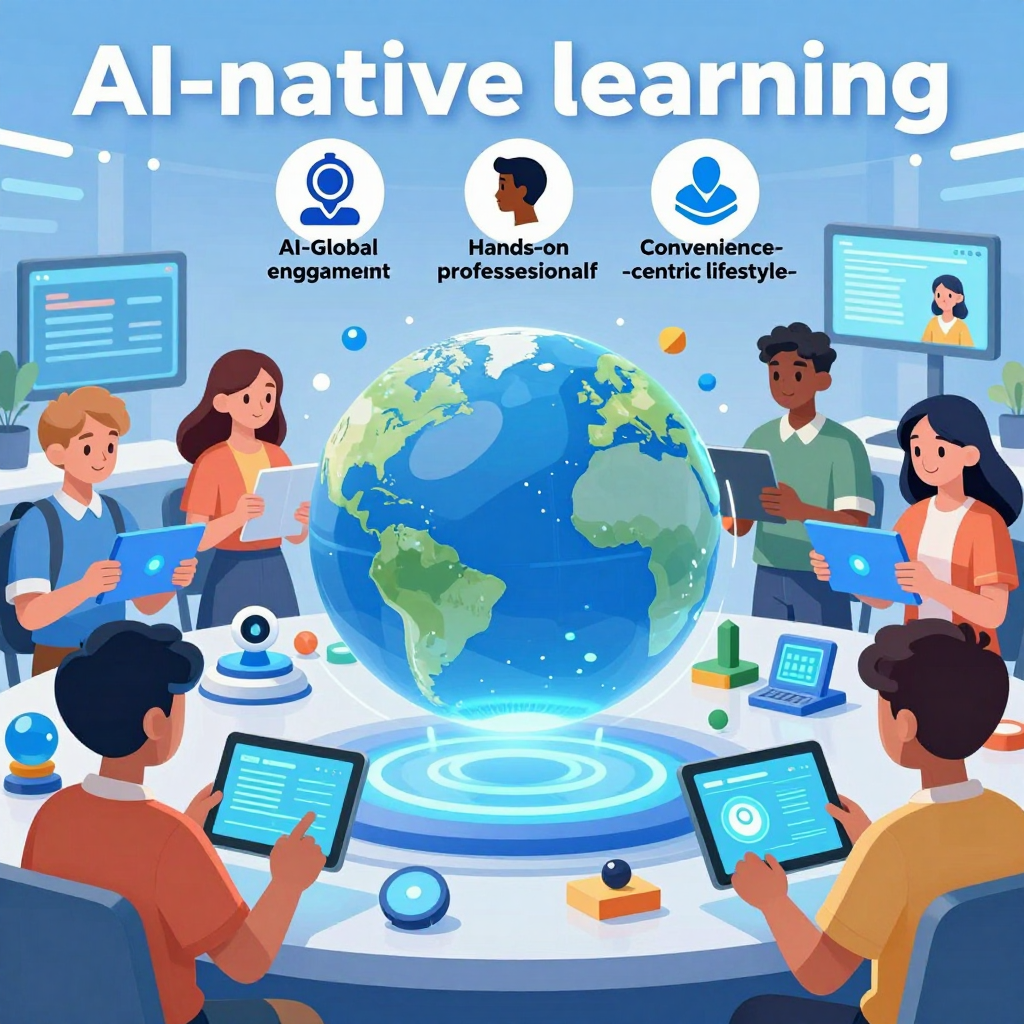
Did you know that students are no longer just traditional learners but an ‘AI-native’ generation who learn with and leverage AI? The students of 2026 are rapidly being redefined—not merely as recipients of knowledge “to be written down,” but as future talents who design their learning alongside AI, collaborate in a global environment, and equip themselves with practical skills and inclusivity.
Students Are Not ‘AI Tool Users’ but Learners Studying With AI
AI is no longer an advanced tool reserved for a select few; it has become a fundamental learning infrastructure for students. From searching and summarizing to translating, drafting, and receiving feedback, every step of the learning process is connected with AI. AI is no longer just an aid but a learning partner (learning copilot).
The crucial shift is not “whether to use AI or not,” but how to study together with AI—this difference is what determines learning outcomes.
The Rise of Student-Centered Classes: Participation, Literacy, and Critical Thinking Are Key
Teaching methods are also moving from teacher-led instruction to student-driven learning. In AI-enhanced education, students actively create questions, compare and analyze materials, and organize project deliverables, strengthening participatory learning.
With a growing emphasis on literacy—the ability to read and comprehend—students increasingly engage in discussion and inquiry. This shift means that rather than merely “finding the right answer,” the ability to read, question, verify, and persuade has become the ultimate competitive edge.
The Normalization of Global Campuses: Students Grow Not as Locals, but as ‘Glocal’ Citizens
Thanks to the influence of K-culture, the community of international students visiting Korea is expanding, and local regions are establishing one-stop support systems for them, turning campuses rapidly global. As a result, students in 2026 naturally form teams with peers from diverse linguistic and cultural backgrounds, experiencing a ‘glocal’ learning environment—starting locally but growing by global standards.
Content and services aimed at students now must be designed with learners from various backgrounds in mind, moving beyond assumptions of domestic-only audiences.
Practical Orientation and Inclusivity in One Sentence: Describing the Student of 2026
In summary, the student of 2026 is a generation that accelerates learning through AI, collaborates globally, prepares practical skills grounded in real-world contexts, and grows grounded in diversity.
The best way to understand students today is to stop viewing them merely as “people studying” and to see them as the group that most rapidly embodies the skills demanded by future industries and society.
The Learning Revolution with Student AI: From Simple Tool to Learning Partner
AI is completely transforming how students learn. What if AI goes beyond just being a tool for finding information to become a “learning copilot” that supports the entire learning process—from reading to discussion? The key is not whether you use AI, but how you design learning to study alongside AI.
Student learning shifts from ‘search → answer’ to ‘question → exploration’
In the past, it was common to start assignments by gathering materials through searches and then piecing together sentences close to the correct answer. Now, with AI quickly handling summaries, translations, and drafting, students spend their time less on finding answers and more on formulating and verifying questions. In other words, the focus of learning moves from the end product to the thought process.
Student reading changes too: from summarizing plots to ‘critical reading’
The true value of an AI copilot shines in reading and literacy. Beyond simply writing reactions after reading a book, students can now work with AI to:
- Separate and organize central claims and supporting evidence
- Identify weak logic or potential bias by raising questions
- Create debate points by assuming counterarguments
- Reinterpret the text from different perspectives (social, scientific, ethical, etc.)
This shifts student reading from “reading a lot” to “reading deeply,” naturally transforming classes into more interactive experiences.
The engine for student-driven classes: AI creates a ‘feedback loop’
When AI is used as a learning partner, students don’t just get feedback once before submitting work—they receive short and frequent micro-feedback throughout the learning process. As a result:
- Iterating through drafts, revisions, and rewrites becomes easier
- Ability to refine questions independently grows rapidly
- Student-driven activities like debates and projects become practically achievable
Ultimately, AI stops being a source of answers and becomes a mirror that helps students sharpen their own thinking.
Three ‘learning copilot’ prompts students can use right away
- Reading: “List the main claim and three supporting reasons from this text in a table, then identify the weakest reason and create a counterargument.”
- Debate: “Make three strongest arguments for both pros and cons on this topic, then turn each other’s weakest points into questions.”
- Writing: “Mark any sentences in my draft that have logical leaps and suggest clearer transitional sentences. But do not change my conclusion.”
For AI-native students, what matters most is not how to use the tool, but the power to design questions. The stronger this ability becomes, the more personalized learning grows, classes become more engaging, and the quality of outcomes naturally improves.
The Global Campus and International Student Ecosystem from a Student’s Perspective: Changes Sparked by K-Culture
More and more young French are flocking to Korea, and local communities are stepping up to support them in every way. Studying in Korea has evolved beyond a simple demand for “foreigners coming to experience Korea” to become a campus ecosystem where youth cultures from around the world intersect.
How K-Culture Changed the Motivation for Studying Abroad: Students Take the Lead
Whereas studying abroad in the past centered on majors and employment, recently, cultural experience has become a strong driving force behind academic choices. Especially with the rapid growth of the French international student community, Korea is no longer seen as just “a specific Asian country” but as a destination for youth culture.
The core of this change is simple. Students now choose schools and cities not only based on language or majors but also on the cultural scenes they want to belong to.
International Student Support Evolves into One-Stop Service: Regions Design the Campus
As the number of international students grows, competitiveness no longer rests solely with universities but with the regional-level system. In fact, some regions run one-stop support systems covering everything from recruiting international students to academic and daily life support, job connections, and settlement, accelerating the globalization of their campuses.
This structure matters for a clear reason: International students need more than admission guidance. They require
- administrative, housing, and daily life adaptation
- community connections
- career paths and local settlement opportunities after graduation—
in other words, the whole ‘living experience’.
The Future Lies in Designing for Both Domestic and International Students
Whether it’s content or services aimed “for students,” it’s no longer feasible to target domestic students alone. The everyday language, consumption patterns, and community culture on campus have already transformed into a multinational environment.
Ultimately, the global campus of 2026 can be defined like this: An era where K-Culture fuels student mobility, and local communities connect that mobility to settlement. Studying in Korea is no longer just an “education product” but a platform combining youth culture and career.
Practice-Oriented Student Education and Industry-Academia Collaboration: Cultivating Real-World Skills Before Graduation
The era of teaching theory alone is over. As collaboration between logistics and tech industries rapidly expands, the trend is shifting toward students handling real-world operational systems during their studies and producing results through project-based approaches. It’s no longer about “learning after graduation” but about “mastering the language of work while still in school.” So, what exactly does this transformation entail?
A New Way for Students to Learn ‘Actual Work Systems’
While traditional majors focused on concepts and theory, recent industry-academia partnership models bring tools used in the corporate world directly into the curriculum. Especially in logistics, management, and tech, the following elements are increasingly common:
- Hands-on practice with enterprise software like ERP: Understanding workflows such as ordering, inventory, shipping, and billing through data
- Simulation-based problem solving: Designing optimal solutions by manipulating variables like cost, lead time, and volume
- Industry-focused projects: Evaluations that emphasize “delivering outcomes” rather than just “getting the right answer”
As a result, students don’t just write reports in class—they gain experience understanding business processes and implementing them using tools.
Why Industry-Academia Collaboration Is Becoming a ‘Pipeline’ Instead of Mere Credentials
The purpose of collaboration between companies and universities is now clear. Companies secure a talent pipeline ready to be deployed before hiring, while universities boost students’ employability. As this system takes root, two major changes occur for students:
Portfolios become concrete
Instead of saying, “I’m interested in logistics,” students can explain, “I designed a process to improve inventory accuracy using ERP and compared alternatives through simulation.”Career choices become faster and more realistic
By experiencing what roles exist in the industry and what tools to use, career exploration shifts from ‘imagination’ to ‘validation.’
A Checklist Every Student Should Follow Now
To truly benefit from practical education, students must shift from “attending classes” to “demonstrating skills.”
- Record the names of tools used in classes/projects (ERP, simulation, analytics tools, etc.)
- Attach metrics to deliverables (time saved, cost reductions assumed, error rate improvements, etc.)
- If working on team projects, describe your role in task units (data cleansing, process design, testing, presentation, etc.)
The core of practice-oriented education and industry-academia collaboration isn’t merely “gaining field experience” but having the experience of defining problems in the language of the field and solving them with the right tools. Students who embrace this trend will kickstart their careers one step ahead the moment they graduate.
The Era of Student Inclusion and Convenience: A Student Life That Resonates with Everyone
A busy student’s day is tightly packed with classes, assignments, part-time jobs, and extracurricular activities. That’s why “quick and easy choices” dictate daily life, and simultaneously, “support that understands my circumstances” becomes essential for students from diverse backgrounds to continue their learning. Today’s education ecosystem is being reshaped around two core pillars: convenience (time-saving) and inclusiveness (accessibility and fairness).
‘Convenience’ Transforming Student Life: Saving Time as a Survival Strategy
The demand for ready-made and instant meals reflects not just a change in eating habits but a structural outcome of student lifestyles. As options that minimize cooking time and reduce cost burdens become the norm, services for students are evolving toward short, frequent-use UX experiences (micro-interactions).
- Why time-saving consumption becomes the standard: Schedules are irregular, meal times are short, and students often need to eat on the move
- Service focus points: fast payment and pick-up, small portions with good value, optimized routes for repeated use
- Changes in educational institutions and campuses: “Campus life infrastructure” that includes not only study spaces but also areas for eating, resting, and commuting is emerging as a core element of the student experience
Ultimately, “convenience for students” is no trivial consideration but a practical competitive advantage directly linked to academic success and daily stability.
Redefining Students through ‘Inclusiveness’: Focusing on ‘Diverse Conditions’ Rather Than Averages
Meanwhile, designing based on an average student profile is rapidly reaching its limits. Factors like multicultural backgrounds, disabilities, youth under protection, and regional disparities create differences in experience regardless of learning motivation, and policies and programs aimed at reducing these gaps are expanding.
- Support to reduce experience gaps for vulnerable students: Connecting students with limited exposure to science culture to inquiry and career experiences to increase STEM accessibility
- Emotional and learning integration support for multicultural students: Expanding structures with 1:1 matching to university mentors to support language, learning, and psychological stability during settlement
- Key shift: Moving from “equal provision” to “access tailored to needs” as the standard for fairness
Inclusiveness is evolving beyond welfare into a fundamental educational design principle that enables students to continue learning and connect with society.
An Ecosystem Reorganized Around Students: ‘Empathetic Convenience’ and ‘Tangible Inclusion’
Going forward, the critical questions in the student market and education policy become clearer and clearer:
- Does this service truly save time for busy students?
- Does this policy realistically adjust the starting lines for diverse students?
Convenience and inclusiveness don’t operate separately. Improving the nuanced details of daily life (time, cost, movement) with empathy for all, while designing systems that exclude no one—at this intersection, student life in 2026 is crafting a new standard.
Comments
Post a Comment