The Truth About Ashton Jeanty’s Injury: ACL Tear Rumors vs. the Ankle Sprain Twist—What Really Happened?
 \n
The Moment the Fear of an ACL Injury Began for Ashton Jeanty, Everyone Froze
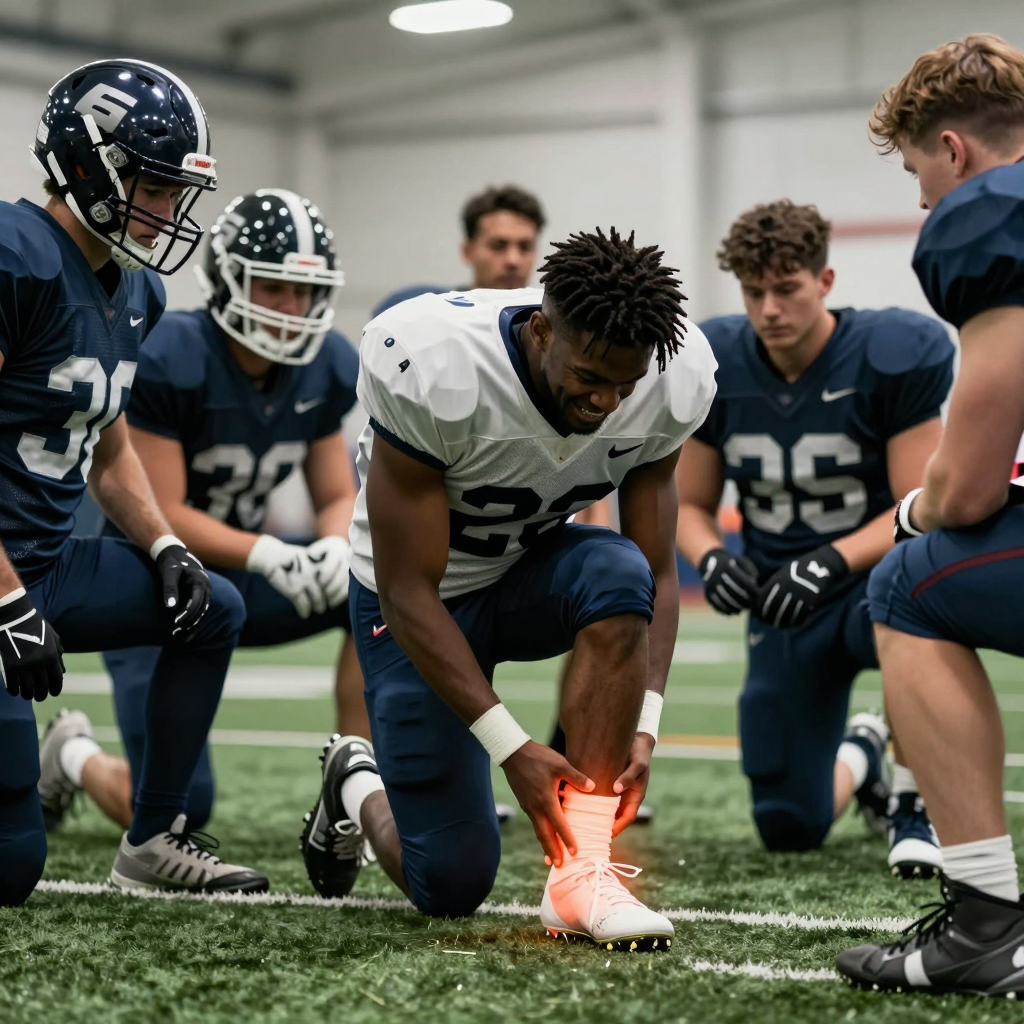
The Las Vegas Raiders’ practice field fell silent in an instant. Star running back Ashton Jeanty had attempted a diving catch on a pass from the quarterback before landing awkwardly on the indoor turf. He failed to secure the ball, but what happened next was far more alarming. He remained on the ground, unable to put any weight on his right leg.
Trainers and medical staff rushed over, and Jeanty was helped off the field. Initial reports from the scene could not clearly identify the injured area, describing it as either a “right knee” issue or a “lower-body injury.” With the diving landing, inability to bear weight, and immediate exit from the field all unfolding together, fans were quick to think of one word.
ACL.
Why His Teammates Took a Knee
The atmosphere surrounding the injury was far more serious than a routine practice stoppage. According to some reports from the scene and on social media, Raiders players even knelt and prayed as Jeanty was moved away on a cart.
Their reaction was not an overstatement. Jeanty is the centerpiece of the Raiders’ offense, responsible for both rushing and receiving production. If a player who recorded 1,321 scrimmage yards and 10 touchdowns as a rookie went down just before the preseason, it was only natural for the entire team to fear the worst-case scenario.
He has been the kind of running back capable of creating production even behind an offensive line that received poor reviews. That is why this injury appeared to threaten more than just the loss of a backup—it looked like a moment that could shake the very offensive blueprint the Raiders had been preparing.
A Frightening Scene Does Not Equal a Confirmed Diagnosis
Still, the fact that the scene looked devastating does not mean it can immediately be declared an ACL tear. Early reports primarily referred to a “knee injury” or a “lower-body injury,” and based on those descriptions, some columns and videos even raised the possibility that his season could be over. However, no official diagnosis had been issued at that stage.
Later, ESPN’s Adam Schefter and NFL Network’s Ian Rapoport reported updates indicating that the injury appeared to be a right ankle sprain and was not considered a long-term injury. Since the Raiders have yet to officially announce the precise diagnosis or a return timeline, caution is still necessary. But based on the information currently available, the ankle-sprain report is considered far more credible than the ACL-tear speculation.
There was a clear reason everyone on the field froze that day. But the most terrifying first impression is not always the final verdict. For now, what the Raiders and their fans are waiting for is not another rumor, but Ashton Jeanty’s official diagnosis and return timeline.
Ashton Jeanty Injury Update: The Night a Knee Scare Turned Into an Ankle Sprain Report
When the first reports from the scene came in, the mood was grim. Ashton Jeanty had awkwardly landed after attempting a diving catch for a pass during an indoor practice, then left the field with the help of trainers, unable to put weight on his right leg. Initial reports described it as a “right knee injury” or, more broadly, a “lower-body injury.”
Based on the scene alone, it was understandable that some fans feared an ACL tear. Several media outlets and social media accounts raised the possibility of a serious knee injury, and even unverified season-ending rumors spread rapidly. However, no official diagnosis had been made at that point.
A Turning Point in Reports From Trusted Insiders
As the night progressed, the flow of information changed dramatically. ESPN’s Adam Schefter and NFL Network’s Ian Rapoport both reported that Jeanty’s injury was believed to be a sprained right ankle.
Even more important was this: updates from both insiders indicated that the injury was not considered a long-term injury. In other words, the reports pointed in a very different direction from the initially feared ACL tear or season-threatening knee injury.
| Category | Initial On-Site Reports | Overnight Insider Updates |
|---|---|---|
| Injury Area | Suspected right knee or lower body | Reported as a sprained right ankle |
| Overall Outlook | Concern over a possible ACL tear | Unlikely to be a long-term injury |
| Nature of Information | On-site observations and initial descriptions | Follow-up reporting from top league insiders |
| Confirmation Status | Not an official diagnosis | Still pending an official team announcement |
Why the ACL Tear Rumors Should Be Viewed With Caution
Some YouTube channels and social media posts stated definitively that Jeanty had suffered an ACL tear and would miss the season. However, so far, neither the Raiders nor major outlets such as ESPN and NFL Network have confirmed an ACL tear.
The distinction here is clear:
- Information close to confirmed: Schefter and Rapoport reported that it was an ankle sprain and did not appear to be a long-term injury.
- Information not yet confirmed: The Raiders have not officially announced the exact diagnosis or a return timeline.
- A weakly supported claim: Definitively declaring a complete ACL tear and a season-ending injury conflicts with the latest reports from highly credible sources.
Therefore, the most reasonable conclusion right now is that Ashton Jeanty suffered a sprained right ankle that could lead to a short-term absence, but there is insufficient evidence to view it as an injury threatening his career or entire season.
Of course, even an ankle sprain is not something a running back can afford to take lightly. Change of direction, cutbacks, pass protection, and receiving routes all depend heavily on ankle stability. Still, simply stepping back from the scenario fans feared most—the “ACL tear”—is clearly a source of relief for the Raiders and Fantasy Football managers.
Why Is the Rumor Mill Growing Even Larger Amid the Lack of an Official Ashton Jeanty Announcement?
The biggest issue is that the Raiders have yet to release an official diagnosis or timeline for his return. Seeing Ashton Jeanty leave practice while being supported by medical staff and unable to put weight on his right leg immediately led fans to imagine the worst-case scenario.
When there is an information vacuum, on-site videos and early eyewitness accounts spread faster than the facts. What initially began as vague descriptions such as “a right knee injury” or “a lower-body injury” evolved on social media into “a possible ACL tear.” Some YouTube channels eventually spread definitive headlines declaring that he was “out for the season.” But the fact that the scene looked serious and the fact that an ACL tear has been confirmed are two entirely different things.
As of now, the most reliable updates have come from ESPN’s Adam Schefter and NFL Network’s Ian Rapoport. Both insiders have reported that Jeanty’s injury is believed to be a right ankle sprain and is not considered a long-term injury. While this is not an official team announcement, the fact that two insiders with some of the strongest information networks in the league have reported similar details is significant.
The Order of Priority When Evaluating Information
When following breaking injury news, it is important to distinguish between sources.
- Highest priority: The Raiders, the player himself, and official medical updates
- High credibility: Major insiders such as Schefter and Rapoport, who have connections to team and league sources
- For reference: On-site descriptions and practice observations from local reporters
- Use caution: Social media posts diagnosing an injury based solely on video footage, and YouTube content without a source
The phrase “ACL tear” is highly effective at generating clicks, but neither the Raiders nor any major U.S. media outlet has confirmed it as of yet. Conversely, reports of an “ankle sprain” should not be treated as the final diagnosis until the team makes an official announcement.
Therefore, the most accurate conclusion for now is simple: Ashton Jeanty is reportedly dealing with an ankle injury that could keep him out for the short term, but his exact recovery timeline remains unknown. Rather than reacting to season-ending rumors, both fans and fantasy football managers should remain calm and wait for an official update from the Raiders.
How Much Will the Raiders’ Offense Change Without Ashton Jeanty?
975 rushing yards, 346 receiving yards, and 10 total touchdowns. Ashton Jeanty was far more than a running back who simply took the ball and ran. He was the centerpiece of the Raiders’ offense, influencing everything from establishing the rhythm of the running game and opening up play-action opportunities to finishing drives in the red zone.
That is why the possibility of his short-term absence should be viewed as more than “one running back missing a game.” It means losing a player who created production even in an environment with limited space before contact—especially concerning given that the Raiders’ offensive line is viewed as one of the weaker units in the league.
The Rushing Share Could Decline, and the Offense May Become More Conservative
Jeanty is the type of player who can create positive yardage even in narrow rushing lanes and use short passes almost like extensions of the running game. Without him, the Raiders may be more likely to choose safer play calls early in the down-and-distance count rather than aggressively leaning on the running game.
The expected changes could include:
- A reduced emphasis on inside runs and complex rushing concepts
- Greater use of short, quick passes to distribute the ball
- A potential decline in the efficiency of screens, checkdowns, and play-action
- Greater reliance on the quarterback on third down
Jeanty’s ability to contribute as both a runner and a receiver also made it difficult for defenses to predict a play simply by looking at his alignment. He could release from the backfield into a passing route, turn the play into a screen, or take the ball and run. Once that versatility is removed, defenses can read the Raiders’ offensive tendencies with far greater comfort.
Wide Receivers and Tight Ends Could Take on Larger Roles
If Ashton Jeanty’s absence becomes a reality, the Raiders will naturally have to shift more of their focus toward a passing game centered on wide receivers and tight ends. The shorter-yardage situations and safe passing options usually handled by the running back would have to be distributed among other positions.
This could become especially apparent in two situations:
Red-zone offense
Jeanty was also a productive touchdown scorer. Without him, the Raiders could increase their use of tight ends near the goal line, along with quick passes such as slants and fades in short-yardage situations.Third-down packages
His 55 receptions last season showed that he was not merely a runner, but also a reliable option on passing downs. His absence could create more opportunities for slot receivers and tight ends to see additional targets.
That does not necessarily mean the offense will immediately become more productive. If the checkdown option and matchup advantage provided by the running back are reduced, the quarterback may be forced to take on more difficult, longer-developing passing situations.
The Main Concern Is Early-Season Rhythm, Not a Crisis for the Entire Season
The most credible reports at this point do not view Jeanty’s injury as one that is expected to keep him out for an extended period. As a result, it would be premature to say that the Raiders need to completely overhaul their offensive philosophy for the entire season.
However, the situation looks different with the regular-season opener approaching. The preseason is when a running back builds conditioning, develops chemistry in pass protection, and sharpens red-zone packages. If Ashton Jeanty is unable to fully go through that process, the Raiders may cautiously manage his snaps early in the season while adjusting the role of the running game.
Ultimately, the key factors are not the diagnosis alone, but his return date and his role after returning. If Jeanty comes back quickly, the center of gravity for the Raiders’ offense can shift back toward the backfield. If his return is delayed or his playing time is limited, the Raiders will have to rely more heavily on their receivers and tight ends for the time being.
The Ashton Jeanty Fantasy Football Decision: Drop Him or Wait?
An insider report saying that “it does not appear to be a long-term injury” is certainly reassuring. But in fantasy football, reassurance alone is not enough to set your lineup. The exact amount of time he will miss, whether he will play in the regular-season opener, and the possibility of a snap-count restriction after his return all remain unknown.
For now, the most reasonable conclusion is simple: It is too early to drop Ashton Jeanty, but he should not be valued as if nothing has changed.
Why Stashing Him on the Bench Is Better Than Dropping Him
Reliable reports have identified Jeanty’s injury as a right ankle sprain, not the kind of long-term injury that would cost him the entire season. There has also been no official confirmation of a torn ACL or a season-ending injury.
That makes the following approach appropriate in leagues where the focus is on the entire season:
- If he is already on your roster, stash him on the bench rather than dropping him
- Use an IR spot aggressively if your league rules allow it
- Prepare a replacement RB or flex option under the assumption that he could miss the first one or two weeks
- Until official injury reports and practice participation are available, take a conservative approach when setting your starting lineup
Jeanty’s value is especially difficult to explain through rushing production alone in PPR formats. After recording 55 receptions as a rookie, he established himself as a back capable of consistently catching passes on screens, checkdowns, and third-down routes. If his ankle recovers, he may have a chance to regain his fantasy production faster than a back who relies primarily on rushing volume.
His ADP Could Fall, but a “Crash” Is Not Automatically an Opportunity
If the injury news breaks just before the draft, Ashton Jeanty’s ADP could certainly drop. Managers who dislike uncertainty may avoid a player whose availability for the opener is unclear, choosing safer volume-based running backs or more reliable wide receivers instead.
However, a falling ADP should not automatically be treated as a buying signal. The key factor is the size of the discount.
| Situation | Recommended Approach |
|---|---|
| He is still available around his original projected draft range | Pass or proceed with caution |
| He falls by one or two rounds or more and reaches RB2 pricing | Consider buying while accepting the risk |
| His price drops to the level of a bench option | Aggressively pursue the upside |
| A Week 1 absence or limited role is officially confirmed | Draft him only if you have an early-season replacement plan |
The key is not to pay the price of the “pre-injury Ashton Jeanty.” An ankle sprain may not be a long-term problem, but the loss of preseason rhythm and the possibility of managed touches early in the season are real risks.
Approach the Trade Market as a “Low-Cost Upside” Opportunity
If your league’s draft has already taken place, Jeanty could become a classic buy-low candidate. However, that only makes sense if the opposing manager is genuinely panicking.
The conditions for considering an acquisition are clear:
- Your team has enough RB depth to cover the early-season uncertainty.
- Your lineup will not collapse if Jeanty misses one or two weeks.
- The opposing manager is willing to trade him for a healthy mid-tier RB or flex option.
- His value has fallen excessively based only on rumors before an official announcement.
On the other hand, if you would need Jeanty to immediately serve as your team’s RB1, it is better to avoid an aggressive trade. His ceiling remains extremely high, but what you may need right now is not his ceiling—it is reliable volume in the opening week.
Final Verdict: Avoid Panic Selling, but Don’t Buy Blindly
The best fantasy strategy at this point is not an extreme one. Selling Ashton Jeanty for pennies based on unconfirmed ACL rumors would be an overreaction. At the same time, paying an RB1-level price simply because the injury is “not long-term” would also be risky.
Hold him if you can afford to keep him on your bench, buy him if the price is sufficiently discounted, and prioritize a replacement option if you need immediate production in the opener. Until an official diagnosis and return timeline are available, this is the most realistic conclusion.
Comments
Post a Comment