 \n
The Moment Jihyo Changed the Waterbomb Formula with a Pair of Jeans
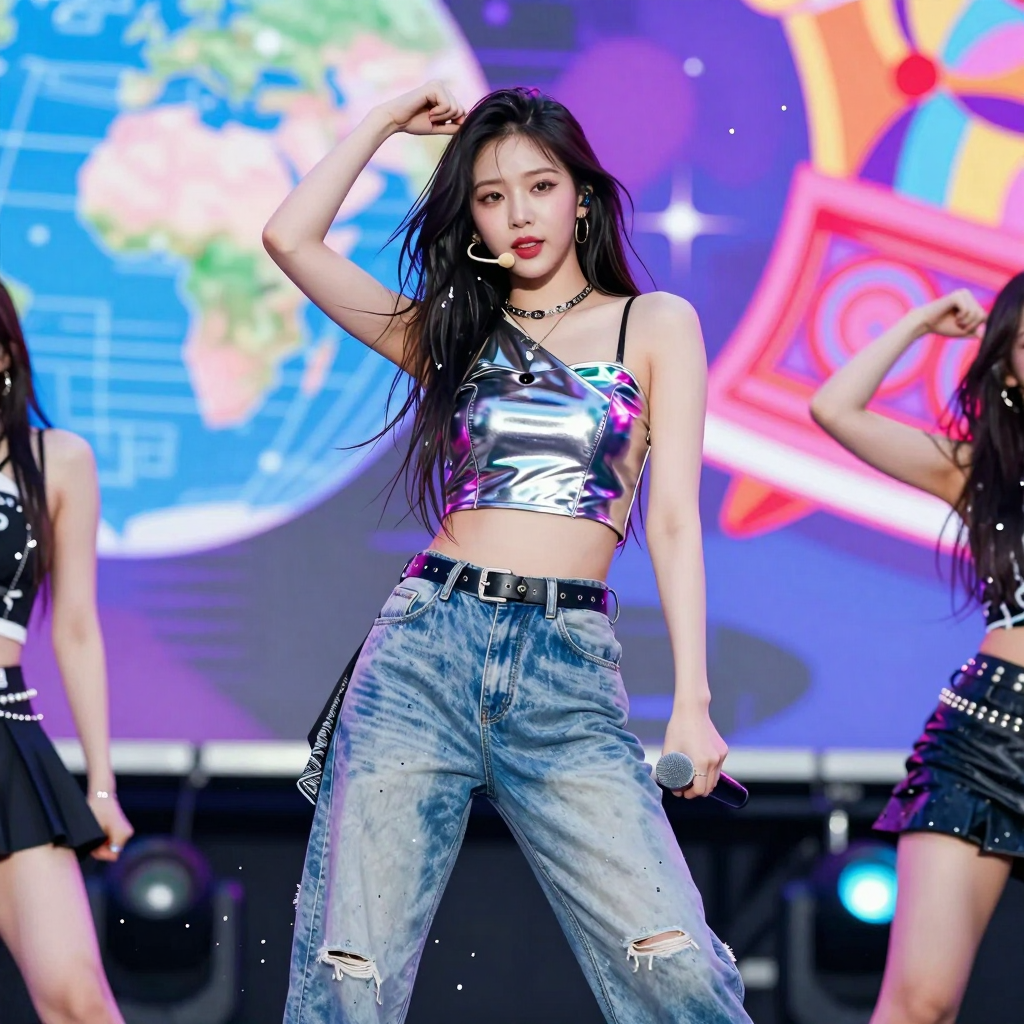
For years, Waterbomb stages have followed an unspoken formula: water, intense performances, and revealing, lightweight outfits. Against that backdrop, Jihyo took the stage at Waterbomb Kaohsiung in a silver-toned metallic crop top and washed denim pants. They were long jeans that would only become heavier and more cumbersome once soaked with water.
When a fan asked, “You’re the first person I’ve seen wearing jeans at Waterbomb. Weren’t they heavy?” Jihyo gave a brief but unmistakable answer.
“They were heavy, but it was my choice.”
The remark became a talking point not simply because of her unconventional styling. It was because it expressed her determination to make her own decisions about her body and outfit onstage, rather than be guided by the audience’s gaze or the festival’s conventions.
At Waterbomb, denim may not seem like the most practical choice. But for Jihyo, the jeans became a symbolic item—something she chose to stand by even at the cost of discomfort, and a way of showing that she was the one in control of the stage. The key point was not that she wore them “because they revealed less,” but that she wore them “because she chose to.”
The moment subtly shifts the way we view Waterbomb fashion. It sends the message that sexiness does not require showing a great deal of skin, and that a powerful performance does not have to follow a predetermined outfit formula. In fact, her clear willingness to stand by her own choice made Jihyo’s signature healthy, grounded energy shine even more brightly.
In the end, a single pair of jeans became more than a fashion statement. They became a declaration: stage outfits are also a form of artistic expression, and at the heart of every choice, the artist herself should always come first.
The Question Jihyo Raised: A Message More Powerful Than “Sexiness”—My Body, My Choice
Jihyo’s jeans at the Waterbomb festival were not simply an outfit that revealed “less.” At a festival where revealing clothing has long been accepted almost as convention, she chose her own comfort and convictions over other people’s expectations. And her brief response to a fan’s question—“They were heavy, but it was my choice”—made the meaning behind that decision even clearer.
The combination of a silver-tone crop top and washed denim pants was glamorous enough, and it did nothing to conceal Jihyo’s energy onstage. It was simply different from what many had expected. At an outdoor performance involving water and constant movement, long jeans were certainly difficult to view as a purely practical choice. Even so, Jihyo wore them without offering an elaborate explanation for her decision.
“They were heavy, but it was my choice.”
The sentence was powerful because it made clear who had the authority to decide what she wore. For a long time, female artists’ stage outfits have been linked to concepts, buzz, and the public gaze. This is especially true on stages like Waterbomb, where the imagery of “water, summer, and revealing clothing” is particularly strong. But Jihyo’s jeans questioned the unspoken formula that says, “You have to dress this way for this kind of stage.”
Comfort Over Convention, Agency Over Expectations
Jihyo’s choice was less a rejection of sexiness than an attitude of deciding for herself even how that sexiness should be expressed. It showed that a powerful performance does not require maximum exposure, and that an artist’s appeal comes not from other people’s standards but from her own choices.
In this context, the jeans became a statement piece. A stage outfit was no longer merely something used to adorn the body; it became a language through which an artist expresses how she wants to present herself.
- I decide how much of my body to reveal.
- I control my image onstage.
- A performance can be powerful enough without following convention.
The heart of the buzz Jihyo created was not the denim pants themselves. It was the way she quietly but firmly stated her own standards in the face of a formula everyone had come to accept.
From “A Body to Be Seen” to “A Person Who Decides”
Female artists in popular culture are often treated as objects to be evaluated and admired. But this performance invites audiences to see Jihyo not simply as “someone to be seen,” but as a person who actively decides how her image and body are presented.
This is also an important message for her fans. No one should be expected to endure discomfort just to meet someone else’s expectations, and decisions about one’s body and personal style belong to oneself. Ultimately, Jihyo’s jeans became more than a small variation on Waterbomb fashion; they remain a moment that prompted people to reconsider female artists’ right to choose and their agency over themselves.
Jihyo Offstage: The Healthy Influence of a 3 km Morning Run
After the dazzling lights and powerful performance came to an end, another side of Jihyo was already running through a park in the United States that morning. Dressed comfortably for a run rather than in stage outfits, she covered 3 km—and the sight left a deeper impression on fans than they expected.
What made the video special was that it went beyond simply being “an idol sharing proof of her workout.” Rather than feeling like a star to admire from afar, Jihyo came across as a running buddy in everyday life, almost as if she were saying, “Why don’t we go for a run together this morning?” In fact, many fans responded that they started exercising after watching the video.
Why Jihyo’s Run Became a Source of Workout Motivation
Three kilometers is far enough to feel like an achievement, yet not so far that it seems overwhelming. That is why Jihyo’s morning run comes across not as content showcasing a perfect physique, but as a healthy routine that anyone can begin at their own pace.
- She showed the importance of building a habit of moving consistently rather than pursuing grand goals.
- She demonstrated that exercise can naturally be part of an idol’s everyday life.
- She gave fans realistic motivation, making them think, “I can do it too.”
In particular, this gently shifts idol discourse—often centered on appearance and weight—in a different direction. The body is not merely something to be displayed; it is the foundation for taking care of oneself, building strength, and enjoying life.
From Onstage Energy to Everyday Wellness
The explosive energy Jihyo shows onstage naturally connects with the image of her running. It reveals that behind her powerful vocals and performances are physical stamina, routines, and time dedicated to taking care of herself.
To fans, Jihyo is now not only an artist who leads the crowd’s cheers from the stage, but also a wellness icon they would love to run alongside in a morning park. Her short 3 km run ultimately expands into a warm, relatable message: “Health isn’t only for special people.”
Jihyo’s Global Energy, Expanding from Waterbomb to the World Cup
From headlining the Waterbomb stage in Kaohsiung, Taiwan, to joining the World Cup commemorative collaboration song “Follow Me,” Jihyo’s recent moves represent far more than simply expanding the regions where she performs. By connecting the electrifying atmosphere of music festivals with a sporting event that has the whole world cheering together, she is once again emerging not only as a member of TWICE, but as a truly distinctive global artist.
Waterbomb is a festival where on-site energy and performance meet most directly. On the Taiwanese stage, Jihyo captivated the audience with her powerful live vocals and commanding presence, proving that she can dominate an overseas festival stage without missing a beat. In particular, her personally chosen style and performance left the impression of a stage she designs for herself—not merely a stage created to be seen.
The World Cup commemorative collaboration song “Follow Me” marks another expansion. The World Cup is a global event that brings people together through shared emotions of passion, challenge, and solidarity, transcending language and borders. Jihyo’s participation as a vocalist symbolizes the new synergy created when K-pop’s influence meets sports culture.
When the two activities are viewed together, one common keyword becomes unmistakable: energy.
- At Waterbomb, explosive energy that allows her to instantly connect with the audience
- In the World Cup collaboration song, positive energy that unites fans around the world
- In her everyday content, sustainable energy expressed through healthy routines
Jihyo is no longer confined to any particular stage or genre. By connecting the freedom of festivals, the passion of sporting events, and the polished excellence of K-pop performance, she is building a global narrative all her own. At the heart of that expansion is Jihyo’s unwavering energy—the energy that leads her to choose stages on her own terms and connect with fans in her own way.
Jihyo Is Creating a New Idol Narrative
Jeans, running shoes, and a global collaboration track. At first glance, they may seem like entirely different scenes, but Jihyo’s recent moves all point to one clear message: “I choose the direction of my body, my life, and my stage.”
At Waterbomb, Jihyo chose a metallic crop top paired with long jeans instead of the festival’s familiar formula of revealing outfits. The clothes were bound to become heavy once soaked with water, but she made the reason behind her choice clear, saying, “They were heavy, but it was my choice.” More than a simple styling issue, the moment can be read as a reflection of a female artist taking control of how she chooses to present her own body.
Her three-kilometer morning run in an American park follows the same thread. Rather than presenting her body as something shaped for the gaze of others, Jihyo shows herself as the active subject of her everyday life—moving, training, and building her health. Fans’ reactions, saying that they started exercising after watching her video, show that she is now becoming more than a star onstage: she is becoming a lifestyle icon who shares healthy habits with others.
Her participation in the World Cup commemorative collaboration track “Follow Me” expands Jihyo’s stage to an even wider world. The energy of the festival, the persistence symbolized by running, and the spirit of connection embodied by global sports all converge within the image of a single artist.
Ultimately, the narrative Jihyo is creating is not the story of an idol who simply “shows more.” It is the story of an artist who chooses her clothes by her own standards, practices a healthy lifestyle, and connects with stages around the world. This shift also shows that the way K-pop views female artists is gradually beginning to change.
Comments
Post a Comment