 \n
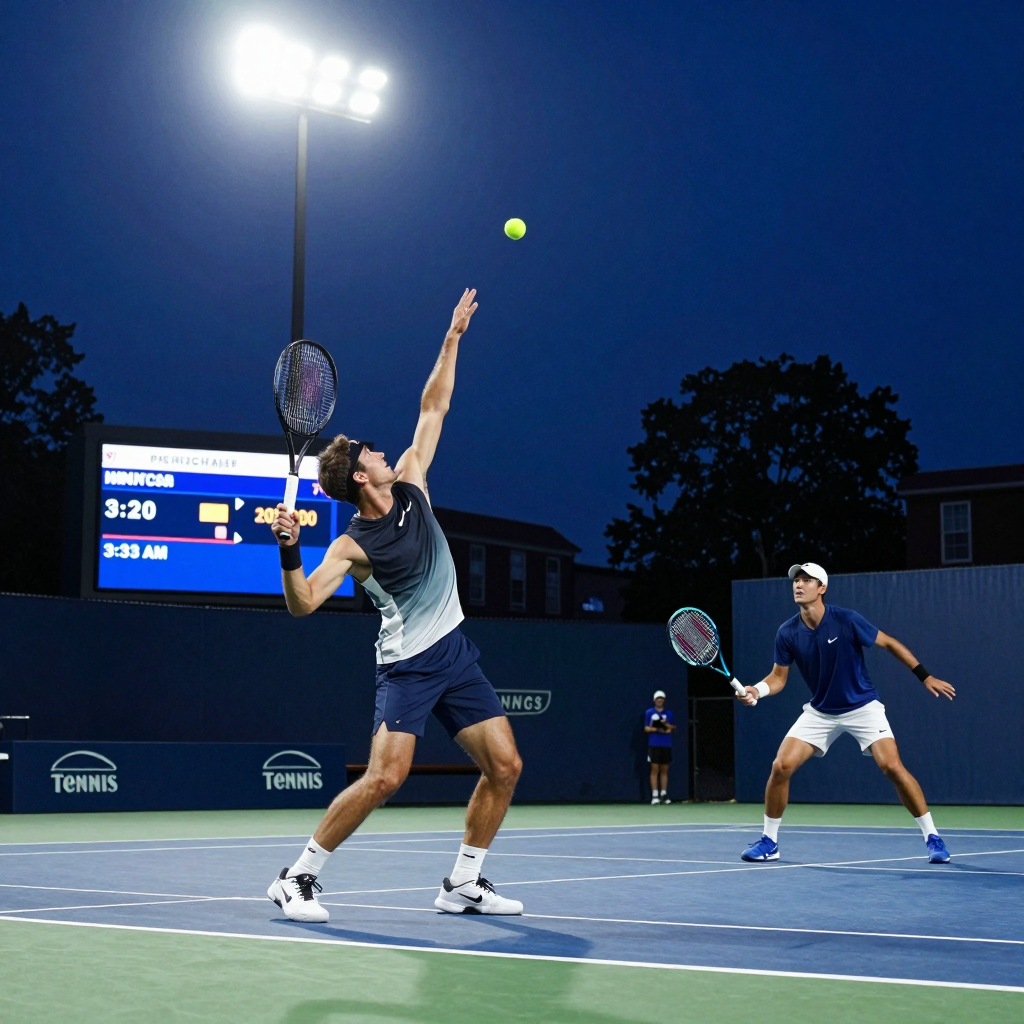
3:33 a.m., and American Tennis Began Moving Again: The Night of Ben Shelton
As the crowd at Arthur Ashe Stadium began to tire, Ben Shelton declared his era in the most powerful way possible. An ace clocked at 235 kilometers per hour. It was the final blow after 4 hours and 28 minutes of battling the defending champion, Carlos Alcaraz.
The score was 6–7, 6–1, 6–3, 1–6, 7–6. After surrendering the opening tiebreak, Shelton completely turned the momentum around in the second and third sets. Even in the deciding set, when Alcaraz mounted his comeback, Shelton refused to back down. The match ultimately went to a super tiebreak, and Shelton finished it with his greatest weapon—his serve—at the moment when the pressure was at its highest.
Concluding at approximately 3:33–3:34 a.m. local time, the match became the latest finish in US Open history. But the significance of the record goes far beyond the hour on the clock. More important was the fact that Shelton, who had previously lost 17 straight matches against top-three players in the world, had defeated the toughest opponent on the biggest stage.
The victory looked like the moment American men’s tennis had been waiting for. For American fans who had found it difficult to dream of a home Grand Slam champion since Andy Roddick, Shelton was no longer merely a promising prospect. With his booming serve, fearless net play, and the courage to withstand the pressure of a five-set battle, he proved he belonged among the title contenders.
As the night grew deeper, the stadium grew quieter. But whenever Shelton’s aces struck the court, everything changed. This was not simply a quarterfinal victory for one player. It was a signal that the clock of American tennis had begun moving again.
ben shelton: A 4-Hour, 28-Minute Comeback Thriller of Falling and Rising Again
The first set belonged to Carlos Alcaraz. Shelton held on all the way to the tiebreak, but in the end, he could not overcome the defending champion’s relentless pressure. Usually, this is the point at which many players begin to waver under the weight of their opponent’s name and the atmosphere. But ben shelton was different.
From the second set on, he completely changed the pace of the match. He used his powerful left-handed serve to create short points, and whenever an opening appeared, he charged forward to the net without hesitation. The result was overwhelming. Shelton took the second set 6–1 and the third 6–3, instantly turning the atmosphere inside Arthur Ashe Stadium on its head.
But Alcaraz was not a player who would collapse easily. He found his rhythm again in the fourth set, drawing Shelton into deep rallies, and the battle ultimately stretched into a deciding fifth set. As the early morning hours wore on, fatigue began to show in both players’ movements—but their focus grew even sharper.
The match was decided in the super tiebreak. And the final scene captured Shelton more clearly than anything else. With the tension at its peak, he fired an ace at 146 miles per hour—approximately 235 km/h. What ended the 4-hour, 28-minute war was not merely a serve. It was the audacity of a player who refused to abandon his attacking identity even after losing the opening set.
Completed at around 3:33 a.m., this victory was more than a comeback in a quarterfinal. It was ben shelton’s mental breakthrough—a moment in which he overcame both the towering wall of Alcaraz and his own history of 17 consecutive losses against Top 3 opponents.
How Ben Shelton’s 146-Mile Serve and Charge to the Net Disrupted Alcaraz’s Rhythm
Ben Shelton’s victory over Carlos Alcaraz was not simply a case of “a big server having a great day.” To unsettle Alcaraz, a player with world-class defense and creativity, Shelton used his power with far greater precision. The angles unique to a left-hander, his rapid attacking patterns, and his fearless net play continually disrupted the rhythm of an opponent who prefers long rallies.
The Uncomfortable Angles Created by a Left-Handed Serve
The defining moment of the match was the 146-mph, approximately 235-km/h ace that brought it to an end. But the power of Shelton’s serve cannot be explained by speed alone. The combination of his 193-centimeter frame and left-handed delivery creates a particularly difficult problem on hard courts.
A serve that bends wide pushes the opponent outside the court and leaves open space for the next shot. By contrast, a fast serve aimed down the T disrupts the timing of the return itself. Even a player like Alcaraz, blessed with exceptional reflexes and court coverage, can struggle to establish a stable return pattern when faced with different angles, heights, and speeds on every point.
Shelton turned that uncertainty into a weapon. Rather than testing Alcaraz’s defense in extended rallies, he forced uncomfortable decisions from the very first strike.
The Shot After the Serve: Ending Points Quickly
For a big server, the number of aces is not the only thing that matters. More important is how he handles the weak return created by the serve. Shelton seized control of the court aggressively with his first or second shot, leaving Alcaraz less time to unleash his trademark unpredictable defense.
It was an extremely practical choice. The longer a rally goes, the more Alcaraz’s options multiply—drop shots, passing shots, counterpunches, and more. Shelton, by contrast, controlled the length of the points. After disrupting Alcaraz’s balance with a powerful serve, he immediately followed with pressure from his forehand and forward movement.
In short, Shelton did not turn the match against Alcaraz into a contest of “who can create the more spectacular rally.” Instead, he transformed it into a battle over “who can put the other player in an uncomfortable position first.”
Charging the Net Wasn’t Reckless—it Was Calculated
Shelton’s net play was one of the most impressive tactical elements of the match. Rather than engaging Alcaraz endlessly from behind the baseline, he moved forward whenever an opportunity appeared. This was not merely an instinctive urge to attack; it was a choice designed to limit Alcaraz’s strengths.
Alcaraz is a player who uses every inch of the court. When an opponent stays deep, he creates space with wide-angled groundstrokes and drop shots. But when Shelton advances toward the net, the equation changes. Alcaraz must immediately produce a precise passing shot or lob, increasing the pressure on him.
Shelton created his chances to move forward with powerful serves and deep attacking shots, then finished the points at the net. This pattern continually forced Alcaraz to feel that he had to hit the next shot perfectly. Even a world-class defender will eventually produce errors or shorter balls when asked to find the perfect answer every time.
Attacking Courage Held Firm Through the Fifth Set
What made this strategy even more impressive was that Shelton never abandoned it late in the match. In a four-hour-and-28-minute battle, followed by a deciding fifth-set super tiebreak, judgment and nerve become more important than technique. Many players retreat into safer choices in moments like these.
Shelton did not. He continued to seize control with his serve, moved forward when balls landed short, and trusted his biggest weapon when the pressure was at its highest. That belief led to the most Shelton-like ending imaginable: a 146-mph ace.
This victory made one thing unmistakably clear. Ben Shelton is no longer merely a power player with enormous potential. He has developed into a player who can read his opponent’s rhythm, shape his strengths into a tactical plan, and execute that plan all the way through on the biggest stage.
Ben Shelton Breaks Through the 0–17 Wall to Become America’s New Tennis Hero
Numbers can sometimes explain a player’s limitations with brutal clarity. 0–17 against Top 3 opponents, and 0–3 against Carlos Alcaraz. Until the start of the 2026 US Open quarterfinals, a clear wall stood in Ben Shelton’s way. His talent and star power had already been recognized, but he had yet to prove that he could defeat a top-tier player on the biggest stage.
But the five-set battle that stretched into the early morning turned all of those records into history in an instant. Shelton surrendered the opening set to defending champion Alcaraz, yet refused to waver. He seized control with aggressive play in the second and third sets, and even when the match was forced back to level terms in the decider, he never backed down. The 146-mph serve that exploded under the pressure of the super tiebreak was more than just an ace. It was the shot that shattered the “big-match wall” that had followed him for so long.
This victory matters for reasons that go far beyond his ranking or his place in the semifinals. Shelton is no longer merely “a highly promising American player.” He has become a Grand Slam title contender capable of actually taking down the best players in the world. His first win over a Top 3 opponent, his first victory against Alcaraz, and his triumph in the latest-finishing match in US Open history—all three milestones were completed within a single night of drama.
That is also why American tennis is captivated by this moment. Since Andy Roddick lifted the 2003 US Open trophy, American men’s tennis has endured a long drought, yearning for a homegrown champion at its home major. Countless promising players have emerged, but a figure powerful enough to define an era has been hard to find.
Shelton is different. A left-handed big serve, fearless net play, the confidence to draw in the crowd, and even his “hang up the phone” celebration—he is a modern star who possesses both the game and the character. More importantly, this victory proved that he is a player capable of putting his name on the biggest moments.
The question is no longer, “Can Ben Shelton one day lead American tennis?” At 3:30 a.m. inside Arthur Ashe Stadium, he had already begun to provide the answer. The new face of American men’s tennis is no longer a figure of the future.
Ben Shelton Hangs Up the Phone and Opens the Next Chapter of American Tennis
After defeating Carlos Alcaraz, Ben Shelton once again pulled out his signature celebration: pretending to make a phone call, then delivering a brief, emphatic hang-up gesture. At Arthur Ashe Stadium, well past 3:30 a.m., it was more than a simple victory celebration. It felt like a new message—one American men’s tennis had been waiting a long time to hear.
“It’s my turn now.”
Shelton will face Frances Tiafoe in an all-American semifinal next. Whoever wins, an American player is guaranteed a place in the US Open final. But for Shelton, this is more than a battle for a spot in the championship match. It is a chance to restart the clock on an American men’s singles Grand Slam drought that has stood still since Andy Roddick won the title in 2003.
On Court, Tiafoe; Off Court, a Growing Presence
The match against Tiafoe could feel like an “internal final” for American tennis. Tiafoe’s creativity and energy, and Shelton’s explosive left-handed serve and aggression, draw American fans in through entirely different styles. But Shelton’s performance against Alcaraz carried a greater sense of weight. He refused to back down against a major name and closed out the match with his fastest serves when the pressure was at its peak.
His presence off the court is expanding just as quickly. His public relationship with U.S. soccer star Trinity Rodman has turned Shelton into a figure who reaches beyond the tennis fan base. The two support each other at their matches and have drawn attention as America’s next-generation sports couple, connecting tennis and soccer. This is more than mere publicity—it is part of the reason Shelton is becoming a more familiar and culturally resonant star to younger generations.
Now He Must Prove He Has What It Takes to Be a Champion
Of course, reaching the semifinal and defeating Alcaraz alone does not make someone a champion. Winning a Grand Slam demands more than producing your best tennis; it requires the ability to reproduce that level again and again. The emotional battle against Tiafoe, the pressure of the final, and the expectations of the home crowd will all be the next hurdles Shelton must clear.
Even so, the current mood is unmistakable. Ben Shelton is no longer merely “a highly promising American prospect.” He has defeated the defending champion on the biggest stage and possesses a style, a signature celebration, and star power all his own.
The moment he hung up the phone, American tennis may have ended its call with the past. Now, only one question remains: Can Shelton become the first American Grand Slam champion of this next chapter?
Comments
Post a Comment