 \n
Edge AI: Machines Must Make Decisions Before the Cloud Can Reach Them
In the few seconds it takes for sensor data from a factory robot to travel to the cloud and for the analysis results to return, a defective product may already have passed through the production line. In an autonomous vehicle, that brief delay can mean the difference between a dangerous moment and a safe evasive maneuver.
AI’s competitive edge is no longer found simply in building larger models. The key is now how quickly and reliably decisions can be made as close as possible to the point where data is generated—at the very moment it emerges. At the center of this shift is Edge AI.
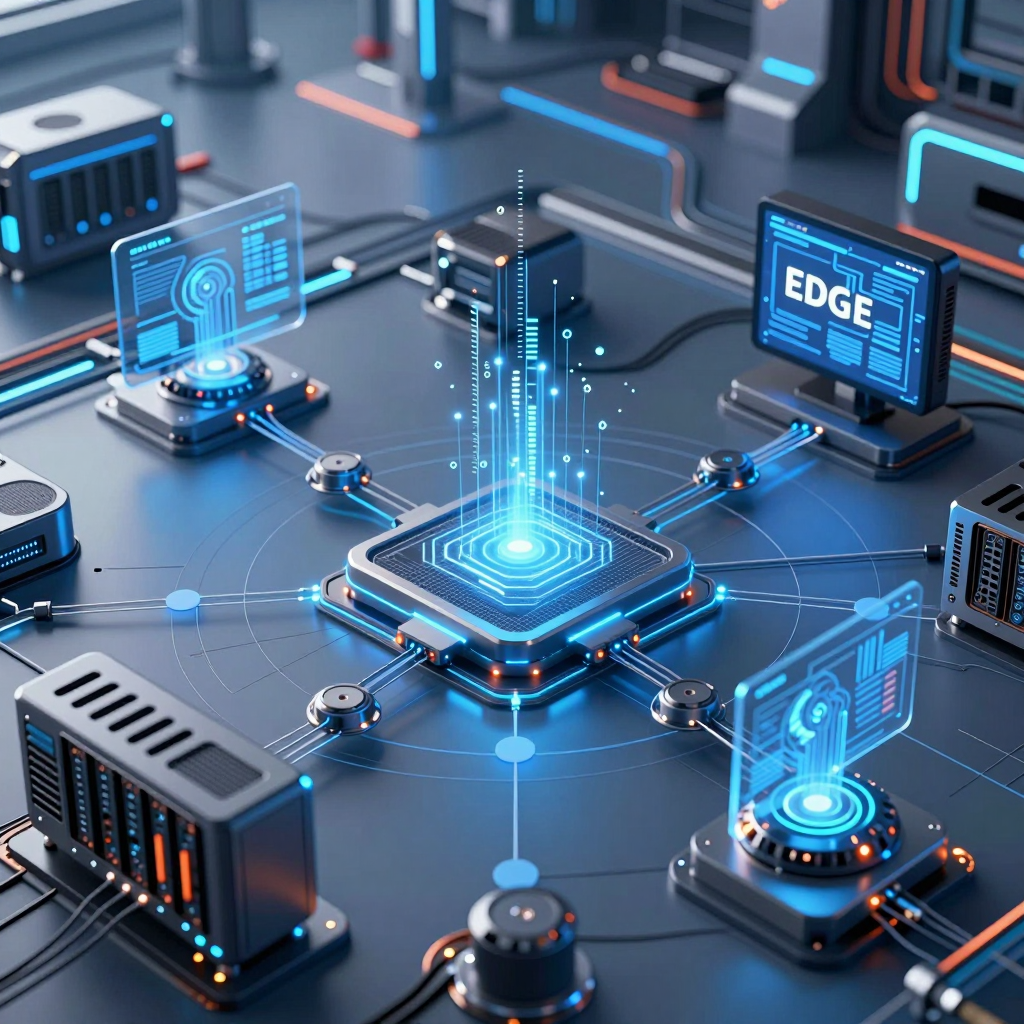
Edge AI is an approach in which AI inference is performed close to where data is created—on cameras, sensors, robots, vehicles, and industrial gateways. Instead of sending all raw data to a centralized cloud, machines recognize situations and make decisions directly on-site.
For example, an industrial camera can determine whether a product is defective on the spot, immediately after capturing its image. When an anomaly is detected, it can send an instant signal to a robotic arm or control system to separate the product from the production line. The cloud handles long-term data analysis, model retraining, and policy updates, but decisions that cannot afford to wait are made at the edge.
This architecture matters for three reasons:
- It reduces latency. Because inference takes place locally without a round trip to the cloud, it is well suited to control and safety operations that require millisecond-level responses.
- It eases the burden on networks. Rather than transmitting every piece of high-volume raw data, such as video, vibration, and temperature readings, systems can send only anomaly events and summarized results to higher-level systems.
- It keeps operations running even when connectivity is lost. Even when communications within a factory network or from a vehicle in motion become unstable, AI deployed on-site can continue making critical decisions.
This does not mean replacing the cloud. Instead, it is a shift toward defining each role more clearly. The cloud handles large-scale training and company-wide optimization, the network edge aggregates data from multiple devices, and individual devices perform immediate perception and control.
Ultimately, the transformation created by Edge AI is more than simple “distributed processing.” Factory equipment, robots, vehicles, and network devices are evolving from entities that merely wait after observing data into entities that understand their own state and act instantly. In an era when AI existed only inside the cloud, intelligence is now moving down to the real-world environments where machines actually operate.
The Next Industrial Revolution Powered by Edge AI: Where OT Meets IT
How would factories change if on-site data—such as temperature, vibration, and production speed—were connected in real time with ERP, MES, and network logs? They would transform from places that search for causes after failures occur into systems that detect the possibility of failure in advance and adjust operating conditions on their own. This is precisely why Qualcomm views Edge AI as a catalyst for the next industrial revolution.
In the past, operational technology (OT) and information technology (IT) were relatively separate in industrial environments. OT encompasses the areas that directly drive production, such as equipment, sensors, robots, and PLCs. IT, on the other hand, covers the systems that manage information, including ERP, MES, data analytics platforms, and network operations systems. The problem was that these two worlds operated at different speeds and in different ways.
Edge AI, however, performs AI inference close to where data is generated. As a result, it can immediately analyze subtle changes in equipment vibration, rising temperatures, declining production speeds, and early signs of defects in camera footage. The analysis can be fed directly into on-site control systems, while only the necessary information is sent to MES, ERP, and the cloud.
From Responding After Failure to Making Decisions Before It Happens
Traditional equipment management is largely reactive. Only after a machine stops or defect rates rise do companies collect data, analyze the cause, and schedule maintenance. This process can easily increase production losses and maintenance costs.
Edge AI-based operations, by contrast, continuously detect signs of anomalies on-site.
- They detect early signs of possible bearing wear from motor vibration patterns.
- They identify subtle quality defects in real time using thermal imaging and industrial cameras.
- They analyze production volumes, energy consumption, and equipment utilization together to reduce energy waste.
- They detect network latency or declining connection quality and automatically adjust communication policies.
The key is not simple monitoring. It is that on-site data, after passing through AI-based decision-making, leads to immediate action. For example, if the system detects a risk of overheating in a specific piece of equipment, it can do more than send an alert. It can recommend or execute actions such as reducing production speed or distributing the workload to alternative equipment.
The Value Created When OT and IT Data Come Together
Sensor data from the field can reveal the condition of equipment, but it is difficult to determine how that condition will affect production plans and profitability. Conversely, ERP or MES data alone cannot immediately show whether an actual machine is currently in a dangerous state.
That is why connecting OT and IT matters.
| Data Domain | Representative Data | Edge AI-Based Applications | |---|---|---| | OT | Temperature, vibration, pressure, video, robot status | Anomaly detection, quality inspection, predictive maintenance | | IT | ERP, MES, inventory, production plans, network logs | Adjusting production priorities, resource optimization, operational decision-making | | Integrated Data | Equipment status + production orders + network status | On-site automation and enterprise-wide operational optimization |
For example, suppose AI detects a high probability of failure in a particular machine. OT data tells us that “the equipment is in a risky condition.” When MES work orders, ERP delivery information, and inventory data are added, the system can go further and determine “which orders should be transferred to another production line first to minimize losses.”
This is the difference between simple automation and autonomous operations.
Why Intelligence Must Be Deployed on the Front Line
In industrial environments, the speed of decision-making is a competitive advantage. Sending all sensor and video data to the cloud, analyzing it there, and then receiving the results can introduce limitations such as latency, bandwidth costs, and connectivity failures. This approach may be unsuitable for tasks that require a response within milliseconds to seconds, such as robot control, safety monitoring, and quality inspection.
Edge AI performs these decisions on devices, at factory gateways, or on local edge servers. This allows industrial sites to secure the following benefits:
- Low latency: It reduces the round-trip time between data collection, decision-making, and control.
- Resilience to connectivity failures: Even when external networks are unstable, critical equipment can continue operating locally.
- Stronger security and data sovereignty: It minimizes the need to send sensitive production and video data outside the site.
- Lower operating costs: Instead of transmitting all raw data, it shares primarily event-based and summarized information.
Ultimately, Edge AI transforms factories from places that merely accumulate more data into places that understand data immediately—and act on it.
The Core of the Industrial Revolution Is Not Simply ‘Smarter Machines’
The essence of the next industrial revolution does not lie in adding a single AI capability to individual machines. It lies in having equipment, robots, cameras, sensors, factory networks, MES, and ERP operate within one unified feedback loop.
The field detects its condition in real time, the edge makes immediate decisions, and the cloud improves models and policies using long-term data. The improved models are then deployed back to the field. As this cycle repeats, factories evolve into operating systems that are more predictable, more efficient, and more autonomous.
The point where the boundaries between OT and IT disappear—and the point where intelligence is transformed into action at the very moment data is generated. That is where the next industrial revolution, powered by Edge AI, is beginning.
Autonomous Networks Evolving with Edge AI
Until now, networks have been closer to managed assets that people inspect when something goes wrong. When traffic surged or service quality declined, operators checked alerts, analyzed the cause, and modified routing policies or QoS settings. The speed of incident response ultimately depended on the experience and judgment of operations personnel.
However, network scale and complexity have reached a level at which it is difficult for people to assess every situation in real time. In environments where countless devices and applications, traffic across different sites, and security events occur simultaneously, it is difficult to ensure stable operations through a “respond after failure” approach alone.
At the center of this transformation is Edge AI.
The Era When Connected Equipment Does More Than Deliver Data—it Makes Decisions
Edge AI deploys AI inference capabilities close to where data flows, such as base stations, edge routers, CDN nodes, and enterprise gateways. The key is not to send all network data to a central system for analysis, but to read patterns and respond immediately at the point where problems occur.
For example, AI at an edge node can analyze the following signals in real time:
- Abnormal traffic surges in a specific section
- Increases in latency and signs of packet loss
- Declining QoS for a particular service
- Access patterns that differ from normal or signs of security anomalies
- Equipment load, link congestion, and early warning signs of failure
Based on the results of this analysis, the network can take action within the boundaries of established policies instead of waiting for manual intervention. It can reroute traffic away from congested paths, reallocate bandwidth to high-priority services, or deliver content from a cache node closer to users.
From Reactive Operations to Predictive Operations
The difference with an autonomous network is not simply automation. Rather than automation that follows predefined rules, it is an operational approach that predicts the likelihood of problems based on past and current conditions and makes proactive adjustments.
The conventional approach generally looks like this:
Failure occurs → Check the alert → Analyze the cause → Operator takes action → Service recovery
By contrast, an Edge AI-based network aims for the following flow:
Detect conditions → Analyze anomalies → Predict the likelihood of failure → Apply policies automatically → Learn from the results
For instance, before a major sporting event or live broadcast begins, the network can anticipate a sharp increase in demand across base stations and CDN segments in specific regions. Instead of responding after congestion actually occurs, it can expand cache capacity in advance, adjust traffic routes, and prepare priority policies.
This shift not only reduces the risk of service interruptions but also enables more efficient use of network resources.
A Network Cognition Architecture Built by the Cloud and the Edge Together
An autonomous network cannot be completed by the edge alone. In general, it operates as a layered architecture in which devices, the network edge, and the cloud divide responsibilities.
- Devices and on-site equipment generate immediate status information and sensor data.
- The network edge analyzes traffic, latency, and signs of failure within a short time and executes local policies.
- The cloud and core systems handle long-term data analysis, large-scale model training, global policy development, and model updates.
In other words, the edge makes fast decisions, while the cloud learns on a broader scale. When Edge AI at the site handles responses in seconds or milliseconds, the cloud combines data from multiple regions and time periods, then deploys improved operational policies back to the edge.
As this feedback loop repeats, the network evolves from infrastructure that merely maintains connectivity into a cognitive system that understands its own condition and chooses better actions.
Why Autonomous Networks Matter
This transformation is not limited to telecommunications companies. It is becoming increasingly important anywhere connection reliability directly determines operational stability, including smart factories, logistics centers, hospitals, campuses, and energy facilities.
In industrial environments in particular, a network failure can go far beyond a simple internet inconvenience, leading to production stoppages, safety risks, and declines in quality. Therefore, the ability of a network to understand equipment conditions and service priorities, then adjust bandwidth and priorities on its own according to the situation, becomes a core competitive advantage.
Ultimately, the change brought by Edge AI is clear. A network is no longer just plumbing waiting for commands from a central system. It is becoming an intelligent operational system that interprets situations while delivering data, predicts risks, and takes action on its own.
From Device to Cloud: How Edge AI’s Three-Layered Brain Works
Entrusting every decision to devices enables instant responses, but it has limitations when it comes to complex judgments that require analyzing multiple pieces of equipment and datasets together. Conversely, sending all data to the cloud expands analytical capabilities, but communication latency and bandwidth costs become obstacles.
That is why Edge AI in industrial environments is evolving not as one giant brain, but as a collaborative structure made up of three intelligence layers, each with a distinct role.
The Device Edge: Making Decisions in the Moment of Action
The lowest layer consists of the equipment where data is actually generated. Industrial cameras, robot controllers, vehicle ECUs, smart sensors, and mobile devices all belong here.
The role of this layer is clear: handling tasks that require an immediate response.
For example, a camera on a production line can determine whether a product is defective immediately after capturing its image. When sensor readings move outside a safe range, a robot can instantly stop or reduce its speed. Autonomous vehicles likewise need to process camera, radar, and lidar data inside the vehicle itself to make braking and steering decisions.
These decisions cannot afford to wait for a round trip to the cloud. Devices therefore typically use lightweight, quantized models. The key is to reduce model size and power consumption while still performing the necessary inference in an extremely short time.
The device edge is much like a “reflex system that acts the instant it detects something.”
The Network Edge: Connecting Multiple Sites to Interpret the Situation
It is difficult to see the full flow using devices alone. An individual camera may be able to detect defects, but it is far harder for it to analyze why defect rates are rising simultaneously across multiple production lines.
This is where the network edge—including factory gateways, enterprise edge servers, servers near telecom base stations, and CDN nodes—takes on the role of an intermediate brain.
The network edge gathers data from multiple devices nearby and performs tasks such as:
- Integrating and analyzing events from multiple sensors, cameras, and pieces of equipment
- Identifying site-specific anomaly patterns and quality trends
- Applying local policies and adjusting priorities
- Sending only summarized information to the cloud instead of raw data
- Detecting and adjusting network traffic, latency, and QoS issues
Suppose abnormal vibration is detected in one piece of equipment. The device immediately issues an alert, while the network edge compares the surrounding equipment’s temperature, power consumption, and production speed data as well. This makes it possible to determine more accurately whether the issue is simply a sensor error or a sign of an impending failure across an entire process.
The same principle applies to telecommunications infrastructure. Edge nodes can analyze traffic spikes or rising latency on-site and adjust caching, routing, and bandwidth policies. This is why networks are moving beyond merely responding after failures occur toward predicting problems and optimizing themselves.
The network edge is the layer that connects signals from individual devices and reads the “context of the entire site.”
The Cloud and Core: Learning from Everything and Designing the Future
The uppermost cloud and core layer focuses less on immediate control and more on global analysis and long-term learning. Large-scale data storage, training complex AI models, comparing multiple sites, and managing policies are among its primary responsibilities.
Based on events, statistics, and summarized data sent up from the edge, the cloud performs tasks such as:
- Training and retraining models with large-scale datasets
- Comparing the performance of multiple factories, regions, and equipment groups
- Analyzing long-term patterns for predictive maintenance and demand forecasting
- Centrally managing model versions, security policies, and operational standards
- Redeploying improved models to devices and edge servers
The important point is that the cloud does not necessarily need to receive all raw data. Instead of continuously transmitting entire videos or thousands of sensor logs per second, it is more efficient to upload only anomaly events, feature values, and statistical data selected on-site. When necessary, the original data can be transmitted separately for more detailed analysis.
Rather than directly controlling every moment in the field, the cloud is the strategic brain that teaches the entire system to make better decisions.
The Three Layers Do Not Compete; They Create a Feedback Loop
The key to this structure is not choosing just one place to run AI. It is about dividing responsibilities among the layers best suited to each task based on time sensitivity, data volume, security requirements, and model complexity.
| Layer | Primary Role | Suitable Tasks | |---|---|---| | Device Edge | Immediate decision-making and control | Defect detection, emergency stops, robot control, vehicle perception | | Network Edge | Site-wide integration and local optimization | Equipment-group analysis, data aggregation, QoS adjustment, policy application | | Cloud and Core | Learning and global optimization | Model retraining, long-term analysis, centralized management, multi-site comparison |
The flow is not one-way. Devices detect data in the field, the network edge adds context, and the cloud improves models and policies based on long-term data. The improved models are then deployed back to the edge and devices.
As this feedback loop repeats, the system moves faster in the field and becomes smarter across overall operations. Ultimately, the true value of Edge AI does not lie simply in deploying AI at the site level. It lies in connecting the immediacy of devices, the coordination capabilities of the network edge, and the learning capabilities of the cloud into a single operating system.
In the Era of Edge AI, the Fate of Autonomous Industries Will Be Decided by Their “Operating Structure”
From defect detection in smart factories and safety decisions in vehicles to traffic management across communications networks, Edge AI is already creating the technological foundation for making immediate decisions and taking action where data is generated.
But the fact that the technology is now possible does not mean industrial innovation will automatically follow. A more important question remains:
Who will deploy and update thousands—or tens of thousands—of distributed AI models, while continuously proving their safety and return on investment?
The companies that answer this question will gain leadership in autonomous industries. Ultimately, the true competition in Edge AI will not be determined solely by the performance of a single chip or the accuracy of a particular model. It will be a competition over who controls the industry’s operating model—the operating system for reliably running AI in the field.
Field Operations Are Harder Than Model Deployment
Edge environments are fundamentally different from the cloud. While the cloud can be managed centrally in relatively standardized data centers, the edge across industrial sites is highly heterogeneous.
- Each factory has different equipment and sensors.
- The hardware specifications of cameras, robots, PLCs, and gateways vary widely.
- Network connectivity differs from factory to factory, vehicle to vehicle, and base station to base station.
- Because production stoppages immediately translate into losses, update failures are difficult to tolerate.
- Regulations concerning safety, privacy, and industrial confidentiality also vary by site.
For example, deploying a quality-inspection AI model across 10 factories is an entirely different challenge from deploying it across 1,000 production lines. In the latter case, a company needs more than a simple model-deployment tool. It needs a system that can verify device status, detect performance degradation, and safely roll back to a previous version when necessary.
In other words, Edge AI requires a distributed MLOps operating system in which model development → deployment → monitoring → retraining → redeployment operates without interruption.
Four Conditions for Edge AI Operations in Autonomous Industries
To build a competitive edge in autonomous industries, the following four elements must work together.
1. Integrated Device and Model Management
Industrial sites contain a mix of cameras, sensors, robots, gateways, and edge servers from different manufacturers. Operators need a unified view of which AI models are installed on which devices, whether those models are up to date, and whether computing resources and power levels are sufficient.
This requires a platform that integrates hardware management and AI model management rather than treating them as separate domains. Field operators must be able to see not only “which device has failed,” but also “which model’s decision accuracy has declined.”
2. Secure OTA Updates and Rollbacks
An Edge AI model is not software that is deployed once and then forgotten. As data distributions change due to seasonal shifts, lighting conditions, equipment aging, and product specification changes, model performance can decline. This is known as model drift.
An operating platform must therefore support over-the-air (OTA) updates and provide the following capabilities during the update process:
- Phased deployment, beginning with a limited number of devices
- Performance validation comparing the new model with the existing model
- Immediate rollback to the previous version when anomalies occur
- Audit logs recording changes to models, data, and configurations
- Supply-chain security through signature verification and access control
Especially in safety-critical fields such as vehicles, healthcare, energy, and manufacturing control, predictable updates and verifiable recovery procedures matter more than simply achieving higher accuracy.
3. A Framework That Connects Field Performance to KPIs
AI accuracy is a metric for the technology team, but it is not the final metric for executives. In industrial environments, the value of Edge AI must ultimately be translated into operational outcomes.
For example, the following connections are necessary:
| Edge AI Technical Metric | Field Operations Metric | Business Outcome | |---|---|---| | Improved defect-detection accuracy | Fewer re-inspections and discarded products | Lower costs | | Earlier detection of equipment anomalies | Reduced downtime | Higher productivity | | Local analysis of video data | Lower volume of data sent to the cloud | Reduced network costs | | Traffic prediction and control | More stable QoS | Improved customer experience and lower churn | | Optimized energy consumption | Lower peak power demand | Reduced energy costs |
A strong Edge AI project does not stop at “model accuracy improved by 3%.” It must also prove how many hours of unexpected equipment downtime were eliminated, and how much defect rates and energy costs improved.
4. Joint Operations Across OT, IT, and Security
Autonomous industries are not projects owned by technology teams alone. OT professionals understand equipment safety and the realities of production processes. IT teams manage data, cloud infrastructure, and networks. Security teams are responsible for access privileges and data protection.
The challenge is that these three organizations speak different languages and operate according to different priorities.
- OT prioritizes keeping operations running without interruption.
- IT emphasizes scalability and standardization.
- Security demands control and risk minimization.
- Field managers want clear ROI.
Therefore, successful Edge AI adoption begins not by creating a separate AI organization, but by designing a system in which these groups share the same operational metrics and decision-making framework.
Chips and Models Will Change, but the Operating Platform Will Remain
NPU performance will continue to improve, and lightweight AI models will advance rapidly. The advantage of a particular semiconductor or framework may shift over time. However, the operating platform that brings together field equipment, data flows, deployment policies, security systems, and performance measurement practices will not be easily replaced.
For this reason, the center of competition is likely to shift in the following directions:
- Chip vendors will need to provide deployment tools and development ecosystems beyond raw hardware performance.
- Cloud providers will need to strengthen integrated MLOps connecting the cloud, edge, and devices.
- Telecommunications companies will need to secure low-latency AI services and autonomous network-operation capabilities based on the network edge.
- Industrial companies will need to continuously transform field data into learning assets without becoming dependent on any single technology.
Ultimately, the winners in autonomous industries will not be the companies with the fastest inference chips. They will be the companies with the structure to operate vast numbers of field AI systems reliably and repeatedly scale the value they create. The future of Edge AI depends on moving beyond the question of “where should intelligence be deployed?” to a more fundamental one: “Who will take responsibility for operating that intelligence all the way to the end?”
Comments
Post a Comment