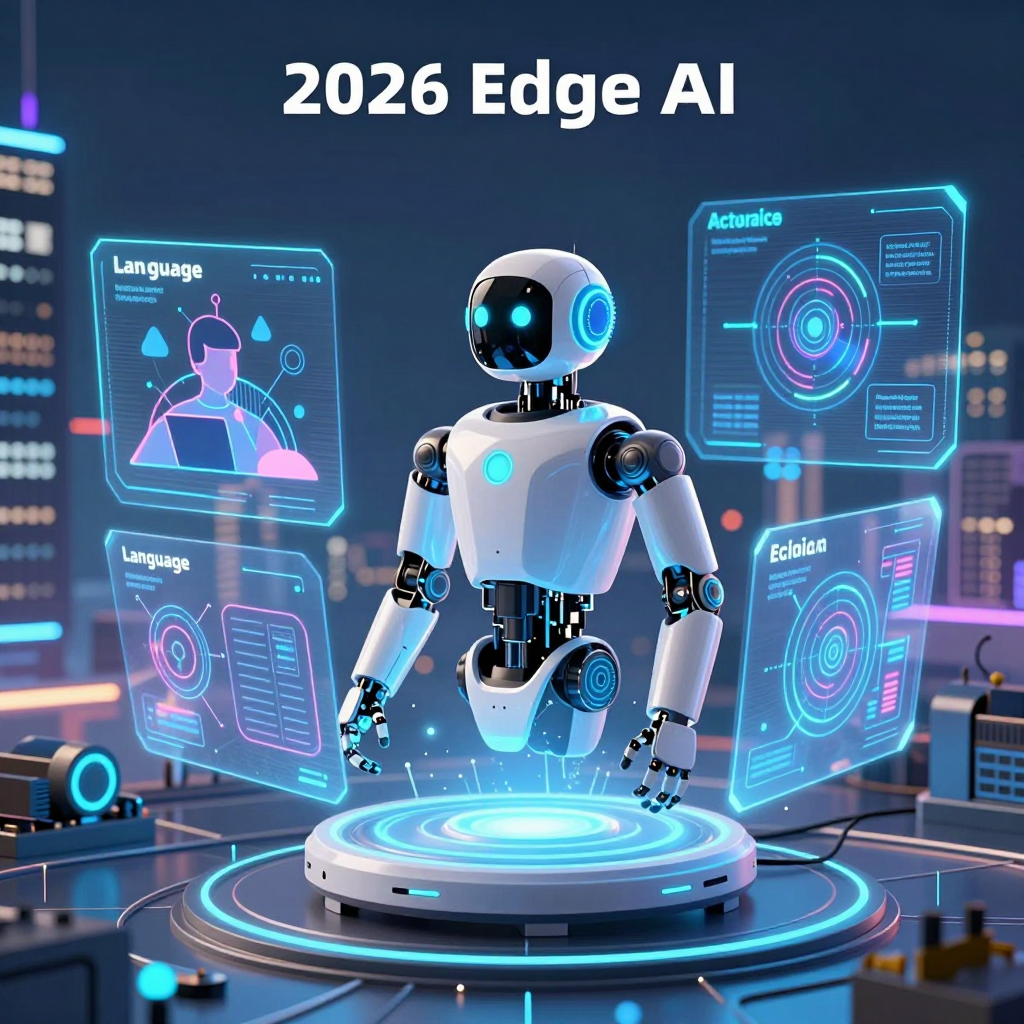
1. Standing at a New Turning Point for AI in 2026
Beyond cloud-centric AI, devices themselves now understand their environment and make decisions on the spot? 'Physical AI' is shaking up the technology market in 2026.
In recent years, AI development has largely focused on cloud data centers. Massive language models and image-generating AIs operated remotely, relying on immense computational power in distant servers. But 2026 marks a fundamental shift in this paradigm.
The Shift of AI’s Core to Edge AI
The most attention-grabbing change in the AI industry today is the migration to Edge AI environments. Complex AI computations once possible only in the cloud are now running directly on edge devices like smartphones, robots, and IoT sensors. This is no mere technical evolution—it’s a revolutionary shift that transforms how AI interacts with the real world.
Thanks to exponential hardware performance improvements, devices no longer depend solely on cloud instructions. Devices can now see, think, decide, and act on their own. This is the heart of 'Physical AI,' a concept championed by NVIDIA.
Physical AI: The Birth of AI That Understands the World
Physical AI goes beyond simply processing information—it means AI that grasps causal relationships in the physical world and interacts with it in real time. Just as humans observe, understand, and respond to their environment, AI is now beginning to do the same.
This change matters because it happens in Edge AI environments. When devices independently understand and judge their surroundings, there’s zero latency. This immediacy can save lives in fields requiring instant action—such as autonomous driving, robotics, and medical diagnostics.
The technological breakthroughs of 2026 ultimately lie in freeing AI from external cloud dependency and empowering devices to think independently. This is true AI democratization and a pivotal turning point that will ignite innovation across every industry.
2. The Trinity of Physical AI: Revolutionizing Edge AI through Cosmos, Omniverse, and AlphaMaya
What kind of innovation becomes possible when AI truly understands the physical laws and causal relationships of the real world, learns safely in a virtual environment, and immediately executes in real-world settings? NVIDIA’s trinity architecture of physical AI provides the answer. These three core pillars driving the evolution of Edge AI go beyond mere technology stacks—they fundamentally transform how artificial intelligence interacts with the world.
Cosmos: The Birth of Intelligence that Understands Physical Laws
The first pillar, Cosmos, serves as the 'brain' of physical AI. It goes beyond simple pattern recognition to deeply comprehend the physical laws and causal relationships governing the real world.
What Cosmos learns is not superficial correlations. For instance, when seeing a ball rolling out in front of a car, Cosmos does not merely register "the ball is moving." Instead, based on physical laws, it comprehensively infers the ball’s trajectory, the likelihood of a child being nearby, and how imminent the risk of collision is.
This capability is especially critical in Edge AI environments. Sending data to the cloud and waiting for a response can be fatal when split-second decisions are required. By running directly on the device, Cosmos enables causal reasoning and decision-making with zero latency.
Omniverse: A Virtual Realm for Safe Learning and Experimentation
The second pillar, Omniverse, is a virtual physical simulation environment where AI can learn and experiment without real-world risks. This dramatically enhances the efficiency and safety of AI development.
Take autonomous vehicles as an example: it’s impossible to expose them to every possible scenario on real roads, and testing dangerous situations directly is not an option. Omniverse solves this problem by accurately reflecting physical laws in a virtual world where thousands of scenarios—rainy weather, night driving, sudden obstacles—can be simulated repeatedly.
What’s more, the knowledge gained in Omniverse transfers directly to the real world. Because the physical laws are identical between the simulation and reality, causal understanding acquired in the virtual realm remains valid in real environments. This enables huge reductions in development time and costs while ensuring safety.
AlphaMaya: The Acting Agent Bringing Learned Intelligence to Life
The third pillar, AlphaMaya, is the agent that concretely executes the knowledge acquired from Cosmos and Omniverse in the real world. It is the embodiment of physical AI stepping away from abstract concepts to tangible interactions with reality.
AlphaMaya’s breakthrough lies in its transparent decision-making process. Equipped with a VLA (Vision-Language-Action) model, AlphaMaya does not merely generate low-level commands like "turn left." Instead, it understands situations in natural language, reasons causally why specific actions are necessary, and then acts accordingly.
For example, upon spotting a ball rolling in an alley, AlphaMaya works like this:
“The ball is rolling on the road. Considering physical laws, its trajectory will soon intersect with the car’s path. The presence of the ball usually indicates a child may be nearby. The child could suddenly dart onto the road chasing the ball. Therefore, the vehicle must immediately slow down and stay alert.”
This systematic reasoning happens in real time within Edge AI environments. Without relying on the cloud, it identifies complex causal relationships and responds swiftly—marking a fundamental departure from traditional AI systems.
Synergy of the Trinity: Unlocking New Frontiers
True innovation emerges when these three elements integrate. The physical understanding gained by Cosmos is safely validated in Omniverse, then brought to life in the real world by AlphaMaya, creating a virtuous cycle.
This revolution is set to transform not only autonomous driving but all Edge AI domains interacting with the physical world—robotics, smart factories, medical devices, smart cities, and more. Physical AI running directly on devices minimizes latency while drastically enhancing decision safety and transparency. This is why it will be the cornerstone of AI technology in 2026 and beyond.
3. Integrating Vision-Language-Action in VLA Models: The Secret of Causal Reasoning Realized in Edge AI
How is the remarkable reasoning ability of the VLA model created—an AI that goes beyond simple image recognition to judge situations through linguistic thought, predicting the child behind the ball rolling out from an alleyway?
What is a Vision-Language-Action Model?
Traditional autonomous driving AI functioned by receiving camera footage and generating immediate control signals. However, the Vision-Language-Action, or VLA model, fundamentally overcomes these limitations. The VLA model integrates visual information, linguistic reasoning, and action into one unified system, designed to enable more sophisticated decision-making in Edge AI environments.
This is not just about reflexively reacting like “red light, stop” by analyzing images. Instead, it involves a linguistic reasoning process to understand causal relationships in a given situation and decide actions accordingly.
Predicting the Child Behind the Ball in the Alley
Let’s understand the capability of the VLA model through a real-world example. An autonomous vehicle is passing through a narrow alley when suddenly a ball rolls onto the road. A conventional image recognition system would likely classify this simply as an “obstacle.”
But AlphaMaya, equipped with the VLA model, acts differently. Receiving the visual cue of the rolling ball, it simultaneously performs the causal reasoning: “A ball suddenly appearing in an alley likely means someone threw it or children were playing nearby.” Going further, it predicts that “there is a very high possibility a child will run out chasing the ball.”
Based on this reasoning, AlphaMaya proactively slows down and watches its surroundings more carefully. This is exactly the ability the VLA model provides—expressing the causal relationships of situations in language and acting upon that understanding.
Opening the Black Box: The Arrival of Explainable AI
Another revolutionary feature of the VLA model is that it makes the AI system’s decision-making process understandable to humans. This solves the long-standing ‘black box problem’ faced by autonomous driving systems.
Traditional deep learning AI was opaque in its processes between input and output—you couldn’t explain why it made certain decisions. But the VLA model analyzes input video data to generate explanations and reasoning behind judgments in natural language text.
For example, it can clearly express its rationale like: “A ball has rolled onto the road. Given the alley’s characteristics, it is likely children were playing nearby. Therefore, a warning about nearby hazards is issued.” This transparency boosts trust for both users and regulators.
Innovation Enabled by Edge AI
The sophisticated cognitive ability of the VLA model became possible thanks to advances in Edge AI. In the past, such complex computations had to be sent to the cloud, making real-time responses impossible. But with the arrival of modern edge devices—especially high-performance processors and dedicated AI chipsets mounted on vehicles—these complex inferences can be performed on-device in real time.
This improvement is more than a speed boost. With no network delays, safety is maximized; private data is not sent externally, protecting privacy. Most importantly, because the device operates independently, it can adapt and learn from new situations.
How Language Shapes Thought
To understand how the VLA model operates, we must focus on the role of language. Human brains also form abstract concepts and grasp causal relationships through linguistic thought processes. The VLA model attempts to embed this human cognition mechanism into AI.
By expressing and understanding ‘intent’ and ‘causal relationships’—which cannot be captured by images alone—through the medium of language, the AI transcends simple pattern recognition to achieve authentic situational understanding. This is why the VLA model differs fundamentally from existing autonomous driving technologies.
Evolving Through Interaction with the Physical World
The VLA model is not limited to autonomous driving. It can be applied to all Edge AI systems that must interact with the physical world in real time, including industrial robots, drones, and smart home systems.
Ultimately, what the VLA model opens is a path for AI to evolve from a mere information processor into an intelligent entity that understands the world and actively acts within it. By 2026, this change is no longer a dream of the future but a reality unfolding now.
Section 4. The GR00T Project: Intelligence Embodied in Robots, Realizing Physical AI
What does the future look like for embodied AI robots that understand human language and behavior while interacting with the physical world? NVIDIA’s GR00T project goes beyond conventional robot development to showcase the pinnacle of Edge AI technology. It’s an ambitious effort to bring the concept of physical AI to life through a real robotic platform—an innovative project poised to lead the technological wave in 2026.
The Fusion of Edge AI and Robotics: GR00T’s Core Identity
At its heart, the GR00T project implants multimodal generative AI into robots. Moving away from cloud-centered processing, robots equipped with Edge AI operate directly on-device and feature the following key characteristic:
Real-time independent decision-making means that GR00T robots can instantly perceive and react to their surroundings without any cloud connection. On-device processing in an Edge AI environment enables rapid responses free from network delays. This capability is especially valuable in environments demanding immediate action, such as factory automation, logistics centers, and medical settings.
Revolutionizing Human-Robot Interaction
What makes GR00T truly groundbreaking is its ability to understand and respond simultaneously to human speech and body language. When a worker casually instructs, “Please organize that box on that shelf,” the robot doesn’t merely parse the text command.
It achieves contextual understanding that includes nonverbal cues. By analyzing the worker’s gestures, facial expressions, and gaze direction, the robot accurately grasps intent. NVIDIA’s VLA (Vision-Language-Action) model is concretely realized within the robot, breaking free from rigid command structures to foster genuine collaboration.
Causal Reasoning About the Physical World
Another powerful skill GR00T possesses is understanding physical laws and drawing causal inferences. For example, when told to fill a transparent glass with water, the robot isn’t just blindly repeating the “pour water” action.
It visually perceives the rising water level and knows when to stop. If the glass tilts, it understands the need to adjust balance. It predicts the possibility of spillage and modulates speed accordingly. This reflects physical knowledge learned by NVIDIA’s Cosmos component being applied in real time within an Edge AI system.
Safe and Efficient Learning: The Role of the Omniverse Virtual Environment
Why can GR00T robots rapidly learn new tasks without repeating risky mistakes? NVIDIA’s Omniverse virtual environment holds the answer.
Before deployment, the robot undergoes millions of simulations—from objects slipping when grasped, to collision scenarios, to complex task sequences—all experienced in virtual space. These simulations build up the neural network within the Edge AI robot, forming a foundation for swift and precise decision-making in the real world.
What the GR00T Project Means for the Future of Edge AI
Looking toward 2026, the significance of GR00T is not merely improved robot performance. It marks that Edge AI technology has matured enough to tackle complex real-world problems.
The shift away from cloud-centric centralized processing toward a distributed AI era—where each device independently makes intelligent decisions—is now becoming a reality in products. As physical AI robots expand their footprint in manufacturing, logistics, healthcare, and service industries, they will fundamentally transform repetitive tasks and operations in hazardous environments once impossible for humans.
Ultimately, the GR00T project stands as living proof of how substantial and innovative the evolution of Edge AI is by 2026, signaling the pivotal moment when physical AI transcends concept to become a practical tool in the real world.
Section 5: The Coming Era of AI Edge Computing with CES 2026
Edge computing, which embeds intelligence directly into smartphones and IoT devices, is set to lead the future of AI technology by maximizing safety and efficiency. What can we expect in the next phase of technological innovation?
Why Edge AI Is Rising to the Mainstream
The shift from cloud-centric AI to edge-centric AI is accelerating. What stands out at CES 2026 is the emphasis on AI-driven edge computing as the cornerstone of safety and efficiency.
The driving force behind this change is clear. Thanks to enhanced hardware performance, the reliance on cloud-based processing is rapidly giving way to a model where recognition and decision-making occur directly on individual devices like smartphones or IoT sensors. This is the essence of Edge AI’s value.
The Tangible Advantages of Edge AI: Speed, Security, Autonomy
Running AI in an edge computing environment is not just a technical choice—it delivers fundamental benefits.
First, a revolution in response speed. By eliminating latency caused by sending data to the cloud and waiting for responses, real-time decision-making becomes possible. In scenarios where autonomous vehicles must detect obstacles and react instantly, this speed difference is literally a matter of life and death.
Second, enhanced security and privacy. Sensitive personal data is processed on-device, with only necessary information transmitted selectively, dramatically reducing the risk of data leaks.
Third, reduced dependence on network connectivity. AI-powered devices can perform intelligent functions autonomously even in environments with unstable internet connections.
What CES 2026 Foretells for the Future of Edge AI
The signals at CES 2026 are clear. Physical AI powered by Edge AI and VLA (Vision-Language-Action) models is opening the door to an era where AI can not only perform on-device inference but also understand and proactively interact with complex edge environments.
From NVIDIA’s GR00T project deploying multimodal generative AI on robotic platforms, to the causal reasoning capabilities demonstrated by autonomous vehicle AlphaMaya, and the autonomous decision-making within smart home devices—these showcase the tangible transformations Edge AI advancements are set to bring.
The Societal Impact of Edge AI Innovation
Beyond 2026, the world will revolve around devices equipped with Edge AI. Smartphones will evolve from mere computing tools to personal assistants, and IoT sensors will transform from simple data collectors into intelligent decision-makers.
This evolution presents new opportunities for both businesses and individuals. By running AI within the edge environment, services will become faster, safer, and more efficient than ever. At the same time, moving away from cloud-centric AI models towards local intelligence will also propel the democratization of AI technology.
What we will witness at CES 2026 goes beyond mere tech demos. It offers a concrete vision of how Edge AI will transform our daily lives. This future is already unfolding right before our eyes.
Comments
Post a Comment