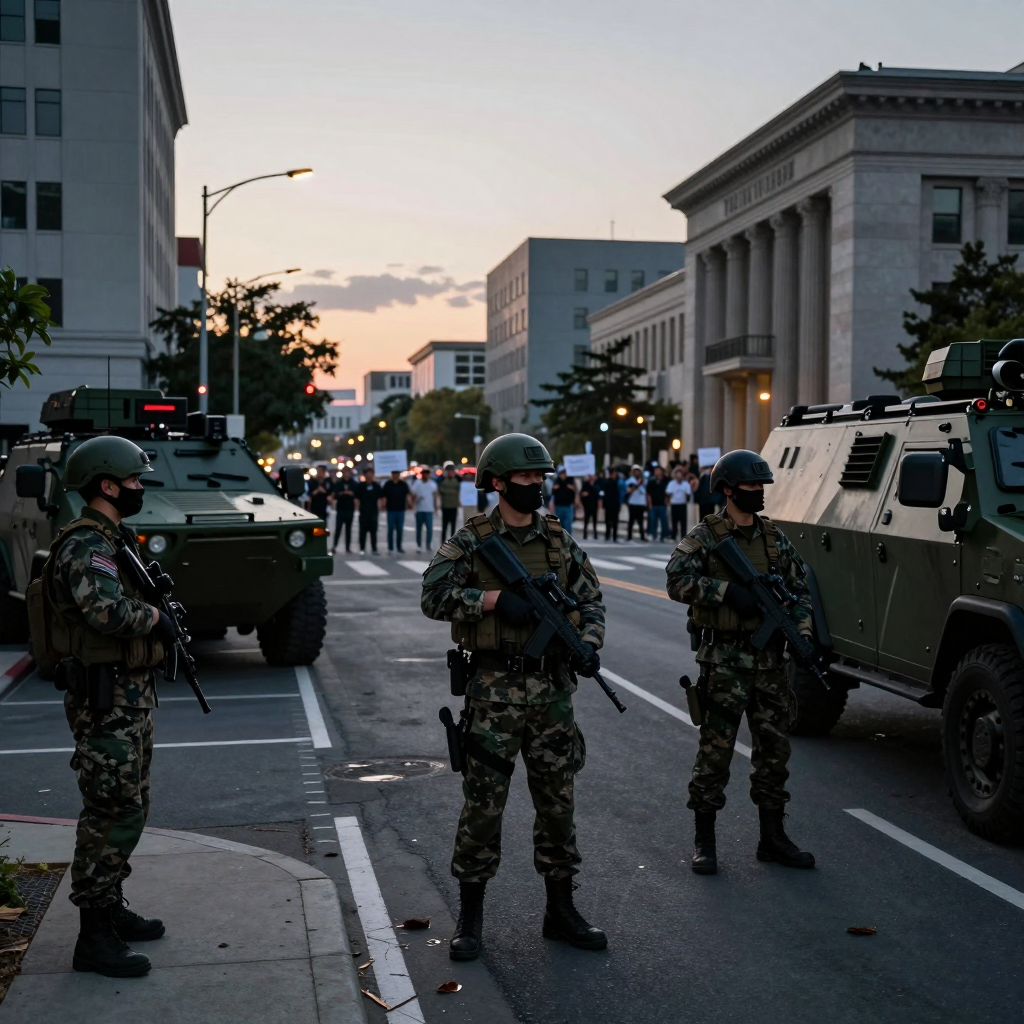
1. The Hidden President’s Supreme Power: The Insurrection Act
Did you know there is a 19th-century law that allows the president to deploy the military at any time? Even more astonishing is that this law—the Insurrection Act—has been in effect for nearly 200 years. Enacted in 1807 and still active today, this law grants the U.S. president immense authority.
What is the Insurrection Act?
The Insurrection Act empowers the U.S. president, relying on broad authority, to deploy active-duty military forces and state National Guard troops to suppress insurrections and enforce federal laws. First passed in 1807 and significantly amended in 1874, this law gives the president wide discretion without procedural restrictions or congressional oversight.
How the Insurrection Act Works
The Insurrection Act operates through three main mechanisms. First, the president can deploy troops when a state requests federal support to suppress an insurrection. Second, the president may act unilaterally whenever "unlawful obstruction, combinations or assemblages, or rebellion" make it impossible to enforce U.S. laws. Third, the president can intervene if state authorities fail to protect constitutional rights.
Most importantly, the law does not define what constitutes ‘insurrection’ or ‘rebellion’—granting the president enormous power to interpret what qualifies. The Supreme Court has ruled that apart from extremely limited circumstances, the president’s judgment under this law is not subject to judicial review.
The Problem with Such Broad Discretion
The Insurrection Act contains no procedural requirements whatsoever: no mandatory consultation with state officials, no reporting duty to Congress, and no built-in time limits. William Banks, a military law expert at Syracuse University, explains that the president “executes the Act based solely on his own judgment, with no specific standards to follow.” This open-ended framework essentially permits presidential action whenever deemed necessary.
Historical Examples of Its Use
The Insurrection Act and its predecessors have been invoked roughly 30 times across nearly two centuries of crises. The most recent example was in 1992, when President George H.W. Bush deployed troops to California at the governor’s request to suppress the Los Angeles riots.
Interestingly, in the past 130 years, the president has used the Insurrection Act unilaterally only five times—each during the Civil Rights era. Presidents Eisenhower, Kennedy, and Johnson acted despite state opposition, using federal troops to enforce desegregation in Arkansas, Mississippi, and Alabama.
On January 15, 2026, President Trump threatened to invoke the Insurrection Act in response to protests following a shooting of Immigration and Customs Enforcement (ICE) agents in North Minneapolis. He warned that if state officials failed to control demonstrations against federal immigration enforcement, he would deploy the Act to suppress “professional agitators and insurgents.”
Legal Limitations
While the Insurrection Act confers substantial power, some limitations remain. The military cannot replace local law enforcement in ordinary criminal investigations, may not be used to violate constitutional rights, nor be stationed at polling places. Additionally, invoking the Act temporarily overrides the Posse Comitatus Act of 1878, which generally prohibits military involvement in domestic law enforcement—making the Insurrection Act its “most important exception.”
Residents of Minneapolis, along with Minnesota officials like Senators Amy Klobuchar and Representatives Ilhan Omar, publicly opposed Trump’s threat. Critics characterized potential troop deployments not as legitimate emergency responses but as authoritarian escalations.
How Does the Insurrection Act Work?
Let’s unravel what powers this law — which lacks clear definitions of 'rebellion' and 'resistance' — grants to the president, and how those powers are exercised in reality. Enacted in 1807, the Insurrection Act bestows tremendous authority on the U.S. president under the pretext of maintaining domestic order. So, how exactly does this law operate, and just how far does presidential power extend under it?
The Mechanisms Behind the Insurrection Act
The Insurrection Act operates through three main mechanisms. First, the president can deploy troops or militias when a state government requests federal support. Second, the president may act unilaterally if he determines that "unlawful obstruction, combination, assemblage, or rebellion" renders federal law enforcement impossible. Third, the president can intervene if state authorities fail to protect constitutional rights.
The Dangerous Ambiguity of Undefined 'Rebellion' and 'Resistance'
The greatest flaw of the Insurrection Act is its failure to clearly define "rebellion" or "resistance." By leaving these crucial terms vague, the law grants the president virtually unlimited interpretive power. What qualifies as a "rebellion" and what does not is entirely at the president’s discretion. Even the Supreme Court has ruled that, except in very limited circumstances, judicial review of the president’s judgment is extraordinarily difficult.
The Absence of Procedural Safeguards
Even more astonishing is the minimal procedural requirements built into the Insurrection Act. There are no mandatory consultations with state officials, no reporting duties to Congress, nor any explicit time limits on actions taken. William Banks, a military law expert from Syracuse University, explains that the president "can decide solely on his own word, with no special standards to follow." This open-ended framework allows the president to act whenever he deems it necessary.
The President’s Expansive Discretionary Power
At its core, the Insurrection Act grants the president wide-ranging discretion to assess situations and decide on troop deployments. This stands as the most significant exception to the Posse Comitatus Act of 1878, which generally prohibits military involvement in domestic law enforcement. Thus, once the Insurrection Act is invoked, peacetime legal constraints can effectively be suspended.
While the law was designed to enable swift response in national emergencies, its vague definitions and lack of procedural checks leave few barriers to curtail presidential power.
Unlimited Authority and Its Shadows: The Dangers of the Insurrection Act
What if the president could deploy the military onto the streets based solely on personal judgment? With no procedural constraints and no obligation to report to Congress? This is not a hypothetical scenario—it is the legal framework that the Insurrection Act has brought to life.
The Procedural Void of the Insurrection Act
Since its enactment in 1807, the Insurrection Act has granted the president almost unrestricted power. The most problematic aspect is that the law includes virtually no procedural checks on the exercise of this power.
There is no requirement to consult with state officials. No obligation to report to Congress before or after deployment. Not even clear rules defining the duration of military deployment. As military law expert William Banks of Syracuse University pointed out, the president "acts solely on personal judgment, with no specific criteria to follow." This structure means there is effectively no way to limit the executive branch’s arbitrary decisions.
Undefined Core Concepts
Even more concerning is the lack of clear definitions of key concepts in the Insurrection Act. Terms like "insurrection" and "rebellion" are used without specific definitions.
This essentially grants the president the authority to interpret what these words mean on their own. Historically, the Supreme Court has ruled that the president’s judgment in this regard is not subject to judicial review. This implies a failure of the judiciary’s check-and-balance function and legally guarantees the executive branch’s absolute supremacy.
The Tension Between Democracy and Rule of Law
The broad discretion granted by the Insurrection Act clashes with the core democratic principle of checks and balances. Laws are generally designed to limit executive power and subject it to congressional oversight—but this law does the exact opposite.
The president’s power to deploy federal troops whenever deemed "necessary" concentrates the authority to label someone an "insurrectionist" and justify military intervention in the hands of one person. This fundamentally undermines the principle of separation of powers.
Contemporary Concerns
In January 2026, when President Trump threatened to invoke the Insurrection Act in response to protests in Minnesota, it vividly illustrated how these concerns could turn into reality. Senators like Amy Klobuchar and Representatives like Ilhan Omar, both from Minnesota, criticized this as an authoritarian expansion rather than a legitimate emergency response.
Unrestricted power, undefined concepts, unchecked judgment—at the intersection of these three factors, the Insurrection Act becomes the most dangerous tool for presidential power outside democratic control.
Section 4: The Insurrection Act in Practice Through History, and the 2026 Crisis
The Insurrection Act is not merely a legal provision. It stands as a living record demonstrating how far presidential power can extend during the most turbulent moments in American history. Over nearly two centuries, this law has been invoked in about 30 crises, during which American society repeatedly grappled with the delicate balance between liberty and order.
The Civil Rights Era: The Insurrection Act at Its Most Forceful
The American Civil Rights Movement of the 1950s and 1960s was the period when the Insurrection Act was employed most dramatically. President Eisenhower deployed federal troops to enforce school integration in Arkansas, while Presidents Kennedy and Johnson took similar actions in Mississippi and Alabama, respectively. These events made it clear that despite resistance from state governments, the federal government could mobilize the military to protect constitutional rights.
Notably, all five instances during which the Insurrection Act was unilaterally invoked happened within this Civil Rights era. This underscores the law’s formidable power and highlights how heavily such decisions rely on presidential judgment.
The 1992 LA Riots: State Requests and Crisis Response
A more recent example is the 1992 Los Angeles riots. President George H.W. Bush responded to California’s request by deploying federal troops to quell the unrest. This was a textbook case of the Insurrection Act’s first mechanism—federal intervention initiated at the request of a state government.
The situation was dire. Protests against police brutality escalated into widespread riots, overwhelming local authorities’ ability to maintain order. In this context, the deployment of federal troops was seen as a democratically sanctioned crisis response.
The 2026 Minneapolis Incident: Threatening Unilateral Invocation of the Insurrection Act
History reached a new turning point on January 15, 2026, when President Trump threatened to invoke the Insurrection Act in response to protests following a shooting of ICE officers in Minneapolis.
This marked a decisive departure from previous cases. Whereas President Bush acted upon a state government’s request, President Trump declared his intention to deploy federal troops unilaterally, without the consent of Minnesota state authorities. He labeled the protesters as “professional agitators and insurgents,” warning that if state officials failed to control demonstrations opposing federal immigration enforcement, he would invoke the Insurrection Act.
This represented a full-scale attempt to wield the law’s most perilous clause—allowing the president to act unilaterally if he judges that “illegal obstruction, association, assemblage, or rebellion” hinders law enforcement.
Experts’ Concerns and Political Backlash
The Minneapolis situation triggered fierce opposition from civil rights advocates. Minnesota politicians, including Senator Amy Klobuchar and Representative Ilhan Omar, condemned it as an authoritarian escalation rather than a legitimate emergency measure.
Legal and military experts also highlighted structural flaws in the Insurrection Act. Because the law does not define “insurrection” or “rebellion,” the president’s interpretation of these terms is virtually unchecked by the judiciary. This effectively grants the president a blank check in wielding military force domestically.
Lessons from History
Nearly two centuries’ worth of experience with the Insurrection Act offers clear lessons. It demonstrates that the law can serve as an effective tool during genuine emergencies, yet simultaneously reveals how broad presidential discretion—absent democratic oversight—can lead to misuse.
Past invocations during the Civil Rights Movement aimed to protect constitutional rights, and the 1992 case was grounded in a legitimate state request. However, the 2026 threat frames the exercise of citizens’ freedom of expression in opposition to federal immigration enforcement as “rebellion,” using military power to suppress it. This starkly exposes how the Insurrection Act can dangerously diverge from its original intent and become a perilous instrument.
Section 5: Legal Limits of the Insurrection Act and Current Political Controversies – Between Authority and Liberty
From legal constraints aimed at preventing constitutional rights violations due to military deployment, to the political backlash and criticism in today's arena—let’s explore the legal mechanisms that limit the president's sweeping powers under the Insurrection Act and the ongoing debate over whether these measures are sufficient.
Legal Constraints of the Insurrection Act: Present but Possibly Inadequate?
While the Insurrection Act may appear to grant unlimited power, it actually contains several legal restrictions. For instance, military forces cannot fully replace local police for ordinary criminal investigations. Additionally, the deployment of troops cannot be used to infringe upon individuals’ fundamental constitutional rights, and they are explicitly prohibited from being stationed at polling places.
However, legal experts question how effective these constraints truly are. The Insurrection Act lacks specific procedural requirements, mandatory consultation with state officials, reporting obligations to Congress, and implicit time limits on military deployment. This raises doubts as to whether these legal safeguards genuinely restrict the president’s discretionary powers in practice.
Relationship with the Posse Comitatus Act: The Exception Within Exceptions
Understanding the Insurrection Act requires examining the Posse Comitatus Act of 1878, which generally prohibits the use of the military in domestic law enforcement. The Insurrection Act stands as the most critical exception to this law. When invoked, it temporarily overrides Posse Comitatus restrictions, permitting direct military involvement in domestic enforcement activities.
This underscores that the Insurrection Act is not merely an “emergency authority” but the strongest legal tool for military deployment within the U.S. constitutional framework.
Political Concerns and Criticism: A Warning Sign of Authoritarian Expansion?
In January 2026, when President Trump threatened to invoke the Insurrection Act to suppress protests against immigration enforcement in northern Minnesota, political reactions were sharply divided. Democratic lawmakers interpreted this as a sign of authoritarian overreach.
State officials, including Senator Amy Klobuchar and Representative Ilhan Omar of Minnesota, publicly opposed the move. Their critique was clear: the invocation of the Insurrection Act was not a legitimate emergency response but an attempt to label lawful protests against federal immigration actions as “subversive conduct” to justify suppression.
This criticism highlights a core flaw of the Insurrection Act: terms like “riot,” “insurrection,” and “rebellion” are not clearly defined, leaving room for the president to interpret them subjectively, potentially converting legitimate resistance or demonstrations into justifications for its deployment.
Limits of Legal Review: The Role of the Judiciary
The Supreme Court has ruled that judicial review of a president’s invocation of the Insurrection Act is generally off-limits, allowing court intervention only in extremely rare cases. This is one of the most dangerous aspects of the Act. Even if legal restrictions exist, without an effective body to enforce or review them, these safeguards can become practically meaningless.
The Constitutional Challenge We Face
The current state of the Insurrection Act poses difficult questions for democratic society: Does the president need broad authority to respond swiftly to national crises? If so, how should such authority be limited? And who should actually enforce those limits?
This gap between legal boundaries and political realities is the challenge we must collectively address. The existence of the Insurrection Act starkly reveals the tension between power and liberty, prompting a fundamental dialogue about how emergency powers should be managed in a democracy.
Comments
Post a Comment