What Are the Latest 2025 Agentic RAG Technologies, Evaluation Criteria, and Real-World Databricks Use Cases?
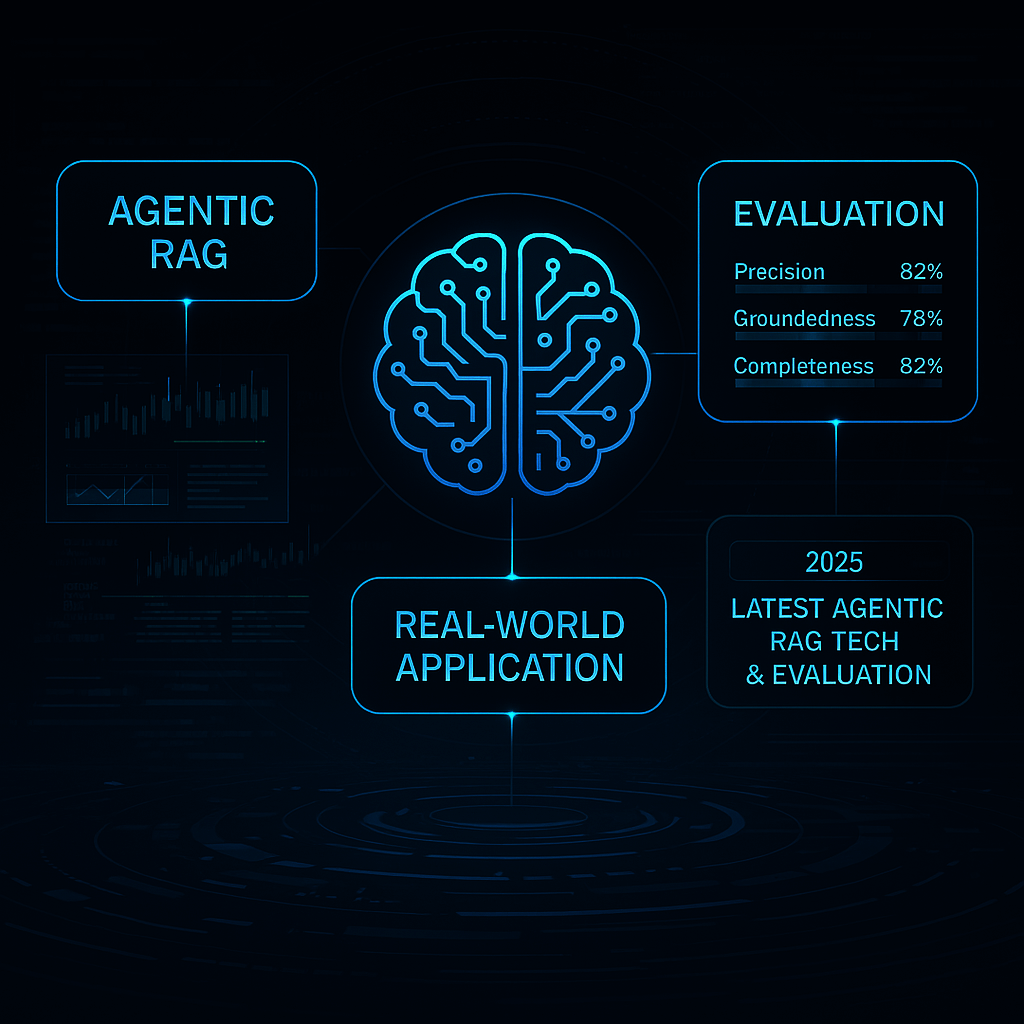
The Future of AI: The Dawn of a New RAG Era with Agentic RAG
By 2025, AI technology has reached levels beyond our wildest imagination. The evolution of Retrieval-Augmented Generation (RAG) technology, in particular, is advancing at a breathtaking pace. At the heart of this revolution lies an innovative approach called ‘Agentic RAG.’ This technology goes beyond mere information retrieval and generation—it demonstrates the ability to autonomously structure and solve complex problems.
The core of Agentic RAG lies in perpetually cycling through a ‘plan-search-refine-evaluate’ process. Through this, AI dissects problems like a seasoned expert, precisely finds necessary information, and derives optimal solutions.
For example, imagine a user requests, “Analyze this month’s budget expenditures.” The Agentic RAG system undergoes the following steps:
- Query analysis: Reformulates the query as “analyzing spending patterns based on bank statements.”
- Multistage search: Gathers information from diverse sources such as internal databases, financial APIs, and the user’s real-time transaction history.
- Result reordering: Uses advanced embedding models to select the most relevant information.
- Response generation: Crafts a detailed budget analysis report based on the collected data.
- Quality evaluation: Verifies the accuracy and completeness of the generated report and reruns the process if necessary.
Agentic RAG’s capabilities extend far beyond simple Q&A, enabling it to tackle complex tasks. For instance, Databricks has successfully leveraged this technology to automate highly technical work such as debugging SQL pipelines.
Furthermore, RAG technology is sparking innovation in education. With tools like NotebookLM, AI Studio, and LearnLM emerging, students now enjoy personalized learning experiences. These tools reference only trusted academic materials to minimize hallucination issues, delivering tailored answers to each student’s unique questions.
The evolution of Agentic RAG doesn’t stop here. Recently, it has integrated with computer vision technologies to enable image and video-based Q&A. It can now accurately answer intricate questions like, “Is the product in this photo included in this month’s budget?”
As of 2025, Agentic RAG is opening new horizons in AI. Its development—the ability to autonomously solve complex problems—promises to fundamentally transform how we live and work. It’s time to closely watch how far Agentic RAG will progress and the profound impact it will have on society.
The Cyclic Process of Agentic RAG: Repeating Planning, Searching, Refining, and Evaluating
Behind Agentic RAG lies a human-like cycle of planning, execution, review, and refinement. The secret to this technology’s game-changing prowess is not mere data retrieval, but a cascading, evolutionary decision-making method embodied in this repetitive process.
1. Planning Phase: Strategic Query Design
Agentic RAG doesn’t just accept the user’s question at face value; it devises an optimal search strategy. For example, when asked, "Which budget items exceeded this month’s limits?" it systematically:
- Identifies the budget data sources
- Determines how to search expenditure records
- Sets thresholds for what counts as exceeding the budget
Through such detailed planning, the RAG system performs searches more accurately and efficiently.
2. Searching Phase: Leveraging Multiple Sources
Following the plan, it gathers information from diverse data sources:
- Internal databases
- External APIs (e.g., real-time financial data)
- User-provided documents
Here, RAG transcends simple keyword matching by applying advanced search techniques that consider semantic similarities.
3. Refining Phase: Context Optimization
Collected data is never taken at face value. Agentic RAG refines information by:
- Assigning relevance scores that quantify each piece’s pertinence to the question
- Removing duplicates to reduce noise by consolidating similar information
- Chronologically ordering data to prioritize the most recent insights
This process ensures that only the most suitable context advances to the next stage.
4. Evaluation Phase: Quality Verification and Feedback
Generated responses aren’t immediately sent to the user. Agentic RAG evaluates them based on:
- Grounding: Is the answer supported by the provided information?
- Completeness: Does it cover all aspects of the query?
- Consistency: Is it free from internal contradictions?
If shortcomings are found, the system restarts the process from scratch—this time learning from previous results to craft an improved plan.
The Evolving RAG: Continuous Self-Improvement
This cyclic process is far from mere repetition. With each cycle, the RAG system:
- Learns successful search patterns
- Discovers effective refinement techniques
- Fine-tunes evaluation criteria
As a result, Agentic RAG evolves into a self-enhancing system that grows smarter the more it’s used. This is the real magic behind why RAG technology transcends simple search tools to become true artificial intelligence.
Missing Not a Single Line: The Complete Guide to RAG Evaluation Framework
Microsoft’s new RAG evaluation standard dreams of achieving the perfect balance between ‘accuracy’ and ‘comprehensiveness.’ What if AI had to retake the test if ‘groundedness’ isn't guaranteed? The rigor of evaluation pushes RAG to grow just an inch further.
The Three Core Metrics of RAG Evaluation
Microsoft Azure AI proposes three essential metrics to precisely measure the performance of RAG systems. These indicators meticulously evaluate each phase of RAG to ensure the overall quality of the system.
Document Relevance: Assesses how well the retrieved documents relate to the user's query. This is a crucial metric for measuring the accuracy of the first stage of RAG—the retrieval process.
Groundedness: Verifies that the generated response relies solely on the content of the retrieved documents. This key metric ensures the AI avoids ‘hallucinations’ and delivers only trustworthy information.
Response Completeness: Evaluates whether the generated answer contains all the necessary information to fully address the user’s question. This metric confirms that the RAG system provides comprehensive responses without omission.
Balancing Precision and Recall: Groundedness vs. Completeness
The most fascinating aspect of the RAG evaluation framework lies in balancing ‘groundedness’ and ‘completeness.’ These two metrics represent precision and recall, respectively.
Groundedness: Focuses on precision. It confirms that the response is generated using only the information found in the retrieved documents. For example, when asked about a financial report, it avoids including information not present in the report.
Completeness: Emphasizes recall. It ensures that all necessary information has been included to answer the user’s question fully. For instance, when requesting a list of all company departments, it checks that no departments are missing.
Striking the right balance between these two metrics is the critical challenge for RAG systems. Overly strict groundedness can lead to incomplete answers, while pursuing excessive completeness might increase the risk of including inaccurate information.
Practical Application of RAG Evaluation Tools
Microsoft provides specific tools that apply these evaluation standards:
- Document Retrieval & Retrieval: Document relevance assessment
- Groundedness & Groundedness Pro: Groundedness verification
- Response Completeness: Measuring response completeness
These tools analyze each step of the RAG system in detail, enabling precise diagnosis of weaknesses and targeted improvements.
The Future of RAG: Continuous Learning and Improvement
The ultimate goal of the RAG evaluation framework goes beyond mere performance measurement—it aims for ongoing system enhancement. If generated responses fail to meet groundedness or completeness criteria, the system automatically reruns the process. It’s as if the AI itself is retaking the exam.
Through this strict evaluation and iterative refinement, RAG systems will evolve into increasingly accurate and reliable providers of information. The evolution of RAG, which pursues both meticulous attention to every line of documents and comprehensive, perfect answers to user queries, will open new horizons in AI technology.
Databricks and RAG in Schools in Action: How AI is Transforming Work and Learning
From debugging complex SQL pipelines to providing personalized feedback for each student—the true power of Agentic RAG unfolds through Databricks’ real-world cases and educational applications like AI Studio and LearnLM. Just how far has this technology advanced?
Databricks’ RAG-based Workflow: Revolutionizing SQL Debugging
Databricks has dramatically enhanced the SQL pipeline debugging process by leveraging an Agentic RAG system. Here’s how it works:
- Document Retrieval: It swiftly searches for relevant SQL code, documentation, and log data based on the user's debugging requests.
- Context Filtering: Using sophisticated embedding models, it selects only the most pertinent information.
- Response Generation: The language model creates step-by-step debugging guides based on the curated information—for example, guiding users through “error log analysis → SQL query modification suggestions → test execution methods.”
- Evaluation Loop: The generated responses undergo automated verification for accuracy and completeness, with reprocessing if needed.
This approach drastically reduces the time required to solve complex data pipeline issues. Developers can now identify and fix errors faster and more precisely with the RAG system’s assistance.
The RAG Revolution in Education: AI Studio and LearnLM
Innovative tools leveraging RAG technology are also transforming education. Introduced at the CTRL AI session in June 2025, AI Studio and LearnLM are reshaping the learning paradigm:
Personalized Learning Experiences:
- AI Studio provides real-time, individualized feedback by retrieving relevant materials based on student questions.
- LearnLM dynamically adjusts content to match a student’s learning progress and style.
Highly Reliable Information Delivery:
- These tools minimize hallucinations by exclusively searching trusted academic papers and textbooks.
- Students gain access to verified information at all times.
Real-Time Learning Support:
- Teachers can instantly address diverse in-class questions using RAG technology.
- Students can request additional explanations or deeper learning resources anytime, expanding the depth and breadth of their education.
The Future of RAG: Breaking Down the Boundaries Between Work and Learning
The Databricks case and innovations in education demonstrate that RAG technology goes beyond mere information retrieval—it enables complex problem-solving and personalized learning. Going forward, RAG will evolve to:
- Cross-Domain Problem Solving: Combining knowledge from various fields to tackle complex challenges.
- Real-Time Knowledge Updates: Reflecting the latest research findings and industry trends to provide always up-to-date information.
- Collaboration Support: Optimizing individual roles and contributions in team projects or group learning settings.
RAG technology is now an indispensable core tool in both work environments and education. As more groundbreaking applications emerge, RAG is set to fundamentally transform how we work and learn.
Not Missing a Single Photo: The New Era of Multimodal RAG
Just like budget spreadsheets, photos and videos are now targets for RAG searches. Imagine a future where you can identify products in images and even determine whether they’ve been purchased—multimodal RAG is already making waves across healthcare, manufacturing, and daily life. How far will this evolution go?
The Fusion of RAG and Computer Vision
Multimodal RAG, proposed by Ultralytics, expands beyond text-based searches to analyze images and videos as well. This breakthrough opens new horizons for RAG technology, empowering it to process diverse data types in an integrated way.
How It Works: A 3-Step Process
- Image Analysis: State-of-the-art object detection models identify key elements within an image.
- Text Search: The RAG system retrieves relevant textual information related to the detected objects.
- Integrated Response: The system synthesizes the image analysis and text search results to generate a final answer.
Real-World Application Example
Take the question, “Is the product in this photo included in this month’s budget?”
- The system detects a specific product in the image, such as a laptop.
- It searches financial records for purchase details related to that product.
- It responds, “Yes, this laptop was purchased on June 10th and is included in this month’s budget.”
The Potential of Multimodal RAG
- Healthcare: Analyzing X-rays or MRIs linked with medical literature to support precise diagnoses.
- Manufacturing: Real-time monitoring of production line footage combined with quality control manuals to predict defects.
- Everyday Life: Offering personalized services like nutrition facts and recipe suggestions based on photos of food.
Future Outlook: Infinite Expansion of RAG
Multimodal RAG is not just about combining images and text anymore. The next frontier is ‘omnimodal RAG,’ which will integrate various data types including voice and sensor inputs. This marks a critical milestone where AI moves closer to human-like multisensory processing.
The advance of multimodal RAG promises to make our lives smarter and more efficient. Beyond simple text searches, we are on the brink of an AI era that truly understands and leverages all the visual information around us.
The Challenges and Promises of Agentic RAG: The Next Chapter in AI Innovation
Agentic RAG learns, evaluates, and improves itself. AI is no longer just a smart assistant—it’s becoming a partner in solving problems together. How do we navigate this transformation side by side?
Agentic RAG (Retrieval-Augmented Generation) is opening new horizons in AI technology. This groundbreaking approach surpasses the limitations of traditional RAG systems, offering smarter and more adaptive AI solutions. Yet, with this progress comes significant challenges—and immense opportunities.
Key Features of Agentic RAG
Self-Learning Capability: Agentic RAG continuously learns and improves from its interactions with users, meaning its responses become more accurate and personalized over time.
Solving Complex Queries: Beyond simple information retrieval, it tackles complex problems requiring multi-step reasoning and analysis—for example, analyzing corporate financial data to suggest long-term strategies.
Multi-Source Integration: By gathering and integrating information from diverse data sources, it provides more comprehensive answers—a vital asset for solving cross-domain issues.
Challenges Facing Agentic RAG
Ethical Considerations: As AI gains autonomy in decision-making, ethical guidelines become crucial. How can we prevent biased data or flawed judgments from causing negative outcomes?
Data Privacy: Greater data access raises privacy concerns. How do we secure user data while optimizing AI performance?
Explainability: It’s essential to make complex decision-making transparent and understandable for users. How can the ‘black box’ nature of Agentic RAG be made more transparent?
Future Outlook for Agentic RAG
Agentic RAG is poised to revolutionize multiple industries:
Healthcare: By comprehensively analyzing patient records, the latest research, and genetic information, it can craft personalized treatment plans.
Financial Services: It can offer tailored investment strategies based on complex market data and individual financial situations.
Education: It designs and dynamically adjusts personalized curricula according to each student’s learning style and pace.
Agentic RAG has the potential to fundamentally reshape human-AI collaboration. To harness its power effectively, technological innovation must be paired with social and ethical preparedness. How can we wield this potent tool to build a better future? The evolution of Agentic RAG continues—and we are part of this revolutionary journey.
Comments
Post a Comment