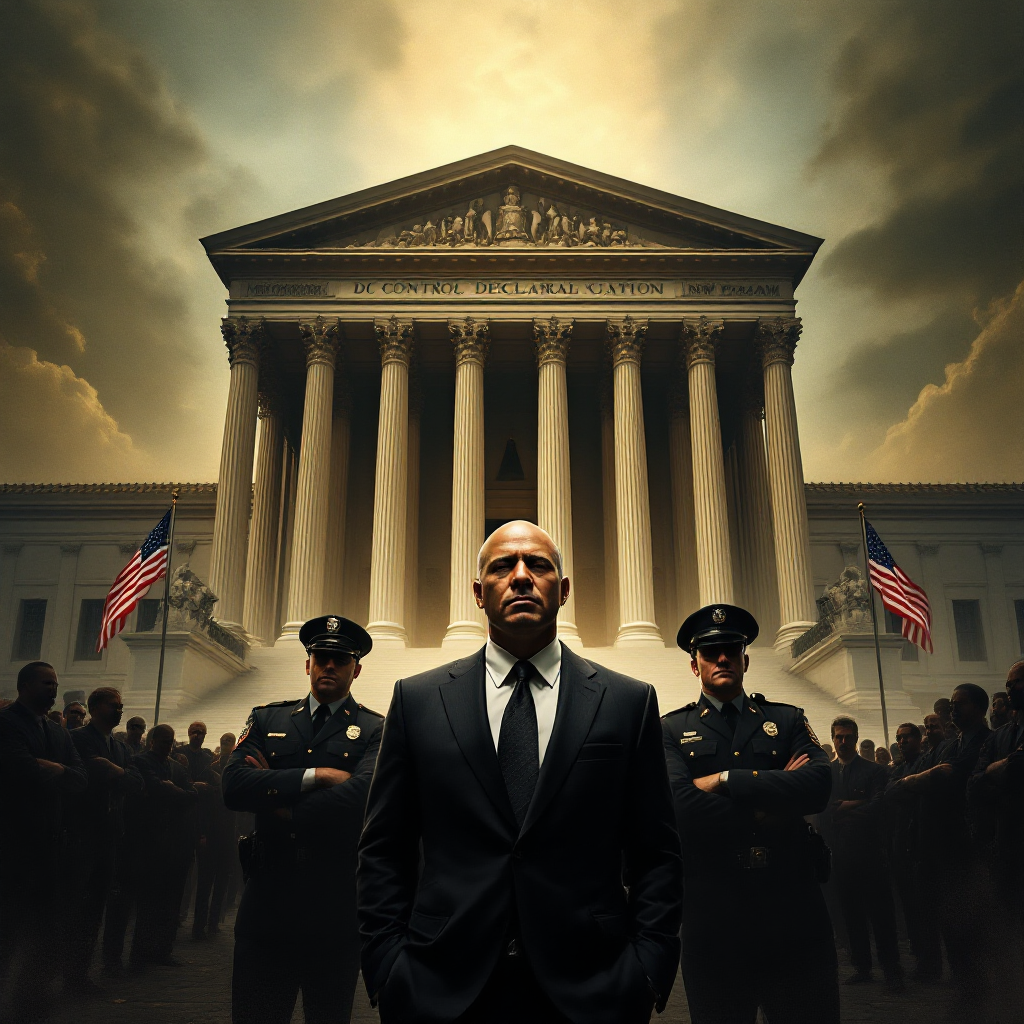
Trump's Declaration of Federal Control Over Washington D.C.: A Major Turning Point in American Politics?
In August 2025, shocking news rocked the American political landscape. Former President Donald Trump declared direct federal control over Washington D.C.'s police force and National Guard. This sudden move sent shockwaves across the nation, signaling the dawn of profound political upheaval.
Trump justified the action as "DC's Day of Liberation," yet many view it as a dangerous precedent that infringes upon D.C.'s autonomy. Given that Washington D.C. has a predominantly Black population, suspicions have also arisen that racial motives may underlie this decision.
The key points of this declaration are as follows:
- Federal takeover of the D.C. Metropolitan Police Department
- Deployment of the National Guard to maintain security within D.C.
- Implementation of forced evictions targeting the homeless population
Trump’s camp cited rising crime rates and a public safety crisis in D.C. as justification, but opponents have condemned it as a "21st-century Jim Crow law."
This crisis goes beyond a mere administrative maneuver—it threatens to shake the foundations of American federalism, racial issues, and the ongoing debate over D.C.'s statehood. As the world watches closely, many wonder whether Trump’s "reclamation of DC" will mark a new watershed moment in U.S. political history.
The Complex Constitutional Status and Autonomy Debate of Washington D.C.: A Capital City of 700,000 Residents Without Voting Rights
Washington D.C. is the capital of the United States and the heart of American politics. Yet, despite being a large city with a population exceeding 700,000, D.C. residents find themselves in a unique situation where they have no voting representation in the federal Congress. This stems from the distinctive structure and historical background of the U.S. Constitution and lies at the core of ongoing debates surrounding the district.
The Constitutional Status of D.C.: A Federal Territory
According to Article I, Section 8 of the U.S. Constitution, Washington D.C. is designated as a federal district under direct federal government jurisdiction. This means D.C. is not part of any state and is governed directly by the federal government. Because of this special status, D.C. residents cannot elect senators or representatives, leaving them effectively unrepresented in Congress.
The Home Rule Act and Limited Autonomy
The Home Rule Act, enacted in 1973, granted D.C. limited self-governance. Under this law, D.C. can elect its own mayor and city council. However, Congress retains the authority to approve or reject the district’s budget and laws. Especially notable is Section 740 of the Home Rule Act, which grants the federal government the power to directly control D.C. in emergencies—an authority that sparked controversy recently, exemplified by actions taken during the Trump administration.
"Taxation Without Representation": A Modern Colony?
D.C. residents criticize their situation as "taxation without representation," paying federal taxes yet lacking a vote in Congress. This phrase echoes the slogan that fueled American colonial resistance against British rule and leads some to view D.C. as a modern-day “federal colony.”
The Push for D.C. Statehood: A Solution?
To resolve these issues, movements advocating for D.C. statehood have gained momentum. The proposal is to elevate D.C. to the 51st state, granting it full congressional representation. However, the matter is highly political, sparking fierce partisan battles between Republicans and Democrats.
Conclusion: An Unresolved Dilemma of American Democracy
The unique status and autonomy issues of Washington D.C. reveal a fundamental dilemma in American democracy. The fact that over 700,000 citizens lack full political representation clashes with the democratic ideal of equal citizenship. How this problem will be resolved and how it will reshape America’s political landscape remains a crucial story to watch.
Is it Strengthening DC Security or Racial Discrimination? A Sharp Divide Between the Camps
Since Trump's announcement to take control of Washington DC, the two sides have been fiercely clashing. Trump's camp emphasizes a security crisis, citing a 25% rise in homicides and plans to evict homeless people, while the opposition condemns it as racial oppression. Which side’s claim is closer to the truth?
Trump Camp’s "Security Crisis" Argument
Highlighting Crime Statistics: Declared a "public safety emergency," pointing to a 25% increase in homicides and an 18% rise in robberies in DC during the first half of 2025.
Addressing the Homeless Issue: Plans "orderly eviction with federal support," arguing that homeless communities downtown threaten public safety.
Emphasizing Bipartisan Approach: Interior Secretary Doug Burgum stated, "Cleaning up DC crime isn’t a partisan issue," challenging Democratic claims of crime reduction.
Opposition’s "Racial Oppression" Criticism
Allegations of Racial Discrimination: DC residents’ group 'Free DC' labeled the move a "racial attack on Black neighborhoods," organizing large-scale protests.
Pointing Out Trump’s Racial Motives: Remarks like "He hates that DC is a Black city" sparked controversy, linking Mayor Bowser’s conflict to racial issues.
Raising Constitutional Concerns: Argued that "Stripping DC residents’ voting rights is a 21st-century Jim Crow law," questioning the constitutionality of federal control without Congressional approval.
Evaluating the Truthfulness of Both Claims
Context of Crime Statistics: While there is a short-term rise in crime, long-term trends and comparisons with other cities require analysis.
Dual Nature of Homelessness Policy: Balancing public safety improvements with a humanitarian approach is crucial.
Complexity of Racial Factors: Careful consideration of DC’s demographic makeup and historical context is needed.
Political Motive Analysis: Political calculations ahead of the 2026 midterm elections cannot be ruled out.
The controversy surrounding the DC control measure reveals deep fractures in American society beyond mere security concerns. It’s time to objectively scrutinize both sides’ claims and adopt a balanced approach to genuinely improve the quality of life for DC residents.
Cases of Federal Control over Washington DC in History, and the Significance of the Current Measure
Federal intervention in Washington DC has historically been at the heart of controversy. From the Clinton administration in the 1990s to the George Floyd protests in 2020, DC control has repeatedly sparked political turmoil and social conflict. So how does Trump’s current measure differ from those in the past?
1990s: Financial Crisis and the Control Board
- In 1995, faced with a severe financial crisis in DC, the Clinton administration established a ‘Control Board’
- Federal oversight of DC’s finances was implemented for eight years
- Outcome: financial stabilization was achieved, but controversies over infringement on DC residents’ self-governance persisted
2013: Obama Administration Nullifies Marijuana Legalization
- The federal government nullified DC’s marijuana legalization law
- A law passed by resident vote was overridden by congressional power
- This raised fundamental questions about DC’s autonomy
2020: George Floyd Protests and National Guard Deployment
- President Trump deployed the National Guard despite opposition from the DC mayor
- Constitutional debates over federal military involvement in domestic security intensified
- Marked a symbolic event of racial conflict and political confrontation
Present 2025: Trump’s Declaration of ‘DC Control’
This current measure shows several key differences compared to past cases:
- Comprehensive Control: Direct oversight of the police department combined with National Guard deployment simultaneously
- Long-term Plan: An attempt to alter the very governance structure of DC, going beyond mere ‘restoration of security’
- Political Context: A bold move based on a strengthened power base following re-election
Because of these differences, this DC control cannot be seen simply as a ‘security enhancement’ but rather as a critical event that could shake the foundation of American federalism. It is a pivotal moment to watch how the balance between DC residents’ autonomy and federal authority will be redefined—and what impact this will have on the future of US politics.
What Does the Future Hold? Legal Battles, Political Turmoil, and Social Clashes Surrounding DC
Trump’s move to take control of DC is expected to send shockwaves through American politics and society. Let’s explore the unfolding situation from three key perspectives.
1. Prolonged Legal Battles
The DC government is highly likely to challenge the constitutionality of this move in federal court. Major issues will include:
- The scope of interpretation of Section 740 of the Home Rule Act
- The legality of assigning the National Guard law enforcement duties
- Whether the autonomy of DC residents has been infringed upon
This litigation could last for months, potentially stretching over a year if it reaches the Supreme Court. Meanwhile, DC’s legal status will remain uncertain.
2. Political Upheaval Ahead of the 2026 Midterms
The DC control controversy is poised to become a central issue in the 2026 midterm elections.
- Democrats: Will reignite the push for DC statehood to mobilize voters
- Republicans: Will advocate for stronger urban law enforcement and expanded federal authority, rallying their conservative base
This conflict threatens to expand beyond a mere DC issue, touching on fundamental questions regarding the balance of power between federal and state governments and minority rights in American politics.
3. Escalating Social Conflicts
The control move is intertwined with racial issues and could ignite nationwide social unrest.
- Revival of the "Black Lives Matter" movement: Considering DC’s majority Black population, this action may be labeled as a racially discriminatory policy, triggering large-scale protests
- Conservative response: Demonstrations supporting law and order and crime prevention are expected
Such clashes could spread beyond DC to other major cities, further deepening social divisions across America.
Conclusion: The Fate of DC, The Future of America
Trump’s DC control measure is more than a mere administrative order—it challenges the entire political, legal, and social framework of the United States. The developments ahead will serve as a crucial test not only for DC but for the future of American democracy itself. We must recognize that this crisis goes beyond “urban control” to embody the fundamental challenges the U.S. faces in the 21st century.
Comments
Post a Comment