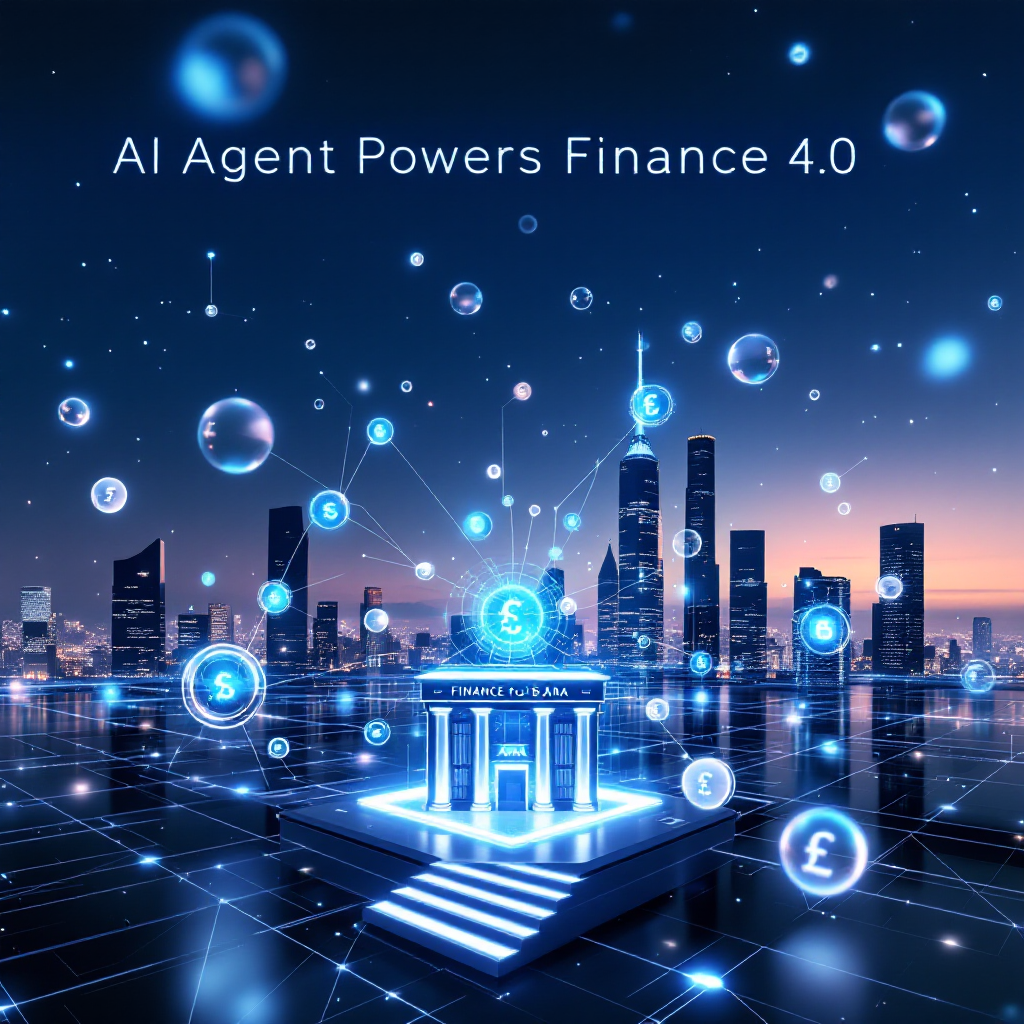
The Financial Landscape Transformed by AI Agents: Are You Ready?
A revolutionary wind is blowing through the financial industry. An era is approaching where AI agents negotiate and transact with each other without human intervention. Is such a future truly possible? The latest report from Samil PwC offers a startling answer to this question.
A2A Economy: A New Financial Ecosystem Led by AI Agents
The Samil PwC report titled "The Financial Frontline Transformed by AI, The Future of AI Agent Finance" introduces the groundbreaking concept of the 'A2A (Agent-to-Agent) Economy.' This represents an economic structure where AI agents autonomously make decisions and execute actions. Imagine your personal AI assistant directly negotiating with AI agents from other financial institutions to find the optimal financial products for you.
How AI Agents Actually Operate: The Future of Financial Transactions
- A client requests their AI agent to search for financial products.
- The AI agent analyzes the client’s financial status and goals.
- It connects in real-time with multiple financial institutions’ AI agents to exchange information.
- It automatically negotiates to secure the best terms.
- Once an agreement is reached, the transaction is executed automatically through smart contracts.
All of this happens without any direct human involvement. Isn’t that incredible?
New Challenges for Financial Institutions: The API-First Strategy
How must financial institutions transform to survive in the A2A economy? The report stresses the importance of an API-first strategy. Financial products and services must be provided in ways that AI agents can easily understand and utilize. This goes beyond simply adopting new technology—it demands a redesign of the very business model.
A $19 Trillion Opportunity—and Risk
The A2A economy is predicted to trigger a $19 trillion value redistribution worldwide. This presents both tremendous opportunity and significant risk. Financial institutions unable to adapt in the age of AI agents may be left behind in the market. Conversely, those leading this change could become cornerstone players in the new financial ecosystem.
The future of finance is already at our doorstep. Are you and your company prepared for this new economic system led by AI agents? Now is the time to reassess our strategies and begin preparing for the future.
What Is the A2A Economy? The Heart of Technology Where AI Agents Reshape Finance
The future of finance is rapidly approaching. The Agent-to-Agent (A2A) economy—an economy powered by AI agents—is ready to completely transform the paradigm of financial decision-making. Let’s delve into how this revolutionary concept works and how it will reshape our financial lives.
The Core Mechanics of the A2A Economy
At the foundation of the A2A economy lies the autonomous interaction of AI agents. Within this system, AI agents collaborate, negotiate, and make decisions without human intervention. But how does this process actually unfold?
Analyzing Customer Requirements:
- A personal AI agent comprehensively examines the customer’s financial status, goals, and risk tolerance.
- This analysis extracts accurate data while safeguarding the customer’s privacy.
Exploring Financial Products:
- The personal AI agent connects in real-time with AI agents from various financial institutions.
- Through APIs, it requests detailed information on financial products and performs comparative analysis.
Automated Negotiations:
- AI agents negotiate with one another to derive optimal conditions tailored to the customer.
- Complex algorithms and machine learning models power these negotiations.
Smart Contract Execution:
- Upon completing negotiations, blockchain-based smart contracts are automatically created.
- Once conditions are met, follow-up procedures like fund transfers are executed automatically.
The Financial Revolution Brought by the A2A Economy
The A2A economy goes beyond mere process automation—it reshapes the very structure of the financial industry:
Customer-Centric Services:
- AI agents work tirelessly 24/7 to serve the customer’s best interests.
- Decision-making becomes free from human bias or conflicting interests.
Hyper-Personalized Financial Solutions:
- Financial products can be customized to fit each customer’s unique circumstances.
- Instant responses to shifting market conditions become possible.
Increased Transparency and Efficiency:
- Every transaction between AI agents is recorded and traceable.
- Direct dealings without intermediaries reduce costs and accelerate processing speeds.
Formation of a New Financial Ecosystem:
- Traditional financial institutions will see their roles evolve, and new types of financial service providers will emerge.
- The API economy will flourish, accelerating the modularization and recombination of financial services.
Challenges in the Era of the A2A Economy
Amidst these revolutionary changes, financial institutions face new challenges:
Building API-Based Infrastructure:
- Establishing a robust technical foundation to provide all financial services via APIs is essential.
- Real-time data processing and strengthened security are critical priorities.
Addressing AI Ethics and Regulation:
- Ensuring transparency and explainability in AI decision-making processes is paramount.
- Collaborations with regulators to develop new regulatory frameworks are necessary.
Talent Development and Organizational Culture Shift:
- Rapidly securing talent capable of collaborating with AI is urgent.
- Re-educating existing employees and cultivating an AI-friendly organizational culture are required.
The A2A economy is not just a technological innovation but a paradigm shift redefining the essence of finance. Only the companies that adapt and lead in this new era will command the future financial landscape. We are witnessing a historic moment as a new chapter in finance unfolds before our eyes.
Crisis and Opportunity Facing the Financial Industry: A Radical Shift to AI Agent-Driven Competitive Structures
The financial industry stands at a monumental crossroads of transformation. With the rise of the AI Agent economy, traditional financial systems are being shaken to their very core. This marks not only a crisis but also the dawn of a new era full of unprecedented opportunities.
The Financial Ecosystem Reshaped by AI Agents
A striking forecast from Samil PwC reveals a future where an A2A (Agent-to-Agent) economy—where AI Agents communicate and transact with each other—becomes reality. In this emerging landscape, financial institutions will lose direct contact with customers. Instead, AI Agents will discern customers’ needs, identify the optimal financial products, and finalize contracts, establishing a brand-new operational model.
API-Centric Service Competition: The Key to Survival
In this whirlwind of change, financial firms must completely overhaul their survival strategies. Brand recognition and branch networks will no longer be the core of competitiveness. Rather, the decisive factor will be how efficiently they can engage with AI Agents through APIs.
The Crucial Role of an API-First Strategy: Every financial product and service must be offered in API form. This becomes the foundation enabling AI Agents to compare and select products in real time.
Structured and Real-Time Data: Systems must structure data in formats AI Agents can easily interpret and process, coupled with real-time updates to maintain relevance.
Agent-Friendly Interfaces: Beyond simply providing APIs, creating environments where AI Agents can operate efficiently is essential. This includes offering metadata and automated negotiation protocols.
Stark Warning: Failure to Adapt Means Obsolescence
The report warns that financial institutions failing to adapt in the AI Agent era risk relegation to the status of ‘B-Players.’ This is not merely a question of adopting technology; it demands a comprehensive transformation—from the organization’s DNA and business model to how relationships with customers are defined.
Opportunity: A $19 Trillion Value Redistribution
Yet within this crisis lies a massive opportunity. According to Lsvp’s analysis, the AI Agent economy is poised to trigger a global value redistribution worth $19 trillion. Financial firms that respond proactively will dominate emerging markets and earn unparalleled customer trust through innovative services.
The financial industry now stands at a historic turning point. To survive in this AI Agent-powered economic regime, it must boldly discard old mindsets and embrace groundbreaking change. This juncture is both a crisis and an unrivaled chance. Only those who adapt swiftly will emerge victorious in the age of AI Agents.
Global Innovation and Financial Institutions' Strategies: Challenges Posed by Microsoft Agent Mode and AI Foundry
Leading global tech companies are unveiling AI agent platforms, presenting new challenges to the financial industry. In particular, Microsoft’s recent announcement offers crucial implications for financial institutions.
Microsoft’s Groundbreaking AI Agent Technology
On September 29, 2025, Microsoft introduced the 'Agent Mode' for Microsoft 365 Copilot. This feature delivers a powerful AI agent that automates document creation, analysis, and collaboration within Office apps. Additionally, with the launch of Azure AI Foundry, Microsoft provides an integrated platform for enterprises to build their own AI agents.
Microsoft defines AI agents with three core components:
- Model (LLM)
- Instructions
- Tools
This framework ensures that AI agents can perform specific roles while operating in a safe, observable, and controllable environment.
Essential Strategic Responses for Financial Institutions
In response to innovations from tech giants like Microsoft, financial institutions must adopt these three core strategies:
Establish an API-first Strategy
- Break down financial products into functional units and convert them into APIs
- Build real-time data update systems
- Offer interfaces that AI agents can easily access and utilize
Develop Agent-friendly Interfaces
- Design data structures that AI agents can easily understand and process
- Provide detailed metadata supporting automated product comparisons
- Design APIs considering interactions between multiple agents
Prevent Platform Dependency
- Secure multi-agent compatibility that is not reliant on specific platforms like Microsoft or Google
- Build and operate proprietary AI agent ecosystems
- Enhance interoperability through adoption of open standards and protocols
By implementing these strategies, financial institutions can proactively respond to the AI agent era and unlock new business opportunities. The API-first strategy, in particular, will emerge as a key competitive advantage in the Agent-to-Agent (A2A) economy.
The Future of Financial Institutions: An Agent-centered Ecosystem
Financial institutions must go beyond simply adopting AI technology—they need to redesign their collaboration frameworks around AI agents. This requires a comprehensive transformation not only in technology but also in organizational culture, business models, and strategic mindsets.
The next 1-2 years will be a critical period for establishing the A2A economic system. During this time, financial institutions should build AI agent testing environments, overhaul their data strategies, and expand strategic partnerships with leading tech companies and innovative startups.
The AI agent era is both a challenge and an opportunity for financial institutions. Only those who swiftly adapt to this change and lead innovation will emerge as the winners of the future.
The Dawn of the AI Agent Era: New Roles as Economic Actors and Our Future
The rapid advancement of AI agent technology is fundamentally transforming our economy and society. Notably, the latest report from Samil PwC introduces the concept of an 'A2A (Agent-to-Agent) economy,' clearly illustrating how AI agents are evolving from mere tools to autonomous economic actors.
A $19 Trillion Value Shift
According to analysis by Lsvp, the AI agent economy is expected to trigger an astonishing global value redistribution worth $19 trillion. This signifies a revolution not only in technology but in the very structure of the economy. AI agents will play critical roles across all industries, including finance, retail, and manufacturing.
Redefining the Human Role
The rise of AI agents inevitably demands a fundamental reassessment of humanity’s role. As experts say, “Just as human existence has been defined by 'usefulness,' in the AI agent era, the human role will be redefined.” We must explore new domains where we can coexist with AI and create unique value together.
Strategies for Preparing the Future
Enhancing AI Literacy: We must understand how AI agents operate and their limitations, developing skills to utilize them effectively.
Fostering Creativity and Emotional Intelligence: Focus should be placed on strengthening uniquely human abilities that AI can scarcely replicate.
Strengthening Ethical Judgment: The ability to oversee AI agents’ decision-making processes and provide ethical guidance will become increasingly vital.
Establishing Lifelong Learning Systems: Continuous education and reskilling are essential to adapt to the rapidly evolving technological landscape.
Conclusion: A Future of Coexistence and Collaboration
The advent of the AI agent era is not a cause for fear but a gateway to new opportunities. By leveraging the unique strengths of both humans and AI agents in partnership, we can achieve innovations and progress previously unimaginable.
What matters most is not passively reacting to these changes but actively preparing and leading. The future we build alongside AI agents depends entirely on the choices we make today.
Comments
Post a Comment