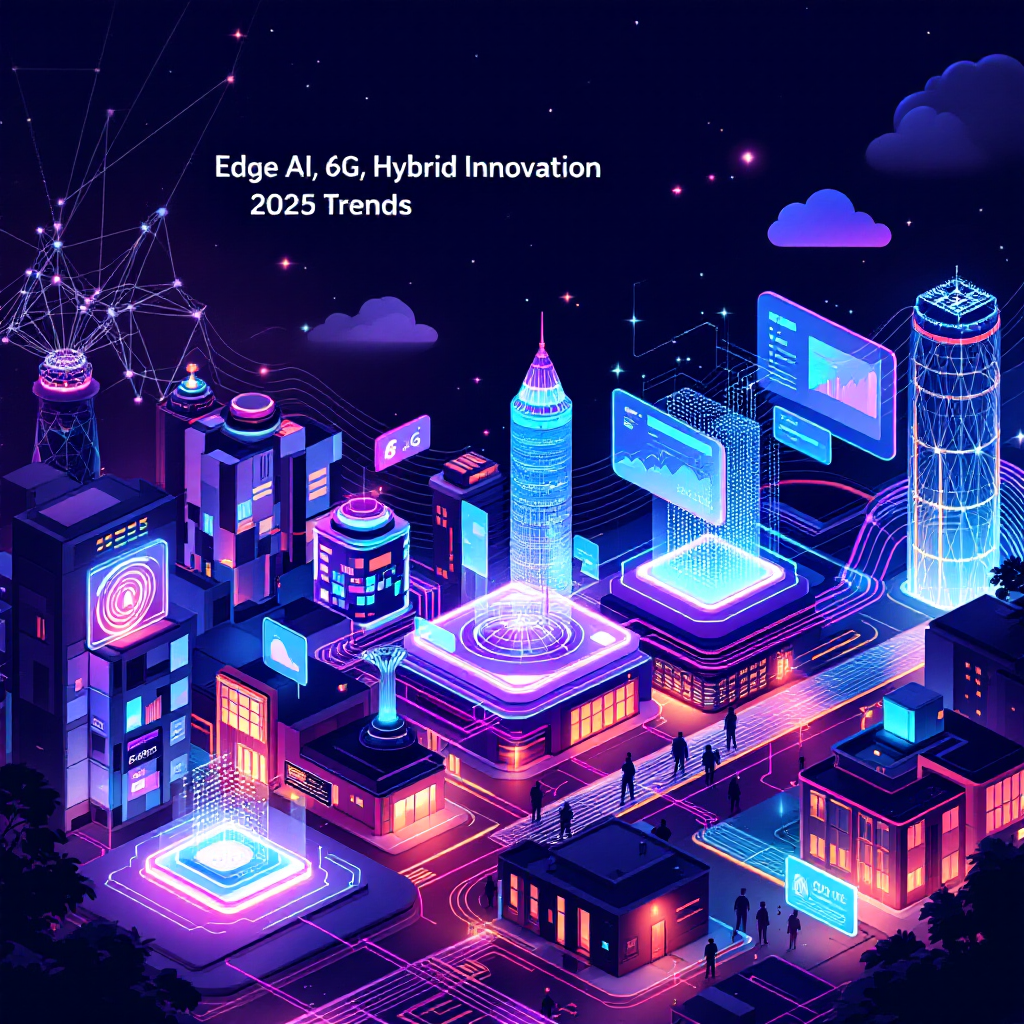
The Edge AI Revolution: Why Are Cloud and Edge Joining Forces?
The era of cloud and edge rivalry is over! Let’s explore how hybrid AI architectures are unlocking the next wave of innovation.
In September 2025, Qualcomm’s report, "The Edge's Essential Role in the Future of AI," unveiled a groundbreaking new paradigm in Edge AI. The key? Collaboration between cloud and edge. But why is this shift happening now?
The Synergy Between Cloud and Edge
Edge AI is no longer a mere alternative to the cloud. Instead, cloud and edge are leveraging their unique strengths to form an unbeatable partnership. The cloud handles complex model training and massive data processing, while the edge takes charge of real-time inference and sensitive data management. This division of labor dramatically boosts the overall performance and efficiency of AI systems.
The Revolutionary Impact of 6G
Launching commercially in 2026, 6G technology will catapult Edge AI to new heights. More than just faster communications, 6G is designed as an AI-native architecture that enables seamless data flow and cooperation between edge devices and the cloud. Ultra-low latency under 1 millisecond, ultra-high reliability, and exceptional energy efficiency will revolutionize real-time AI applications.
User-Centric Intelligent Experiences
Edge AI’s evolution is sparking a revolution in user experience, far beyond mere technical upgrades. Edge devices can now understand users’ context, nuances, and behavioral patterns in real time, enabling predictive actions. For example, a smartphone can learn daily routines to optimize battery life or monitor health indicators to detect early warning signs — delivering highly personalized services like never before.
Challenges and Future Outlook
Challenges remain in advancing Edge AI: limited computing power and memory of edge devices, energy efficiency, model slimming, and enhanced security are prime concerns. Yet these obstacles fuel innovation. Techniques like quantization and pruning, federated learning, and hardware-software co-design are actively overcoming these barriers.
Edge AI is no longer a technology of the future. Even now, it’s driving breakthroughs in everyday life and across industries. The collaboration of cloud and edge, integration with 6G, and creation of user-centric intelligent experiences—this is the essence of the great transformation Edge AI will bring. We are witnessing the dawn of a new AI era.
The Convergence of 6G and Edge AI: The Perfect Harmony of Future Networks
6G technology is evolving beyond merely enhancing communication speeds into an AI-native network. Serving as the crucial link between edge AI and the cloud, it will unlock revolutionary services and applications beyond our imagination. So, what does the future shaped by the synergy of 6G and edge AI look like?
AI-Native 6G: A New Horizon for Edge AI
From the ground up, 6G networks adopt an AI-native architecture, embedding AI capabilities directly into their design. This means the network itself possesses AI processing power, optimizing data flows between edge devices and the cloud. Edge AI applications, built on this infrastructure, will operate with greater strength and efficiency than ever before.
Ultra-Low Latency and Edge AI Synergy
6G technology achieves ultra-low latency communication below 1 millisecond. This is pivotal for edge AI to make complex real-time decisions. Imagine autonomous vehicles instantly perceiving road conditions and responding immediately or remote surgical robots flawlessly mimicking a doctor’s movements without delay—these capabilities become a reality.
A Leap Forward in Energy Efficiency
6G networks also make significant strides in energy efficiency, crucial for edge AI devices where battery life is paramount. By optimizing the network’s own energy consumption and employing AI-driven dynamic power management, the operating time of edge devices can be dramatically extended.
Realizing Context-Aware Intelligence
The fusion of 6G and edge AI enables ‘context-aware intelligence’ that perfectly understands surrounding environments. The network can analyze user location, activities, and preferences in real-time to deliver optimized services. This breakthrough fosters innovative applications in personalized healthcare, smart city services, augmented reality experiences, and more.
Accelerating Distributed Learning
Thanks to 6G’s high-speed, ultra-low latency features, cooperative learning among edge AI devices becomes more effective. Distributed AI learning methods like federated learning can proceed faster and more efficiently, paving the way to continuously improve AI models while safeguarding data privacy.
The combination of 6G and edge AI promises more than just technical progress—it heralds revolutionary changes across daily life and industries. On this journey toward an era of hyper-connectivity and hyper-intelligence, we will confront a world of new possibilities beyond imagination. Let us eagerly anticipate the thrilling future of the edge AI revolution in the 6G era and watch how it transforms our lives.
Real-World Transformations Driven by Innovative Edge AI Solutions
From Qualcomm’s latest chipsets to ultra-lightweight military computers and groundbreaking energy-saving object detection—witness firsthand how Edge AI is being applied in real life to maximize performance.
1. Qualcomm’s Snapdragon 8 Elite: The Pocket-Sized Edge AI Powerhouse
Qualcomm’s Snapdragon 8 Elite epitomizes the future of Edge AI. This cutting-edge chipset focuses not just on benchmark scores but on AI efficiency in real-world environments.
- Real-time language translation: High-quality translations without any network connection
- Personalized recommendation systems: Learns user behavior patterns to deliver tailored content
- Enhanced camera features: AI-powered image processing enabling professional-level photography
As Qualcomm’s CEO Armon puts it, “The goal is to have AI understand users closest to them—right on their handheld devices.” This vision defines Qualcomm’s approach to Edge AI.
2. Neousys’ FLYC-300: Ultra-Lightweight Edge AI Computer Built for Extreme Conditions
Unveiled at ADEX 2025, Neousys’ FLYC-300 AI mission computer pushes the boundaries of Edge AI innovation.
- Powered by NVIDIA® Jetson Orin™ NX: Delivering an astonishing AI performance up to 100 TOPS
- Ultra-lightweight design at 297 grams: Perfectly optimized for weight-sensitive environments like drones and military gear
- MIL-STD-461 compliance: Reliable AI inference even under the harshest conditions
In real military operations, the FLYC-300 is employed for real-time video analysis, instantly detecting and responding to threats. This stands as a clear testament to Edge AI’s crucial role in defense sectors.
3. EdgeNavMamba: Setting a New Standard in Energy Efficiency for Edge AI
Built on the Mamba architecture, EdgeNavMamba is an optimized object detection model that makes a significant leap in solving Edge AI’s energy efficiency challenges.
- Over 30% energy savings compared to existing Transformer models
- 20% faster processing speed enabling real-time object recognition
- Tailored design for IoT sensor networks and mobile robots
The research team anticipates, “This technology will drastically extend battery life for smart city infrastructures and autonomous driving systems.” With EdgeNavMamba’s debut, the practicality and sustainability of Edge AI technology are set to soar.
These groundbreaking Edge AI solutions do more than advance technology—they are genuinely transforming our daily lives and industrial landscapes. As Edge AI continues to evolve, new possibilities beyond our imagination will continuously emerge.
Technical Mountains to Overcome in the Booming Edge AI Market
The Edge AI market is exploding with growth. By 2025, the global Edge AI market size is projected to reach an astonishing $25 billion—an impressive 45% increase compared to 2023. However, behind this monumental growth lie critical technical challenges that must be conquered.
The Battle Against Limited Hardware Resources
The biggest hurdle for Edge AI is the inherently limited hardware resources. Edge devices are naturally small and designed to operate in low-power environments. This translates to constrained computing power and memory. Running complex AI models in such conditions is no easy feat.
A promising solution is "model compression." Techniques like Quantization and Pruning drastically reduce model size and computational complexity. This allows AI models to be optimized for edge environments while maintaining accuracy.
Energy Efficiency: The Achilles’ Heel of Edge AI
Another major challenge for Edge AI devices is energy efficiency. AI models need to run continuously on IoT sensors operating 24/7 or mobile devices powered by batteries, making power consumption optimization absolutely essential.
The answer lies in the "Hardware-Software Co-design" approach. By jointly optimizing AI chips and software, energy efficiency can be maximized. For instance, Qualcomm’s Snapdragon 8 Elite chipset has significantly boosted AI efficiency in real-world usage through this strategy.
Strengthening Security: A New Challenge in Distributed Environments
Edge AI inherently involves a distributed architecture, making it potentially more vulnerable to security threats compared to centralized cloud environments. Data security becomes paramount, especially when handling sensitive personal information.
The rising star solution here is "Federated Learning." This technology enables distributed training on each edge device without sending data to a central server, safeguarding data privacy while enhancing AI model performance.
Edge AI technology undoubtedly holds revolutionary potential. However, the success or failure of this transformative field hinges on how effectively these technical obstacles are overcome. The future of technological progress and the new possibilities Edge AI will unlock are eagerly awaited.
The Future Has Already Begun: The Era of Self-Evolving and Collaborative Edge AI
By 2026, we will witness a revolutionary evolution in Edge AI technology. While the current technology has already reached astonishing levels, the future that lies ahead is truly beyond imagination. AI that learns and improves on its own, a world where multiple devices collaborate like a single organism, and the AI-native 6G networks that make all this possible — this is the future of Edge AI we are about to face.
AI-Native 6G: The Perfect Platform for Edge AI
6G networks will evolve beyond mere communication technology into the optimal infrastructure for AI. With ultra-low latency, ultra-high speed, and ultra-connected characteristics, 6G will dramatically enhance the performance of Edge AI applications. For example, autonomous vehicles will analyze every road situation in real time and make immediate decisions, while sensors in smart cities will collect and analyze data with greater precision to proactively solve urban challenges.
Self-Evolving Edge AI: Continuous Learning and Adaptation
Future Edge AI systems will possess the ability to continuously improve themselves through ongoing learning — much like how the human brain constantly develops through new experiences. For instance, smart home systems will learn residents’ lifestyle patterns to deliver increasingly accurate predictions and optimized services. This self-evolving capability will significantly reduce maintenance costs of Edge AI systems and continuously enhance user experience.
Collaborative Edge AI: The Power of Collective Intelligence
Beyond the limits of individual devices, multiple Edge AI devices will collaborate to solve more complex problems. This is akin to an army of ants cooperating to accomplish massive tasks. For example, in a smart factory, various robots and sensors will share information and work together to maximize production line efficiency, or in disaster zones, a swarm of drones will coordinate to perform rapid and effective rescue operations.
Sustainable Edge AI: Leading the Way in Eco-Friendly Technology
Energy efficiency is a key challenge in advancing Edge AI. After 2026, Edge AI technology will develop in increasingly eco-friendly and sustainable ways. For instance, ultra-low-power Edge AI sensors powered by solar energy or even human body heat will emerge, and AI algorithms themselves will be optimized to minimize energy consumption. This will dramatically extend battery life for IoT devices and significantly reduce the power consumption of data centers.
The future of Edge AI holds the potential not only for technological progress but for fundamentally transforming how we live and how society is structured. Edge AI will play a central role in creating a smarter, more efficient, and more sustainable world. We already stand at the threshold of that future. Are you ready? Let’s embrace the astonishing future that Edge AI will create — together.
Comments
Post a Comment