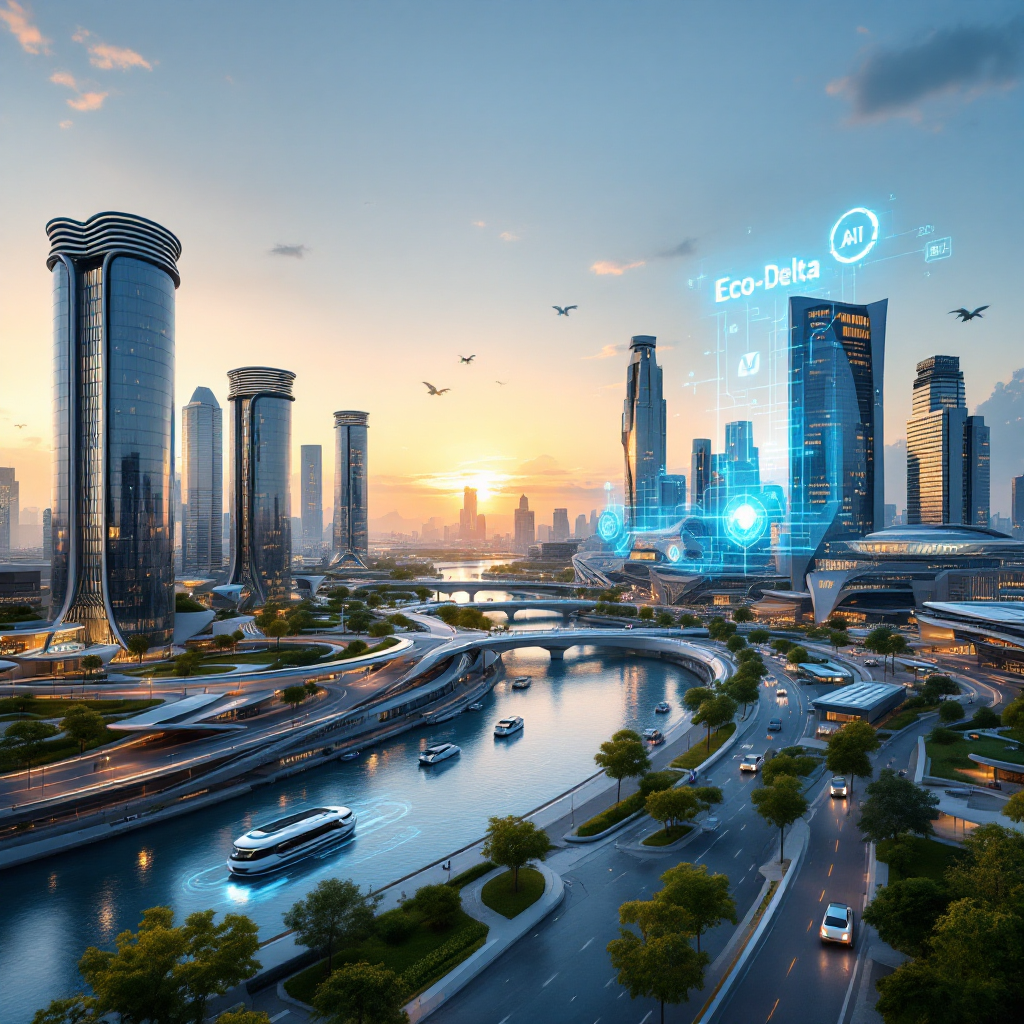
Busan Eco Delta Smart City: The Dawn of Future Urban Innovation
In November 2025, the Busan Eco Delta Smart City—where robots and AI converge—began transforming the future of daily life into reality. What revolutionary changes will this innovative city bring to our lives?
IoT Technology Connects an Entire City as One
The full-scale launch of Busan Eco Delta Smart City represents more than a mere technology demonstration. Here, IoT technology is seamlessly integrated across the entire urban infrastructure, marking the first complete realization of a futuristic smart city genuinely working in citizens’ everyday lives.
Traditional cities have operated their electrical, water, and transportation systems independently. But Eco Delta breaks down these boundaries. Through IoT sensors and communication technologies, every system across the city is connected like one nervous network, exchanging real-time data and delivering optimized services.
Smart City Experiences Embedded in Daily Life
The changes citizens experience in Eco Delta are tangible and profound. When you wake up in the morning, lighting automatically adjusts gently to your personal biological rhythm; the moment you step outside, smart transport robots suggest the best travel options. All of this stems from an IoT-powered personalized service system.
Autonomous mobile robots scattered around the city continuously gather environmental data. Traffic flow, air quality, noise levels—every piece of information streams via the IoT network to a central control system, where AI analyzes it for instant optimization. Traffic signal timings adjust in real-time according to traffic volume, and air purification systems activate automatically when pollution is detected.
Ultra-Connected Infrastructure Powered by 5G Network
At the heart of Eco Delta Smart City lies a 5G core network, serving not just as a communication tool but as the city’s nervous system. Thanks to 5G’s ultra-low latency, IoT devices respond within milliseconds—enabling real-time urban management.
For instance, if an emergency occurs, the nearest robot can react instantly because of this network. Additionally, 5G-enabled edge computing processes over 70% of data inside city centers, minimizing cloud dependence. This results in faster services coupled with enhanced security.
Innovation Driven by Seamless Robot and AI Collaboration
One of Eco Delta’s most groundbreaking features is the collaboration between robots and AI. Robots throughout the city are not mere tools but intelligent agents working alongside AI coordinators. They receive commands from a central AI system and also make autonomous decisions based on data collected onsite.
A prime example is the predictive maintenance system. IoT sensors installed on roads, bridges, and power grids monitor infrastructure conditions 24/7. AI combines historical and real-time data to predict possible failures 72 hours in advance. When issues arise, small repair robots automatically deploy to address them—signaling a fundamental shift from reactive maintenance to proactive management.
Citizen-Centered, Customized Urban Services
Though Eco Delta is a vast technological ecosystem, its true focus remains its citizens. Personal data collected through IoT is utilized to deliver superior services. AI personal assistants learn your daily routines to proactively suggest what you need, while indoor environments adjust automatically based on your biological rhythms.
This personalization goes beyond convenience to safeguard health and safety. In healthcare, IoT continuously monitors individuals’ health, detecting abnormalities early and linking to medical systems. Enhanced security becomes standard with 24/7 robotic patrols and real-time environmental monitoring.
Busan’s Vision for the Future City
As of 2025, Busan Eco Delta Smart City sets a benchmark for the best future urban model attainable today. Built on a robust foundation of IoT technology, unified with AI, robotics, and 5G networks, it brings to life a city where technology and humanity harmonize.
No longer just a pilot project, Eco Delta is becoming a shining example setting new standards for smart city development worldwide. As its innovations expand to other cities within the next two to three years, the very nature of urban life and how we live in cities will be fundamentally transformed.
In-Depth Analysis of Integrated IoT Platforms and 5G Hyperconnected Infrastructure Technologies
What if sensors across an entire city exchanged data in real-time, and a 5G-based network processed it with ultra-low latency? The City Data Platform of EcoDelta holds the answer.
City Data Platform: The Integrated Hub of IoT Technologies
At the core of Busan EcoDelta Smart City lies the integrated IoT platform. It completely breaks down the traditional boundaries between IT and OT (Operational Technology) data, managing all information collected across urban infrastructure on a single platform.
This system is far more than just a data collection tool. Everything—from electricity, water, traffic, and environmental monitoring systems to individual household IoT devices—is connected via a unified communication channel. This data pipeline simultaneously handles both structured and unstructured data, functioning as the city’s pulse measured in real-time.
The 3-Layer Structure of the IoT Data Pipeline
EcoDelta’s IoT system is designed with three layers to maximize efficiency.
Layer 1: Edge Collection Layer
Sensors and IoT devices distributed throughout the city collect local data in real-time. Tens of thousands of IoT devices—smart streetlights, environmental sensors, traffic signals, parking space detectors—act like tiny nerves gathering information in their respective zones.
Layer 2: Edge Processing Layer
Over 70% of the collected data is immediately processed in an edge computing environment. This avoids the inefficiency of sending all data to the cloud and performs real-time analysis at regional processing nodes. This enables instantaneous decision-making, such as controlling traffic lights, optimizing street illumination, and improving traffic flow.
Layer 3: Central Integration Layer
Crucial information and analysis results processed on the edge are aggregated into the integrated IoT platform. Here, comprehensive city-wide analyses are performed, leveraging AI-driven advanced predictive models to support strategic decision-making.
5G-Based Hyperconnected Infrastructure: The Nervous System of IoT
The 5G core network acts as the nervous system of the EcoDelta Smart City. Beyond merely improving communication speed, it creates an unprecedented connectivity environment through Network Function Virtualization (NFV) and Software-Defined Networking (SDN) technologies.
Realizing Ultra-Low Latency IoT Communication
EcoDelta’s 5G infrastructure guarantees millisecond-level response times. This is not just a technical statistic but a game-changer in real life.
Take pedestrian safety systems as an example. From the moment crosswalk IoT sensors detect a pedestrian to the traffic light’s reaction, the delay shrinks to milliseconds. Autonomous robots and Autonomous Mobile Robots (AMRs) within the city receive data from surrounding sensors almost instantaneously, enabling them to proactively avoid collision risks.
From vehicle traffic signals to pedestrian warning messages, all information exchanges between devices occur without delay, allowing seamless and organic cooperation among IoT devices.
Priority Management through Network Slicing
EcoDelta’s 5G system employs network slicing technology. This divides a single physical 5G infrastructure into multiple logical networks, each tailored to meet specific performance needs.
Emergency ambulance signals are assigned the highest-priority slice, unaffected by other traffic. CCTV video streaming efficiently utilizes a separate slice with allocated bandwidth. Regular IoT sensor data is managed within another slice, each maintaining optimal performance. This enables differentiated network resource allocation based on the importance and characteristics of IoT devices.
Strengthening Security Mechanisms Between IoT Devices
With a vast scale of connected IoT devices, security becomes paramount. EcoDelta implements 5G core security solutions to systematically manage authentication, encryption, and access control for each IoT device.
Device Identity Management assigns unique digital IDs to all IoT devices, based on which identity verification and access permissions are controlled. End-to-end encryption ensures data generated from sensors to cloud storage remains encrypted throughout transmission.
Additionally, the Zero Trust security model is applied, inherently distrustful of all network communications and requiring authentication at every instance, proactively blocking potential security threats.
Real-Time Monitoring and AI-Based Decision Making
The integrated IoT platform does not merely store the collected data. An AI-driven real-time analytics engine continuously diagnoses the city’s conditions.
When traffic congestion occurs, traffic light timings are automatically adjusted and public transportation optimized. Energy consumption patterns are analyzed to predict power demand and efficiently redistribute energy within microgrids. Environmental sensors detecting air quality deterioration automatically send alerts to citizens and initiate necessary actions.
All these processes occur simultaneously atop the integrated IoT platform connected via the ultra-low latency 5G network. Urban management no longer solely depends on human judgment but shifts to a data-driven automated system.
3D Visualization Through Digital Twins
EcoDelta’s City Data Platform visualizes the entire city status three-dimensionally using 3D Digital Twin technology. Since real-time IoT data is reflected in the digital twin environment, city operators can grasp the whole urban situation at a glance, much like watching a game screen.
Information such as vehicle locations, pedestrian movement patterns, energy flows, and air quality distribution are all visualized within a 3D space, dramatically enhancing the speed and accuracy of decision making.
Busan EcoDelta’s integrated IoT platform and 5G hyperconnected infrastructure are not merely technological integrations. They embody a new urban management paradigm that integrates the entire city into a single organic system, where all components communicate and collaborate in real-time. The city is no longer just static infrastructure but a living system that breathes and responds.
3. The Reality of Smart Cities Crafted Together by Robots and AI
How do autonomous mobile robots and AI coordinators deliver personalized services tailored to each citizen's individual needs? Let's uncover the secret behind this perfect collaboration between humans and machines.
The most innovative aspect of Busan Eco Delta Smart City lies in its seamless collaboration system between robots and AI. This goes beyond mere robotic automation—integrating IoT technology to make the entire city function as one intelligent living organism.
The City's Nervous System Tightly Connected through IoT Technology
At the foundation of Eco Delta’s robot-AI cooperative system is an IoT network spanning the entire city. Sensors adorn every element—buildings, roads, traffic signals, public health facilities—generating and collecting data in real time.
Autonomous Mobile Robots (AMRs) act as the eyes and ears of this IoT network. They patrol the city, gathering environmental data while detecting dynamic information that fixed sensors cannot capture. For example, real-time monitoring captures changes in air quality in specific areas, road safety conditions, and citizens’ movement patterns.
This collected data is sent to the City Data Platform (CDP) for integrated processing. As the boundaries between IT (Information Technology) and OT (Operational Technology) dissolve, data from city infrastructure and individual IoT devices are managed consistently within one platform.
AI Coordinator: The City’s Intelligent Brain
The AI coordinator analyzes all data gathered in the CDP to make optimal decisions. Structured with an architecture similar to AWS IoT SiteWise, it orchestrates the operations of various robots and IoT devices in real time.
Specifically, the AI coordinator handles tasks such as:
- Prioritizing Tasks: Determining which robot should be deployed where and when amid countless urban situations
- Resource Optimization: Efficiently allocating robots based on battery status, location, and task capability
- Real-Time Route Optimization: Setting robot paths dynamically, reflecting traffic conditions, city congestion, and roadworks
- Predictive Response: Anticipating potential issues and proactively deploying robots
For instance, when IoT sensors detect flooding risk in a rainwater drain on a certain road, the AI coordinator immediately dispatches nearby drainage robots. Simultaneously, alert messages are sent to citizens, and traffic signals are adjusted to control vehicle flow in that area. This entire process unfolds within milliseconds.
Technology Enabling Personalized, Tailored Services
What’s truly fascinating about Eco Delta is how this robot-AI collaboration extends into personalized services at the individual level. Based on biometric rhythm data (similar to Samsung SmartThings technology), necessary services are automatically provided to each citizen.
Say Citizen A shows a pattern of arriving home later than usual; the system learns and adapts. Lighting intensity along their route is increased, safety robots ramp up patrols, and nearby convenience stores or delivery services are prompted to prepare essentials for that late hour.
Even more astonishing is the Personal Mobility Robot (PMR). This on-demand personal transport anticipates user mobility needs through IoT-based AI. As work start time approaches, a nearby PMR autonomously approaches the user to offer service.
5G Hyperconnected Infrastructure: Millisecond-Scale Responsiveness
This collaboration is possible thanks to ultra-low latency communication built on the 5G core network. Network Function Virtualization (NFV) and Software Defined Networking (SDN) technologies enable millisecond-level communication among all IoT devices, robots, and the AI coordinator.
Such responsiveness can be life-saving in emergencies. Upon detecting a pedestrian traffic accident, sensors trigger a chain reaction within milliseconds: emergency vehicle dispatch, traffic signal control, and deployment of first-aid robots. Moreover, processing over 70% of data at the edge minimizes cloud transmission, ensuring even faster responses.
Technology Deeply Embedded in Citizens’ Daily Lives
The AI personal assistant represents the pinnacle of Eco Delta’s system. It learns daily life patterns to proactively suggest necessary services. By 7:30 AM every Monday, it recommends coffee orders and provides weather updates for frequently visited areas throughout the week. It even analyzes health data to encourage nearby exercise facilities on days with insufficient physical activity.
All of this is made possible because IoT, AI, and robots are deeply integrated into every facet of citizens’ lives. This technology exists not for itself, but to enhance citizens’ convenience, safety, and health.
In Busan Eco Delta Smart City, the collaboration between robots and AI transcends simple automation; it is redefining human-centered urban living. These systems operating quietly behind the scenes are the true heart of a genuine smart city.
From Predictive Maintenance to Personalized Services: The Frontier of Technological Innovation
What if your city could predict a breakdown 72 hours in advance, robots could automatically repair it, and your indoor environment adjusted perfectly to your biological rhythms? In Busan Eco Delta Smart City, this is no longer a dream—it’s reality. Combined IoT technologies and AI are revolutionizing everything from urban infrastructure to personal daily life, and we invite you to explore this groundbreaking scene.
Diagnosing the City's Health in Advance with IoT Sensors: Predictive Maintenance Systems
Traditional urban maintenance has always been reactive—responding only after problems arise. Potholes appear on roads, cracks form on bridges, power grids fail, and only then do authorities spring into action. But Eco Delta Smart City has completely overturned this approach.
By introducing the concept of smart infrastructure, Eco Delta has equipped all key urban structures with IoT sensors. Roads, bridges, power grids, water pipes—each now continuously reports its condition 24/7. Data captured by RTK GPS and a variety of sensors is transmitted in real time to a central platform, where machine learning-based AI models analyze it.
The most astonishing innovation? Predicting failures 72 hours before they occur. By merging subtle structural deformation data collected by sensors with historical failure cases, AI detects potential issues three days in advance. For example, if a specific section of a bridge shows minute sagging, the system flags it and alerts engineers—before the problem worsens.
Eco Delta goes a step further. Beyond mere sensors and AI, there are automated repair robots deployed throughout the city. For minor damages, these compact robots move autonomously to perform repairs—patching potholes, filling cracks, conducting simple electrical inspections—all without human intervention. This not only ensures citizen safety but drastically reduces maintenance costs and downtime.
The City Moves to Your Biological Rhythm: Personalized Urban Services
The real value of a smart city lies not only in efficiency but in personalization. Eco Delta’s personalized services perfectly exemplify this.
Imagine you are a resident of Eco Delta. Every morning when you wake up, lights gently turn on—calibrated to the optimal brightness tailored to your biological rhythms. By the time you arrive at your office, temperature and humidity are already adjusted to your preferred comfort level. Even ambient noise is automatically regulated to a level that won’t disrupt your focus.
How is all this possible? Through the fusion of IoT technology and individual biometric data. Eco Delta citizens provide their biological rhythm information—heart rate, sleep patterns, activity levels—via smart bands or smart home devices. Based on this data, AI learns what environment maximizes your productivity.
There’s more. The Personal Mobility Robot (PMR) is a personalized transport option available on demand. Instead of crowded public transit during rush hour, you get a tailored travel solution. Connected to the IoT network, these robots receive real-time traffic updates to offer the optimal route.
Moreover, the AI personal assistant function is remarkable. As the system learns your daily patterns, it proactively suggests services. Detecting that you always feel tired at 3 p.m. on Thursdays? It offers coffee shop discount coupons. Noticing stress levels spike every Friday evening? It recommends meditation programs. This moves beyond simple data analysis—it’s a genuine enhancement of individual quality of life through technology.
Synergy of IoT and AI: Integration with a Smart Port System
Considering Busan’s geographical importance, Eco Delta’s innovations couldn’t be confined solely to the city interior. Integration with the smart port logistics system has been realized.
Every container and vehicle in the port is equipped with IoT sensors, enabling real-time tracking of cargo location, condition, temperature, and humidity. All logistics moving from port to city and vice versa are connected via this IoT network.
Now, with AI added to the mix, what happens? Crane operations, truck routing, and cargo handling sequences are all optimized in real time. Where port managers once relied on experience and intuition, decisions are now driven scientifically by comprehensive data and pattern analysis. This maximizes operational efficiency and minimizes energy waste.
The Essence of Change Driven by Technology
Predictive maintenance, personalized services, smart port integration—at the heart of these innovations lies IoT technology. Sensors, networks, data, and analytics intertwine organically, transforming the city into a living organism that responds and adapts.
Where the city was once a static structure, it has become a dynamic system. Problems are automatically detected, citizens’ needs anticipated, and changing situations addressed in real time. This is the urban transformation brought by IoT technology.
At the Eco Delta Smart City site, we witness technology not merely adding convenience but fundamentally reshaping urban management paradigms. Predicting failures 72 hours ahead, environmental control systems reading your biological rhythms—these are no longer distant visions of the future but realities we experience together today.
Section 5: The Future of Sustainable Cities: Social Impact and Upcoming Challenges
From energy savings and carbon emission reductions to privacy protection and technological standardization—let’s explore the challenges Eco Delta Smart City faces and the paths forward.
Achievements and Challenges of IoT-Based Environmental Solutions
The environmental impacts proposed by Busan’s Eco Delta Smart City are truly impressive. With an AI-driven energy management system projected to reduce the city’s overall energy consumption by 30%, and an optimized transportation system targeting a 40% decrease in carbon emissions, these milestones mark significant progress toward realizing a sustainable city.
Yet, turning these promises into reality demands more than simply adopting new technology; it requires a fundamental paradigm shift. The vast amount of data collected by IoT sensors must be efficiently processed and successfully translated into actual energy savings—and this process involves numerous variables. For instance, for a microgrid-based energy distribution system to function properly, IoT devices in every building and household must exchange energy information in real-time. Communication errors or delays in this exchange could undermine the entire system’s efficiency.
Data Privacy: Balancing Technological Advances and Personal Privacy
One of the most sensitive issues in operating Eco Delta Smart City is data privacy. Collecting and analyzing extensive personal data—such as biometric rhythms, individual mobility patterns, and daily life details—greatly enhances the convenience of citizens’ lives but simultaneously triggers serious privacy concerns.
IoT devices operate 24/7, amassing unimaginable volumes of data. An AI coordinator providing personalized city services learns citizens’ outing schedules, preferred temperatures, and even health information. But what happens if this data is misused or leaked?
To address this, Eco Delta implements the following measures:
- Data Encryption: Protecting all personal information with advanced encryption techniques
- Distributed Storage: Keeping sensitive personal data on individual devices or regional distributed storage instead of centralized servers
- Enhanced Transparency: Establishing systems where citizens can easily check their data collection status and withdraw consent anytime
Nevertheless, technical solutions alone are not enough. Building citizen trust alongside legal and regulatory improvements is paramount.
Need for Compatibility Among IoT Devices and Technology Standardization
Another pressing challenge during Eco Delta Smart City’s implementation is standardizing technology. Thousands of IoT devices across the city come from different manufacturers—smart streetlights from company A, parking sensors from company B, ventilation systems from company C.
Ensuring these heterogeneous devices work smoothly on a single integrated IoT platform is an extremely complex task. It’s akin to having people who speak various languages attempt to communicate without a universal translator.
Eco Delta’s current standardization approach includes:
- Adopting Open Protocols: Implementing open communication standards (e.g., MQTT, CoAP) that are not vendor-dependent
- API-Based Integration: Defining each IoT device’s functions through APIs for centralized management by the City Data Platform
- Compliance with International Standards: Developing technologies aligned with ISO/IEC, IEEE, and other global benchmarks
Beyond mere technical interoperability, such standardization significantly enhances the potential for the Eco Delta model to spread to other cities in the long term.
Social Acceptance: Coexistence of Technology and Humanity
Equally important as technology is social acceptance. No matter how revolutionary the technology, it’s meaningless if citizens reject it. Systems such as Eco Delta’s robotic patrols or AI-driven personal services might initially be perceived as unfamiliar or even unsettling by many residents.
Concerns like “Is a robot watching me 24/7?” or “If AI knows everything about me, is my freedom infringed?” naturally arise. To alleviate these fears, the following are essential:
- Expanding Educational Programs: Enhancing citizen understanding of IoT technologies through targeted education
- Transparent Communication: Regular open forums and briefings explaining system operations and safety measures
- Gradual Rollout: Beginning with voluntary participants before expanding city-wide, rather than implementing all at once
Future Development Directions: Scalability and Globalization
For the Eco Delta Smart City project’s success to spread to other cities, several key conditions must be met.
First, verifying results in initial pilot zones is critical. It must be confirmed that all IoT-based systems operate as expected in real environments and deliver promised energy savings and carbon reductions. Potential unforeseen issues should be identified and resolved early on.
Second, diversifying services through private sector collaboration is essential. Beyond state-led basic services, building an ecosystem where private enterprises can participate and develop a wider range of smart city applications is vital. For example, encouraging startups to innovate IoT applications atop the smart city platform.
Third, establishing international standardization and a foundation for global expansion. The technologies and operational models developed in Eco Delta should become global standards, making it possible for cities worldwide to benefit from Eco Delta’s experiences and innovations.
The Feasibility of Realizing Sustainable Cities
Ultimately, the challenges Busan’s Eco Delta Smart City faces—data privacy, technology standardization, social acceptance—are not limitations of IoT technology itself. Rather, how these challenges are addressed will decide whether sustainable cities become a reality or merely remain technology-centric urban experiments.
If Eco Delta successfully overcomes these hurdles, it will transcend being just a success story of a single city, becoming a groundbreaking model for urban development worldwide. It will demonstrate how IoT, AI, and 5G technologies can jointly advance environmental protection and human dignity. This is the true significance of Eco Delta Smart City as of 2025 and the blueprint for the future cities we are about to create.
Comments
Post a Comment