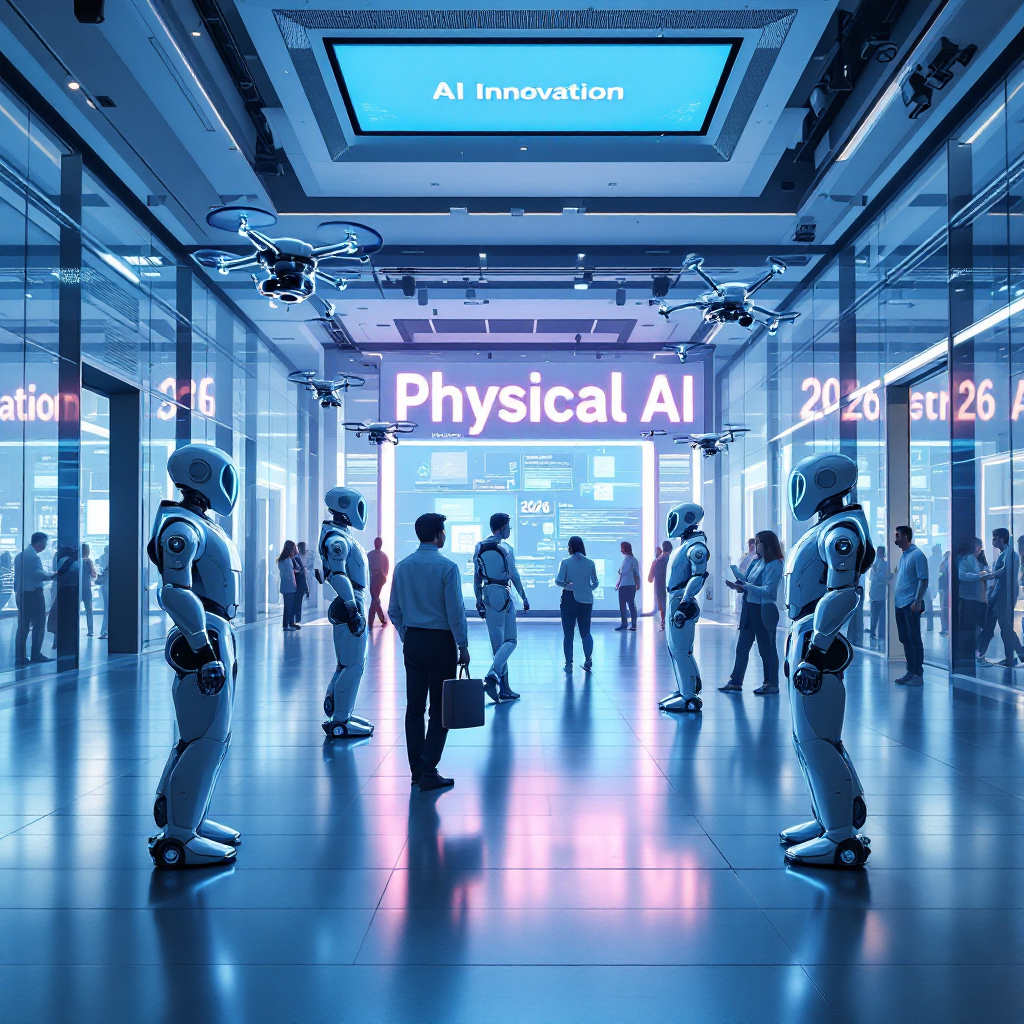
1. A New Starting Point for AI: Physical AI Diving into the Real World
The AI revolution that began with ChatGPT in November 2022 is now expanding beyond screens and entering the physical world. As AI begins to move and make decisions on its own, what impact will this transformation have on our lives?
The rapid advancement of generative AI over the past three years has been nothing short of astonishing. But now, a new chapter is unfolding. AI no longer stops at generating text or creating images—it is starting to move alongside us in the actual physical world. This marks the dawn of a new era known as Physical AI or Embodied AI.
From Brain to Body: What is Physical AI?
Until now, AI has resembled a brain without a body. It analyzed data, recognized patterns, and offered optimal answers, but all these activities remained confined within the virtual realm of computer screens.
Physical AI gives that AI a body. It becomes the arms of a robot, the wings of a drone, the wheels of an autonomous vehicle. More importantly, AI no longer just follows preset commands; it perceives the real environment, makes its own judgments, and reacts flexibly.
The core characteristics of Physical AI are as follows:
While conventional industrial robots only performed programmed repetitive motions, robots powered by Physical AI can respond to unexpected obstacles, learn new tasks independently, and adapt to changing environments. This is the real-time embodiment of AI seeing, thinking, and acting in the physical world.
CES 2026: Proving the Explosive Growth of Physical AI
In November 2025, the announcement of the 2026 Innovation Awards at the world’s largest IT exposition, CES, clearly demonstrated that the era of Physical AI is no longer in the future.
Remarkably, the fields of AI, Robotics, and Drones each showed record growth of around 30% among the 36 award categories. This is no coincidence. It signals that AI (the brain) has seamlessly integrated with robotics and drones (the body), firmly ushering in the age of Physical AI.
Especially noteworthy is how CES itself has dramatically transformed. Moving beyond a consumer-focused technology showcase, it introduced five new categories: Edutech, Enterprise Tech, Film Production & Distribution, Supply & Logistics, Travel & Tourism. This reflects how AI technology is no longer just a future innovation for specific sectors—it has become an essential tool across all industries.
AI’s Transformation Unfolding in the Real World
Physical AI is no longer just a subject of research labs. It is already driving tangible changes across various aspects of our daily lives.
In healthcare, surgical assistant robots equipped with AI analyze patients’ vital signs in real time and support surgeons’ hands, enabling surgeries with unprecedented precision.
In manufacturing, robotic arms in smart factories go beyond simple automation: they visually detect minute product defects, predict quality issues, and optimize the entire production process.
In agriculture, drones fly over vast farmland, monitor crop health in real time, and apply pesticides precisely where needed, reducing resource waste.
These transformations are far beyond mere automation. AI is expanding human capabilities in the physical world, taking on the role of a new partner that creates better outcomes.
2. What is Physical AI? The Decisive Difference from Generative AI
What if AI that used to create only text and images now becomes the brain of robots and drones? Physical AI goes beyond simple automation, embodying remarkable intelligence that senses and responds autonomously within the physical environment. What is its secret?
The Essence of Physical AI: Evolution from Brain to Body
Let’s compare the evolution of AI technology to the human body. Generative AI has played the role of an exceptional “brain.” Just as ChatGPT generates sentences, DALL-E creates images, and code-generation AI writes software, generative AI has focused purely on intellectual tasks.
In contrast, Physical AI installs these brilliant brains into “bodies” such as robots, drones, and autonomous vehicles. Through these bodies, it interacts directly with the real physical world. It senses the environment with sensors and operates motors and actuators based on AI’s decisions to influence the actual world.
The Fundamental Difference Between Generative AI and Physical AI
The difference between these two technologies is not just an addition of features—it’s a completely different paradigm.
Characteristics of Generative AI:
- Operates primarily within digital environments
- Optimized for generating content like text, images, videos, and code
- Produces new digital content based on given input data
- Errors are mostly correctable within a digital context
Characteristics of Physical AI:
- Operates directly within the physical world
- Executes the entire process from sensing the environment through sensors to decision-making and action execution
- Adapts to unpredictable situations and learns new tasks autonomously
- Adjusts actions instantly based on real-time feedback
The Complete Sensor-Judgment-Action Cycle
Physical AI is fundamentally different from generative AI because it builds a closed-loop system.
Traditional industrial robots repeat fixed programmed motions. If programmed to move items from point A to point B, they would stop whenever an obstacle appears. But Physical AI-based robots are different.
Sensing phase: They detect their surroundings in real-time using various sensors such as cameras, LiDAR, and ultrasonic sensors.
Judgment phase: AI models analyze the sensory data to understand the situation and decide the optimal course of action.
Action phase: The chosen action is executed by the robot’s motors and actuators.
Feedback phase: The results of the action are sensed again and factored into the next decision.
This completed feedback loop enables robots to flexibly respond to environmental changes and find the best action even in new situations.
Understanding Physical AI Through Real-World Examples
Example 1: Warehouse Automation Robots
Generative AI alone cannot find and move items in a warehouse. But what about robots equipped with Physical AI?
- They scan the warehouse layout and locate items using sensors
- AI calculates the shortest path and determines the route
- If unexpected obstacles appear en route, they instantly reroute
- When picking up items, the gripper adjusts force according to size and weight
- The entire process is learned over time to improve efficiency for future tasks
Example 2: Surgical Assistant Robots
The true value of Physical AI shines in medical settings.
- Continuously monitors patient vital signs like heart rate and blood pressure
- Detects and stabilizes surgeon’s hand tremors for steadier movements
- Automatically adjusts incision depth based on tissue characteristics
- Reacts immediately to unforeseen situations during surgery
These two examples demonstrate that Physical AI is more than mere automation—it’s a system equipped with genuine intelligence capable of understanding situations and adapting in real time.
Advancements in AI Technology Enable Physical AI
The rapid recent progress of Physical AI is driven by revolutionary advances in AI itself.
Deep Learning and Neural Networks: Greatly improved ability to recognize complex patterns, enabling robots to interpret visual information much more accurately.
Computing Power: Advances in edge AI technology allow robots to incorporate powerful processors onboard, enabling real-time processing without reliance on the cloud.
Data and Learning: Pre-training with massive datasets accumulated over years equips robots with foundational intelligence to quickly adapt to new environments.
Multimodal AI: The emergence of AI capable of processing text, images, voice, and sensor data simultaneously allows robots to make decisions based on richer information.
The Change Physical AI Will Bring
If generative AI revolutionized the creation of information, Physical AI will directly transform reality.
From defect detection in manufacturing plants to precision surgeries in healthcare, precision pesticide application in agriculture, and life-saving operations in disaster zones—Physical AI helps humans escape dangerous or repetitive tasks while enabling highly precise work once impossible for humans.
This is not mere automation. It means imbuing the physical world itself with intelligence, heralding a new era where reality collaborates with AI.
The Explosive Growth and Industrial Expansion of Physical AI Proven by CES 2026
AI and robotics technologies accounted for 30% of innovation awards, alongside the newly established supply and logistics category. CES 2026 clearly demonstrates how AI is rapidly spreading across entire industries. How exactly are these technologies transforming our industrial landscape?
The Simultaneous Growth of AI and Robotics: The Perfect Union of the 'Brain' and the 'Body'
The results of the CES 2026 Innovation Awards far exceeded expectations. Among the 36 categories recognized, AI, robotics, and drones collectively achieved explosive growth of around 30%. This is more than just a shifting technology trend.
There is a clear reason behind this phenomenon. As generative AI has evolved into an advanced 'brain,' the demand for 'bodies'—robots and drones—to bring this intelligence into the physical world has surged dramatically. AI is no longer an abstract entity confined within data centers. It has evolved into Physical AI, sensing the environment through sensors and physically acting through actuators.
This change is being felt in industrial fields in real time. While traditional programmed robots repeated fixed tasks, Physical AI-based robots respond flexibly to unexpected situations and even learn new tasks autonomously when necessary.
CES 2026’s Strategic Shift: Industry Expansion Focused on B2B
Another key signal from CES 2026 is the emergence of newly established categories. Moving away from a purely consumer-focused exhibition, five new categories were introduced:
- EdTech
- Enterprise Tech
- Film Production and Distribution
- Supply and Logistics
- Travel and Tourism
These new categories clearly show AI technology’s evolution toward meeting the deep, specific needs of various industries. The creation of the Supply and Logistics category is particularly meaningful, signaling that the adoption of AI and Physical AI in logistics is no longer optional but essential.
Supply and Logistics: The First Large-Scale Application of Physical AI
The logistics industry offers the most tangible examples of Physical AI’s achievements. Major e-commerce platforms like Amazon and Coupang already operate large-scale AI-based automated logistics systems.
Physical AI is realized in logistics through:
Autonomous logistics robots: Robots handling the entire process within warehouses—from picking to packing—calculate optimal routes in real time via AI. They navigate complex warehouse environments while avoiding collisions and minimizing product damage.
Drone-based delivery: AI analyzes weather conditions, no-fly zones, and delivery times comprehensively to set the most efficient delivery routes.
Demand forecasting and inventory optimization: AI algorithms analyze historical sales data, seasonality, and social trends to precisely predict needed products and optimize warehouse inventory.
These logistical innovations go beyond mere efficiency improvements—they revolutionize consumer experience with faster deliveries, more accurate delivery time predictions, and damage-free product receipt—all hallmarks of Physical AI’s impact.
The Rise of Industry-Specific AI Solutions
CES 2026 highlights another trend: the shift from generic AI adoption to industry-tailored AI solutions. This signals that AI technology has matured significantly.
- Enterprise Tech: Automating business processes, data analytics, and decision support
- EdTech: Personalized learning paths, student performance analysis, and prediction
- Film Production and Distribution: AI-powered automatic editing, effects creation, and target audience analysis
Each industry faces unique challenges, and AI has now advanced to meet those specialized requirements. The era of force-fitting generic AI technologies into industries is over.
A Bird’s-Eye View of the Future Industrial Structure
Analyzing the CES 2026 Innovation Awards reveals an outline of how industry structures will evolve. The concurrent growth of AI, robotics, and drones implies:
- Advanced industrial automation: Moving beyond simple automation to intelligent automation systems
- Expanded human-machine collaboration: Robots handle hazardous or repetitive tasks, while humans focus on creativity and judgment
- Real-time optimization: Shifting away from rigid, planned production to dynamic systems that instantly respond to changing conditions
The reality companies now face is clear: Physical AI is no longer a future technology. CES 2026 has definitively proven that Physical AI is driving ongoing industrial innovation today.
Real-World Applications of Physical AI Shining in Industrial Fields
From robots providing precise assistance in operating rooms to smart factories and drones managing crops in real time, let’s take an exciting look at how Physical AI is revolutionizing industrial sites.
The Physical AI technologies showcased at CES 2026 are no longer just stories of the future. Around the globe, physical systems equipped with AI are already driving groundbreaking changes in various industries. Let’s explore how Physical AI is actually operating across different sectors.
Healthcare: AI-Powered Surgical Assistive Robots Maximizing Precision
The use of Physical AI in healthcare is one of the most remarkable domains. The “surgical assistive robots” highlighted at CES 2026 go beyond serving as mere advisors to medical professionals—they actively participate on the frontline of medical procedures.
These robots analyze patients’ vital signs in real time and complement surgeons’ hands to enable ultra-precise surgeries impossible for humans alone. Especially during microsurgery, AI suggests safe incision paths through neural network analysis and even compensates for surgeons’ subtle hand tremors, dramatically enhancing accuracy.
What’s more fascinating is that these surgical assistive robots can monitor the postoperative recovery process as well. If AI algorithms detect early signs of complications by tracking the patient’s physiological responses, they immediately alert medical staff. This leads directly to higher success rates of surgeries and shorter recovery times for patients.
Manufacturing: The Brain and Body United in Smart Factories
Manufacturing is where the true value of Physical AI truly shines. Traditional automation systems performed only pre-programmed repetitive tasks, but robots in AI-equipped smart factories are far more intelligent.
In modern smart factories, Physical AI systems manage the entire production process integrally. During quality inspection, high-resolution cameras combined with deep learning AI visually identify even the tiniest defects in products. Irregularities down to tens of micrometers that could be overlooked by conventional means are automatically detected.
Beyond simply spotting defects, AI analyzes why they occur. It collects and processes thousands of variables in real time—such as line temperature, humidity, and machine status—to predict root causes. As a result, robots autonomously adjust production conditions and take preventive measures before problems escalate.
For instance, if the defect rate of a particular part trends upward, the AI system automatically forecasts maintenance timing for the relevant machine and adjusts schedules accordingly. This minimizes production downtime while maintaining top product quality. Ultimately, manufacturing costs decrease and production efficiency maximizes, creating a virtuous cycle.
Agriculture: The Future of Precision Farming Created by Drones and AI Together
Physical AI use in agriculture is especially meaningful for its fusion of agronomy and cutting-edge technology. Decision-making, once reliant on farmers’ experience and intuition, is now supported by precise data analysis.
Drone-based Physical AI systems fly over vast farmlands, monitoring crop health in real time. Equipped with multispectral cameras and thermal sensors, drones capture stress signals in plants invisible to the naked eye. For example, heat stress caused by water shortage is first detected by thermal cameras, triggering automatic activation of irrigation systems.
More sophisticated AI systems predict early outbreaks of pests and diseases. By analyzing past climate data, soil moisture, and current crop conditions, they calculate the likelihood of specific pests appearing and determine the optimal timing and dosage for pesticide application. Guided by this information, drones precisely spray pesticides only where needed, significantly reducing unnecessary chemical use.
This approach not only cuts costs but also directly contributes to environmental protection. Reduced chemical usage through precision farming prevents soil contamination and enables sustainable agriculture. Farmers gain the dual benefit of higher productivity and nature conservation.
Common Thread: The Value of Physical AI Beyond Human Limits
What stands out across these three industries is that Physical AI goes beyond simple automation to create a new level of “human-machine collaboration.” Medical professionals rely on the precision of robots, factory engineers trust AI’s predictive power, and farmers depend on drones’ information-gathering capabilities.
Within this collaborative structure, AI acts not just as a tool, but as a trusted partner. The true value of Physical AI lies not in the technology itself, but in performing what humans cannot and enabling people to focus on critical decision-making. This is precisely why Physical AI drew such attention at CES 2026—because it represents tangible innovation already proven across industrial fields.
Section 5: Challenges and Opportunities Toward the Future: The New Era Unlocked by Physical AI
While Physical AI faces numerous hurdles—ranging from safety and ethical concerns to technical challenges—the market is projected to grow at an annual rate exceeding 40%. Are you ready for a future where humans and machines join hands to create a new world?
Core Challenges in the Era of Physical AI
As Physical AI technology advances rapidly, it brings both exciting opportunities and pressing challenges. Amid the explosive growth showcased at CES 2026, we face three major challenges that demand our immediate attention.
First, the gravity of safety issues. Unlike generative AI that may produce inaccurate information, errors in AI operating in the physical world can have life-threatening consequences. For instance, a surgical assistant robot misinterpreting a patient’s vital signs can lead to medical accidents, and sensor malfunctions in autonomous vehicles can cause severe traffic accidents. Due to these risks, companies developing Physical AI must meet far more stringent safety standards than conventional AI systems. In high-risk industries like healthcare, transportation, and manufacturing, rigorous certification processes and exhaustive testing are mandatory.
Ethical Concerns: The Boundary Between Responsibility and Trust
Second, ethical considerations are increasingly critical. Who bears responsibility when problems arise in environments where humans and AI machines work side by side? Is it the manufacturer, the user, or the AI algorithm developer when a robot harms a worker in a manufacturing setting?
This issue goes beyond mere legal debates; it affects the foundation of societal trust. The UK and EU have already proposed regulations outlining ethical standards for AI, while the US and South Korea are also formulating related policies. Companies adopting Physical AI must focus not only on technological efficiency but also on building systems that emphasize transparency and explainability.
Technical Complexity: The Challenge of Integration
Third, technical complexity presents the most tangible barrier to developing Physical AI. Physical AI cannot function solely on powerful algorithms. It requires dozens of sophisticated mechanical components—cameras for vision, LiDAR for distance measurement, motors and actuators for movement, sensors for interacting with the external environment—all working flawlessly in perfect harmony without even the slightest error.
Moreover, these hardware components must handle vast volumes of real-time data and make decisions within milliseconds. For example, autonomous vehicles analyze billions of data points every second, where a single error can result in catastrophic accidents. This represents a level of technical challenge fundamentally different from that faced by generative AI.
Global Market Outlook: Growth Potential Exceeding 40%
Despite these challenges, industry experts remain highly optimistic about Physical AI’s future. Current forecasts predict the Physical AI market will grow annually by over 40% through 2027—a rate far surpassing the overall AI industry growth.
This surge is driven by clear economic incentives. Physical AI delivers tangible value that offsets investment costs: enhanced productivity in manufacturing, improved surgical precision in healthcare, increased crop yields in agriculture, and reduced delivery times in logistics. Additionally, as global labor shortages intensify, companies are focusing sharply on automation through Physical AI.
A New Paradigm of Human-Machine Collaboration
Emerging from the process of overcoming these challenges is a new paradigm of human-machine collaboration. Whereas past automation often excluded humans, collaboration in the era of Physical AI combines human creativity with AI’s precision.
For example, collaborative robots (Cobots) in modern manufacturing work alongside human operators—handling the heavy lifting while humans focus on complex tasks like assembly and inspection. In operating rooms, AI analyzes anatomical structures in real time to support surgeons’ decisions. This goes beyond mere automation, showcasing AI as a new tool that extends human capabilities.
Strategic Shift for Companies: The Urgency of Establishing a ‘Physical AI Strategy’
At this point, companies must move beyond simply adopting AI; they need to formulate and integrate a ‘Physical AI strategy’ throughout their organizations. This entails a comprehensive transformation—from technology adoption to business strategy, organizational structure, and workforce training.
Leading firms are already taking steps such as:
- Analyzing applicable Physical AI technologies and conducting pilot projects tailored to their industry.
- Creating internal guidelines that align with safety and ethical standards.
- Retraining existing staff and developing skills for AI collaboration.
- Enhancing digital infrastructure across the entire supply chain.
Industrial Ecosystem 2–3 Years from Now: The Everyday Reality of Physical AI
Within the next two to three years, Physical AI is expected to become commonplace across industries like manufacturing, healthcare, agriculture, and logistics. What is optional today will soon become indispensable, and the technological gap between early adopters and laggards will widen significantly.
The innovation awards at CES 2026 clearly demonstrate that AI has evolved from a mere tool into a transformative force reshaping entire industrial ecosystems. AI, once confined to digital screens, is now stepping into the physical world—fundamentally changing how we work.
In this historic transition, both businesses and individuals must prepare—not only through technological innovation but also by fostering ethical responsibility, enabling genuine cooperation between humans and machines. This is the new era that Physical AI will usher in.
Comments
Post a Comment