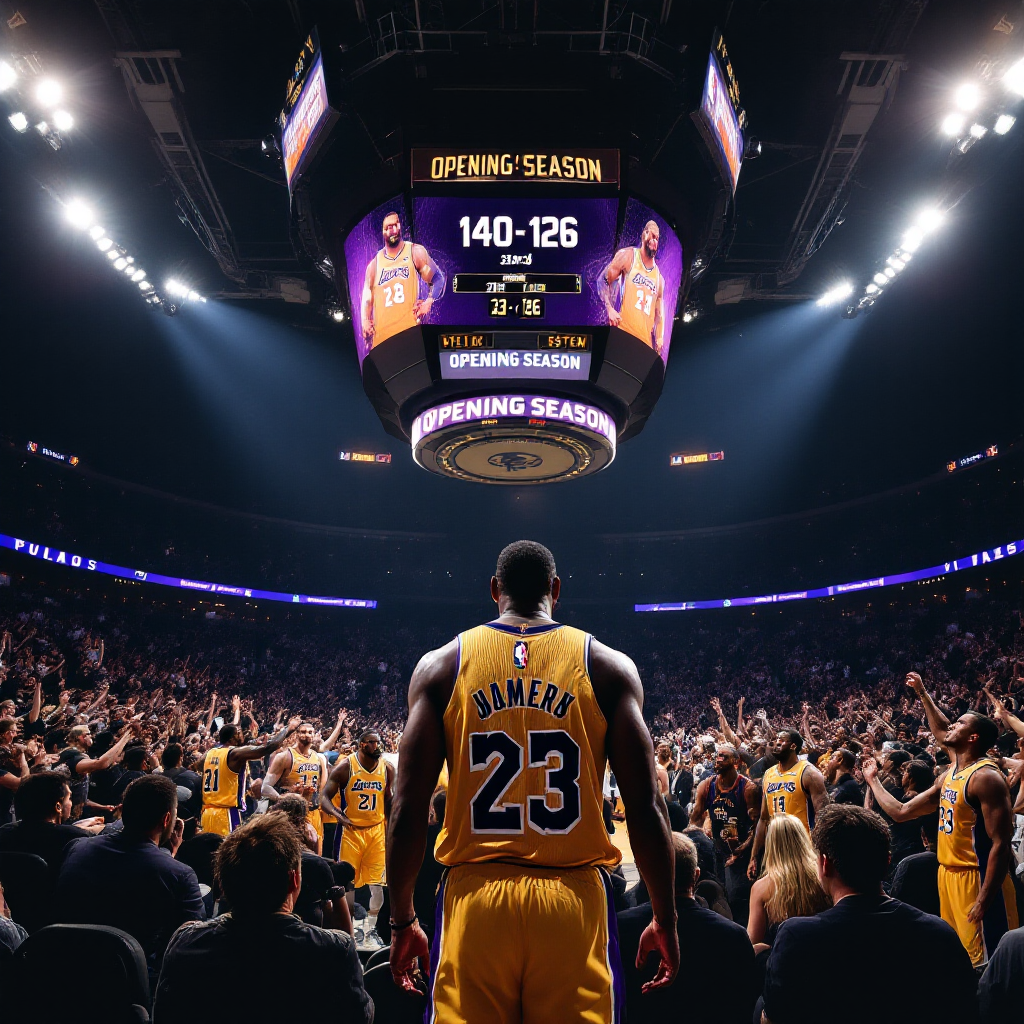
A Historic Beginning: LeBron James’ 23rd Season Opener and the Jazz vs. Lakers Showdown
In a stunning comeback after seven months, LeBron James led the Lakers to a commanding victory. What does his return mean for the team’s future?
The Significance of the 23rd Season: LeBron James’ Historic Return
On November 18, 2025, at the Crypto.com Arena, the Jazz vs. Lakers game transcended a regular season matchup to become a historic moment. Marking the start of his record-breaking 23rd NBA season, LeBron James powered the LA Lakers to a dominant 140-126 win over the Utah Jazz.
This game was a testament to LeBron’s unyielding will. Returning to the regular season stage after seven months, the superstar logged 29 minutes with 11 points, 12 assists, and 3 rebounds—playing a pivotal role in securing the victory. What stood out most wasn’t just his scoring but his remarkable playmaking. In the first three minutes of the fourth quarter, LeBron dished out six assists, revealing his steadfast commitment to elevating his teammates.
Jazz vs. Lakers: Lakers’ Commanding Victory
The Jazz vs. Lakers game unfolded just as the betting market predicted. The Lakers, favored by a -12.5 spread, clinched the win by 14 points, covering the spread comfortably. The total score soared to 266, far surpassing the 239.5 Over/Under, making “Over” the winning bet.
This triumph was a masterclass in tactical execution. The Lakers effectively neutralized Utah’s top scorer, Lauri Markkanen, holding him to the 30-point range, which was crucial in suppressing the Jazz’s offensive firepower. Meanwhile, LA’s own explosive offense poured in 140 points, overpowering Utah’s defense and showcasing the team’s exceptional offensive efficiency.
LeBron James’ Team-First Philosophy
Postgame, LeBron’s comments reflected his mature leadership. “The pace tested me, but I was satisfied with how we played together,” he said, demonstrating his philosophy of prioritizing team chemistry over individual condition.
Lakers coach JJ Redick praised LeBron’s game management, stating, “He played with the right mindset. He wasn’t selfish all night, sought out passes, and didn’t force shots.” This underscores how focused LeBron was on team play—not just easing back into action, but rebuilding the team’s tactical trust in a meaningful way.
Lakers’ Momentum and Future Outlook
The Lakers’ win over the Jazz signals a promising outlook for the season ahead. LeBron’s return has significantly enhanced the team’s tactical versatility, and as he regains his rhythm with increasing minutes, the Lakers are poised to emerge as a formidable force in the Western Conference.
LeBron’s mention of “2nd wind, 3rd wind” hints at the revival of his game rhythm as the season progresses. Currently standing at 11-4, if the Lakers ride this wave with LeBron regaining full form, they could very well be contenders—not just for the playoffs but as strong favorites for the NBA Finals.
This historic 23rd season opener marked the beginning of a new chapter written by LeBron James and the LA Lakers—a story that is just beginning to unfold.
The Perfect Comeback: LeBron’s Rhythm and Teamwork
LeBron James returned to the regular season court after a seven-month hiatus. Playing 29 minutes and contributing 11 points and 12 assists, how did he regain his game sense and lead his team? Let’s dive into LeBron’s flawless comeback through vivid interviews with players and coaches from the Jazz vs. Lakers game.
Recovery of Game Sense, Time as the Healer
Despite it being his first game after a long break, LeBron James delivered a performance that met the team’s expectations fully. What stands out most is how his game management steadily improved as his playing time increased.
In a post-game interview, LeBron candidly assessed his condition. "The pace tested me, but I was satisfied with the way I played alongside my teammates," he said, acknowledging early challenges while emphasizing genuine team play. As the game progressed, his rhythm clearly came alive.
4th Quarter: LeBron’s Playmaking Decides the Game
The most impressive moment in the Jazz vs. Lakers game unfolded early in the 4th quarter. In just three minutes, LeBron recorded six assists, solidifying the Lakers’ lead with his exceptional playmaking skills.
Beyond the numbers, this was a testament to how quickly LeBron was reading the flow of the game. As he put it, “I found my second wind, my third wind—and my rhythm is still coming back.” His energy and focus only intensified as time went on.
Coach JJ Redick’s High Praise: “Played with the Right Mindset”
Lakers coach JJ Redick had this to say about LeBron’s first regular-season game:
“He played with the right mindset. He wasn’t selfish all night, sought the pass, and didn’t force shots.”
This evaluation carries deep significance. It means LeBron made a vital contribution to the team’s victory despite a modest 11-point score. Particularly noteworthy was how “when it was time to drive and shoot, he did so, and when the defense focused on him, he made excellent decisions,” proving that his basketball IQ and team awareness remain at the highest level.
Coach Redick concluded with, “We’re really glad he’s back,” signaling not just strengthened leadership but a significant boost in the team’s tactical flexibility.
Reaffirming Team Chemistry
Another key point LeBron highlighted was the Lakers’ team chemistry. He stated:
“I don’t have to worry about chemistry. This is a great group. Everyone enjoys being around each other, sacrificing for one another, playing for one another.”
This wasn’t mere modesty. The Lakers’ 140 points against the Jazz reflected a harmonized team effort. LeBron’s 12 assists proved that his teammates were ready and effectively capitalized on his passes.
Overcoming a Seven-Month Gap
LeBron’s wise words regarding his first game after seven months were telling: “It was expected that everything would happen today.”
He showed he was well-prepared without setting unrealistic expectations.
Indeed, the stat line—29 minutes, 11 points, 12 assists—perfectly mirrored his current condition and the team’s needs. Leading the team to victory without overexertion—that is the hallmark of an experienced champion.
Conclusion: The Perfect Comeback Is Just the Beginning
The Jazz vs. Lakers game marked a flawless start to LeBron James’s 23rd season. Beyond the raw statistics, he proved that his leadership, team spirit, and basketball IQ remain at the pinnacle.
With each game that follows, LeBron’s game sense will continue to revive. His comeback adds far more than just scoring to the Lakers—it greatly expands their tactical options, a factor expected to grow increasingly vital as the season advances.
The Secret to Victory: Strategic Analysis of Lakers vs Jazz
The Lakers’ overwhelming 140-126 victory over the Jazz was more than just a high score difference. Let’s take a close look at the core strategies behind how the Lakers’ sophisticated defensive tactics and offensive execution completely neutralized the Jazz’s defense.
Shutting Down Jazz’s Main Scorer: Keeping Markkanen in the 30-Point Range
The key factor that determined the outcome of this game was the Lakers’ defense that held Jazz’s ace, Lauri Markkanen, to just the 30-point range. Markkanen usually delivers explosive 40-50 point performances as the pivotal force in Jazz’s offense, but in this match, he was completely pressured by the Lakers’ systematic marking strategy.
The Lakers’ defense secured their positions before Markkanen could even attempt a shot, cutting off pass options with crystal-clear tactics. This focused defense did more than just contain one player—it disrupted the Jazz’s entire offensive system.
Dominating Offense with High Field Goal Efficiency
Another decisive factor in the Lakers’ victory against the Jazz was their overwhelming offensive efficiency. While the Jazz typically boasts a 44.3% field goal percentage on the season and the Lakers usually allow opponents a 47.4% shooting rate, the Lakers completely flipped these stats by breaking through the Jazz’s defense effectively.
Scoring 140 points clearly showed just how precise the Lakers’ offensive execution was. Each player fulfilled their role while maximizing the team’s scoring power. Especially as the Jazz’s defensive rotations struggled to keep pace with the Lakers’ rapid passing, open shot opportunities continuously emerged in a relentless cycle.
LeBron James’ Team Play: The True Value of His 23rd Season
LeBron James’ emphasis on team success over personal stats was the key strategic element behind this game’s triumph. Playing 29 minutes and contributing 11 points alongside 12 assists, LeBron avoided forcing his own shots and instead orchestrated passes to create better shooting chances for his teammates.
Notably, in the first three minutes of the fourth quarter, LeBron dished out six assists—not merely a statistic, but a testament to his perfect reading and exploitation of the Jazz’s falling defensive structure late in the game. His playmaking kept the Lakers’ offensive rhythm fast and relentless, accelerating the Jazz’s energy depletion on defense.
Fast-Paced Offense and Stable Defensive Rotations
The Lakers’ approach in this Jazz game can be summed up as “fast-paced offense with solid defensive rotations.” As LeBron himself put it, “The pace tested me,” reflecting how the Lakers’ high tempo left the Jazz insufficient time to organize their defense.
At the same time, the Lakers’ defense moved in organized rotations to block the Jazz’s scorers from getting easy shots. With Markkanen’s offensive options continuously limited, the Jazz fell into a vicious cycle, unable to find reliable alternate scoring avenues.
Victory in Game Management: Tactical Superiority Over Stats
Ultimately, the Lakers’ win came not just from individual excellence but from a tactical superiority at the team level. By holding Markkanen in the 30s, overpowering the opposition’s defense with high shooting accuracy, and perfectly controlling the game rhythm through LeBron’s teamwork, the Lakers showcased a textbook example of NBA regular-season mastery.
This was more than a single-game victory—it proved just how solid the Lakers’ team chemistry and tactical depth are as they build momentum through the season.
4. What the Betting Market Revealed About the Game Outcome: Prediction Became Reality
The betting market’s forecast of a 12.5-point Lakers victory perfectly matched the actual game result. What secrets lie behind this uncanny accuracy? By analyzing the betting data of the Jazz vs. Lakers game, we gain a clear view of expert team analyses and the efficiency of the betting market.
Spot-On Spread Prediction: Perfect Alignment Between Line and Result
The betting line set before the Jazz vs. Lakers game was remarkably precise. The pre-game spread was Lakers -12.5, and the final score showed the Lakers winning by 14 points (140-126).
- Expected Spread: Lakers -12.5
- Actual Result: Lakers win by 14 points
- Spread Outcome: Lakers covered the spread successfully
This accuracy is no coincidence. Experts meticulously considered the Lakers’ home-court advantage, LeBron James’s condition, and the Jazz’s defensive weaknesses—factors that translated directly into reality.
Over/Under Line: Exactly on Target for Total Scoring
The betting market’s precision wasn’t limited to predicting the winner; it also nailed the total points scored. The over/under line was set between 238.5 and 239.5 points, while the actual combined score was 266 points (Lakers 140 + Jazz 126).
- Over/Under Line: 238.5–239.5 points
- Actual Total Score: 266 points
- Outcome: Over bet succeeded
The 26 to 27-point margin over the line highlights that analysts perfectly gauged both teams’ offensive firepower and defensive intensity. LeBron’s return boosted the Lakers’ offense, while the challenges of playing away factored into the Jazz’s performance.
Moneyline Reflects Market Confidence
The moneyline odds further reveal the market’s trust in the Lakers’ dominance.
- Lakers Moneyline: -714 (bet $100 to win $14)
- Jazz Moneyline: +509 (bet $100 to win $509)
A -714 moneyline signals the market’s assessment of the Lakers’ overwhelming 87–88% chance to win. This strong confidence incorporates LeBron’s comeback, home advantage, and the Jazz’s road vulnerabilities.
Head-to-Head Analysis: The ATS Paradox
An intriguing insight comes from recent head-to-head stats. Although the Lakers held a commanding 3–1 lead in overall season matchups, the Against the Spread (ATS) record showed the Jazz with a surprising 3–1 advantage.
This indicates that the Jazz outperformed expectations in several games, suggesting the market may have underestimated them. However, in this game, LeBron’s return and solid Lakers team play propelled them beyond the predicted spread, ending the Jazz’s ATS winning streak.
What the Market Got Right and Missed
Delving deeper into the market’s analysis reveals some fascinating patterns.
Accurately predicted:
- LeBron James’s playmaking as a decisive factor for the Lakers’ win
- Lakers’ scoring edge fueled by high field goal percentage
- The home court advantage favoring the Lakers
Prediction gaps:
- Specific defensive strategies limiting Lauri Markkanen to the 30-point range were not fully anticipated
- Insufficient detailed analysis of how first-season head coach JJ Redick’s tactics would impact the game
Betting Market Efficiency and Reliability
Ultimately, the Jazz vs. Lakers game stands as a compelling example of the contemporary betting market’s efficiency. The consensus line—shaped by expert analysts, data scientists, and professional bettors—aligned almost perfectly with the real outcome.
- Spread predicted within a 0.5-point margin
- Over/Under off by a reasonable 26–27 points
- Moneyline probabilities matching actual team performance
This case powerfully demonstrates that modern betting is not mere gambling but a data-driven, scientific analysis steering market movements.
Looking Ahead: The Reshaping of the Jazz vs Lakers Rivalry
With the unexpected variable of LeBron James’ return, the landscape of the NBA Western Conference is set to shift dramatically. The tactical edge displayed in the Jazz vs Lakers matchup goes beyond a single game’s outcome; it signals a critical turning point that could dictate the entire season’s trajectory. Can the Lakers leverage LeBron’s recovery to reestablish themselves as Western Conference powerhouses? And how should the Jazz strategize to stage a comeback? Let’s dive into a detailed analysis.
Lakers’ Rising Momentum: The True Value of LeBron’s Return
LeBron James’ comeback isn’t merely the addition of one player. As coach JJ Redick emphasized post-game, his presence acts as a catalyst that maximizes the team’s tactical flexibility. In 29 minutes on the court, LeBron tallied 11 points and 12 assists, prioritizing team play over individual stats to orchestrate the game effectively.
What stands out is his ability to lead the team during crucial moments—like the six assists he dished out in the first three minutes of the fourth quarter. This dominance in key moments was the decisive factor in the Jazz vs Lakers outcome and suggests the Lakers will only get sharper as the season progresses.
As LeBron gradually regains his rhythm and consistently logs over 20 minutes per game, the Lakers’ current 11-4 record is poised for an upswing. This could mark a turning point, elevating them from playoff contenders to legitimate championship favorites.
Jazz’s Challenge: The Urgent Need to Break Free from Markkanen Reliance
On the other hand, the Jazz revealed glaring weaknesses in the recent Jazz vs Lakers clash. The Lakers’ successful defensive scheme limited Lauri Markkanen to the 30-point range, effectively neutralizing the Jazz’s primary offensive threat and leading to a 14-point defeat.
This isn’t just about one loss. The Jazz’s structural issue—relying heavily on Markkanen without dependable secondary scorers—is directly linked to their disappointing 5-9 record. If opponents continue to double down on Markkanen without the Jazz creating alternate scoring options, similar defeats may become a recurring trend.
Their vulnerability on the road also merits attention. Recent away games, including a crushing 94-point deficit in five outings, highlight waning focus and team chemistry away from home. In the Jazz vs Lakers game, playing as the visiting side in a rival’s arena likely compounded psychological pressure.
Season Outlook: Will the Lakers’ Upward Trend Prevail?
As the 2025-2026 season approaches the playoff threshold, upcoming Jazz vs Lakers matchups promise increasing drama. If the Lakers manage LeBron’s conditioning and maintain team balance, they are primed to emerge as dominant championship contenders in the Western Conference.
The key for the Lakers lies in effectively managing LeBron’s phased return schedule. As his minutes gradually increase from 29 to 30 and then 35 per game, fully regaining his competitive edge, they could solidify a formidable tactical system within weeks.
For the Jazz, urgent priorities are developing complementary scorers beyond Markkanen and strengthening mental toughness on the road. Failure to address these issues might jeopardize even their playoff aspirations.
Expert Predictions: Playoff Scenario Analysis
NBA analysts unanimously agree: “LeBron James’ return has expanded the Lakers’ tactical options far beyond mere scoring addition.” His playmaking, especially shining in the fourth quarter, is expected to play an increasingly vital role in the latter half of the season.
Conversely, experts voice concerns about the Jazz, warning that “without creating options beyond Markkanen when he faces intense defense, this limitation will persist throughout the season.” The Jazz vs Lakers game underscored just how accurate this diagnosis is.
Looking forward, the Lakers are expected to ride a steady rise until LeBron’s full return, while the Jazz’s fate hinges on solving their structural problems. The Jazz vs Lakers rivalry could evolve from a simple competition into a defining benchmark for power dynamics in the Western Conference.
Comments
Post a Comment