The Untold Story Behind the Dallas Cowboys' Heartfelt Victory
What is the true secret behind the Dallas Cowboys’ resounding 33-16 win, achieved while bearing the heavy weight of Marshawn Kneeland’s tragic death? Their November 11, 2025 triumph over the Las Vegas Raiders was far more than just a sports victory—it became a profound testament to human resilience and the true meaning of team spirit.
Cowboys Defensive Lineman Marshawn Kneeland’s Death and the Team’s Grief
In October, defensive lineman Marshawn Kneeland of the Dallas Cowboys tragically passed away by suicide. This heartbreaking news cast a deep shadow of sorrow over the entire team. The game against the Raiders was their first match played with ‘heavy hearts’ following his passing.
Players and coaching staff took to the field to honor Kneeland’s memory. Despite the circumstances, the focus and unity they displayed went beyond typical sportsmanship — it showed what true dedication to each other means.
Cowboys’ Dramatic Turnaround: Escaping from a 3-5-1 Record
The emphatic 33-16 victory marked a pivotal moment for the Dallas Cowboys. Prior to the game, their record stood at a dim 3 wins, 5 losses, and 1 tie (3-5-1), leaving their playoff hopes looking bleak. Morale was especially low after losing two consecutive games.
But this win broke the losing streak and rekindled their playoff aspirations. More importantly, the team’s performance transcended the simple binary of winning or losing.
Defensive Revamp Yields Eye-Catching Results
The key to this triumph lay in the Cowboys’ innovative defensive overhaul. Until now, opposing teams had routinely scored over 20 points against them—a pattern shattered thanks to the contributions of newly acquired players and renewed efforts from existing members.
Standout Performers in the New Defensive Lineup
- Quinnen Williams: The Pro Bowl defensive lineman from the New York Jets, now the cornerstone of the reinforced defensive front.
- Logan Wilson: Experienced linebacker from the Cincinnati Bengals.
- DeMarvion Overshown: Starting linebacker making his season debut.
- Shavon Revel Jr.: Third-round rookie cornerback making his first appearance of the season.
DaRon Bland’s Dominating Performance
A particular highlight was DaRon Bland, who recorded a team-high 10 tackles and 2 pass defenses during this game. These stats clearly demonstrate how effectively he stifled the Raiders’ offense.
Cowboys’ Upcoming Challenge: Grueling Three-Game Stretch in 11 Days
Following this victory, the Dallas Cowboys face an even tougher test. From November 24 to December 5, they will undergo a demanding schedule of three games in just eleven days.
The Upcoming Fixtures
November 24: Philadelphia Eagles (8-2) vs. Dallas Cowboys (Home game)
November 28 (Thursday): Dallas Cowboys vs. Kansas City Chiefs (Thursday Night Football)
December 5 (Thursday): Detroit Lions vs. Dallas Cowboys
This three-game gauntlet is widely regarded as a make-or-break series that will decide the Cowboys’ playoff fate. Particularly, matchups against powerhouses like the Eagles and Chiefs will prove how solid the revamped defense truly is.
The Real Secret Behind the Victory: Team Spirit and Remembrance
Ultimately, this 33-16 victory is not just a number. It is the result of the Dallas Cowboys players and staff united by their tribute to Marshawn Kneeland—a genuine display of team spirit.
Maintaining team cohesion during tough times and quickly syncing the revamped defense means far more than just great performance; it is an inspiring example of giving one’s best for those who matter.
Though what the Cowboys achieve in the upcoming three-game stretch remains uncertain, they have already demonstrated something that transcends wins and losses.
New Heroes: The Rising Power of the Dallas Cowboys' Evolving Defense
How did a defense equipped with bold trades and fresh debuts shut down opposing offenses and instantly transform the team’s spirit? The answer lies in the November 11th showdown where the Dallas Cowboys dominated the Las Vegas Raiders 33-16. Let’s uncover the stars behind this dazzling performance.
Defense Revolution in Dallas: The Arrival of New Faces
Since the start of the 2025 season, the biggest vulnerability for the Dallas Cowboys had been their defense. Opponents frequently racked up more than 20 points with ease, dragging down the team’s overall morale. But the front office turned this crisis into an opportunity with bold decisions—results that shone clearly in this game.
Pro Bowl Acquisitions: Strengthening the Defensive Line
Quinnen Williams’ New Mission
Acquired in a trade from the New York Jets, Pro Bowl lineman Quinnen Williams has lived up to his reputation with outstanding performances. His addition has lifted the entire Cowboys defensive line, intensifying pressure on opposing quarterbacks like never before.
Linebacker Logan Wilson’s Experience
Joining from the Cincinnati Bengals, linebacker Logan Wilson has fortified Dallas’ midfield defense. His experience and field intelligence have proved invaluable, serving as a mentor who accelerates the growth of younger defenders.
Rookies and Debutants Shine: Lighting the Path Forward
DeMarvion Overshown’s Impactful Debut
Starting linebacker DeMarvion Overshown marked his season debut by significantly solidifying the Cowboys’ defense. His swift movements and aggressive style effectively stifled the Raiders’ running game.
Rookie Cornerback Shavon Revel Jr.’s Breakthrough
Third-round rookie cornerback Shavon Revel Jr. also stepped onto the field for his season debut, bolstering the secondary. Despite being a newcomer, his focus and positioning captured the attention of many insiders.
DaRon Bland’s Stellar Performance: The Heart of the Defense
The standout player of the game was DaRon Bland, who led the team with 10 tackles and 2 pass defenses. His leadership on defense not only showcased personal excellence but also proved the new defensive system’s remarkable effectiveness.
A Turnaround in Spirit: Victory Amid Adversity
This game transcended a mere sports result. Faced with heavy odds, the newly revamped defense completely shut down the Raiders’ offense. The Dallas Cowboys broke a two-game losing streak, improving to 3-5-1 with renewed confidence.
Challenges Ahead: A Crucial Three-Game Stretch
This victory is just the beginning. The Cowboys now face a demanding three-game stretch within 11 days, starting at home against the 8-2 Philadelphia Eagles on November 24. The key question: can the Dallas defense maintain this transformation as pressure mounts?
Armed with new heroes, the Dallas Cowboys’ defense has breathed fresh hope into the entire franchise and revived their playoff dreams. The upcoming games will be the true test of this team’s renaissance.
The Forgotten History of Black Cowboys, and the Message They Send Us
Did you know that in the 19th-century American West during the frontier era, one-quarter of the cowboys managing cattle on ranches were Black? This reality starkly contrasts with the cowboy image we've encountered through Hollywood films and popular culture. As of 2025, this forgotten history is being illuminated through Beyoncé’s album Cowboy Carter and Jordan Peele’s documentary High Horse: The Black Cowboy.
The Historical Truth: Hidden Diversity Among 19th-Century Cowboys
Historian William Loren Katz’s book The Black West fundamentally transforms our understanding of cowboy history. Following the Civil War, in Texas where millions of cattle were managed, cowboy teams were organized on a large scale, and on average, 2 to 3 out of every 11 cowboys were Black. Some teams were even composed entirely of Black cowboys.
Even more fascinating is the origin of the term “cowboy” itself. Originally, the word was used as a derogatory term toward Black people. Katz explains, “When Black men took on this dangerous and demanding job, the word ‘cowboy’ was deliberately used with a belittling meaning.” Over time, the term gradually became universal, transforming into the common label we know today for cowboys.
The Revival of Black Cowboy Culture in Modern Times
As the dark pages of history are brought to light, modern Black cowboy culture is actively experiencing a vibrant revival.
Cali Cowboy Company in LA: A Living Legacy
Founded last October in Los Angeles, the Cali Cowboy Company revives the Black tradition of horse ranching in the present day. Run by six founders including Scott, this organization currently cares for about a dozen horses, preserving the cultural heritage of the Black community.
Even more noteworthy is a pioneering example from the 1990s. Established by Mayisha Akbar at Richland Farms, the Compton Jr. Posse did more than pass on horse-riding culture. This project offered hope and identity to Black youth exposed to street violence and poverty through cowboy culture. It has since evolved into the Compton Cowboys riding club, symbolizing a cultural restoration movement within the American Black community.
Reexamining History Through Art and Media
Jordan Peele’s Documentary and Its Cultural Message
Oscar-winning director Jordan Peele’s High Horse: The Black Cowboy is more than a historical documentary; it is a cultural declaration. The message embedded in this film—“They tried to erase us, taking up space as a Black cowgirl in LA”—resonates across past and present.
Beyoncé’s Cowboy Carter album sparked the “Yeehaw Agenda,” which is far more than a music trend. It is a movement for Black Americans, long excluded from mainstream culture, to reclaim cowboy identity. This movement is an essential struggle to educate the public on historical truths and to secure recognition for Black cultural contributions.
The Message They Send Us
The rediscovery of Black cowboy history poses vital questions for American society. How do we remember history? Who becomes the hero, and who is excluded?
These questions extend beyond cowboy history alone. In every domain of American life, how much exclusion and distortion lie hidden in the histories we think we know?
The message from today’s Black cowboys and cultural activists is clear: forgotten histories can be rewritten; excluded voices can be reclaimed; stolen identities can be reconstructed. What America in 2025 is learning from its past cowboys, its modern Black youth on horseback, and its cultural artists is precisely this.
The Multi-Layered Identity of the Modern Cowboy Hidden in Fashion and Art
The black cowboy hat is making its way from the runway to the streets. Cowboys are no longer confined to the 19th-century Texas frontier. In 2025, the cowboy identity is breaking down the boundaries between tradition and modernity, reborn as a new cultural movement within fashion and art. Experience the rebellion of the black cowboy hat and witness how Western art expands beyond mere imagery into a vast cultural phenomenon.
Women’s Black Cowboy Hats: Redefining Fashion
One of the most remarkable trends in the 2025 fashion world is the rapid rise of black cowboy hats designed for women. More than just an accessory, this symbolizes a cultural movement intent on redefining gender and race within the cowboy identity.
Since John B. Stetson revolutionized Western attire in the 1860s, the cowboy hat has stood as a symbol of specific identities and power. But now, its meaning is swiftly evolving. Women’s black cowboy hats challenge the traditional monopoly over Western imagery, raising questions about who owns and expresses the cowboy identity.
Modern brands like Eric Javits are unveiling designs that blend tradition with contemporary styles, under the concept “Heritage Behind Western Cowboy Hats.” Their approach respects historical authenticity while embracing modern aesthetics and diversity, showing just how carefully yet boldly cowboy culture is being reshaped.
The Expansion of Western Art: From Cowboys to Landscapes
According to the National Cowboy Museum’s podcast, Western art fundamentally shifted after Clark Hulings’ 1973 Prix de West-winning piece, "Grand Canyon, Kaibab Trail." This was not just an art historical milestone but a cultural paradigm shift.
Museum Director Dean Krakel initiated efforts to broaden Western art beyond cowboy themes to encompass the vast landscapes, diverse figures, and rich cultures of the West. This marked the first time the art world began valuing works that capture the vivid realities of the West, moving past the narrow focus on cowboys.
Artists like Hulings inspired a rediscovery of Western identity through works depicting the rising sun, sheer canyons, and landscapes etched with the marks of time. As a result, modern Western art has evolved beyond romanticized cowboy imagery into reflections on the grandeur of the land itself and humanity’s small place within it.
From Fashion to Cultural Movement
The popularity of the black cowboy hat and the expansion of Western art are no coincidence. Both are part of a broader cultural movement sparked by Beyoncé’s album "Cowboy Carter" and Jordan Peele’s documentary "High Horse: The Black Cowboy."
The fame of women’s black cowboy hats in fashion shows that cowboy identity no longer signifies a fixed role. Instead, it conveys a message that Black women, Latina women, and all women can interpret and claim the cowboy identity in their own ways.
Simultaneously, the academic reevaluation of Western art restores the true diversity of cowboy culture based on historical facts. This demonstrates that the cries of Black cowgirls—“They tried to erase us, but we are taking up space”—are not mere slogans but represent tangible changes sweeping across the cultural landscape.
The Future of Cowboy Identity
The reconstruction of cowboy identity in fashion and art is one of the most fascinating cultural phenomena in 2025. This is not simply a style trend but a mirror reflecting how American society views its history and imagines its future.
From women’s black cowboy hats to the expansion of Western art, all these movements converge on a single question: Who is a cowboy? The answer is no longer limited to specific historical figures in textbooks. Today’s cowboy is every individual who defines themselves, with fashion and art serving as the most powerful means to express that layered identity.
5. Cowboy Identity: From the Ancient West to the Heart of Modern America
The cowboy is being reinterpreted across sports, history, art, and society at large. But where does the multilayered meaning of this symbol come from, and what potential changes could it bring to America’s future?
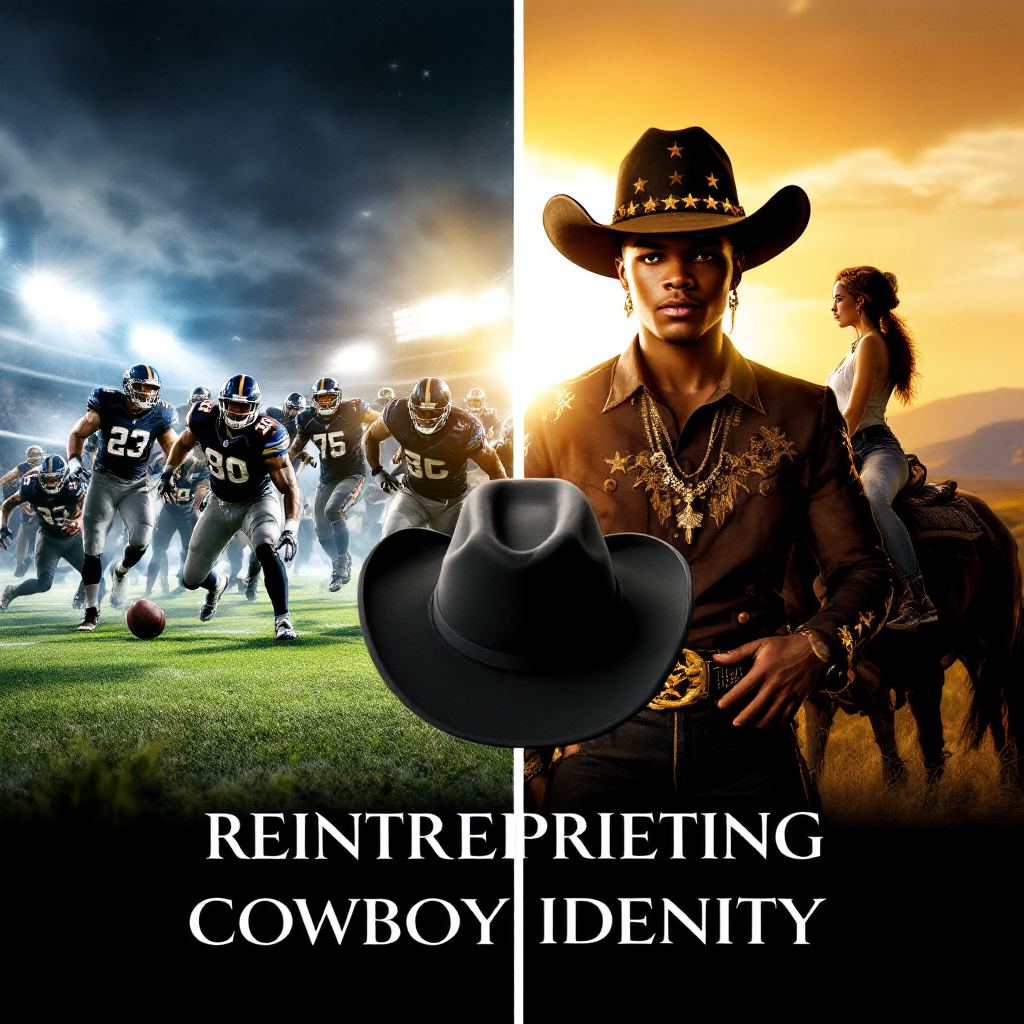
In 2025, America faces the symbol of the cowboy—but this is no longer the cowboy of the 19th-century Western frontier. From the roaring cheers on the Dallas Cowboys’ field, to the silhouette of a Black woman riding through the streets of Los Angeles, to the ringing “Yeehaw” in Beyoncé’s music—modern cowboys are not mere historical figures, but central to how Americans today seek and define their own identities.
Redefining Cowboy Identity: The Beginning of Inclusion and Rediscovery
Traditionally, the image of the cowboy has been deeply ingrained as a myth centered on white men. Hollywood films and Western literature have long reinforced this biased narrative, deliberately or unconsciously erasing the existence of Black, Latino, and female cowboys from Western history.
But history does not lie. The fact that about 25% of 19th-century cowboys were Black reveals a truth long hidden in the shadows of the past, now emerging before us. American society is embarking on a process of restoring these omitted stories, and in doing so, the very identity of the cowboy is being redefined.
Resilience Spoken through Sports and Culture via the Cowboy
Just as the Dallas Cowboys are experiencing a season of overcoming, the symbol of the modern cowboy is being reborn with new meaning. The identity embodied by the team’s name transcends a mere sports logo; it now represents the human spirit confronted with challenges and rising above them.
Community movements like Los Angeles’ Compton Cowboys offer an even more direct expression. Black youth threatened by street violence reclaim their power and dignity by riding horses—this is the face of the contemporary cowboy. Traditional cowboy culture functions now as an escape from economic hardship, social discrimination, and psychological wounds.
Art and Fashion Leading the Cowboy’s Rediscovery
As Clark Hulings’ philosophy of Western art demonstrates, today’s cowboy culture cannot be confined to narrow categories. The National Cowboy Museum’s efforts to expand cowboy themes into vast Western landscapes and diverse cultures exemplify a movement toward a more inclusive reconstruction of cowboy identity.
The rise of black cowgirl hats for women in mainstream fashion fits this context perfectly. Brands like Eric Javits weave tradition and modernity under the concept “Heritage Behind Western Cowboy Hats,” while Beyoncé’s ‘Cowboy Carter’ album redefines the cowboy image in popular culture. All these trends point in one direction: the cowboy is evolving into a universal identity that transcends gender, race, and generations.
Historical Justice and the Future of Cowboy Identity
What stands out most is that these reinterpretations are not mere cultural trends or marketing strategies. Projects like Jordan Peele’s documentary High Horse: The Black Cowboy reflect a serious societal effort in America to confront its historical blind spots and integrate the experiences of excluded groups into the mainstream narrative.
“They tried to erase us, taking up space as a Black cowgirl in LA” — this phrase is not simply a slogan. It embodies a firm determination by cowboys lost to history to reclaim their place in America today. Through this, the cowboy identity transforms into a symbol of struggle, inclusion, and justice.
An Open Question Toward the Future
The multilayered redefinition of cowboy identity in modern American society raises a question beyond mere historical correction: How will America build its future? Whether it’s the resilience shown by the Dallas Cowboys in their upcoming three-game stretch, the self-esteem experienced by youth on horseback at Cali Cowboy Company, or the cowboy image being reimagined in fashion and art—these all reveal how seriously America is approaching the construction of a new identity based on diversity and inclusion.
The cowboy is no longer a figure of the past captured in history books—it is a way for Americans living today to express and define themselves. And as this process unfolds, the symbol of the cowboy will grow richer and encompass even more stories. This is why cowboy identity transcends the ancient West and pulses through modern America.
Comments
Post a Comment