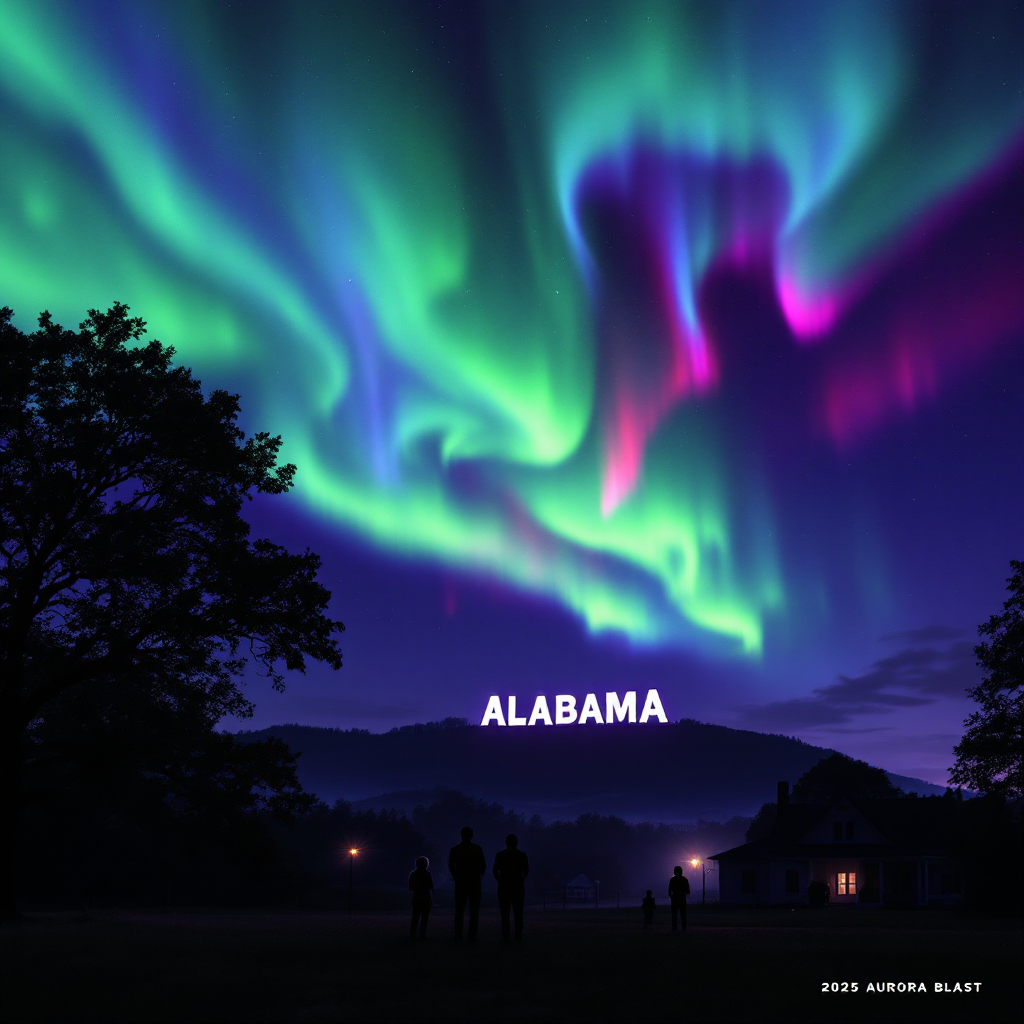
The Catastrophic Aurora Night That Shook the U.S. in November 2025
A breathtaking aurora borealis descended all the way to Alabama—but this was no ordinary natural spectacle. It was the harbinger of the largest solar storm in 22 years. What secrets lie behind this astonishing display?
A Miracle in 22 Years: Northern Lights Reaching Alabama
On the night of November 10, 2025, the entire United States held its breath. An X-class solar flare erupted from the sun, striking Earth’s magnetic field with such force that the northern lights, typically confined to the Arctic, surged south at an unbelievable pace. Birmingham’s night sky was painted vivid green, marking the largest event since the 2003 Halloween Storm—a phenomenon unseen in 22 years.
This was no mere “beautiful night sky.” Scientists classified it as a G4-level geomagnetic storm—an extreme magnetic storm—and NASA warned it could foreshadow a disaster on the scale of the historic 1859 Carrington Event. The brighter the celestial lights, the more they paradoxically exposed the fragility of our civilization beneath.
Solar X9.8 Flare: A Cosmic Blitz at 1.5 Million km/h
The spectacular spectacle was triggered on November 9 when the sun unleashed an X9.8-class flare—the most powerful of 2025—along with a coronal mass ejection (CME) hurtling toward Earth at 1.5 million kilometers per hour. Just 24 hours later, at 8 PM EST on November 10, this high-energy plasma cloud struck Earth’s magnetic field head-on.
The impact was immediate. The Kp-index, a measure of geomagnetic storm intensity, soared to 8+. What does that mean?
- Kp-index 5+: Strong storm level
- Kp-index 7+: Northern lights visible as far south as northern Texas and California
- Kp-index 8+: Auroras extended all the way to Alabama and Georgia (NOAA data)
The auroral oval—the usual ring of northern lights—is normally around latitude 65°. This time, it plunged over 3,000 km south to latitude 35°, right over Alabama. This was far beyond any previous expectation.
The Color Science of the Atmosphere: Green, Red, and the Mysterious Purple
The magic of northern lights lies not just in their brightness, but in the palette of colors lighting the sky—each a scientific signal. When high-energy particles from the sun collide with Earth’s atmospheric gases:
- Green/Red: Reactions with oxygen (O₂) occur at 100–300 km altitude
- Blue/Purple: Bonds with nitrogen (N₂) occur below 100 km
What stole the show in this storm were the striking purple bands spotted even in southern states. These brilliant purples indicated intense nitrogen reactions at lower altitudes, visually underscoring the severity of the geomagnetic storm. Even the colors in the night sky carried an ominous cosmic warning.
The U.S.’s Diverging Fate: Triumph and Disappointment
Success in witnessing the northern lights hinged on more than just the Kp-index. Weather—most critically, cloud cover—became the deciding factor.
Victories:
- Alabama, Tennessee: Around 10 PM on November 10, clear green auroras over Birmingham lit up social media.
- Fort Collins, Colorado: Auroras visible surprisingly south of Portland.
- Connecticut, Maine: The East Coast witnessed “red curtains” of northern lights, with local media cheering, “Aurora in our backyard!”
Failures:
- Portland: Meteorologist Jennifer Haynes’s anguished cry, “Cloud cover is killing us!” as a low-pressure system blanketed the sky 100% with clouds. Despite perfect Kp 7+ conditions, no auroras were visible.
- Chicago, Indianapolis: Only faint glimpses of green light occasionally broke through partial clouds, leaving onlookers frustrated: “So close, yet so far.”
This stark contrast revealed one undeniable truth: the sky’s gifts appear only to those prepared to receive them.
From Solar Flares to Geomagnetic Storms: The Science Behind the Miraculous Mechanics of the Northern Lights
A violet aurora unfolded as solar high-energy plasma flying at 1.5 million km/h met Earth’s atmosphere. How did the aurora expand all the way down to 35 degrees north latitude? Let’s uncover the secret science reveals.
🔬 From Solar Eruption to Aurora: A Cosmic Chain Reaction
Normally, northern lights are visible only near the Arctic Circle. But on the night of November 10, 2025, a vivid green aurora captured in Alabama shattered the laws of science with a surreal spectacle. Behind this miraculous event was a cosmic phenomenon where a high-energy solar plasma cloud (CME, Coronal Mass Ejection) struck Earth’s magnetic field squarely.
Let’s break down the core mechanism of this phenomenon in three steps.
📍 Step 1: Solar Eruption – The Power of the X-Class Flare
On November 9, an X9.8-class flare erupted on the solar surface — the strongest rating for 2025 — releasing immense energy when the sun’s surface temperature soared to 15 million degrees.
The force of this explosion is beyond imagination. The emitted high-energy plasma cloud was launched towards Earth at a staggering speed of 1.5 million km/h. To put it into perspective, that’s about 1,400 times faster than a supersonic jet.
📍 Step 2: Arrival at Earth and Triggering the Geomagnetic Storm
At 8 PM EST on November 10, the CME reached Earth, hitting its magnetic field with a massive shockwave.
Looking at the measuring standard called the Kp-index (geomagnetic activity index):
- Kp-index above 5: Signals a strong geomagnetic storm
- Kp-index above 7: Northern lights visible as far south as northern California and Texas
- Kp-index above 8: Aurora expands down to Alabama and Georgia (according to NOAA data)
This event recorded a Kp-index over 8+, historically rare for aurora sightings to reach southern states. Normally, the auroral oval forms near 65 degrees north latitude, but this time it astonishingly extended down to 35 degrees north (Alabama’s latitude)—a 30-degree southward shift.
📍 Step 3: The Mystery of Colors – How Atmospheric Collisions Create the Lights
The dazzling colors of the northern lights are created when solar plasma collides with gas molecules in Earth’s atmosphere.
Green Aurora (Most Common)
- Reaction with oxygen (O₂) molecules
- Occurs at altitudes of 100–300 km
- Appears brightest and clearest to the human eye
Red Aurora
- Also from oxygen reactions but at higher altitudes (above 300 km)
- Rarer and more mysterious in appearance
Blue and Purple Aurora
- Due to nitrogen (N₂) molecule interactions
- Occur in the lower atmosphere below 100 km
- This storm’s striking violet bands were even seen as far south as the southern states, sparking fascination
The November 2025 aurora featured an unusually deep and vivid purple hue, signaling intense interaction in the lower atmosphere. In other words, the color vividly proved just how severe the geomagnetic storm was.
⚡ Scientific Spotlight: A Harbinger of the 1859 Carrington Storm?
Astronomers view this event with mixed emotions: awe at a miraculous celestial phenomenon alongside concern as a warning sign.
The most powerful geomagnetic storm on record is the 1859 Carrington Storm. Back then, auroras were visible almost worldwide, and global communication networks (mostly telegraphs) were paralyzed. Modern scientists estimate that a similar-scale storm today could cause trillions of dollars in damage by triggering widespread power grid failures and satellite system breakdowns.
We are currently at the solar activity peak (Solar Cycle 25’s summit) in 2025. NASA released a statement saying, "This is a wake-up call. We're not ready for a Carrington-level event."
🌌 Looking Up at the Sky Again
Science teaches us two vital lessons. First, a sense of awe before nature—the wonder before the uncontrollable mysteries of the cosmos. Second, a scientific alertness—the threat lurking behind such breathtaking beauty to our Earth’s systems.
The November 2025 northern lights were more than a mere astronomical phenomenon; they were a vivid textbook demonstrating how closely Earth and space are intertwined. The journey of a solar eruption at 1.5 million km/h reached Earth’s atmosphere and then our eyes. It is pure scientific marvel—and at the same time, a future challenge humanity must face.
Light and Darkness Across the U.S.: The Northern Lights Observation Battling the Clouds
While some places captured stunning auroras, others were left disappointed as clouds obscured the skies. Follow the hidden stories behind the scenes, from Birmingham’s joy to Portland’s sighs.
🌟 A Moment of Triumph: The Miracle of Auroras Lighting Up the South
On the night of November 10th, a historic spectacle unfolded in the southern United States—something unimaginable on any ordinary night.
Victories in Alabama and Tennessee
The night sky over Birmingham transformed as if straight out of a movie. Around 10 PM, observers’ cameras captured vivid green auroras—the sheer power of the northern lights felt in every fiber. These videos quickly spread on social media, sparking awe with comments like, “Seeing the northern lights in Alabama?!” Tennessee saw the same wonder. Residents pointed their cameras skyward all night, witnessing this mysterious phenomenon for the first time in their lives.
A Red Curtain Along the East Coast
The northern lights’ reach extended even to Connecticut and Maine. Observers there witnessed not green, but a curtain of red light. Local media heralded the astonishing news under headlines like "Aurora is in our backyard!" and a caravan of aurora hunters left city lights behind to chase the spectacle in the countryside.
An Unexpected Success in Colorado
Even more surprising was the confirmation of auroras over Fort Collins, Colorado, south of Portland. Experts hadn’t predicted it—this unexpected triumph was clear proof of how massive this geomagnetic storm truly was.
😔 Lessons in Disappointment: Opportunities Lost to the Clouds
The sky was not fair everywhere. Elsewhere on the same night, vastly different fates unfolded.
Portland’s Desperate Cry
Meteorologist Jennifer Haines’ voice was filled with frustration: "Cloud cover is killing us!" Her lament went beyond just a weather report. All the scientific conditions were perfect—the Kp-index topped 7+, the ideal threshold for northern lights. Yet, a low-pressure system churned clouds covering 100% of the sky, shattering every hope.
This is aurora-watching tragedy: no matter how perfect the science, a single layer of clouds can block every dream. Portland’s residents looked up all night, only to see a blanket of gray.
Faint Glimmers in Chicago and Indianapolis
Some areas fared slightly better. Chicago and Indianapolis caught glimpses of faint green light through partial breaks in the clouds. Yet, observers’ expressions were far from bright: "So close, yet so far!" perfectly captured their bittersweet feelings. The northern lights appeared; the clouds thinned a bit—but it wasn’t nearly enough.
💡 Keys to Success and Lessons from Failure
This experience left behind vital insights.
Conditions for Successful Viewing
The common thread among successful areas was clear: a high Kp-index (7+) and—most importantly—a cloud-free sky. The triumphs in Birmingham, Tennessee, and along the East Coast weren’t luck. Many observers checked weather conditions ahead of time and traveled to optimal locations.
What Portland Taught Us
Despite her despair, meteorologist Jennifer Haines offered crucial advice: "Get away from city lights, let eyes adjust for 20 minutes, check after midnight." These are essential when clouds part to increase your chances. But that night in Portland, all these tips were powerless beneath the persistent clouds.
🌌 The Message from the Field
The northern lights observation on the night of November 10th teaches us this: Science can predict auroras, but nature remains unpredictable. Clouds may come—or clear skies may spread wide.
For residents in successful regions, this night will be a lifelong memory. Those in Portland and Chicago left with regrets—but also with lessons. Next time, they know to prepare better.
Want to never miss the next aurora? The skies have a clear message: Monitor forecasts, track cloud coverage, and, crucially, look up. The wonders of nature await the prepared.
Section 4: Upcoming Aurora Opportunities – Guard the Winter Sky of 2025
As the sun enters its peak activity in 2025, another powerful northern lights display is on the horizon. This is great news for those who missed the cataclysmic aurora show last November. With winter deepening and nights growing longer, the sun’s explosive activity will continue. Here’s an expert strategy and essential checklist for when, where, and how to catch this celestial spectacle.
🗓️ 2025 Winter Aurora Forecast Calendar: Opportunities You Can't Miss
As of November 12, the sun remains highly active. According to NOAA’s Space Weather Prediction Center (SWPC), G3–G4 geomagnetic storms are likely to recur in the coming weeks. Plan your schedule with the forecast below.
| Date | Expected Kp-index | Optimal Viewing Areas | Viewing Difficulty | Additional Info |
|---|---|---|---|---|
| Nov 14 | 5–6 | Minnesota, Wisconsin | ★★☆ | 70% cloud cover likely, camera recommended |
| Nov 18 | 7+ (forecasted) | Ohio, Pennsylvania | ★★★★ | New Moon ideal timing, visible as far east as the Atlantic coast |
| Nov 24 | 4–5 | Washington, Oregon | ★★☆ | Pacific low pressure influence favors Western viewing |
| Early Dec | 6–7 (forecasted) | Northern Great Plains | ★★★☆ | Winter holiday season, active sky tours |
🌌 Golden Rules of Northern Lights Viewing: 3 Expert Secrets
Step 1: Monitor the Kp-Index – Numbers Tell the Story
The success of aurora viewing hinges on the Kp-index. Know what it means and how to use it.
- Kp 0–3: Auroras mostly invisible except at polar extremes
- Kp 4–5: Possible in northern Canada and Alaska (challenging for casual viewers)
- Kp 6–7: Viewable in Minnesota, Wisconsin, Washington State ✓
- Kp 8+: Visions may reach as far south as Alabama, Georgia, Pennsylvania ✓✓✓
Real-time Kp-index monitoring apps:
- NOAA SWPC official site: swpc.noaa.gov
- "My Aurora Forecast" (iOS/Android)
- "SpaceWeatherLive" (with real-time push alerts)
Step 2: Check Cloud Forecasts – Is the Sky Clear?
No matter how high the Kp-index, cloudy skies ruin the show—as November in Portland painfully demonstrated.
Recommended sites:
- ClearDarkSky.com: Hourly cloud cover forecasts (most accurate)
- Weather.gov (NOAA): Detailed regional cloud analyses
- Pro Tip: Monitor "lower cloud" layers—auroras occur above 100 km altitude, so mid- to high-level clouds interfere less
Step 3: Choose Your Location – Escape City Lights
No stunning aurora can compete with urban brightness.
Finding prime viewing spots:
- Light Pollution Map (lightpollutionmap.info): Select black areas (usually rural zones 50+ km from cities)
- Minimum distance: At least 30–50 km from city centers
- Direction: Focus northward where the aurora oval forms
- Elevation: Higher altitude locations preferred (mountainous terrain is best)
📸 Northern Lights Photography Tactics: Why You Can’t Do Without a Camera
Strong auroras with Kp 7+ can be seen with the naked eye, but most cases require a camera. Why?
Human eye vs. camera:
- Human eye: Poor color sensitivity in the dark → usually sees only bright green
- Camera: Captures reds, blues, purples with ISO 1600–3200 ✓
Essential gear:
- Camera: DSLR or mirrorless (smartphones rarely suffice)
- Lens: 14–24mm wide-angle (80°+ field of view)
- Tripod: Mandatory (exposures of 15–20 seconds)
- Settings: ISO 1600, f/2.8 aperture, 15-second exposure
🎯 Aurora Viewing Checklist: Everything You Need for Success
Before you depart:
- [ ] Confirm Kp-index is 6 or higher (NOAA SWPC)
- [ ] Verify cloud cover below 70% (ClearDarkSky)
- [ ] Check light pollution levels at the site (choose black zones)
- [ ] Test camera, lens, tripod
- [ ] Pack warm clothes, heat packs, blankets (plan on 2–4 hours outside)
At the viewing site:
- [ ] Allow at least 20 minutes for eye adjustment (avoid phone flashlights)
- [ ] Focus on the northern sky (auroras start there)
- [ ] Best time is after midnight (darkest skies)
- [ ] Bring enough food and drinks (auroras can appear and vanish unpredictably)
- [ ] View with a companion (safety first)
🌠 When Is the Best Time to See the Northern Lights in Winter 2025?
Why December through January is prime:
- Longest nights: Viewing possible well before midnight
- Clearest skies: Winter’s dry air means fewer clouds
- Sun remains highly active: Peak solar cycle continues through 2025
- New moon phase: December 30, 2025, new moon for darkest skies
💡 Good News for Those Who Missed It: Another Chance Is Coming
Did clouds block the aurora on November 10? Or were you unprepared with no camera? Don’t worry. The solar cycle runs every 11 years, and with this peak, powerful geomagnetic storms are expected for months to come.
Some scientists even predict massive G4–G5 storms near late December 2025 to January 2026. The northern lights reward those who wait patiently.
🔔 Final Advice: Make Looking Up a Habit
This winter, look up every Thursday night. Set push notifications on the NOAA SWPC app to alert you whenever the Kp-index reaches 6 or higher. That moment is your northern lights chance.
The northern lights are not just a natural phenomenon—they are the universe’s energy, the sun’s breath, the dance of Earth’s magnetic field. This winter of 2025, you could be a witness to that miracle.
Miracles and Warnings: The Sky’s Message About the 2025 Solar Storm
The Uncomfortable Truth Behind the Northern Lights
On the night of November 10, 2025, the Northern Lights witnessed across the United States were far more than a mere natural spectacle. The green and purple curtains that painted Alabama’s sky resembled a cosmic celebration sent from the universe itself—but astronomers wore pale faces. Behind this beauty lurked shadows of power grid failures, satellite communication breakdowns, and human unreadiness.
How Solar Storms Threaten the Vulnerabilities of Modern Civilization
What if the powerful G4-class geomagnetic storm had struck the core infrastructure of our planet? History offers a chilling answer.
In April 2023, just one hour before the Northern Lights appeared in Quebec, Canada, the power grid was down for 12 hours. And that solar storm was far weaker than the one expected in 2025. Imagine if a Carrington Event-sized solar storm—the most massive on record—hit our modern society?
NASA’s warning is bone-chilling: "This is a signal. We are not prepared for a Carrington-level event." This was NASA’s official statement on November 11, 2025.
The Alarming Gaps in Local Government Response Systems
The U.S. federal government established a ‘Space Weather Action Plan’ in 2024. Yet, it remained mostly a paper plan. Experts increasingly warn that local governments’ response systems are still severely underdeveloped.
A power manager from New York State confessed in a blog interview: “We understand the theoretical severity of solar storms, but actual response protocols are almost nonexistent. This is different from a typical blackout, and our equipment and personnel simply aren’t prepared.”
Taking Risk Preparedness Into Your Own Hands
While marveling at the beauty of the Northern Lights, practical readiness is essential.
- Secure an EMP shield (Faraday cage) to protect critical electronics
- Prepare emergency radios for receiving information when communications fail
- Stockpile drinking water and medicines to last at least two weeks during power outages
- Create digital backups of documents, stored redundantly in the cloud
2025 marks the solar activity peak, with over 100 G3 to G4-class storms expected annually. This isn’t just a statistic—it’s a reality humanity must face head-on.
Between Cosmic Awe and Practical Responsibility
“We are made of star-stuff.” Carl Sagan’s famous words remind us of two truths simultaneously.
First, a profound awe for the cosmos. The amazement of Alabama’s residents witnessing the Northern Lights was genuine. In that moment, we become part of the universe, humbled by nature’s grandeur.
Second, our responsibility and readiness. As beings forged from star-stuff, how we interact with the universe should not be passive observation but active preparation. We must appreciate beauty without ever closing our eyes to the threats.
Lessons from the Autumn of 2025
The sky illuminated by the Northern Lights was both a miracle and a warning. Jennifer Hines, a weathercaster in Portland, cried out despairingly, “The clouds will kill us!” This was no mere complaint—it was a cry against humanity’s failure to see beyond the clouds.
Yet, there is no need to despair. The sun will continue to surprise us on its 11-year cycle, each time giving us a chance to grow wiser.
Look up at the sky. Enjoy its beauty, but also listen closely to what it’s telling us. The universe’s message is simple:
"Enjoy the miracle, but prepare for the risk."
Comments
Post a Comment