The 2025 Physical AI Revolution: 5 Predictions for the Future of Humanoid Robots and Industry Transformation
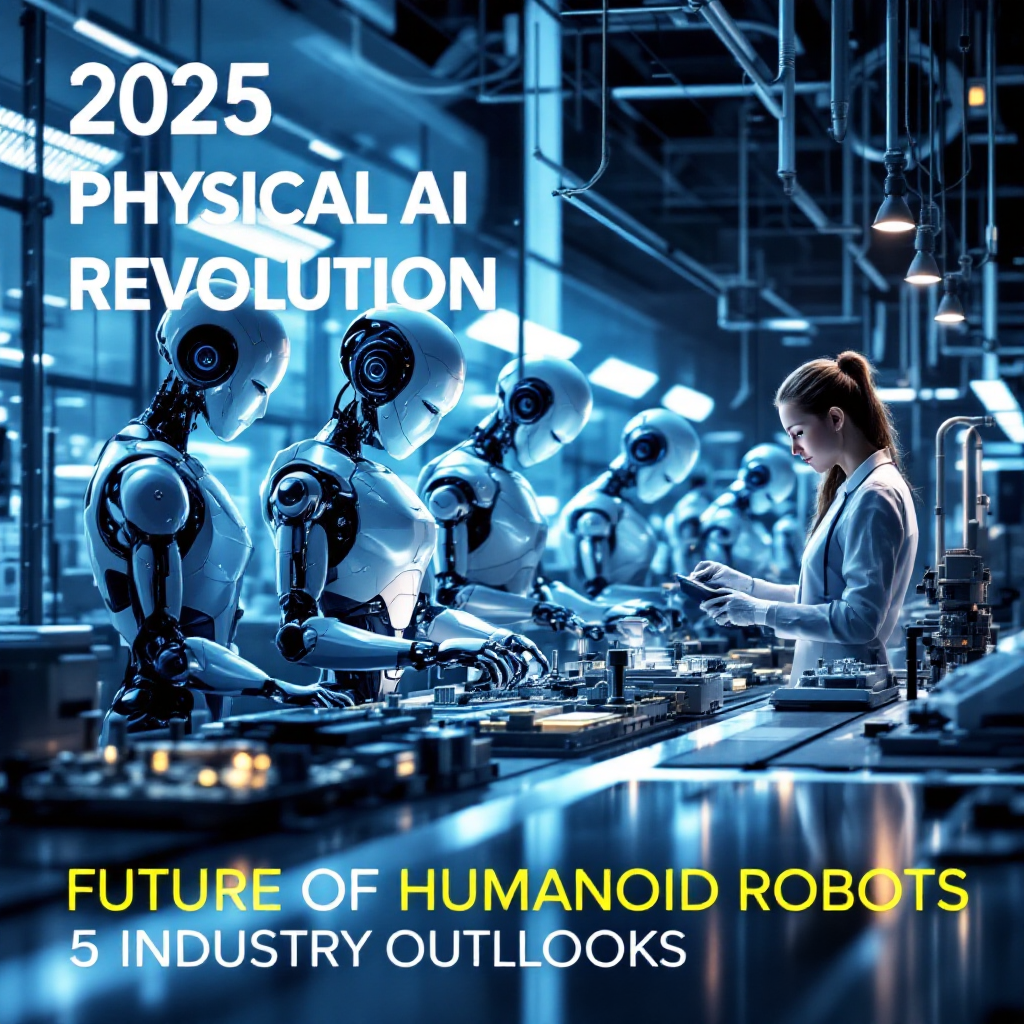
2025: The Dawn of Physical AI and the Era of Humanoid Robots
“The ultimate destination of AI is the humanoid robot.” This startling declaration at CES 2025 heralds more than mere technological evolution—it signals a transformative shift that will reshape human society as a whole.
The moment NVIDIA’s CEO Jensen Huang made this proclamation, the landscape of the tech industry was irrevocably altered. In 2025, artificial intelligence no longer confines itself to the smartphones in our pockets. We have entered the era of “Physical AI,” where AI directly interacts with the physical world beyond data processing and virtual generation.
What does this signify? It means what futurists and tech experts have dreamed of for decades is becoming reality. Through a comprehensive analysis of Deloitte’s ‘Top 10 AI Trends for 2025’ and the ‘State of AI Report 2025,’ it is clear that humanoid robots have emerged as a pivotal turning point in AI technology beyond mere innovation.
Physical AI: From Virtual to Reality
Tracing the evolution of AI thus far reveals a clear trajectory.
In the early 2020s, AI was purely software-based. ChatGPT demonstrated capabilities of generating text, answering questions, and explaining complex concepts—all confined within virtual spaces.
By the mid-2020s, a new change took hold. AI began to “see” the world through cameras and sensors. This marked the arrival of Sensing AI, the first step toward enabling robots to perceive their environment.
Now, in 2025, we have reached the third stage: physical AI in action. AI is no longer limited to observing and thinking—it is beginning to act, create, and transform directly in the real world.
A New AI Thought Process: The Introduction of Think-Then-Act
At the heart of this transformation lies a revolution in AI’s very way of thinking. Cutting-edge AI models like OpenAI’s o1, DeepSeek’s R1, and Anthropic’s Claude 3 have introduced a ‘think-then-answer’ architecture that is now expanding into robotics.
The implications are profound. Traditional robots followed pre-programmed instructions: “Do this in this situation.” But humanoid robots in 2025 can now analyze circumstances, evaluate multiple possibilities, and choose the most appropriate course of action.
For instance, when problems arose on manufacturing lines, older robots would simply stop and await human intervention. But robots equipped with physical AI today can independently analyze issues and devise solutions. This marks the advent of genuine autonomy.
The Technological Foundation: Layered Innovations Behind Physical AI
The rapid advancement of physical AI is not due to a single breakthrough but rather a convergence of innovations across multiple tech domains.
The practicalization of quantum computing enables rapid, human-level calculation amidst complex physical environments. When robots must consider countless variables and find optimal paths in chaotic real-world settings, quantum computing delivers unprecedented speed unattainable by classical computers.
Light-based chip technologies surpass the limitations of traditional silicon chips. New architectures leveraging photons boost processing speeds tenfold, furnishing robots with the capability for real-time complex decision-making.
6G communication technology revolutionizes connectivity between robots and the cloud. With ultra-low latency below 0.1 milliseconds, robots collaborate in real time with centralized high-performance computers—indispensable in environments like manufacturing floors and surgical theaters where immediate responsiveness is critical.
Finally, the AI-native data lake redefines cloud infrastructure. Unlike past clouds that merely stored data, these new data lakes are dynamic learning ecosystems where robots continuously train and evolve.
Together, these layered technological advancements transform physical AI from theory into reality.
Transformation Unfolding on the Ground
These developments are not just abstract concepts. At the 2025 Future Innovation Technology Expo (FIX 2025) held in Daegu, real-world applications of physical AI were unveiled.
HL Robotics showcased an indoor autonomous parking robot that is far from a mere toy. It boasts 99.8% accuracy in 3D spatial awareness and uses 6G networks for real-time environmental mapping. Crucially, this robot autonomously analyzes and resolves issues encountered during operation. It also achieves groundbreaking energy efficiency with a 40% reduction in power consumption compared to previous models.
This technological progress extends well beyond exhibition halls. The scale of AI adoption in manufacturing highlights its impact: the AI market in manufacturing, valued at $34.18 billion today, is projected to explode to $155 billion by 2030. Notably, the share occupied by humanoid robots is expected to surge from 15% in 2025 to 45% in 2030, indicating physical AI’s evolution from a supporting role into a core technology.
This is why 2025 marks the starting point of the era of physical AI and humanoid robots—the moment AI steps out of the virtual realm to collaborate, learn, and solve problems alongside humans in the real world.
The Birth of Physical AI: Evolving Artificial Intelligence from Virtual to Reality
How did humanoid robots that 'think before they act'—surpassing mere text-generating AI—actually achieve human-like autonomous judgment? We unveil the secrets behind the latest technological breakthroughs.
Until 2024, artificial intelligence mostly existed only on screens. The summit of AI was ChatGPT generating text and DALL-E creating images. But by 2025, everything changed. AI began to take a tangible form, performing tasks in the real physical world. This marks the revolution of Physical AI.
What Is Physical AI? Stepping Out of the Virtual Realm
Physical AI is more than a concept. It refers to intelligent systems capable of performing tasks in real physical environments beyond virtual space, representing a groundbreaking shift in AI’s evolutionary journey.
The evolution of AI unfolded in three stages. First, the Software AI Era (early 2020s), dominated by purely digital AI like text and image generation. Then came the Sensory AI Era (mid-2020s), where AI gained the ability to perceive its environment using sensors—cameras, LiDAR, ultrasonic sensors—enabling it to detect the world around it. Now, what we witness is the Physical AI Era (2025), where AI moves limbs, picks up objects, and alters its surroundings.
At the heart of this evolution lies a new mindset: the ‘Think-then-Act’ architecture. Traditional humanoid robots executed commands immediately. Hearing “Pick up the object,” they simply reached out and grabbed it. But the humanoid robots of 2025 are different. They analyze situations first, infer optimal strategies, then act based on that reasoning.
Consider this: when presented with multiple objects and tasked with precisely picking one, how does it work? Traditional robots would mechanically move based only on coordinate data. New physical AI robots, however, sense each object's weight, material, and shape, compute the best grasping method, and even anticipate potential failure scenarios—acting in the safest way possible. This is authentic autonomous judgment.
The Tech Innovations Powering Physical AI
The rapid advancement of physical AI is fueled by the convergence of cutting-edge technologies. Let’s explore how each contributes.
Practical Quantum Computing serves as the brain of physical AI. For humanoid robots to analyze complex physical environments in real-time, enormous computational power is essential. Where conventional computers might take seconds to solve certain problems, robots must decide within milliseconds. Quantum computing accelerates these complex calculations hundreds of times faster than traditional methods.
Photonic Chip Technology acts as the nervous system. Breaking free from traditional electronic chips, this new chip architecture harnesses light (photons). It boosts data processing speeds by roughly tenfold while drastically reducing heat generation, enabling robots to make faster and more stable decisions.
6G Communication Technology functions as the sensory organs. Ultra-low latency (under 0.1 milliseconds) ensures robotic movements are controlled almost instantaneously. For instance, robots communicate with powerful AI servers in the cloud to receive optimal judgments—all without perceptible delay. It’s as fast as a human brain sending signals to the body.
Finally, the AI-native Data Lake is the repository of the robot’s experience and learning. Cloud infrastructure has evolved beyond mere storage into a dynamic space where AI learns in real-time. Data from millions of robots’ operations is collected so that all robots learn together. When one robot encounters a new situation, every robot worldwide benefits from that insight.
Humanoids that Think before Acting: The Reality of Autonomous Judgment
Now, the key question: How can humanoid robots make autonomous decisions like humans?
The answer lies in the ‘think-then-answer’ architecture adopted by the latest AI models like OpenAI’s o1, DeepSeek’s R1, and Anthropic’s Claude 3. This architecture grants AI the "time to think"—instead of responding immediately, it thoroughly analyzes problems, considers multiple possibilities, then delivers an optimal answer.
Expanding this to robotics, humanoid robots undergo the following decision-making process:
Step 1: Situation Analysis (Think) – Sensors scan the surroundings, gathering detailed data about object positions, sizes, weights, surface textures, and even the robot arm’s current location and angle.
Step 2: Strategy Planning – Based on the data, the robot calculates the best course of action. It simulates various options, evaluating the success probability of each. For example, if there are three ways to pick up an item, it estimates the success rate and required time for each.
Step 3: Decision & Action (Act) – It selects and executes the optimal method, all within milliseconds.
This autonomous judgment enables robots to adapt even to unexpected situations. What if an object’s position shifts? Or its surface is slipperier than anticipated? If the previous attempt failed? The robot reevaluates and decides anew. That is true autonomy.
Physical AI in Action: FIX 2025 Showcase
How close is this tech to reality? The FIX 2025 (Future Innovation Technology Expo) in Daegu offers a glimpse. HL Robotics’ autonomous indoor parking robot revealed the current state of physical AI evolution in action.
Its technical highlights include:
99.8% Accuracy in 3D Spatial Recognition: Real-time indoor environment mapping via 6G networks enables the robot to detect complex spaces with precision.
Self-Learning Capability: The robot analyzes and solves issues during operation. For example, if it bumps into a particular obstacle multiple times, it learns to avoid that path.
Energy Efficiency: With 40% lower power consumption than previous robots, it can operate longer.
This isn’t just a self-driving robot—it’s a prime example of physical AI’s maturity. The robot understands, learns, judges, and solves problems within its environment.
Physical AI is no longer a futuristic concept. It’s becoming an integral part of our reality. This evolution from virtual to real will transform every industry and usher in a new era of AI partners that amplify human capabilities.
3. Innovators in Industry and Healthcare: Real-World Applications of Humanoid Robots
With 99.8% accuracy in 3D spatial recognition, 40% reduced energy consumption, and 30% shorter surgical times—how are these revolutionary AI partners transforming our daily lives and health?
Right now, humanoid robots are performing tasks that surpass human limits in factories and hospitals worldwide. Let’s explore the first scenes where technological advancements become reality.
3.1 The Revolution of Fully Automated Manufacturing and Logistics
The use of humanoid robots in manufacturing has evolved beyond collaboration to fully autonomous operations. The indoor autonomous parking robot by HL Robotics, unveiled at FIX 2025, symbolizes this transformation. Its capabilities are truly astonishing.
Innovations in 3D Spatial Recognition
- 99.8% accurate environmental mapping: Ultra-precise perception of complex manufacturing environments through real-time processing based on 6G networks
- Self-learning algorithms: Independently analyzing and solving unexpected issues encountered during operations
- Instant response: Automatic adaptation to changing environments without human intervention
Energy Efficiency Breakthrough
While traditional manufacturing robots consume about 8 to 10kW per hour, the latest humanoid robots operate with 40% less power consumption. This is not just about cost-saving but a core technology for building sustainable smart factories. Supported by liquid cooling and low-power semiconductor development, this achievement accelerates manufacturing’s carbon neutrality goals.
Explosive Growth at an Industrial Scale
The AI adoption in manufacturing is skyrocketing:
- 2025: $34.18 billion market size
- 2030: Expected to balloon to $155 billion—about 4.5 times larger
- Humanoid robot share: Expanding from 15% in 2025 to 45% in 2030
This growth is more than numbers; it signals a fundamental shift in the manufacturing ecosystem. Repetitive and hazardous tasks such as warehouse management, parts assembly, and quality inspection are being replaced by robots, freeing human workers to focus on more creative and strategic roles.
3.2 The Precision Revolution in Healthcare: Operating Rooms and Rehabilitation
The prowess humanoid robots demonstrate in healthcare is equally remarkable. Especially in medical fields where precision is life-critical, these tech solutions maximize their value.
A New Era of Precision Surgery
Precision surgical assistant robots are perfect partners complementing human surgeons:
- Ultra-fine control at 0.01mm: Enabling tumor removal without damaging delicate nerves or blood vessels
- 30% reduction in surgery time: Less anesthesia duration reduces complication risks
- Improved surgical success rates: AI-based real-time interpretation supports clinicians’ decisions
In areas demanding extreme precision, like brain tumor or ocular surgery, humanoid robots are invaluable. They overcome human hand tremors and fatigue, and ultra-low latency communication enables remote surgeries. This serves as a vital tool for reducing disparities in healthcare accessibility.
The Personalized Revolution in Rehabilitation
For patients suffering from stroke aftereffects or spinal injuries, humanoid robots embody hope:
- Real-time motion analysis: Detecting patient movement patterns with millisecond (1/1000 second) accuracy
- Customized rehabilitation programs: Automatically adjusting exercise intensity and methods tailored to individual recovery status
- Emotional interaction: Equipped with emotion-recognition AI, providing psychological support throughout rehabilitation
These robots go beyond physical assistance; they monitor emotional well-being and foster a positive psychological environment. This not only speeds up recovery but fundamentally enhances patients’ quality of life.
Accelerating Innovation in Biopharmaceuticals
Humanoid robots integrated into laboratory automation dramatically accelerate drug development:
- Drug development cycle reduced by 50%: from 10 years to 5 years
- Experiment repetition speed: 10 times higher efficiency with 24/7 nonstop operation compared to human researchers
- Data accuracy: Consistent experimental results without emotional or fatigue-induced errors
This means life-saving treatments for infectious and incurable diseases reach patients faster. Considering how crucial vaccine development speed was during the COVID-19 pandemic, such automation brings paradigm-shifting public health improvements beyond mere efficiency gains.
3.3 Realistic Challenges and Overcoming Cases of On-Site Implementation
However, these innovations do not come without hurdles. Deploying humanoid robots in real-world environments still faces many challenges.
Building Trust and Reliability
Safety is paramount when humans and robots share spaces. Hence, the industry implements:
- Multi-layered safety protocols: Automatic shutdown within 0.1 seconds upon physical contact detection
- Real-time ethical judgment engines: Algorithms prioritizing human safety above all else
- Extensive pre-deployment simulations: Over 10,000 hours of virtual environment testing before actual rollout
Advancements in Technical Standardization
To enhance interoperability, international standards are being developed. This enables robots from different manufacturers to operate seamlessly on the same production line, improving maintenance and upgrade efficiency.
Training On-Site Technicians
As important as new technology is the people behind it. Structured education programs for medical staff and manufacturing technicians are expanding, laying the foundation for harmonious human-technology collaboration.
Humanoid robots’ real-world applications are no longer a futuristic concept. They currently boost efficiency on industrial floors and save lives in medical settings. The year 2025 marks the acceleration of this innovation, and the transformations we will witness over the next five years will surpass our imagination.
4. Technical Barriers and Safety Challenges: Obstacles Physical AI Must Overcome
If the challenges of consuming 5kW of power and ensuring safe interaction with humans are not resolved, the era of humanoid robots will remain far off. But what exactly is the solution?
As of 2025, physical AI technology is advancing at a breathtaking pace, yet the tech industry on the cusp of realistic commercialization still faces two colossal hurdles. These are not mere technical glitches—they are critical issues that could shape the entire future of the industry.
4.1 Power Consumption: The Achilles’ Heel of Humanoid Robots
The Shock of Realistic Power Consumption Figures
According to a Deloitte report, a high-performance humanoid robot consumes approximately 5kW of power while operating for just one hour. To grasp how significant this is, let’s break it down.
Considering that the average household consumes about 250kWh monthly, a single high-performance humanoid robot working continuously for 8 hours a day would consume 40kW daily. This is equivalent to the power usage of ten servers, indicating that power infrastructure could become a critical bottleneck when companies aim to deploy humanoid robots at scale.
This challenge becomes even more pronounced in environments like manufacturing or logistics centers, where large fleets of humanoid robots operate. A factory running 100 robots could demand more than 500kW during peak hours—on par with electricity consumption for a small city.
Innovative Solutions Emerging from the Tech Industry
To tackle this power dilemma, the tech sector is rolling out multi-layered solutions:
1. Liquid Cooling Technology Innovations
The heat generated by high-power chips translates directly into wasted energy. Traditional air cooling is inefficient and adds to power consumption. In contrast, liquid cooling technology flows coolant directly over chip surfaces, maximizing heat dissipation efficiency. This breakthrough has led to:
- A 30% reduction in power consumption
- Twice the thermal management efficiency compared to conventional methods
- Extension of continuous operation time for humanoid robots from 2 hours to 4 hours
2. Development of Low-Power Semiconductors
New semiconductor architectures designed specifically for AI workloads provide far greater power efficiency:
- 40% reduction in power consumption per operation
- Achieving equal performance with 60% less power than prior chips
- Reduced battery capacity requirements, resulting in lighter robots
3. Power Demand Management Systems
Leveraging smart grid technologies and AI-driven scheduling enables:
- Concentration of intensive tasks during low-demand periods (nighttime, early mornings)
- 40% decrease in peak-time power consumption
- 30–50% cut in operating costs through power savings
4. Distributed Energy Systems
Innovative models combining gas power plants with data centers:
- Maximize energy efficiency by recycling waste heat
- Achieve overall energy utilization rates of 80%, compared to the previous 40–50%
- Establish a reliable power supply framework for large-scale humanoid robot deployments
4.2 Safety: Building Trust for Human-Robot Coexistence
Why Safety Is More Than a Technical Issue—It’s an Existential Threat
Physical AI and humanoid robots pose unique challenges because physical interaction with humans is inevitable. Unlike digital AI, robots operate in shared spaces alongside people, and accidents here could have devastating consequences.
The State of AI Report 2025 highlights AI safety as one of six critical pillars, predicting that AI security breaches will become the most serious industrial threat within 3–5 years. Especially with humanoid robots, software glitches or unintended behaviors can directly cause physical harm, highlighting the gravity of the issue.
The Tech Industry’s Multi-Layered Safety Strategy
To address these concerns, the tech community is crafting an integrated safety framework featuring:
1. Multi-layered Safety Protocols
A single system can’t guarantee safety. Instead, multiple independent safety layers work in concert:
- Physical contact detection sensors embedded in the robot’s skin detect touch within 0.1 seconds
- Automatic stop systems instantly halt all movements upon abnormal force detection (response time under 50ms)
- Backup control systems operate independently if the main controller fails
- Emergency kill switches provide a physical button to immediately stop the robot anytime
2. Real-Time Ethical Decision Engines
Perhaps the most groundbreaking innovation, these AI systems imbue humanoid robots with ethical decision-making capabilities:
- Human safety-first algorithms prioritize human physical safety above all else in any situation
- Situational awareness systems analyze real-time environmental data to automatically identify risks
- Adaptive behavior modulation dynamically adjusts robot speed, force, and motion range when danger is detected
- Transparency logging records every decision for thorough post-incident analysis
3. Extensive Pre-Deployment Testing in Virtual Environments
Before entering the physical world, humanoid robots undergo over 10,000 hours of simulation testing to ensure safety:
- Thousands of scenarios recreated in realistic physics-based virtual environments
- Assessment of both predictable and unpredictable factors
- Comprehensive validation of all potential human-robot interaction hazards
- Ongoing algorithm refinement based on failure case analyses
Real-World Example: FIX 2025’s Indoor Autonomous Parking Robot
Shown at FIX 2025 in Daegu, HL Robotics’ indoor autonomous parking robot exemplifies these safety principles:
- 99.8% environmental recognition accuracy using real-time 3D mapping over 6G networks
- Automated obstacle avoidance that detects and navigates unexpected blockages along its path
- Autonomous learning during operation analyzing issues and devising solutions on the fly
- Multi-sensor fusion integrating lidar, cameras, and radar to minimize error rates
This case clearly demonstrates how the tech sector is taking human-centered safety not just as a technical upgrade, but as a foundational commitment.
4.3 The Interlinked Impact of These Dual Challenges and Their Industry Significance
Power consumption and safety issues are deeply intertwined. Without sufficient power, critical safety systems cannot function, while safety enhancements like extra sensors and redundant controls increase power demand. Thus, solving both challenges simultaneously is the key to unlocking the humanoid robot era.
How swiftly the tech industry overcomes these two hurdles will dictate the pace at which humanoid robots spread post-2025. Given current technological progress, practical solutions are expected to emerge in the market between 2026 and 2027.
Global Competition, Korea’s Strategy, and Future Outlook
Amid fierce competition with the United States, China, and Europe, how will Korea leap forward as a technological powerhouse? And by 2030, how will humanoid robots with human-like intelligence transform our lives? The answers to these questions will be crucial in shaping the future of the global tech industry.
Intensifying Competition in the Global Humanoid Robot Industry
As of 2025, the humanoid robot sector is the arena of an intense power struggle among leading global technology nations. Examining each region’s strategic differentiation offers clues to the future trajectory of the tech industry.
United States’ Software-Hardware Integration Strategy
The U.S. leads with unparalleled dominance in integrating software and hardware, driven by top-tier AI companies like OpenAI, Tesla, and Boston Dynamics. Especially notable is Tesla’s Optimus robot, which employs a cutting-edge Think-then-Act AI architecture enabling autonomous decision-making even in complex work environments. America’s strength lies in its massive capital investment and a fully developed ecosystem that spans foundational research through commercialization.
China’s Mass Production and Low-Cost Competition
China’s companies, such as Unitree and Elite Robotics, are rapidly growing by leveraging mass production and price competitiveness to expand their market share. Backed by strong governmental support and low labor costs, the spread of humanoid robots from 2025 to 2030 is expected to outpace Western advanced countries. Penetration of low-cost Chinese robots is predicted to accelerate particularly in manufacturing and logistics sectors.
Europe’s Human-Centered Design Philosophy
Europe highlights a design philosophy centered on humans, focusing development efforts on safety and ethical standards through companies like Sanctuary AI and SoftBank Robotics. Strict regulatory environments, including GDPR, actually foster the development of more trustworthy AI robots. Europe aims to dominate the premium market through superior quality and reliability.
Korea’s Tech Competitiveness: From Precision Control to an Ecosystem Approach
Korean global giants like Samsung, LG, and Hyundai Motor Company collaborate in humanoid robot development, showcasing notable strengths in precision control technologies. The advanced know-how accumulated in Korea’s semiconductor, display, and automotive industries directly supports core component development for humanoid robots.
However, for Korea to secure leadership in global competition, it is critical to move beyond component supply toward building an integrated software-hardware ecosystem. Both the U.S. and China are already pursuing this strategy, emphasizing capabilities not just to produce excellent parts but to design and integrate whole systems.
FIX 2025: Korea’s Regional-Led Innovation Strategy
The FIX 2025 (Future Innovation Technology Expo 2025) held in Daegu has attracted attention as a strategic launchpad for Korea’s rise as a global AI tech power. Under the theme “The Future Has Already Begun, All on AI,” 585 companies participated, sharing technological innovations across five key future industries: Urban Air Mobility (UAM), semiconductors, robotics, healthcare, and ABB.
A standout example is HL Robotics’ indoor autonomous parking robot, demonstrating that Korean firms have already developed near-commercial-grade technology. This robot boasts a 99.8% accuracy in 3D spatial recognition, real-time environment mapping based on 6G networks, and self-learning capabilities, proving world-class technical prowess.
Regional Hub AI Transformation (AX) Innovation Development Project
The government has nominated this project for exemption from preliminary feasibility studies, signaling commitment to AI innovation driven by regional hubs. Moving away from Seoul-centric development, Korea aims to cultivate specialized AI technologies focused on regions such as Daegu, Gwangju, and Busan. Each area will be able to concentrate on AI robot tech tailored to its industrial base.
For example, automotive-focused regions can advance autonomous driving robots; manufacturing hubs can emphasize production automation robots; and healthcare-strong areas can develop surgical assistant robots. This distributed regional strategy is expected to enable Korea to respond flexibly in global competition while simultaneously strengthening regional industrial competitiveness.
2025-2030 Humanoid Robot Technology Roadmap
The humanoid robot sector is anticipated to undergo clear stages of development over the next five years.
2026-2027: Commercialization of Robots Specialized for Specific Tasks
Robots optimized for tasks such as warehouse management, simple manufacturing processes, and basic logistics automation will be deployed on a large scale. If Korean companies enter global supply chains during this phase, they will gain abundant opportunities for ongoing innovation and enhancement.
2028-2029: Entry of Multipurpose Humanoid Robots into Mass Market
Multipurpose robots capable of operating in homes, small businesses, and medical facilities will emerge. This period is expected to be a golden opportunity for Korea’s consumer tech firms. Giants like Samsung and LG entering this domain could allow Korea to lead the home AI robot market worldwide.
2030: Emergence of Humanoid Robots with General Intelligence
Humanoid robots reaching human-like levels of general intelligence will arrive, capable of autonomously handling diverse, unstructured tasks rather than just specialized jobs. Should Korea maintain a technological edge by this point, it can establish itself as a major player in the global AI tech market.
Socioeconomic Changes Brought by Humanoid Robots
The diffusion of humanoid robots will spark structural transformations in society beyond mere technological evolution.
Labor Market Restructuring
About 70% of simple repetitive tasks are expected to be automated, but simultaneously, new creative jobs will proliferate in robot management, programming, maintenance, and ethical evaluation. Korea’s education system and businesses’ speed in adapting to this shift will become critical competitive factors.
Addressing Elder Care in an Aging Society
Korea is the fastest-aging country among OECD members. Once the robot-to-elderly ratio reaches 1:3, a substantial portion of the elderly care shortage can be alleviated. This presents a prime opportunity to overcome one of Korea’s most urgent social challenges through technological innovation.
Acceleration of Energy Transition
Humanoid robots equipped with efficient energy management systems can improve the utilization of renewable energy by about 30%. This contribution is directly linked to Korea’s 2030 carbon neutrality objectives.
Strategies to Strengthen Korea’s Global Tech Competitiveness
To seize global leadership in humanoid robots, Korea must pursue these strategies:
First, increase investment in foundational research. Compared to the U.S. and China, Korea’s foundational AI research investment remains insufficient. Especially critical are developments in sensing technologies, neural network architectures, and energy efficiency—core components of physical AI—requiring robust support from both government and the private sector.
Second, build an open innovation ecosystem. Strengthen platforms where startups, universities, and large corporations collaborate, facilitating the development of integrated software-hardware solutions that are difficult for individual firms to achieve alone.
Third, expand talent cultivation and attraction. Attract global AI tech experts to Korea and enhance AI education in domestic universities to secure a top-tier talent pool.
Fourth, lead in standardization and international regulation. Actively participate in setting safety standards, ethical guidelines, and communication protocols for humanoid robots, shaping global rules that favor Korea’s technological strengths.
Conclusion: Korea’s Tech Challenge Toward 2030
The year 2025 marks Korea’s official entry into the global humanoid robot competition. Balancing between America’s technological prowess, China’s speed, and Europe’s reliability, Korea faces the challenge of carving out its unique competitiveness.
Fortunately, Korea boasts strengths in precision technology, semiconductor industries, and manufacturing capabilities. Combined with distributed innovation ecosystems exemplified by FIX 2025, Korea’s tech companies can lead global standards and create new markets. By 2030, truly Korean humanoid robots will take center stage on the world stage.
Being a genuine technological powerhouse is not merely about making excellent parts. It is about recognizing future challenges first and offering integrated solutions to overcome them. When humanoid robots become tools that genuinely improve human life, Korea will have truly established itself as a global AI tech leader.
Comments
Post a Comment