The Ultimate Solar Flare of 2025! Comprehensive Guide to Aurora Viewing Spots Across the USA Tonight
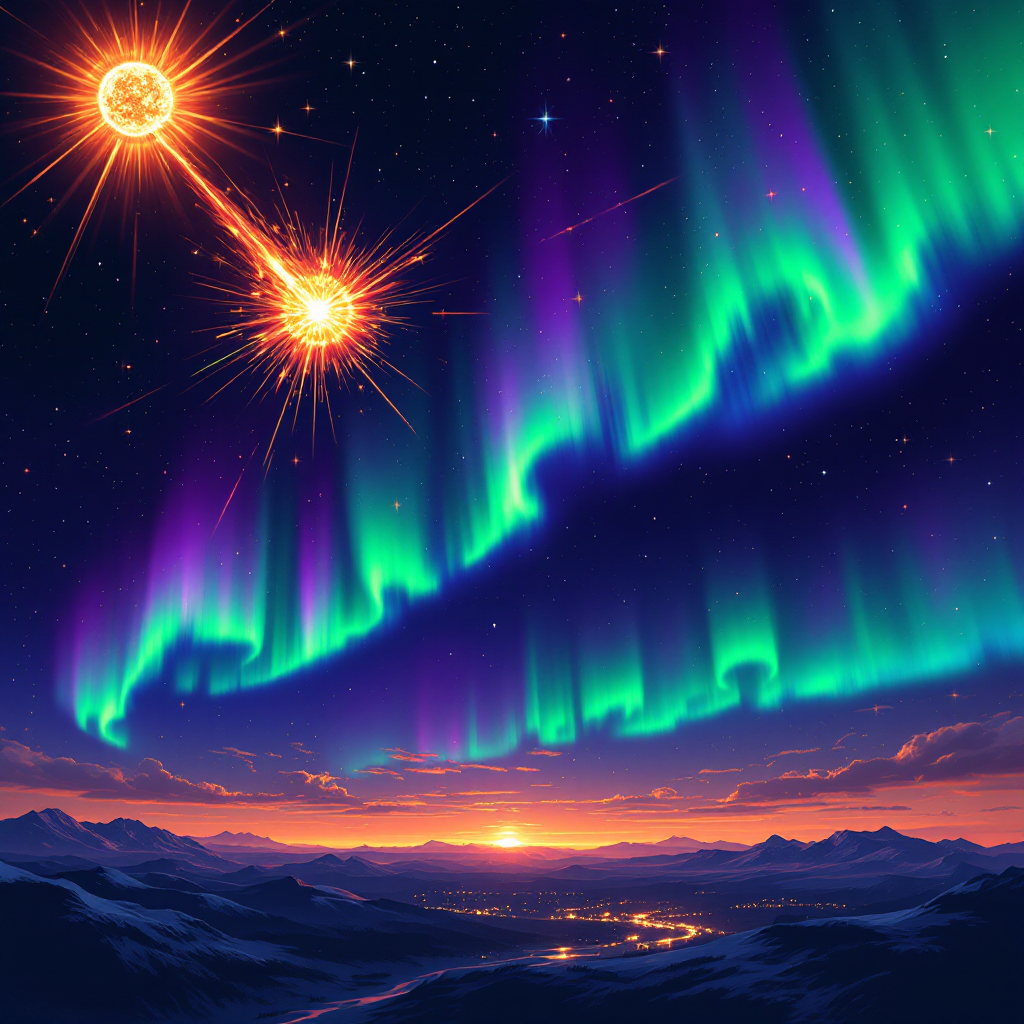
The Ultimate Solar Flare of 2025: The Prelude to a Massive Northern Lights Display
In November 2025, an unprecedented X1.7-class solar flare erupted from the Sun and struck Earth with immense force. What kind of celestial spectacle will this powerful storm unveil for us? The answer lies in the Northern lights tonight.
Historic-Scale Solar Flare: The Strongest on Record in 2025
On the morning of November 12, 2025, the NOAA Space Weather Prediction Center delivered shocking news: a G4 (Severe) geomagnetic storm warning was issued. This was no ordinary alert. It meant that the strongest solar flare of 2025 had hit Earth head-on.
The X1.7-class solar flare, which occurred between November 9 and 10, was emitted from the highly active sunspot AR4274. Not only was this flare powerful, but it was also accompanied by three massive Coronal Mass Ejections (CMEs). This phenomenon, akin to a colossal chain reaction of bombs going off in space, violently shook Earth’s magnetic field.
The “Cannibalizing” Effect of CMEs: Amplified Shockwaves
What makes this event even more fascinating is its mechanism. Two CMEs released on November 9 and 10 raced through space at high speed, overtaking one another. Like cars speeding down a highway where one overtaking the other causes shockwaves to intensify, these CMEs merged to amplify the shockwave.
According to NOAA’s modeling, this interaction upgraded the geomagnetic storm classification from G3 (Strong) to G4 (Severe). As a result, the visibility of the Northern Lights stretched all the way down to 35 degrees north latitude, a vivid testament to the storm's extraordinary power.
Solar Cycle 25: The Peak of Intense Solar Activity
Behind this dramatic event lies a grander cosmic phenomenon: Solar Cycle 25. The Sun follows an approximately 11-year cycle of fluctuating activity levels, reaching a peak around the end of 2024. High-intensity flares continued to erupt in 2025.
Sunspot AR4274 demands particular attention. This massive sunspot remained active for 10 consecutive days facing Earth, releasing three X-class flares during that period. This isn’t a coincidence. When a sunspot faces Earth at the peak of a solar cycle, we witness some of the most spectacular space weather phenomena imaginable.
Historical Comparison: Echoes of the 2003 Halloween Storm
Reflecting on history helps gauge the scale of this storm. NOAA senior scientist Dr. Rob Steenburgh likened the current event to the 2003 Halloween Storm.
What made that 2003 storm so remarkable? It caused massive power outages in Quebec, Canada, and the Northern Lights were visible as far south as Florida, creating a breathtaking spectacle. If this G4 storm reaches a similar magnitude, Northern lights tonight will not just be an ordinary display — it could become a historic record.
From the Sun to Earth: A 150 Million Kilometer Message
At the heart of all these phenomena is the Sun, 150 million kilometers away. When solar activity disrupts Earth’s magnetic field and atmosphere, the effects appear in our night sky.
High-energy particles from the solar flare stream along Earth’s magnetic lines into the polar regions, colliding with oxygen and nitrogen molecules in the atmosphere, producing vivid green, purple, and red lights. This is far more than just a mystical display—it is a breathtaking moment where we witness the physical interaction between space and Earth with our own eyes.
Tonight, as you gaze upon the sky, you aren’t merely admiring beautiful lights. You are witnessing the transfer of immense cosmic energy on a planetary scale.
Section 2: The Light Show Embroidering the Sky: Everything About Northern Lights Viewing Tonight
A G4-class geomagnetic storm alert has been issued by NOAA! A massive aurora is expected to paint the skies across more than 50% of North America—will your area be able to witness this spectacle?
Tonight (November 12–13) is no ordinary night sky. Three gigantic coronal mass ejections (CMEs) unleashed by an X1.7-class solar flare are entering Earth’s atmosphere, creating a special evening where most parts of the North American continent can witness the mysterious aurora. The scale and reach of tonight’s northern lights are being hailed as the largest since the 2003 Halloween Storm.
🗺️ Can You See the Northern Lights from Your Location? A State-by-State Viewing Guide
According to real-time data from NOAA and NASA, the northern lights viewing range on the night of November 12 is exceptionally broad. Check the table below to see the likelihood of aurora visibility from your area.
| Viewing Probability | State(s) | Features |
|---|---|---|
| Clear View (★★★★★) | Alaska, North Dakota, Minnesota, Montana, Vermont | Vivid green and purple auroras stitching the northern sky |
| Naked Eye Possible (★★★★☆) | Wisconsin, Michigan, Maine, South Dakota, Idaho | Observe from northern horizon after 30+ minutes of dark adaptation |
| Camera Required (★★★☆☆) | Iowa, New York, Pennsylvania, Ohio, Illinois | Detectable with smartphone Night Mode (barely visible to naked eye) |
| Limited Visibility (★★☆☆☆) | Indiana, Massachusetts, Nebraska, Wyoming | Only identifiable on the northwest horizon through a camera |
| Extremely Rare (★☆☆☆☆) | Northern California, Tennessee, Northern Alabama | Intermittent sightings only if the G4 storm strength persists |
Important Notice: Success in spotting tonight’s northern lights depends heavily on your location and weather conditions. Especially regions marked as "partly cloudy" by weather forecasts may have difficulty observing the aurora, so always check real-time weather updates.
⏰ Optimal Viewing Time: Midnight is Key
Even with perfect preparation, missing the timing means missing the aurora. NOAA’s Space Weather Prediction Center reports:
- Peak Time Window: Local time from 10 PM to 2 AM (midnight ± 2 hours)
- Prime Viewing Hour: Within 1 hour before and after midnight (brightest and widest aurora activity)
- Eye Adjustment: Spend at least 30 minutes in darkness for your eyes to detect the aurora clearly
With the current KP index forecast at 8, the viewing range may extend into southern areas. It’s wise to head outdoors earlier than planned to let your eyes fully adapt to the dark.
📍 Choosing the Perfect Spot for Successful Viewing
To fully enjoy tonight’s northern lights, selecting the right location is crucial:
Step 1: Minimize Light Pollution
- Use the Light Pollution Map to find regions classified as Class 3 or below
- Avoid urban centers; move at least 30 km away from city lights
- Urban light pollution can block over 70% of aurora visibility
Step 2: Secure a Clear Northern Horizon
- Pick an open northern-facing spot like a mountain peak, lake shore, field, or empty parking lot
- Avoid areas blocked by buildings or trees
- Aim for a wide-angle, unobstructed sky view
Step 3: Confirm Safety and Comfort
- Ensure safe outdoor conditions ahead of time
- Dress warmly, bring blankets and hand warmers (November nights can dip below freezing)
- Fully charge camera batteries and bring extras
📱 Don’t Miss It with Your Camera: Smartphone Tips
The faintest northern lights not visible to the naked eye can appear up to 5 times brighter through your camera. Maximize your latest smartphone’s capabilities:
Smartphone Night Mode Usage
- Latest models like iPhone 15 Pro, Galaxy S24 or newer are recommended
- Mount on a tripod and use 10–30 second long exposure shots
- Use Live View to scan the sky in real time and identify aurora zones
Shooting Tips
- Block blue light to preserve night vision
- Increase ISO carefully without introducing excessive noise
- Focus on stars using autofocus mode
Real-Time Monitoring
- Check NOAA’s SWPC Aurora Dashboard for 30-minute updates
- A KP index of 7 or higher signals expanded viewing ranges
- Trust official data over social media rumors
⚠️ Beware of Misinformation: Spotting False “Northern Lights Tonight” News
Exaggerated claims such as "Northern lights visible from California" are rapidly spreading on social platforms. NOAA clearly warns:
Characteristics of False Information
- "Aurora visible in Florida" → Completely unfounded
- "Aurora surge in Southern California" → Extremely unlikely
- "Anyone can see it without equipment" → Only limited regions under specific conditions
Reliable Sources for Trusted Updates
- NOAA Space Weather Prediction Center (official)
- NASA Solar Dynamics Observatory
- Korea Astronomy and Space Science Institute’s solar activity newsletters
If the G4 storm persists, only faint auroras might appear over northern California—and only under optimal weather. Manage your expectations rationally to avoid disappointment.
🌡️ Weather Conditions Checklist for Viewing Success
Finally, check the weather factors that decide your chances of seeing the northern lights tonight:
- Clear Skies → Optimal conditions (forecasted in the Midwest)
- Partly Cloudy → Moderate chances (expected in the Northeast)
- Mostly Cloudy → Viewing highly unlikely
- Overcast → No chance of observation
Currently, clear weather predicted in the Midwest sets the stage for prime aurora viewing, whereas East and West Coast chances depend heavily on cloud coverage.
You are now fully prepared. Tonight, lift your gaze to the sky and witness the dazzling dance of light traveling from the sun. This is the true wonder gifted by science and nature alike.
Secret Tips from Astronomers: How to Capture the Invisible Northern Lights on Camera
The magic of the northern lights—faint to the naked eye but vividly captured by your smartphone camera! What are the ideal locations, times, and top shooting tips recommended by experts? Tonight, we unveil astronomers’ secret know-how to successfully photograph the northern lights tonight.
🎥 Why Cameras Are 5 Times Better Than the Naked Eye: The Science Behind It
The reason photographing northern lights tonight has such a high success rate with cameras is simple. While human eyes only react to fleeting light, cameras use long exposure techniques to accumulate faint light over time. According to NOAA researchers, the latest smartphone cameras boast over 5 times the light sensitivity compared to what we see with our eyes.
High-end smartphones like the iPhone 15 Pro and Galaxy S24 can capture faint green and purple auroras in Night Mode during 15–30 seconds of exposure. This works by drastically boosting the camera sensor’s ISO setting and extending shutter time to gather more photons.
📍 The Best Shooting Locations: How to Avoid Light Pollution
Half of your success in capturing northern lights tonight depends on where you shoot.
Step 1: Check the Light Pollution Map
First, visit Light Pollution Map and search your area. Color codes are:
- Black (Class 1-2): Optimal astronomical conditions (remote countryside)
- Blue (Class 3): Excellent conditions (rural outskirts)
- Green (Class 4-5): Good conditions (suburbs)
- Red (Class 6-8): Not recommended (city center)
Aim for a location with Class 3 or lower to increase your chances of seeing northern lights tonight clearly.
Step 2: Choose a Spot with a Clear Northern Horizon
Auroras appear in the northern sky, so ideal locations include:
- Lakes or rivers (water reflections amplify light)
- Mountain tops or ridges (minimal obstruction from buildings or trees)
- Expansive farmland or meadows
- Parks or protected reserves (night sky lighting regulations)
Important: Avoid south- or east-facing residential yards. Streetlights or buildings in the background can drastically degrade photo quality.
⏰ The Golden Hours: Peak Time is Midnight ± 2 Hours
The optimal time window for shooting northern lights tonight is 10 PM to 2 AM local time.
This period matters because Earth’s magnetosphere is most intensely impacted by solar winds then. NOAA’s KP index forecast predicts a KP 8 for tonight (Nov 12-13), making the hour around midnight the peak of aurora activity.
Hourly Shooting Strategy
| Time Slot | Aurora Intensity | Shooting Tip |
|---|---|---|
| 9 PM–10 PM | Weak to Medium | Preparation, camera tests |
| 10 PM–12 AM | Medium to Strong | Prime shooting window ★★★★★ |
| 12 AM–2 AM | Strong to Very Strong | Don’t Miss This! ★★★★★ |
| 2 AM–4 AM | Weak to Medium | Last chance, aurora weakens |
📱 Perfectly Capture northern lights tonight with Your Smartphone
Basic Settings: Activate Night Mode
Tripod is a must: Handheld shots shake from vibration. Even an inexpensive phone tripod (5,000–10,000 KRW) works perfectly.
Turn on Night Mode:
- iPhone: Camera app → Night Mode (auto detects)
- Galaxy: Camera app → Mode → Night → select 10–30 seconds
Adjust exposure time:
- Weak aurora: 10–15 seconds
- Medium intensity: 15–20 seconds
- Strong aurora: 20–30 seconds
Pro Tip: Scan in Real Time Using Live View
Most people don’t know about the camera’s Live View feature, but it’s a game changer for capturing northern lights tonight:
- Activate Live View mode on your camera app
- Secure the tripod and slowly scan the northern sky on screen
- Snap the photo immediately when you see green waves on the display
This way, faint auroras invisible to the naked eye appear first on your screen, so you never miss the optimal shot.
Additional Settings Checklist
- Turn off blue light filter: Prevent brightness and color distortion
- Turn off HDR mode: Fixes exposure for auroras
- Focus lock: Set to infinity (∞)
- Manual ISO adjustment: Set highest value (ISO 1600–3200)
🔧 Reveal Hidden Auroras with Camera Editing Techniques
Editing Tip 1: Boost Contrast
After shooting, increase contrast by +30% to +50% in your phone’s default gallery editor to dramatically enhance faint aurora clarity.
Editing Tip 2: Adjust Color Temperature
Make the aurora’s green hues pop by changing:
- Color temperature: +300K to +500K (warmer tone)
- Saturation: +20% (richer colors)
Editing Tip 3: Reduce Noise
Long exposures cause noise; use Adobe Lightroom Mobile’s Detail > Noise Reduction slider to clean up your photos.
📲 Real-Time Monitoring: Don’t Miss the Perfect Moment
The final key to capturing northern lights tonight is staying updated in real time.
Check the Official NOAA Dashboard
At NOAA SWPC Aurora Dashboard, you can:
- View current and 30-minute forecasted KP index values
- Check if your location is within the aurora visibility zone
- Receive updates every 30 minutes
Recommended Smartphone Apps
- Aurora Forecast (iOS/Android): Live KP index alerts
- My Aurora Forecast: Korean language support, location-based predictions
- SpaceWeatherLive: Solar activity and aurora maps
Check these apps 30 minutes before shooting to confirm the KP index is 7 or higher—a sign that auroras might even be visible in southern areas.
🌟 Step-by-Step Practice Scenario: Ultimate Checklist
3 Hours Before Shooting
- Check tripod, battery pack, smartphone
- Finalize shooting location on Light Pollution Map
- Track KP index trend on NOAA dashboard
1 Hour Before Shooting
- Arrive at location
- Set up tripod, confirm northern horizon
- Configure camera: Night Mode on, max ISO, lock focus
During Shooting
- Shoot 5–10 photos every 10 minutes
- Continuously scan north sky using Live View
- If KP index spikes, extend exposure to 20–30 seconds
After Shooting
- Edit contrast and colors at home
- Select clearest shot and share on social media
✨ Final Thoughts: The Universe’s Wonders Through Your Camera
Capturing the northern lights tonight on camera is more than taking a photo—it’s visualizing a physical phenomenon caused by particles from the sun interacting with Earth’s magnetosphere and atmosphere.
Though faint to our eyes, the vivid green waves you capture on your smartphone are a message traveling 150 million kilometers from a distant star. Tonight, gift yourself a glimpse into this cosmic mystery—frozen forever on your camera.
Start preparing to shoot now—the sky’s spectacular dance doesn’t wait!
Why Now? The Scientific Background of the Great Aurora Outburst and the Astonishing Phenomena of Solar Activity
When the massive energy released from the sun reaches Earth's atmosphere, we witness the sky dancing with auroras. But why is this seemingly ordinary phenomenon, like the northern lights tonight, unfolding so dramatically? The answer lies hidden in the peak of the solar activity cycle and the complex mechanisms of space physics.
Solar Cycle 25: The Arrival of the 2025 Maximum Activity Phase
The great aurora outbreak we are witnessing in 2025 is no coincidence. It’s because Solar Cycle 25 has reached its scheduled peak.
The sun follows an approximately 11-year cycle of waxing and waning activity. As of late 2024, we have entered the maximum activity phase of this cycle, and it is predicted that intense solar flares will continue frequently through 2025. In particular, the active sunspot AR4274 amazed us by emitting three Earth-directed X-class flares over an incredible 10-day stretch, showcasing the sun’s awe-inspiring destructive power.
The 'CME Cannibalizing' Phenomenon: Amplifying the Solar Wind
What made this great aurora event even more intense was not just the strength of solar flares alone. A unique physical interaction known in space science as 'cannibalizing' took place.
On November 9 and 10, two massive Coronal Mass Ejections (CMEs) were released in succession and collided in outer space. A faster CME overtook a slower one, generating and amplifying shock waves. According to NOAA’s modeling analysis, the merger of these two CMEs escalated the geomagnetic storm’s strength from G3 (Strong) to G4 (Severe). As a result, the northern lights tonight extended far beyond expectations—even reaching a latitude of 35 degrees north, as far south as Alabama.
Comparing to the 2003 Halloween Storm: Historical Context
To grasp the severity of this event, it helps to compare it with past extreme cases. NOAA senior scientist Dr. Rob Steenburgh explicitly described this storm as “on par with the 2003 Halloween storm.”
The 2003 Halloween storm inflicted real damage beyond just an astronomical spectacle. It caused widespread blackouts in Quebec, Canada, and the aurora was visible as far south as Florida, USA. The fact that current northern lights forecasts are reaching this level of intensity clearly demonstrates the powerful space weather we are experiencing.
The Complexity of Sun-Earth Interactions
The process by which solar flares and CMEs affect Earth is far from a simple, linear relationship. When charged particles ejected from the sun meet Earth’s magnetic field, complex electromagnetic interactions occur. These particles get trapped in Earth’s magnetosphere and cascade into the polar atmosphere, exciting oxygen and nitrogen atoms that emit dazzling green, purple, and red lights.
Tonight’s northern lights event is more than just a beautiful natural spectacle—it is a living science textbook that reveals how the solar cycle’s peak profoundly impacts our surrounding space environment.
Looking Ahead: Solar Activity Forecast for 2025
Solar Cycle 25 remains near its peak, and scientists expect high-intensity flares to continue for several more months. This means there will likely be multiple opportunities to witness dramatic phenomena like the northern lights tonight in the near future.
However, the key is to always refer to accurate NOAA data and consider actual weather conditions when planning observations. When scientific curiosity meets practical preparation, we can fully savor the breathtaking gift that space delivers to us.
🔍 Beware of Exaggerated Information and Embrace the True Value of Appreciation: A Fresh Perspective on Northern Lights Tonight
False Information Dominating Social Media—Where Can You Really See the Northern Lights?
On the night of November 12, 2025, social media buzzed as if the entire United States could witness the wonder of the Northern Lights. Prominent were advertisements claiming "Auroras visible in California" or "Auroras observable even in Florida." However, most of these are exaggerated or distorted facts. NOAA (the U.S. National Oceanic and Atmospheric Administration) issued a clear warning:
"If the G4 storm persists, only faint lights may be visible in northern California, and observations from southern California or Florida are unfounded."
The reason false information spreads is simple: the economics of "proof shots" and "clicks." The more people get interested, the more dramatic the claims become, pushing scientific facts aside. But here’s the truth you must know.
🗺️ The Real Northern Lights Tonight: A Practical Understanding of Observation Areas
Let’s recall NOAA’s detailed map once again. Clear observations are possible only above the 40th parallel north. That means:
- Clear observation zones: Alaska, North Dakota, Minnesota, Montana, Vermont
- Naked-eye visibility zones: Wisconsin, Michigan, Maine, South Dakota, Idaho
- Camera-required zones: Iowa, New York, Pennsylvania, Ohio, Illinois
Seeing the Northern Lights in southern areas like Southern California, Texas, or Florida is extremely rare. Even though this G4-class geomagnetic storm is historically intense, the laws of physics cannot be ignored. The interaction between atmospheric particles and solar wind mainly occurs at high latitudes.
📱 Wise Information Consumption: The Importance of Science-Based Verification
When you encounter claims like “The Northern Lights will be visible tonight,” check these three crucial points:
Step 1: Verify the source
- Is it NOAA SWPC (Space Weather Prediction Center) official site?
- Is it authorized NASA data?
- Or is it a speculation by a general user or marketing account?
Step 2: Confirm location specificity
- The phrase “visible across the entire United States” is false.
- Claims of visibility “in our state” require latitude verification.
- Viewing locations must have a clear north-facing horizon.
Step 3: Consider weather conditions
- No matter how strong the solar storm, if clouds block the sky, viewing is impossible.
- Always review local weather forecasts.
- Northeastern regions had partial cloud cover forecasts, as previously noted.
🌟 Beyond the Proof Shot: Discovering the Scientific Wonder
Here’s the key question: “Why are we so fascinated by the Northern Lights?”
The answer is simple but profound. The Northern Lights are not just a natural phenomenon—they are a living testament to the interaction between the sun and Earth. Particles traveling 150 million kilometers from our star engage in a cosmic dance with Earth’s magnetic field and atmosphere.
To truly appreciate this, embrace:
Deeper understanding.
- The Solar Cycle 25 repeats every 11 years.
- Understanding X-class flares and CMEs (Coronal Mass Ejections) lets you predict aurora intensity variations.
- The KP index (Planetary K-index) scientifically measures the auroral visibility range.
Efforts to enhance experience.
- Choose locations with minimal light pollution.
- Exercise patience by allowing your eyes to adapt to darkness for 30 minutes or more.
- Use smartphone Night Mode to discover a sky deeper than what naked eyes reveal.
✨ The Value of Unembellished Beauty
Let’s be honest—you won’t clearly see the Northern Lights everywhere. But that doesn’t diminish their worth. In fact, quite the opposite.
Break free from the hype of proof shots and focus on what’s realistically observable where you are. If you live in the West, even the faint glow in the night sky can be moving, because it is proof that you are directly connected to the universe.
With scientific curiosity, Northern Lights Tonight transcends mere social media content. It becomes a letter from a corner of the cosmos, sent directly to you.
📊 Final Checklist: Advice for the Wise Observer
As you prepare for tonight, keep this in mind:
- Consult only reliable sources: NOAA, NASA, Korea Astronomy and Space Science Institute (resist the lure of misinformation)
- Set realistic expectations based on your location: Southern residents should prepare cameras; northern residents can hope for naked-eye visibility
- Check weather conditions in advance: Clouds are the biggest variable
- Understand the scientific context: Turn simple observation into a learning opportunity
- Record your experience: Use photos and notes not for validation but for personal reflection
By preparing this way, your night sky observation will transform from a fleeting trend into a lifelong scientific curiosity.
Comments
Post a Comment