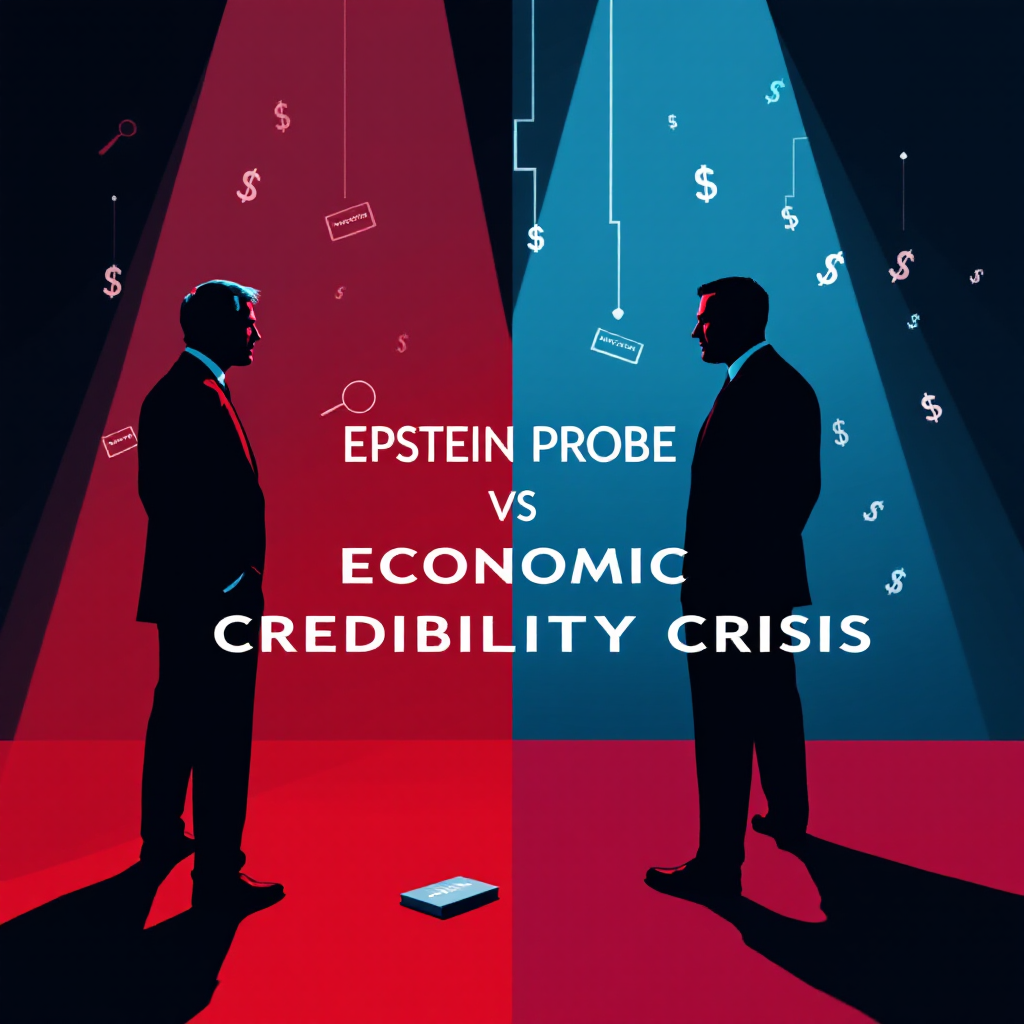
Trump-Clinton Conflict: The Hidden Battleground of the 2026 Midterm Elections
With the Epstein investigation reopening and economic policy credibility collapsing, could this clash become a turning point in American politics? Let’s delve into the battle unfolding between truth and narrative.
Trump’s “Baseless Legal Attack” vs. Clinton’s Counterstrike: The Truth Behind the Epstein Investigation Order
On November 14, former President Donald Trump announced via a White House statement that he instructed the Department of Justice (DOJ) to investigate the relationship between Bill Clinton and Jeffrey Epstein. At first glance, this sounds like a legitimate probe into past scandals, but a closer fact-check reveals a much more complicated reality.
The Background of the Trump-Clinton Clash: Political Revenge or Legal Justification?
The Epstein case reached a dead-end with his death in 2019, making uncovering the full truth virtually impossible. Nevertheless, internal emails and text records from that time suggest that not only Clinton but Trump himself had close ties with Epstein during the 1990s and 2000s. This fact, confirmed by CBS reports, deepens the controversy’s complexity.
So far, there is no legal evidence proving Bill Clinton's involvement in Epstein’s illegal activities. On the other hand, Trump’s claims about "collusion with JPMorgan Chase" were already dismissed in a 2024 civil lawsuit.
This situation implies that Trump’s order to reopen the investigation is likely driven more by political motives than legal grounds. Many analysts view it as a counterattack following Hillary Clinton’s recent aggressive criticism of Trump.
The Danger of the “Culture War” Frame: Risk of Losing the Moderate Vote
Trump’s Epstein investigation directive is seen as an attempt to strengthen the ‘culture war’ narrative. While this may rally his base in the short term, the lack of legal foundation and his own ties to Epstein make it hard to avoid the image of a political revenge plot.
With the 2026 midterms on the horizon, such political assaults risk sowing negative perceptions among moderates and centrist voters, policy analysts warn. Unfounded political offensives can ironically undermine one’s own legitimacy.
Clinton Family’s Counterstrategy: Crafting a Reverse Frame
In response, the Clinton camp is deploying a counter-frame strategy by re-highlighting Trump’s ties to Epstein. This goes beyond old scandal disputes and marks the start of a fierce political offensive for the 2026 midterms.
As the conflict intensifies, American voters face the fundamental question: “Who is telling the truth?” This is precisely why the Trump-Clinton feud could become a pivotal moment in the 2026 midterm elections, far beyond mere past controversies.
In the end, the true victor of this clash will be the side that conveys a message grounded in facts and restores public trust.
Epstein Investigation Directive: Trump vs. Clinton Clash – Political Revenge or Legal Justification?
Shocking White House Statement: "Investigation Ordered into Bill Clinton-Epstein Relationship"
On Friday, November 14, 2025, a statement from the White House shook the American political landscape to its core. Former President Donald Trump has instructed the U.S. Department of Justice (DOJ) to investigate Bill Clinton’s relationship with Jeffrey Epstein. According to Axios, Trump’s team explicitly cited the purpose of the investigation as "obtaining evidence of Bill Clinton’s ties to Epstein."
This proclamation was not merely a legal maneuver but rather a signal reigniting one of the oldest and deepest conflicts in American politics. Yet, the pressing question remains: is this truly about pursuing justice, or is it a calculated move aimed at political gain ahead of the 2026 midterm elections?
A Journey into the Past: Epstein, the Clinton Family, and Trump
Understanding this directive requires historical context. Before his death in 2019, Jeffrey Epstein was at the center of scandals involving extensive interactions with America’s elite. CBS reporting revealed Epstein’s internal emails and text records documenting:
- Interactions with Bill Clinton: Records of various meetings and social gatherings spanning the 1990s to 2000s
- Links to Democratic heavyweights including Barack Obama: Attendance at multiple events
- And, strikingly, Trump himself: Circumstantial evidence showing close ties with Epstein during the 1990s and 2000s
This is the crucial irony. While Trump orders an investigation into Clinton, he overlooks that Epstein’s case crosses political lines without discrimination.
Legal Grounds: Do They Exist?
On the surface, Trump’s directive may sound like a legitimate investigative request. However, serious issues emerge during the legal validation process.
Currently, there is no publicly available evidence proving Bill Clinton’s illegal activities tied to Epstein. Clinton’s mere attendance at Epstein’s parties or meetings does not equate to legal culpability. Social interactions from decades ago are exceedingly difficult to substantiate as criminal evidence in today’s courts.
Even more intriguing is Trump’s accompanying claim of "collusion with JPMorgan Chase." This allegation was already dismissed in a 2024 civil lawsuit. Given that this claim has been rejected once by the courts, why is DOJ being urged to reopen investigations now?
Analyzing Political Intent: When and How Did It Begin?
Connecting the timing of this directive with recent activities of the Clinton family reveals a clear pattern.
Timeline:
- Early November 2025: Hillary Clinton intensifies criticisms of Trump
- Mid-November 2025: Trump announces DOJ directive to investigate Clinton
- Chronologically, this appears as an immediate counterattack to Clinton’s assaults
This is hardly coincidental. It naturally reads as a political tit-for-tat retaliation: "If you attack me, I attack you back."
Considering the timing further, this move can be interpreted as a strategy to resurface Democratic scandals ahead of the 2026 midterms, rallying conservative bases. From a political strategy standpoint, this explanation holds more weight.
Policy Pulse’s In-Depth Assessment
Trump’s directive is better understood as an attempt to amplify the ‘culture war’ frame rather than a pursuit grounded in legal validity. Several reasons support this:
First, the statute of limitations issue
Epstein’s death in 2019 makes uncovering substantive new truths extremely challenging. Discovering fresh criminal evidence from social encounters centuries ago is highly improbable.
Second, the risk of backlash
Given Trump’s own name appears in Epstein’s internal records, this investigation risks reinforcing the narrative of “political revenge." Such a perception could especially alienate moderate voters.
Third, credibility concerns
With Trump’s economic claims already strained against reality, directing this investigation amid political calculations risks further eroding overall trustworthiness.
Clinton’s Counterattack: The Battle of Narratives
Interestingly, this saga is far from one-sided. Hillary Clinton immediately responded with a counter-framing strategy. The Clinton camp re-highlighted Trump’s own links to Epstein, questioning, “Who was truly close to Epstein?”
This escalates the scandal warfare between camps, shifting public focus from “genuine legal accountability” to “political factional battles.”
Conclusion: Politics Disguised as Law
To summarize, Trump’s Epstein investigation directive is:
- Legally weak: Lack of concrete criminal evidence, prior dismissal in civil court cases
- Politically motivated: A clear backlash against Clinton’s attacks, geared toward mobilizing voters before the midterms
- Likely outcome: More a contest of political narratives than courtroom victories
Ultimately, the Trump-Clinton feud is a fight unfolding in the arena of politics, not justice. How it will influence the 2026 midterms depends heavily on the public’s ability to discern “facts” from “political spin.”
The Gap Between Trump’s Economic Boasts and Reality: The Lie of “25% Deficit Reduction”
“Did tariffs really cut the federal deficit by 25%?” Don’t miss the moment Politifact exposes Trump’s economic claims and reveals just how far removed they are from the everyday struggles felt by Americans.
Trump’s “Economic Miracle” Claim Exposed by the Numbers
Former President Trump recently declared boldly in a speech, “My tariff policies have reduced the federal deficit by 25% in 2025.” This was his attempt to convince the public that his policies were driving an economic recovery. Yet fact-checkers quickly revealed just how far off this claim truly is.
According to Politifact’s fact-check (Politifact, November 14, 2025), Trump’s statement is utterly false. This goes beyond mere exaggeration—it distorts the very foundation of the economic policy reality presented to the public.
What the Data Really Shows: Trump’s Claims vs. Actual Figures
Numbers don’t lie. Looking at the actual data for fiscal year 2025, the picture couldn’t be clearer.
| Metric | Trump’s Claim | Actual Data |
|---|---|---|
| Federal Deficit Reduction Rate | 25% decrease | 2.3% decrease (compared to 2024) |
| Deficit Change During Trump’s Tenure (Jan–Sept) | Downward trend | 1.4% increase ($1.064T → $1.079T) |
| Increase in Tariff Revenues | “Key to deficit reduction” | $143.8B increase over 2024 (about 13.4% of total deficit) |
This doesn’t mean tariffs had no effect at all. In fact, the additional $143.8 billion in tariff revenue is a significant sum. But it only represents 13.4% of the total deficit, with the rest still looming large. Even more telling is that the deficit actually grew by 1.4% during the first nine months of Trump’s term, exposing the limits of his policies.
The Economy Felt by Americans Is Quite the Opposite
The disconnect between Trump’s economic boasts and reality is far more evident not in the stock market but in daily life. According to NHPR’s report on November 14, 2025, despite Trump’s touted “record-high stock market,” average Americans are grappling with three major financial pressures.
The Reality of Grocery Prices:
- Up 8.2% compared to 2024 (U.S. Bureau of Labor Statistics data)
- Household grocery bills are increasingly heavy
Housing Costs Burden:
- Median home price at $428,000 (a 5.1% increase over 2024)
- The dream of homeownership is slipping further away
Health Insurance Premium Hikes:
- Averaging $747/month (a 6.3% rise from 2024)
- Medical expenses remain a growing strain
This is the real economy citizens live day-to-day. Rising stock indices do little to ease the anxiety at the supermarket checkout line.
Criticism Erupts Even Within the Republican Party
Interestingly, as the political feud between Trump and the Clintons intensifies, criticism of Trump’s economic policies is emerging from within his own party.
Representative Marjorie Taylor Greene bluntly stated in an interview on the Sean Spicer Show, “Gaslighting only enrages the public. Ignoring what people spend at the grocery store is fatal.”
Such frank remarks from a fellow Republican signal that Trump’s economic claims are losing credibility even inside the party. Because if people don’t feel their lives improving, no sophisticated statistics can convince them otherwise.
The 2026 Midterm Election Will Be Decided by the “Pocketbook Economy”
While the long-running Trump-Clinton political rivalry heats up with the reopening of the Epstein investigation and other past scandals, the real battleground will be the economy as experienced by everyday Americans.
The $143.8 billion in additional tariff revenue Trump secured did contribute somewhat to federal finances. But the public’s perception is nearly zero improvement. On the contrary, rising prices for goods, soaring housing costs, and climbing medical expenses have all eroded real purchasing power.
When voters head to the polls in 2026, their ballots will be a direct verdict on the “pocketbook economy.” Political scandals and media battles matter, but ultimately, voting decisions hinge on whether people feel their economic reality is improving.
In the Age of Fact-Checking, Information Literacy Determines Elections
Trump’s claim of “25% deficit reduction” is a blatant falsehood easily debunked within minutes by expert fact-checkers like Politifact. It stands as a prime example of a “lie disguised in numbers.”
The 2026 election is not just a contest between Trump and the Clinton faction. Fundamentally, it asks whether politicians who present fact-based policies can earn the trust of the public.
When people awaken to false economic claims, politics will finally face genuine change. That is the true mechanism of democracy.
The Outlook of the 2026 Midterm Elections: Economic Sentiments Will Decide
Beyond investigations and political bickering, the true battleground of the midterms lies in voters’ wallets! From Trump’s rallying base, centrist defections, to Clinton’s counterattacks… let’s explore the political forecast shaped by these three unfolding scenarios.
Why the Trump-Clinton Conflict Is a Key Wildcard for the Midterms
In recent weeks, Trump’s order to investigate Epstein and his verbal clashes with the Clinton family have set American politics ablaze. But the real focus has been overshadowed by White House statements and media battles. The hidden variable is the “economic sentiment” felt by everyday citizens.
The 2026 midterms aren’t just a political showdown. They serve as the litmus test for whether Trump’s economic policies have truly improved Americans’ lives. While the Epstein probe and Clinton controversies make sensational headlines, voters are far more sensitive to rising grocery costs and housing prices in their shopping carts.
Three Scenarios: The Turning Points of the 2026 Election
Scenario 1: Trump Successfully Rallying His Core Supporters
Strategy: Frame the Epstein investigation as a “Democratic corruption cleanse.”
In this scenario, Trump recasts the Epstein probe as the “hand of justice exposing hidden Democratic corruption.” If conservative media amplifies this narrative, Trump’s core base—comprising 35-40% of voters—will grow even more united.
Potential Upsides:
- Reunification of Rust Belt workers who drifted away in 2024
- Increased conservative voter turnout, resulting in wins for some Republican candidates
Risks:
- If the economic boost isn’t tangible, long-term effects will be limited
- The centrist voters may perceive the conflict as mere “political mudslinging” and drift away faster
Scenario 2: Accelerated Defection of the Centrist Voters (Most Likely)
Strategy: The combined effect of political bickering and economic stagnation
As Trump and Clinton’s antagonism intensifies, centrist voters are increasingly likely to say, "We don’t care about politicians' old scandal fights.” Coupled with a failure to feel economic improvement, these voters naturally turn toward Democratic candidates.
Warning Signs:
- Democratic victories in the November 2025 Virginia and New Jersey gubernatorial elections
- A dip in positive public sentiment toward the national economy in recent polls
Centrist Mindset:
“The stock market may be up, but my grocery bill jumped 8.2%.
And politicians keep going on about Epstein from 20 years ago?”
→ Outcome: Abstention or voting for the opposition
Scenario 3: Clinton’s Counterattack and Widening Political Turmoil
Strategy: Rehighlight Trump-Epstein ties and launch political counterstrikes
Hillary Clinton’s recent vocal criticisms are no coincidence. She and the Democratic camp are preparing a counterframe accusing Trump: “Weren’t you close to Epstein too?”
Clinton Camp’s Countermoves:
- Reexamination of Trump-related parts in Epstein’s emails and text messages
- Questioning potential Trump ties with JPMorgan scandals
- Simultaneous attacks on genuine corruption and “false economic promises”
Consequences:
- Escalated political clashes fueling greater centrist confusion
- Heightened emotional rifts between Democrats and Republicans
- Polarization leading either to a sharp rise or plunge in 2026 voter turnout
Economic Sentiment: The True Decider of the Midterms
However, one overriding factor outmatches all three scenarios: the “pocketbook economy.”
A Snapshot of Economic Realities
| Indicator | Figure | Felt by Citizens |
|---|---|---|
| Grocery price inflation | +8.2% | Felt every week at the supermarket |
| Median home price | $428,000 (↑5.1%) | Owning a home feels more out of reach |
| Health insurance costs | +$747/month (↑6.3%) | Draining monthly paychecks |
The $143.8 billion in tariff revenue undoubtedly helps reduce the federal deficit. But unless it translates into lower family electric bills, gasoline prices, and food costs, the public will continue to feel economic strain.
The Trump Administration’s Dilemma
Trump: “We cut the deficit by 2.3%!”
People: “Then why hasn’t my paycheck increased?”

Trump: “Stocks are hitting record highs!”
People: “But I don’t own any stocks...”
This gap represents the crucial battleground of the 2026 midterms.
Policy Pulse’s Midterm Outlook
Worst Case: Weakness for Trump’s Party
If the Trump administration fails to deliver household relief measures—such as lowering energy costs, regulating prescription drug prices, or encouraging reduced mortgage rates—then 2026 will spell nightmare for Republicans. The Epstein probe and Clinton scuffles may only rile conservative emotions without swaying the swing voters.
Best Case: Clear Results from Economic Policies
Conversely, if the Trump administration:
- Returns tariff revenue directly to families (e.g., $500 energy vouchers)
- Intervenes in prescription drug prices via the FDA to cut medical bills
- Demonstrates massive job creation through infrastructure investment
…then an improved economic sentiment could trigger a Republican resurgence.
The 2026 Midterms Ultimately Boil Down to This Question:
“Is your life better than it was two years ago?”
The more voters say “yes,” the more Trump and the GOP will gain in November. The more say “no,” the greater the opportunity for Clinton’s camp and the Democrats.
While the Epstein investigation, Clinton sparring, and political clashes make news, at the ballot box in November 2026, voters will bring with them not headlines—but their personal scrutiny of rising living costs.
The winner of the 2026 midterms won’t be decided by who wins political mudslinging—it will be determined by economic reality.
Who Is the True Winner? Fact-Checking Divides Tomorrow’s America Amid Trump-Clinton Clash
Between lies and hype, what will the people choose? Policies grounded in numbers and facts will shape the real victor of the 2026 elections. In this era of verification, here’s a crucial lesson we must all remember.
🎯 In the Age of Information Warfare, Fact-Checking Becomes the Voter’s Power
The most dangerous phenomenon in today’s American politics is not “who yells the loudest”—it’s “which claims get verified.” The revived Trump-Clinton conflict clearly illustrates this reality.
On one side, the old card of the “Epstein investigation” was played; on the other, the future promise of “peak economic performance” was touted. Yet, Politifact’s fact-checking shattered all these claims in just five minutes. The “25% deficit reduction” was actually only 2.3%, and the deficit in Trump’s first nine months in office had, in fact, increased by 1.4%.
This is precisely the factor that will decide the real landscape of the 2026 midterms.
📊 Truth Hidden Behind the Numbers: The Fine Line Between Hype and Verification
Why does Trump’s claim of the “stock market’s all-time high” clash so starkly with how people feel about the economy? The answer to this question is the very essence of the fact-checking era.
Trump’s Economic Claims vs. Public Reality:
- Claim: “Tariff policies boosted imports by $143.8 billion”
- Reality: Simultaneously, grocery prices rose 8.2%, housing prices 5.1%, and health insurance premiums 6.3%
Here lies the core issue. Economic indicators and household burdens have become two separate realities. Numbers may narrate the election story, but the contents of the shopping cart ultimately decide the vote.
At the same time, Clinton’s camp launches counterattacks on the same principle. Attempts to resurrect the old “Trump-Epstein connection” scandal falter under the fact-checking verdict of “no legal basis.” Neither Trump nor Clinton can escape their entanglement in internal email and text records that involve Epstein—that fact alone speaks volumes.
🔬 The Role of Fact-Checkers: The Last Stronghold of Democracy
Whether the 2026 election morphs into a “Trump era without Trump” or sees the base rally once more depends entirely on who offers claims verified more effectively.
Why fact-checking platforms have become critical:
- Uncovering lies behind the numbers: Politifact labeled Trump’s “25% deficit cut” claim false after comparing it with actual data.
- Revealing structural economic pain: Proving that the public’s economic distress is not mere “psychological anxiety” but a real inflationary increase.
- Consistent scrutiny of both parties: Applying the same standards to Clinton and Trump is the first step toward restoring trust.
Even Republican lawmaker Marjorie Taylor Greene’s statement symbolizes this reality. The emergence of internal GOP criticism like “gaslighting only angers the public” is clear evidence that fact-less claims are losing their political vitality.
🗳️ The 2026 Election: What It Takes to Be the Real Winner
Here’s a vital insight we cannot ignore.
The rekindling of the Trump-Clinton conflict actually signals a new ‘camp war’ for the 2026 midterms. But the outcome of this war will no longer hinge on volume of hype—it will depend on the strength of fact-based verification.
Conditions for the real winners in 2026:
| Factor | Past (2024) | Present (Expected 2026) |
|---|---|---|
| Primary Weapon | Emotional hype and old scandals | Verifiable policies and tangible economic improvement |
| Voter Decision Basis | Ideological showdown | Specific reductions in household burdens |
| Trust Variable | Candidate charisma | Fact-based policy pledges |
Here’s the most intriguing point: both Clinton and Trump camps are confronting the ultimate reality—“you cannot beat the fact-checkers.” Independent verification bodies like FactCheck.org, Politifact, and NHPR examine both sides' claims equally, making lying no longer a viable long-term strategy.
💡 The People's Choice: Verification Skills Are Political Power
The most important message from Policy Pulse:
We live in an age of “information sovereignty.” Whether Trump or Clinton, any political claim can be vetted within five minutes of fact-checking.
The party and candidate who will win in 2026 will be those who:
- Present concrete policies like “here’s how we will reduce household burdens,” not vague claims like “the stock market is booming.”
- Offer a forward-looking vision such as “this is how we improve citizens’ quality of life,” instead of “we will investigate the other side.”
- Bring forth verifiable economic pledges rather than recycling old scandals.
This is precisely how, in the “fact vs. frame” battle, the people become the true winners.
🎓 A Lesson We Must Never Forget
The final insight:
The Trump-Clinton clash will be remembered in history as a moment when both sides tried to use the past as a weapon to dazzle the future. But with fact-checking as a new democratic tool, that paradigm is undergoing a complete transformation.
What every political faction aiming to win the 2026 midterms must know:
The public no longer believes lies. Only verified facts and concrete policies will earn voters’ support at the ballot box.
This marks democracy’s maturation. The era of rampant falsehoods is over, and the age of fact-based politics has officially begun. The true champion of 2026 will be neither Trump nor Clinton, but the people who choose to verify.
Comments
Post a Comment