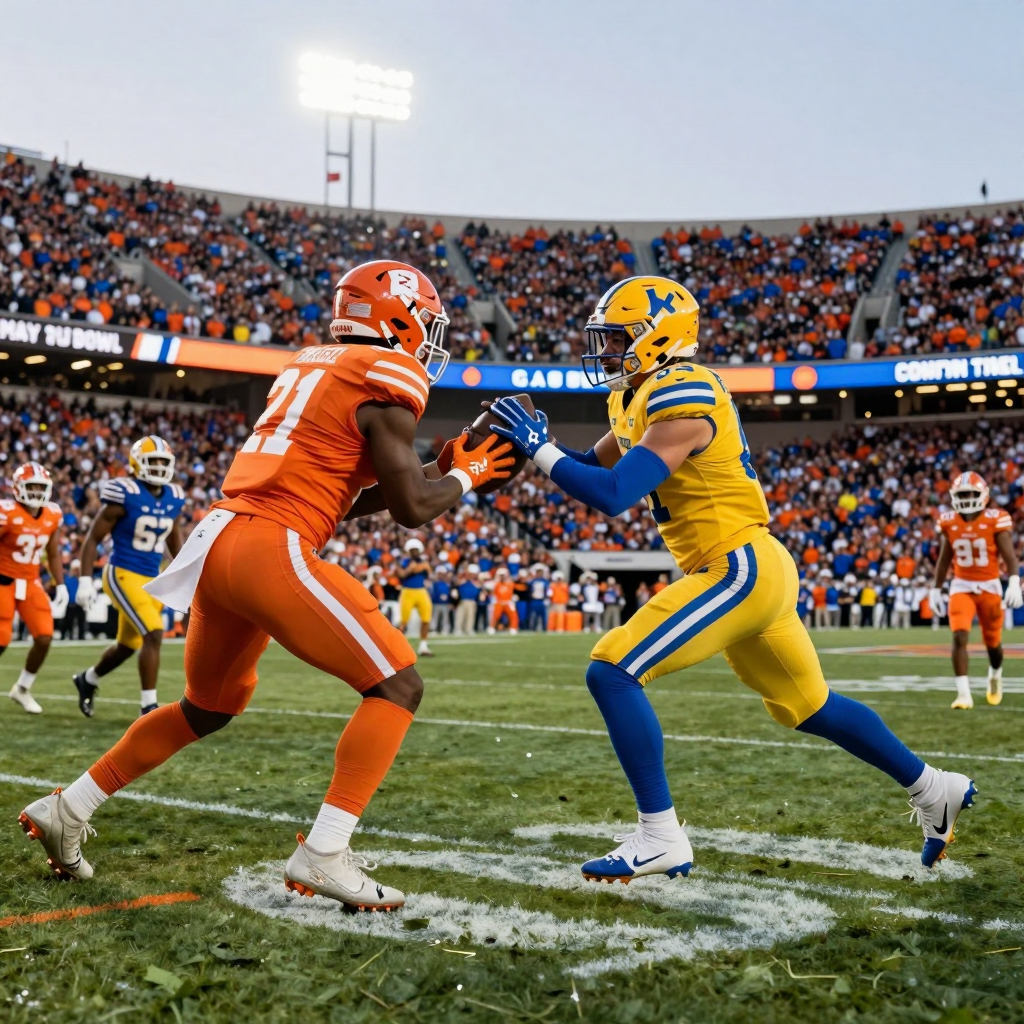
Main Event: The Prelude to the 2025 Citrus Bowl Showdown
If Texas dominates Michigan with a 62% chance of victory, will this prediction become reality? Let’s explore together the thrill that a single game's outcome reveals in sports.
Background and Anticipation for the Michigan vs. Texas Matchup
On December 31, 2025, at Camping World Stadium in Orlando, Florida, the historic 80th Citrus Bowl will unfold. The clash between the Michigan Wolverines and the Texas Longhorns is more than just a season finale; it’s a golden opportunity to truly measure the strength of these two prestigious teams.
Both teams boast identical 9-3 records and carry dreams of glory. Yet, analysts make one thing clear. According to Dimers’ statistical model, Texas holds a 62% chance of defeating Michigan, with a predicted final score of Texas 27, Michigan 22.
What the Betting Market Reveals About the Game
The betting market’s evaluation of the Michigan vs. Texas game is highly reliable. Texas is favored with a -4.5 spread, while the Over/Under is set at 49.5. Moneyline odds also reflect Texas’s advantage.
Even more intriguing is Fox Sports’ analysis. Based on spread and Over/Under, the implicit score prediction estimates Texas at 28 points and Michigan at 21—mirroring Dimers’ forecast. This consensus among experts adds another layer of intensity to the looming battle.
Strengths and Weaknesses of Both Teams Through the Lens of Statistics
Numbers don’t lie. Michigan leads in offensive efficiency with 6.2 yards per play, edging Texas’s 5.7. However, Texas showcases superiority elsewhere. Defensively, Texas ranks 15th nationally, close to Michigan’s 12th, but in red zone scoring efficiency, Texas shines with 84.44% compared to Michigan’s 78.72%.
The most striking stat is turnovers. Texas ranks third nationally with just 8 turnovers, while Michigan sits 40th with 14. This gap could prove a decisive factor shaping the outcome.
Offensive Philosophies and What They Mean for the Game
What truly amplifies the excitement in the Michigan vs. Texas clash is their contrasting offensive strategies. Texas, led by quarterback Arch Manning, executes a balanced attack with a notably effective air game. Michigan, on the other hand, sticks to a traditional rush-heavy approach, maintaining a hefty 59.3% rush play ratio.
This tactical divergence is expected to directly impact both teams’ defensive strategies. Will Michigan’s powerful running game break through Texas’s sturdy defense? Or will Arch Manning’s passing prowess overwhelm Michigan’s edge rush? These questions hold the key to unlocking the heart of this epic showdown.
The Numbers That Could Decide the Game: The Secret Behind the Michigan vs Texas Spread and Odds
With Texas holding a -4.5 spread advantage and a moneyline edge, aren't you curious about how these figures might actually impact the game's outcome? Ahead of the 2025 Citrus Bowl, let's dive deep into the betting market signals revealed by the Michigan vs Texas matchup.
Michigan vs Texas Spread Analysis: The Meaning Behind -4.5
The Texas Longhorns have been set as the favored team with a -4.5 spread. This doesn’t just indicate that Texas is stronger—it’s a crucial indicator showing how the betting market evaluates the skill gap between the two teams.
In the Michigan vs Texas case, the spread movement is particularly intriguing. Texas boasts an impressive 5-0 record in their last five games, but when considering the spread, they’ve struggled with a 2-3 record against it. This suggests the betting line somewhat captures market expectations, yet the actual outcomes have not fully met those expectations.
On the other hand, the Michigan Wolverines have maintained a 4-8 negative record against the spread throughout the season. This implies Michigan tends to lose by larger margins than expected or win by smaller ones. Consequently, the current -4.5 spread could be a positive sign for those backing Michigan.
Over/Under 49.5: Predicting the Score Duel
The Over/Under for Michigan vs Texas is set at 49.5 points. This figure reflects a comprehensive assessment of both teams’ offensive and defensive strengths, plus game tempo.
According to Fox Sports’ analysis, the implicit score based on the spread and Over/Under is Texas 28, Michigan 21. That totals 49 points, nearly mirroring the line itself. Factoring in offensive efficiency, Texas’s attack (ranked 61st, averaging 29.6 points) slightly edges out Michigan’s (ranked 78th, averaging 27.6 points).
Moneyline Odds: Quantifying Winning Probabilities
The Michigan vs Texas moneyline stands at Michigan +170, Texas -205. Unlike the spread, these odds offer a more straightforward reflection of each team's chances of winning.
Texas’s -205 odds mean you must bet $205 to win $100, indicating the market rates Texas’s win probability as quite high. Conversely, Michigan’s +170 payout lets you win $170 on a $100 wager, suggesting an underdog position with some value.
Discrepancies in Expert Prediction Models
What’s especially fascinating is the divergence among analytical models regarding win probabilities.
Dimers’ model assigns Michigan a 38% chance to win, with Texas at 62%, predicting a final score of Texas 27, Michigan 22.
By contrast, Fox Sports’ analysis presents a more Texas-favorable outlook, giving Michigan only a 29.4% chance, while Texas boasts 74.7%, consistent with the implicit score of Texas 28 to Michigan 21.
This roughly 12 percentage point gap between models highlights the uncertainty surrounding the Michigan vs Texas game, hinting at potential value opportunities for savvy bettors.
The Gap Between the Spread and Reality
One crucial aspect in bowl games like Michigan vs Texas is the roster changes due to player opt-outs. Michigan’s diminished edge rush and linebacker capabilities, alongside the absence of Texas’s linebacker corps, may alter the actual dynamics from those assumed when the spread was set.
Such factors might not be fully reflected in official spread adjustments, creating real chances or risks for bettors relying on outdated information.
Conclusion: What the Numbers Are Telling Us
The Michigan vs Texas spread (-4.5) and moneyline (-205) clearly favor Texas. However, differences between expert models, inconsistencies in recent records, and the impact of player opt-outs suggest this matchup could be far more competitive than it appears. Wise betting is not about blindly following numbers, but about understanding the uncertainties hidden behind those figures.
3. The Strategies of Michigan vs Texas and the True Battle Seen Through Statistics
The Citrus Bowl showdown between Michigan and Texas is far more than just a numbers game. The heart of the contest lies in how the two teams' contrasting offensive philosophies and strengths collide on the field. Especially critical will be how Michigan’s outstanding offensive efficiency overcomes Texas’s superior red zone performance and turnover advantage—factors that could ultimately decide the victor.
Michigan vs Texas: A Philosophical Contrast in Offensive Styles
Michigan and Texas reveal fundamental differences in their offensive approaches. Michigan adheres to a rush-heavy, conservative strategy (59.3% rushing plays) that clearly aims to control the tempo of the game. In contrast, Texas prefers a balanced air attack centered around quarterback Arch Manning, leveraging a wider variety of offensive options.
Intriguingly, this philosophical divide is clearly reflected in efficiency metrics. Michigan boasts 6.2 yards per play, surpassing Texas’s 5.7, showcasing superior offensive effectiveness. This means Michigan gains more yards every play on average, underlining the qualitative edge of their offense.
Decisive Strengths in Statistics: Red Zone and Turnover Management
However, looking deeper into the stats reveals Texas’s standout strengths. Texas’s red zone scoring efficiency at 84.44% clearly outpaces Michigan’s 78.72%. This figure speaks volumes beyond mere numbers—it signals Texas’s superior clutch performance near the goal line when the stakes are highest.
Even more striking is turnover management. Texas ranks third nationally with only 8 turnovers all season, while Michigan sits at 40th with 14 turnovers. This six-turnover gap can become a game-changer during critical moments, potentially shifting momentum decisively.
Striking the Balance Between Offensive Efficiency and Clutch Execution
At the heart of the Michigan vs Texas battle is this clash between two pivotal metrics. Can Michigan’s superior offensive efficiency overcome Texas’s red zone precision and turnover advantage?
If Michigan can maintain its offensive flow, it’s likely to create more scoring drives. Yet Texas is lethal with opportunities—they convert on an impressive 84.44% of red zone visits and handle the ball with exceptional care. Ultimately, the true test lies in how effectively each team can capitalize when in scoring position.
The Defensive Statistics Connection
Defensively, the two teams contrast intriguingly as well. Michigan allows 18.7 points per game (ranked 12th), slightly better than Texas’s 19.8 points per game (ranked 15th), but the difference is not decisive. Hence, the outcome will probably hinge on offensive quality, efficiency, and execution at critical junctures.
This Citrus Bowl clash between Michigan and Texas is not merely about which team is stronger. It poses a compelling question: Can refined offensive efficiency defeat smart ball management? The unpredictable variables beyond statistical models are expected to unfold dramatically on game day.
Section 4: Deep Dive into Key Variables – Player Opt-Outs and Clash of Play Styles
Watch closely how the showdown between the pressured quarterback Arch Manning and Michigan’s rush-heavy approach, along with shifts in defensive strength caused by player absences, could shake up the outcome of this Citrus Bowl. The 80th Citrus Bowl clash between Michigan and Texas isn’t just a simple face-off between evenly matched teams; it’s a complex battle intertwined with starkly different tactics and roster changes.
Arch Manning-Led Texas Offense vs. Michigan’s Rush Defense
Texas runs a balanced offensive strategy anchored by quarterback Arch Manning. Their air attack is especially potent, directly challenging Michigan’s defensive schemes. Meanwhile, Michigan sticks to a classic rush-heavy approach, focusing on ground attacks with a rush play rate of 59.3%.
This contrast in styles is pivotal in determining the game flow. Texas’s passing game threatens to exploit Michigan’s comparatively weaker pass defense, while Michigan’s formidable rushing attack puts intense pressure on Texas’s defensive front. Ultimately, this matchup boils down to which team can execute its style more effectively — a defining factor that could tip the scales in this Michigan vs Texas showdown.
Defensive Weaknesses Worsened by Player Opt-Outs
A key variable highlighted by On3’s in-depth analysis is the impact of player absences on both defenses. Michigan’s edge rush capability and linebacker strength have sharply declined, potentially giving Arch Manning more precious time in the pocket. Michigan’s defense may find it increasingly difficult to contain Texas’s efficient offense while facing numerical disadvantages.
On the flip side, Texas also struggles with missing linebackers, which could impair their ability to fully stifle Michigan’s heavy ground game. Considering Texas’s defensive efficiency ranks 15th in yards allowed—slightly behind Michigan’s 12th—this vulnerability may be even more exposed.
The Critical Role of Turnover Management
Statistically, Texas boasts an impressive third-best record in turnover mistakes with only 8, while Michigan is ranked 40th with 14 turnovers. In light of weakened defenses due to player opt-outs, managing turnovers becomes even more crucial. The more prudent Arch Manning’s decision-making, and the more Michigan slips up, the greater Texas’s momentum and control of the game.
Final Analysis: The Equation of Style and Personnel
This Michigan vs Texas battle is not solely decided by raw team strength. The key question: will Texas’s balanced offense overcome the rush-heavy Michigan defense weakened by player departures, or can Michigan’s edge rushers, despite absences, still pressure Arch Manning effectively? Taken together, these variables help explain why Dimers’ 62% win probability for Texas and Fox Sports’ 74.7% prediction feel surprisingly reasonable.
Section 5: Final Watchpoint: Predictions vs. Reality, The 2025 Citrus Bowl Outcome
As the 2025 Citrus Bowl approaches, the matchup between Texas and Michigan carries a deeper meaning beyond mere score predictions. The Michigan vs. Texas game will be a pivotal moment where statistics meet reality, and predictive models face validation.
Texas’s 5-Game Winning Streak vs. Michigan’s Struggling Spread: A Stark Contrast
What immediately stands out is Texas’s astonishing recent performance. With a flawless 5-0 record in their last five games of the season, Texas holds a clear momentum advantage. Yet intriguingly, from a spread perspective, they have underperformed expectations at 2-3. Meanwhile, Michigan’s 4-8 record against the spread throughout the regular season signals a disappointing performance relative to official predictions.
This contrast offers crucial clues for the Michigan vs. Texas contest. Will Texas sustain their momentum and cover the spread? Or can Michigan break free from their historic slump to deliver a performance that defies expectations?
What the Stats Really Say About Winning Chances
Analytical models consistently highlight Texas’s superiority. The Dimers model assigns Texas a 62% chance of victory, predicting a final score of Texas 27–22 Michigan. Fox Sports goes even further, giving Texas a 74.7% probability of winning.
These high odds are grounded in Texas’s strong defensive prowess (ranked 15th) and exceptional turnover management (ranked 3rd). On the other hand, Michigan edges out Texas in offensive efficiency (yards per play of 6.2 vs. Texas’s 5.7) but falls short in red zone scoring success—78.72% compared to Texas’s 84.44%—signaling a critical difference in clutch execution.
A Clash of Offensive Styles and the Unpredictability It Brings
But numbers alone cannot capture the full complexity of sports. Texas’s Arch Manning-led, balanced air attack offers precision and consistency, while Michigan’s run-heavy approach (59.3% rushing plays) complicates defensive predictability even in the worst scenarios.
Adding to this complexity are player opt-outs: Michigan’s diminished edge rush and linebacker capabilities, combined with Texas’s lacking linebacker corps, inject further uncertainty into forecasts.
Which Team Do You Expect to Triumph?
The Michigan vs. Texas showdown defies easy judgment based solely on win probabilities, recent records, or spread stats. Yet at this very moment where all data converge, one thing is clear:
Texas holds the upper hand across every comprehensive metric, making tight victories like 27–22 or 28–21, as projected by Dimers and Fox Sports models, the most realistic outcomes. Still, the true allure of sports lies in those moments that upend predictions.
Michigan’s chance to break the cycle of spread woes and claim victory on the Citrus Bowl stage cannot be entirely ruled out. This is precisely why the 2025 Citrus Bowl captivates fans—not just as a statistical showdown, but as a thrilling narrative where expectations can be shattered.
Comments
Post a Comment