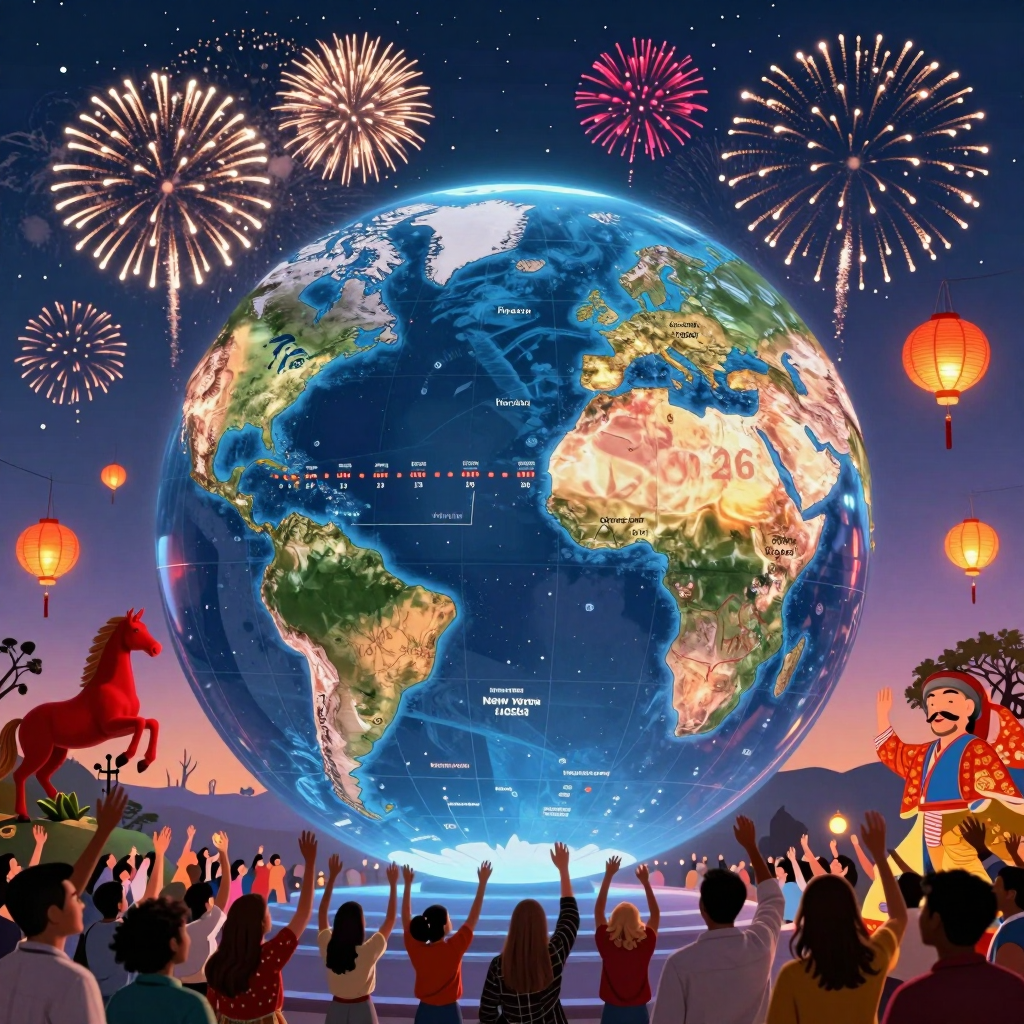
The First Day of the New Year: More Than Just a Simple Beginning
Why is January 1st celebrated as the start of the new year worldwide? Let’s uncover the historical and cultural secrets hidden behind this seemingly simple change of the calendar.
The first day of the new year we welcome each year holds a significance far deeper than just a change in numbers. January 1st officially marks the beginning of a new year in the modern world, but understanding how this tradition was formed and why it persists offers us profound insights into our culture and history.
The Historical Background of January 1st as New Year’s Day
Setting January 1st as the first day of the year is the result of a long historical journey. In Roman times, the year originally began in March, or Martius. However, with the addition of two winter months ahead of the calendar, the first day of Ianuarius (January) gained its status as New Year’s Day.
This change became prominent starting in 153 BCE and was formalized further during the Julian calendar reform in 46 BCE. Fascinatingly, the choice of January 1st was not merely for administrative convenience; it likely incorporated astronomical considerations based on the vernal equinox. This reveals just how deeply historical and scientific layers are woven into the day we celebrate as the start of the new year.
Diverse Ways of Welcoming the New Year’s Day
While it may seem that the new year’s first day happens simultaneously worldwide, in reality, it unfolds sequentially with the Earth’s rotation. The celebration begins at the International Date Line in the east and progresses westward, with the Pacific island nation of Kiribati being the very first to greet the new year.
From the perspective of South Korea, the global ringing in of the new year concludes around 9 PM. This means that New Year’s Day holds significance not just for a specific time zone but as a special moment created by the Earth’s rotation and orbital movement, linking every corner of the globe in a cosmic rhythm.
The Astronomical Wonders of New Year’s Day
Another captivating aspect of New Year’s Day lies in its astronomical uniqueness. Depending on the Earth’s position, the day is experienced in vastly different environments. In the Northern Hemisphere, the new year arrives deep within winter’s grasp, while in the Southern Hemisphere, it comes amid the heat of midsummer.
Even more astonishing are the conditions at the poles. At the North Pole, the sun does not rise at all on New Year’s Day, while at the South Pole, the sun never sets. These extreme astronomical phenomena suggest that New Year’s Day is not merely a cultural celebration but a phenomenon deeply connected with the Earth’s rotation and revolution around the sun.
As we welcome the moment of the new year, we stand within the flow of history while simultaneously participating in the grand cosmic dance of our planet and the universe itself.
The Shift of New Year's Date Starting in Rome
Once upon a time, March marked the beginning of the new year in ancient Rome. But why did January 1 suddenly take its place? Let’s delve into the moment of change shaped by astronomy and politics thousands of years ago.
Originally, the New Year Began in March
The concept of New Year’s Day that we take for granted today is actually the result of historical happenstance. Tracing back the Roman calendar, the year initially started in Martius, or March. This was a rational choice aligned with the seasonal start of spring and the rhythm of life in ancient agricultural society.
However, this custom did not last long. Over time, changes were needed in the Roman calendar system, ultimately leading to a decision that completely overturned the notion of New Year’s Day.
153 BC: The Great Calendar Transformation
The decisive change that confirmed January 1 as the beginning of the new year took hold around 153 BC. The two winter months, Ianuarius (January) and Februarius (February), were added before the original start month of March, elevating January 1 to become the official start of the year.
This change was not merely a matter of rearranging months. Roman rulers sought to set the inauguration of new consuls on January 1 for political reasons. Synchronizing the transfer of political power with the start of the new year served as a strategic move to reinforce the symbolic authority of the state.
The Julian Calendar Reform and Astronomical Considerations
The importance of January 1 was further solidified by the historic calendar reform initiated by Julius Caesar, known as the Julian calendar, in 46 BC. This reform systematized and strengthened January 1’s role as New Year’s Day even more.
Interestingly, astronomical considerations likely played a role in this process. Roman intellectuals at the time revised the calendar using astronomical calculations based on the vernal equinox, and this scientific approach is believed to have influenced the fixation of January 1 as the new year’s start. Thus, New Year’s Day was not just a political decision but a product blending ancient astronomy with political philosophy.
The Enduring Power of a Tradition Spanning Millennia
The concept of New Year’s Day established in this way endured strongly even after the decline of the Roman Empire. It spread across Europe alongside the rise of Christianity and eventually became an international standard as the modern era dawned.
Ultimately, making January 1 the first day of the year was no mere choice—it was a historic outcome shaped by political necessity, astronomical knowledge, and cultural inheritance. When we welcome the New Year on January 1 today, we stand on a continuous thread of change that began over two thousand years ago in Rome.
The Moment the World Becomes One: New Year’s Eve Around the Globe
From Kiribati to the United States, where does the first day of the New Year begin on Earth? Let's embark on a fascinating global time journey exploring the puzzle created by the International Date Line and the moment Korea welcomes the New Year!
On New Year’s Day, the World Awakens from the East
The New Year does not arrive simultaneously around the globe. Instead, it unfolds step by step through intriguing time differences. The wave of New Year celebrations starts east of the International Date Line and moves westwards, vividly illustrating just how vast our planet is.
This phenomenon is a modern marvel created by Earth’s rotation and the system of time zones. During the approximate 24-hour journey it takes for the New Year to circle the globe, each region welcomes the New Year according to its own time zone.
The World’s First New Year Begins in Kiribati
The tiny Pacific island nation of Kiribati is the very first place to ring in the New Year. At 10 a.m. Greenwich Mean Time (7 p.m. Korean Standard Time), 2026 officially begins there.
As the first fireworks light up the night sky over this remote island, nations on the opposite side of the globe are still living in the previous day. Kiribati’s New Year celebrations act like a signal flare announcing the arrival of the year to the entire planet.
Following the New Year’s Journey Across Time Zones
By tracing New Year’s first day as it flows across the Earth, we can deepen our understanding of time itself.
Starting in the East:
- About an hour after Kiribati, New Zealand welcomes the New Year.
- Two hours later, various regions of Australia celebrate the ringing in of the New Year.
Asia-Pacific Region:
- Two hours after Australia, South Korea, Japan, and China mark the beginning of the New Year.
Arriving in Europe:
- Nine hours after Korea, the United Kingdom begins the New Year.
The Americas:
- Five hours after the UK, the U.S. East Coast rings in the New Year.
- And astonishingly, from Korea’s perspective, it’s a full 17 hours later before the U.S. West Coast welcomes the New Year.
South Korea’s New Year’s Day: Embracing Half the World’s New Year
From Korea’s unique viewpoint, there is special significance. By 9 p.m. on January 1, the entire world’s New Year celebrations are completed. Meaning, as Koreans finish their New Year’s dinner, half the globe is still in the previous day, and just as Korea approaches midnight, the United States at the other side of the planet finally steps into the New Year.
This time structure reveals that New Year’s Day is not just a simple date change but a grand festival of time unfolding across our planet.
The International Date Line: Drawing the Boundary of Time
All of this is possible because of the International Date Line. This imaginary line drawn through the middle of the Pacific Ocean allows places geographically close to mark completely opposite dates in time.
Beyond this mysterious line, yesterday becomes today, and today becomes tomorrow. New Year’s Day is the moment when the magic of the Date Line is most dramatically displayed—fireworks erupt on one side while the other side still lives in the previous year.
New Year’s Day: A Moment That Unites the Entire Earth
Rethinking the meaning of New Year’s Day brings home the profound fact that humanity lives on a single planet together.
As the wave of New Year celebrations ignited in Kiribati sweeps from east to west around the globe, people everywhere share the same feeling of celebrating a fresh start in their respective time zones. This is why New Year’s Day transcends a mere calendar change to become a shared festival for all mankind.
The Year of the Red Horse Arrives on a Thursday in 2026
What significance does 2026 hold? From why the first day of the new year falls on a Thursday, shifts in public holidays, to the story of the Bingwu Year in the Chinese lunar calendar, let's explore the vibrant facets of the upcoming year.
The Calendar Significance of January 1, 2026
2026 begins on a Thursday in a common year. This is not just a simple calendar arrangement—it has tangible effects on Korea’s public holiday system. The weekday on which the new year’s first day lands influences the total number of holidays throughout the year; starting on a Thursday may affect at least six days of public holidays.
Even more noteworthy is when the first day coincides with major traditional festivals. When Buddha’s Birthday, Lunar New Year, or Chuseok align with the new year, public holidays can extend up to nine days. To fully grasp the holiday setup in 2026, one must examine how these festivals are scheduled together.
Bingwu Year (丙午年), The Year of the Red Horse
Arriving with the new year, 2026 is the Bingwu Year (丙午年) — the Year of the Red Horse in the Chinese lunar system. It begins on November 13, 2025, and runs until November 23, 2026, by the lunar calendar.
Among the celestial stems and terrestrial branches, ‘Bing (丙)’ symbolizes the Yang element of fire and is represented by the color red. ‘Wu (午)’ stands for the horse. Thus, the Bingwu Year is considered a time of dynamic vitality and passionate energy—a period for change and leaps forward. Traditionally, those born in this year are said to possess fervent and enterprising personalities.
New Year’s Day as a Holiday and Cultural Shifts in Korea
The status of New Year’s Day in Korea reveals fascinating transformations. Until 1989, January 1 through 3 were three-day holidays, but since then, it has been reduced to just one day.
Nonetheless, the cultural significance of New Year’s Day remains powerful. Many families welcome the year by eating rice cake soup (tteokguk), and nationwide events like the ringing of Bosingak bell and sunrise festivals are concentrated on this day. A growing trend also sees New Year greetings replacing the traditional formal bowing, marking a shift in cultural customs.
The Global Timeline Welcoming 2026
The new year doesn’t arrive worldwide at the exact same moment. It begins east of the International Date Line and progresses westward, and 2026 follows this global timetable.
Kiribati, a Pacific island nation, will be the very first to embrace 2026, followed in order by New Zealand and Australia. Korea welcomes the new year two hours after Australia, with the U.S. West Coast closing the countdown. By 9 PM KST on January 1, the entire world will have celebrated the arrival of 2026.
The first day of 2026 is more than a mere calendar shift. It is the convergence point of a Thursday dawn, the traditional Eastern Year of the Red Horse, and Korea’s evolving cultural aspirations toward a fresh start.
Section 5. Darkness of the Arctic and Light of the Antarctic: A Unique New Year’s Landscape Crafted by Astronomy
What does the world look like at the very first moment of the new year? Did you know that the sunrise and sunset we take for granted do not occur the same way everywhere on Earth? At the moment we welcome the first day of the new year, mysterious astronomical phenomena unfold in the polar regions—experiences that modern people rarely get to witness.
A New Year Without Sunrise: The Arctic’s Eternal Night
In regions within the Arctic Circle, the sun does not rise at all on New Year’s Day. This isn’t simply a weather event, but an inevitable result of Earth’s tilt and revolution around the sun, where the planet’s axis points away from the sun. During winter, the Arctic enters a polar night, an extended period where the sun remains below the horizon.
For residents of areas near the Arctic—such as northern Norway, Russia, and Canada—the first day of the new year carries a special significance experienced completely in darkness. Despite these extreme conditions, their tradition of celebrating the new year with extinguished lights and candlelight reveals the profound human spirit that transcends natural phenomena.
A New Year Without Sunset: The Antarctic’s Eternal Daylight
Conversely, within the Antarctic Circle, the sun does not set at all on New Year’s Day. January, which falls during the Southern Hemisphere’s summer, is the time of the midnight sun phenomenon in Antarctica. The sun circles the sky continuously for 24 hours, gifting a mystical experience of a nightless day.
Scientists and inhabitants stationed at Antarctic research bases welcome the new year bathed in unending daylight. This surreal environment highlights the incredible diversity of global New Year celebrations and allows us to directly experience the vast mystery of our planet.
Seasonal Shifts in the Tropics and the New Year
Equally fascinating as the extremes of the polar regions are the conditions in the tropics. As the new year dawns, the northern tropics enter the dry season while the southern tropics are in the heart of their rainy season. At the very same moment, completely different weather patterns unfold at opposite ends of the Earth.
This profound contrast reveals that New Year celebrations are more than cultural traditions—they are deeply intertwined with the scientific reality of Earth’s orbit around the sun.
The Astronomical Meaning Behind the New Year
Ultimately, the first day of the new year represents much more than flipping a calendar page. The astronomical phenomena born from Earth’s rotation and revolution manifest as the eternal darkness and light of the poles and the seasonal rhythms of the tropics, right here beside us. While people worldwide mark the same date as the start of a new year, the natural phenomena they experience obediently follow the strict laws set by astronomy.
Within this rich tapestry of contrasts and diversity lies the true value of the new year’s first day. The astonishing fact that humanity shares a single time frame yet encounters vastly different astronomical experiences depending on Earth’s position and environment is a profound wonder of our planet.
Comments
Post a Comment