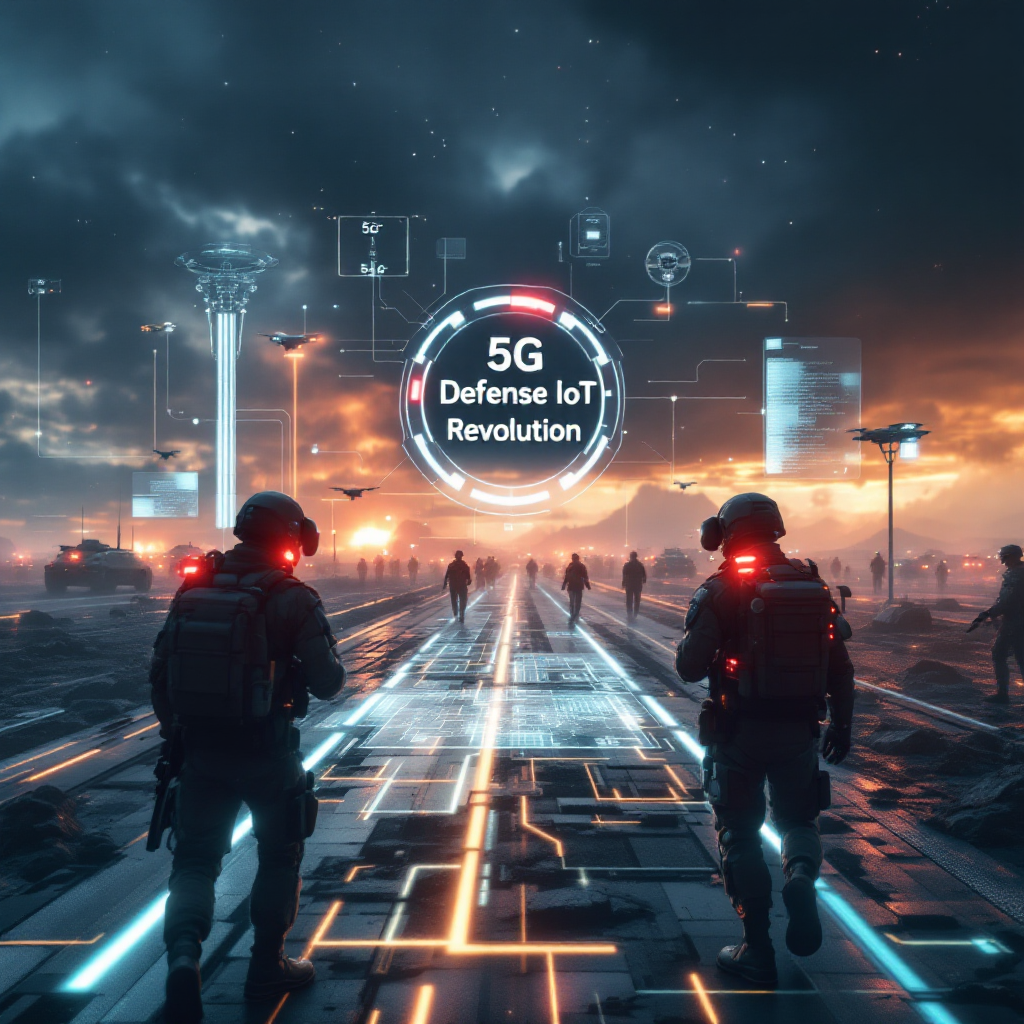
The Battlefield Transformed by 5G: The Revolution of Defense IoT
Did you know that the outcome of a battle can be decided in just 1 millisecond? Let’s explore how 5G technology is reshaping the dynamics of combat on the defense front.
A New Dimension of Battle Created by Ultra-Low Latency Communication
In critical moments on the battlefield, differences are sometimes measured in milliseconds. 5G-based defense IoT technology is revolutionizing traditional communication under such extreme time pressure.
Compared to 4G networks, 5G offers response speeds more than 10 times faster. Specifically, with ultra-low latency of less than 1 millisecond, 5G enables real-time battlefield situational awareness and swift decision-making. This is not merely a technical upgrade—it fundamentally transforms the nature of modern warfare.
As defense IoT systems merge with 5G, we see remarkable leaps forward such as:
Complete Network Integration of Unmanned Systems
Drones, unmanned ground vehicles (UGVs), and unmanned surface vessels (USVs) share data instantly via 5G networks. This elevates each unmanned platform from operating independently to forming an integrated combat ecosystem.
Simultaneous Execution of Multi-Domain Operations
Land, air, sea, and space forces coordinate perfectly through real-time data sharing. Where once each domain operated separately, 5G IoT networks now bring true unified operations into reality.
Emergence of Autonomous Weapon Systems
AI-powered autonomous weapons analyze real-time data via 5G, identify targets, and respond immediately. This marks a paradigm shift in combat.
Simultaneous Connection of Thousands of Devices: Pioneering New Capabilities
Another core 5G technology, massive Machine-Type Communications (mMTC), exponentially expands the scale of IoT systems, allowing thousands of devices to connect and be managed concurrently.
On the battlefield, this massive device connectivity drives innovations such as:
Personal Sensor Networks for Soldiers
Each soldier now wears on average over 10 sensors that collect real-time data on heart rate, body temperature, respiration, precise location, and more. Beyond simple data gathering, this enables comprehensive understanding of a soldier’s tactical status and physical condition.
Complete Tracking and Management of Tactical Equipment
IoT sensors attached to ammunition, fuel, food, and medical supplies monitor inventory, location, and condition in real time, maximizing the efficiency of logistic support systems.
Multidimensional Battlefield Awareness
By gathering and analyzing big data from thousands of sensors through 5G, commanders gain a layered, real-time understanding of battlefield conditions, dramatically enhancing the speed and accuracy of decision-making.
Real-World Applications in Existing Defense Systems
Defense IoT technologies are already being deployed on actual battlefields. The U.S. Department of Defense’s TALOS (Tactical Assault Light Operator Suit) project exemplifies this.
This system collects real-time biometric data from operators via wearable sensors, visualizes battlefield information through augmented reality helmets, and instantly shares information with headquarters over 5G networks. Notably, an AI-powered risk prediction system onboard reportedly improves soldier survival rates by over 30%.
This is not a mere technological demonstration; it represents tangible results, significantly reducing casualties in real combat environments.
Resilient Combat Systems Built on Decentralized Networks
Modern defense IoT systems embrace a decentralized architecture, overcoming vulnerabilities inherent to traditional command systems.
System Operation Maintained Even if Network Segments Are Destroyed
In a decentralized structure, parts of the network can be damaged while others continue functioning independently. Known as resilient networking, this means warfare capability doesn’t sharply degrade even when electronic warfare or enemy attacks partially destroy communication infrastructure.
Enhanced Decision-Making Power at the Edge
Combat units no longer need to await central approval to act; equipped with edge intelligence, they collect necessary information in real time over 5G IoT networks and respond immediately on the ground.
Predictive Tactical Analysis
AI analysis of vast battlefield data collected by 5G-enabled IoT enables predictive battlefield analytics, anticipating enemy movements and proactively adapting to changes in combat conditions.
Particularly, 5G’s network slicing technology allocates separate virtual networks for different types of traffic—biometric data, video, command signals—providing a smart solution that ensures both security and efficiency.
The fusion of defense IoT and 5G is no longer a future concept. As of 2025, it is a core combat system deployed by leading military powers worldwide, fundamentally redefining the future of warfare.
Ultra-Low Latency and Massive Connectivity: The New Battlefield World Unveiled by 5G
Is it possible to connect thousands of devices simultaneously, from soldiers’ biometric data to unmanned drones? 5G’s ultra-low latency communication and mMTC technology are turning this vision into reality.
5G Ultra-Low Latency: The 1-Millisecond Revolution
In the battlefield, a one-second delay can mean the difference between life and death. While existing 4G networks responded within 20 to 30 milliseconds, 5G slashes this to under 1 millisecond. To grasp just how revolutionary this is, one must consider the unique nature of combat environments.
Ultra-low latency in a 5G-enabled defense IoT system isn’t just a technical metric. It means that biometric signals detected by a soldier’s wearable sensors are transmitted to the command’s AI analysis system and returned with immediate danger alerts—all completed within one second. This real-time capability enables groundbreaking transformations:
Revolutionizing Real-Time Battlefield Awareness
Traditional combat operations relied on periodic situation reports. However, 5G-based IoT systems monitor every element of the battlefield in real time. Soldier locations, enemy movements, and environmental factors are updated in milliseconds, allowing commanders to make decisions grounded in the current situation. This drastically shortens response times, greatly boosting mission success rates.
Achieving True Autonomy in Unmanned Systems
Unmanned systems—such as drones, unmanned ground vehicles (UGVs), and unmanned surface vehicles (USVs)—powered by 5G’s ultra-low latency can operate with genuine autonomy. Previously, signal delays prevented remote control over long distances, but now unmanned equipment tens of kilometers away can be handled as if right at one’s fingertips. Furthermore, within the 5G network’s range, unmanned systems collaborate in real time, enabling complex joint operations.
The Revolution of Massive Device Connectivity: The Power of mMTC Technology
Another cornerstone of 5G is mMTC (massive Machine-Type Communications), a technology that connects thousands of IoT devices simultaneously, creating an entirely new operational paradigm on the battlefield.
Simultaneous Connection of Multiple Sensor Devices Per Soldier
A modern soldier is no longer a mere combatant. Under 5G-based IoT systems, each individual is equipped with an average of over 10 sensor devices, including:
- Biometric monitoring sensors that measure heart rate, body temperature, blood pressure, and oxygen saturation in real time
- Position tracking equipment using GPS and inertial navigation systems (INS) for precise location identification
- Environmental sensors detecting radiation, chemical agents, and biological threats
- Equipment status monitors overseeing the condition of firearms, ammunition, and body armor
The simultaneous transmission and collection of all this data is the true strength of mMTC.
Real-Time Tracking and Management of Tactical Equipment
Efficient supply management of ammunition, fuel, and medical supplies directly affects combat effectiveness. 5G-based IoT systems attach sensors to all tactical equipment to track position, quantity, and status in real time. Logistics officers can precisely identify which units require what resources and optimize distribution strategies. This shifts away from periodic reporting to a genuinely adaptive logistics system.
Integrated Coordination of Multi-Domain Operations
The fusion of 5G’s ultra-low latency communications and mMTC technology enables real-time data sharing among land, air, sea, and space platforms. This ushers in a level of operational integration previously unimaginable.
For example, aerial reconnaissance drones detecting enemy movements can instantly relay information to ground combat units, while naval vessels can receive immediate support requests from aircraft carrier command centers. All this transpires in under one second, enabling simultaneous multi-domain operations on an unprecedented scale.
The Rise of Autonomous Weapon Systems
Ultra-low latency in 5G-based defense IoT forms the essential foundation for AI-powered autonomous weapon systems. Real-time data analysis facilitates target identification, and the entire decision-making and attack sequence now executes automatically—without human intervention. While this technological advance spurs vital ethical and legal debates, in reality, major military powers are already investing enormous resources into its development.
What the Expansion of IoT Technology on the Battlefield Signifies
Ultimately, the marriage of 5G and IoT transforms the battlefield into an organic, interconnected network. Individual soldiers are no longer isolated; all equipment and systems are linked in real time to harness collective intelligence. This connectivity maximizes combat efficiency, dramatically improves soldier survivability, and enhances operational precision.
The future of warfare will no longer hinge solely on individual bravery or a commander’s strategic insight. Instead, the decisive factor will be how effectively 5G-based defense IoT systems are constructed, how much data they can gather and analyze, and how swiftly that information can be translated into battlefield decisions.
Deployed Defense IoT in Action: From TALOS to Distributed Combat Management
How did the U.S. Department of Defense's TALOS project boost soldier survival rates by over 30%? And what secret does the distributed architecture hold that keeps operations running even when parts of the network collapse? The answers lie in the real-world fusion of 5G technology and defense IoT.
Smart Warrior System: The Innovation of the TALOS Project
The U.S. Department of Defense’s TALOS (Tactical Assault Light Operator Suit) project stands as the quintessential example of how defense IoT technology is applied directly on the battlefield. This system goes beyond simple gear, actualizing the concept of a ‘smart warrior’ fully equipped with IoT sensors and a 5G network.
At the heart of the TALOS system are numerous wearable IoT sensors attached to individual soldiers. These sensors collect real-time biometric data, including:
- Heart rate and respiration monitoring: Continuously tracking physical condition to detect fatigue or injury early
- Temperature regulation: Monitoring body temperature changes in extreme environments
- Precise location data: 3D position tracking via GPS and IMU (Inertial Measurement Unit)
All collected data is transmitted in real time to command centers leveraging the ultra-low latency features of 5G networks—a speed level impossible with previous 4G technology. This was made possible by 5G’s revolutionary response time of under 1 millisecond.
Even more impressive is the AR (Augmented Reality) helmet integrated into the TALOS system. This helmet visualizes data from the IoT sensors, projecting real-time battlefield information directly before the soldier’s eyes:
- Locations and statuses of fellow soldiers
- Estimated enemy positions
- Rescue request signals
- Supply levels like ammunition and fuel
This IoT-based comprehensive information system dramatically enhances the soldier’s situational awareness. Crucially, TALOS also incorporates an AI-powered risk prediction system. By analyzing the collected data instantly, it warns of potential threats in advance, significantly raising survival chances on the battlefield.
Internal assessments by the U.S. Department of Defense indicate that the TALOS project has improved soldier survival rates by more than 30%. This is conclusive proof that IoT and 5G technologies are not just equipment upgrades but directly contribute to saving lives.
Distributed Combat Management System: Setting a New Standard for Network Resilience
Another major breakthrough in modern defense IoT systems is the adoption of a distributed architecture, moving away from centralized command systems. This strategic choice protects the system from battlefield uncertainties and enemy attacks.
The key advantage of distributed architecture is network resilience. In central systems, destruction of the main command post or loss of communication can paralyze the entire system. In contrast, a distributed IoT network can continue operating independently even when parts of the network are compromised:
- Each combat unit maintains its own IoT sensor network
- Tactical operations continue locally despite communication breakdown with central command
- Partial network reconfiguration leads to automatic recovery
This aligns closely with the concept of Edge Intelligence—combat units don’t need to wait for central commands but analyze the IoT sensor data locally and make independent decisions. This maximizes command flexibility and dramatically improves reaction speed.
Within 5G technology, Network Slicing is the core enabler for such distributed IoT systems. Although physically a single 5G network, it is segmented into multiple virtual networks, each optimized for different needs:
- Biometric data slice: A stable channel optimized for transmitting soldiers’ health information
- Video data slice: Allocates high bandwidth for drone camera feeds
- Command signal slice: Ensures highest priority and extreme reliability for command transmissions
Since each slice operates under its own security policies and priorities, issues in one slice do not affect the others. This is a revolutionary approach that simultaneously achieves security and efficiency in defense IoT systems.
Real-Time Battlefield Analysis: Predictive Battlefield Analytics
A further key function of the distributed IoT system is Predictive Battlefield Analytics. It performs real-time analysis of IoT sensor data collected by each combat unit’s edge computing devices:
- Recognizing enemy movement patterns
- Automatically detecting high-risk zones for friendly forces
- Anticipating supply needs ahead of time
- Suggesting tactical adjustments based on environmental changes
This analysis happens instantly within the local IoT sensor network, without relying on delayed information from central command. The ultra-low latency characteristic of 5G makes this possible.
Today’s defense IoT systems are no longer just tools for information delivery. Through distributed architectures and edge intelligence, the battlefield itself has evolved into an intelligent network. The concrete achievement of a 30% increase in survival rate demonstrated by the TALOS project clearly highlights the profound real-world impact of these technological advances.
Section 4: Hidden Dangers on the Battlefield and Strategies for Overcoming Them
Even cutting-edge technology has fatal vulnerabilities—from data tampering and location exposure to power issues. How are these risks being thwarted in the “invisible war” of defense IoT on the battlefield?
The Hidden Security Threats of Defense IoT Systems
While 5G-based defense IoT spearheads battlefield innovation, one cannot overlook that these systems are exposed to the highest levels of security threats. The environment where thousands of network-connected IoT devices exchange data in real time is simultaneously the most vulnerable to enemy electronic warfare operations and cyberattacks.
The three gravest threats can be summarized as follows. First, data tampering attacks. If the enemy manipulates combatants’ biometric data or weapon system command signals, critical decisions based on false information can lead to tactical disaster. Second, network intrusion through device hacking. In an IoT setting with countless edge devices, breaching just one device with weak security can jeopardize the entire network. Third, location exposure causing direct harm to soldiers. If real-time location tracking is hijacked, soldiers' precise whereabouts become exposed, making them targets of concentrated attacks.
Quantum Encryption and AI-Based Anomaly Detection Systems
To counter these threats, world-leading military powers are urgently adopting quantum cryptography technology. Based on the fundamental principles of quantum mechanics, quantum cryptography guarantees absolute security. Unlike classical encryption methods such as RSA or ECC—which can ultimately be cracked with sufficiently powerful computers—quantum cryptography is theoretically impossible to decipher.
Deploying quantum cryptography in defense IoT offers three vital benefits. First, it ensures the integrity of every piece of data transmitted on the battlefield. Second, it enables instant detection of enemy data tampering attempts. Third, it provides full protection against long-term security threats.
At the same time, AI-based anomaly detection systems oversee real-time monitoring of defense IoT networks. Leveraging machine learning algorithms, these systems analyze network traffic patterns and immediately detect data deviations beyond normal thresholds. For example, if a soldier’s heartbeat suddenly shows abnormal fluctuations or if command signals to unmanned systems appear suspicious, the system automatically triggers alerts and isolates the threat. This AI-driven security infrastructure detects even subtle attacks that human operators might miss, forming a robust cyber defense shield on the battlefield.
Technical Challenges in the Battlefield Environment
Another critical challenge for defense IoT systems lies in the extreme battlefield environment. Signal interference emerges as the most severe issue. Complex mountainous terrain, urban structures, and deliberate jamming from enemy electronic warfare severely undermine the 5G network’s stability. Although this was problematic even during 4G deployments, it becomes devastating when 5G’s ultra-low latency is required for defense IoT.
To overcome this, military experts are integrating Low-Power Wide-Area Network (LPWAN) technologies. LPWAN enables reliable signal transmission over long distances while minimizing energy consumption. Its effectiveness multiplies especially when combined with mesh networking architectures, where each IoT device acts as a relay. Even if a central base station is destroyed or signals are blocked, the entire network remains operational.
Innovative Solutions to Power Consumption Problems
Another non-negotiable problem in the defense IoT environment is battery life. With soldiers wearing dozens of sensor devices continuously transmitting data, batteries drain rapidly. On the battlefield, replacing batteries is realistically impossible, directly impacting combat effectiveness.
To address this, military tech teams adopt multifaceted approaches. First, energy harvesting methods extract power from solar, kinetic, and thermal energy sources. Second, adaptive transmission technologies optimize energy use by transmitting data at high bandwidth during emergencies and at low bandwidth during normal conditions. Third, distributed processing architectures reduce transmission volume dramatically by selectively processing data at edge devices near the source instead of sending everything to a central hub.
Strengthening Network Reliability and Resilience
Loss of network connectivity during battle is tantamount to severing defense IoT’s lifeline. Therefore, securing network reliability is imperative. To this end, 5G’s network slicing technology is strategically deployed. Network slicing logically partitions a single physical 5G network to independently manage traffic with different quality-of-service requirements.
For example, life-critical biometric data receives top priority and bandwidth allocation, situational updates come next, and general information flows at the lowest priority. Clear prioritization ensures that even under high network load or partial channel damage, essential data delivery remains guaranteed.
Additionally, defense IoT systems enhance resilience through a distributed architecture. Unlike centralized structures where loss of communication with headquarters cripples all combat units, distributed architectures equip each unit with edge intelligence—enabling them to autonomously assess situations and make decisions. This dramatically boosts overall system survivability in extreme battlefield conditions.
The Future Direction of Security Strategies
Defense IoT security is evolving beyond responding to current threats to anticipating future dangers. With 6G technology slated for deployment in the 2030s, the military is pushing for full-scale adoption of quantum communication technologies. Going one step beyond quantum cryptography, quantum communication applies quantum mechanical principles directly to the communication process itself—guaranteeing absolute security.
Simultaneously, an autonomous cyber defense system deeply integrated with AI is under construction. In the AIoT (Artificial Intelligence of Things) environment, each IoT device will self-manage its security, automatically detect threats, and block attacks. This means continuous 24/7 security monitoring and response without human operator intervention.
The “invisible war” of defense IoT has transcended mere technical challenge to become a fundamental issue of national security. Constant innovation in technological countermeasures and security strategies now forms the very core of 21st-century military power.
Section 5: The Core of Future Warfare – The Blueprint of 5G-Based Defense IoT
The 5G-based defense IoT revolution, already underway since 2025, is steadily progressing toward the 2030s. What will the future battlefield shaped by 6G, AI, and quantum communication look like? Built on today’s technological foundations, future combat environments are expected to evolve into forms far more sophisticated and complex than we can imagine.
Current Achievements and Future Potential of 5G-Based Defense IoT
By 2025, 5G-based defense IoT systems have entered operational deployment among major military powers worldwide. The over 30% improvement in soldier survivability demonstrated in the U.S. TALOS project is not just a statistical figure. It vividly illustrates the powerful synergy created when wearable sensors, AR helmets, and real-time biometric monitoring systems combine with 5G’s ultra-low latency communication capabilities.
The real-time, data-driven decision superiority provided by 5G defense IoT fundamentally redefines the traditional concept of informational advantage. Edge intelligence, based on distributed architecture, enables each combat unit to make instant decisions on-site without waiting for commands from headquarters, enhancing both the speed and accuracy of warfare simultaneously.
Evolution into Ultra-Intelligent Battlefield Networks in the 6G Era
Set to debut in the early 2030s, 6G technology is not merely a perfected form of 5G; it will enable a defense IoT ecosystem on an entirely different plane. 6G’s terahertz (THz) communication technology is expected to deliver data transfer speeds over 1,000 times faster than 5G, fueling revolutionary advancements such as:
Ultra-Low Latency Battlefield Awareness Systems: While 5G achieves latency under 1 millisecond, 6G will reduce this to microsecond levels. This will elevate the autonomy of unmanned systems—drones, unmanned ground vehicles (UGVs), and unmanned surface vessels (USVs)—to unprecedented heights. In other words, even without commanders present on the field, the system itself will perceive battlefield conditions and make optimal decisions, realizing a truly ‘autonomous battlefield.’
Holographic Battlefield Visualization: 6G’s ultra-high bandwidth will enable real-time transmission of high-resolution 3D holographic data. Headquarters will be able to perceive the battlefield in three dimensions as if they were on-site, significantly enhancing the precision of remote operational command.
Deep Integration of AI and IoT: Combat Applications of AIoT
The introduction of AIoT (Artificial Intelligence of Things) in defense is far more than mere technological fusion—it fundamentally transforms the decision-making architecture of combat systems.
Autonomous Target Identification and Response: While current 5G-based defense IoT systems gather sensor data and rely on human operators to make decisions, future battlefields powered by AIoT will enable systems to independently identify targets and respond automatically within predetermined rules. This will accelerate combat tempo to levels previously unimaginable.
Predictive Battlefield Analytics: Machine learning-based predictive models will analyze vast real-time IoT data to anticipate enemy movements and suggest optimal tactics in advance, revolutionizing the very concept of ‘ambush’ in warfare.
Distributed AI Inference: Edge AI operating over 5G and 6G networks will analyze sensor data locally within each combat unit. This reduces reliance on central servers, enabling a resilient military IoT network that maintains functionality even if parts of the network are destroyed.
The Introduction of Quantum Communication: The Era of Absolute Security
In today’s electronic warfare environment, data tampering and network infiltration remain among the most severe threats. Quantum communication technology, slated for introduction in the mid-2030s and beyond, offers a fundamental solution.
Quantum Encryption-Based Absolute Security: Unlike relying on mathematical complexity, quantum encryption rests on fundamental principles of quantum physics. Any eavesdropping attempt is immediately detectable, and the encryption is unbreakable, providing truly unparalleled security. Integrated into defense IoT systems, it will flawlessly protect battlefield secret commands, biometric data, and weapon system control signals.
Enhanced AI-Based Anomaly Detection: When combined with quantum communication, AI-powered anomaly detection systems will identify and respond to enemy electronic warfare operations from their earliest stages.
The Completion of Multi-Domain Integrated Operations
In the 2030s, a defense IoT ecosystem integrating 5G, 6G, AI, and quantum communication will enable fully integrated operations across land, air, sea, and space domains.
Simultaneous Multi-Domain Operations: Currently, operational domains function somewhat independently, but the future will see truly simultaneous multi-domain operations. Information collected from satellites (space domain) will be delivered within milliseconds to naval drones (sea domain), fighter jets (air domain), and ground forces (land domain), enabling all platforms to conduct unified network-centric warfare.
True Battlefield Information Fusion: While today’s IoT-based data sharing is often limited to certain information types (location, biometrics, etc.), future defense IoT will integrate all types of sensor data—acoustic, electromagnetic, chemical, biological—in real time, providing a comprehensive visualization of every aspect of the battlefield.
Global Security Competition and the Struggle for Technological Leadership
The ongoing race to establish 5G-based defense IoT systems goes beyond mere technological development; it has escalated into a strategic contest for national dominance. The U.S. JADC2 program, China’s Military-Civil Fusion strategy, and South Korea’s smart combat systems each reflect distinct technological philosophies and governance approaches.
As we enter the 2030s, which nation first builds a fully integrated 6G-based defense IoT ecosystem will become a decisive factor in military superiority for the new century. This goes beyond superior weaponry; it will reshape fundamental combat attributes such as information transmission speed, decision-making accuracy, and system resilience.
Envisioning the Future Battlefield: Beyond Imagination
Imagine the battlefield in the mid-2030s: soldiers wear combat uniforms embedded with wearable IoT sensors monitoring every physiological state in real time. These sensors share data with headquarters and fellow soldiers over the 6G network with millisecond latency. Around them, AI-enabled autonomous unmanned systems — drones, UGVs, USVs — execute optimal actions on-site without awaiting central commands.
Every movement integrates data from satellites and high-altitude sensor platforms, displayed at headquarters via holographic battlefield visualization systems. Enemy movements are detected in advance by predictive AI models, which automatically suggest corresponding countermeasures. All communications are shielded by quantum encryption, and any form of electronic warfare is instantly detected and neutralized.
This is no distant scenario; it is the reality unfolding from the evolutionary path of 5G-based defense IoT that began in 2025.
Conclusion: From Blueprint to Reality
The blueprint that 5G-based defense IoT paints is more than technical enhancement; it transforms the very nature of warfare. This revolution, which began in 2025, will forge an entirely new kind of battlefield throughout the 2030s.
The current early stages of 5G-based defense IoT are akin to the era when automobiles replaced horse-drawn carriages. The integrated use of 6G, AI, and quantum communication expected within the next five to ten years will bring fundamental changes to every dimension of military operations. From the viewpoint of defense innovation, now is the most critical period, and the technological and strategic choices made during this time will determine national security for decades to come.
Comments
Post a Comment