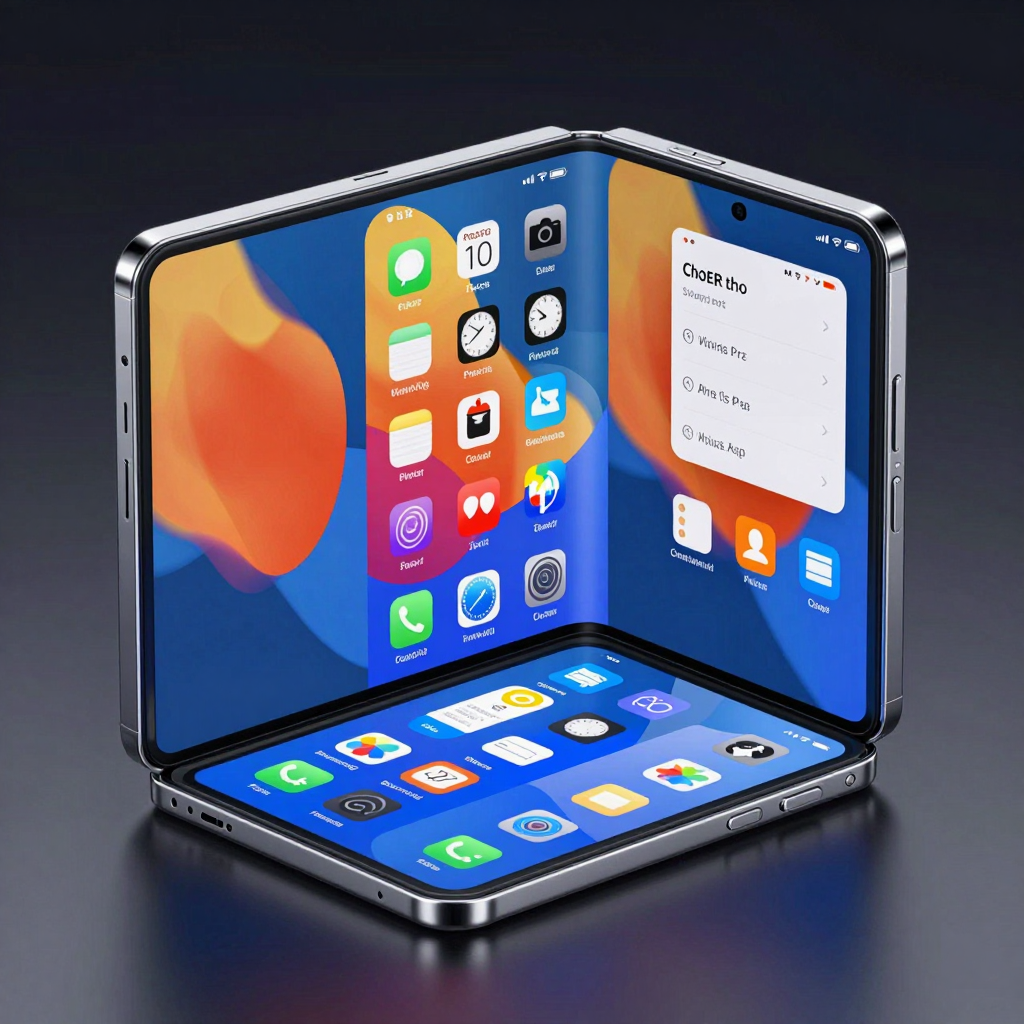
Samsung Galaxy Z Tri-fold: The Revolution of Foldable Smartphones
What new horizons has the world's first triple-fold foldable smartphone, the Galaxy Z Tri-fold, opened in the foldable market? Let’s uncover the secret behind the feeling of “using three phones at once.”
Samsung Galaxy Z Tri-fold: Redefining Foldables
On December 2, 2025, Samsung Electronics sent shockwaves through the foldable smartphone market that surpassed all expectations. The world’s first Samsung Galaxy Z Tri-fold completely overturned the traditional concept of foldable phones that only folded once.
Until now, foldable smartphones typically folded in two, like the Galaxy Z Fold series. But the Samsung Galaxy Z Tri-fold introduced a triple-fold design, folding twice to break down the barriers between smartphones and tablets. Now, users can actually utilize three independent screens simultaneously on a single device.
An Innovative Form Factor: The Perfect Blend of Portability and Productivity
The most striking feature of the Samsung Galaxy Z Tri-fold is its transformative ability. The experience differs completely depending on whether the device is folded or unfolded.
Unfolded Mode: A Tablet-Level Giant Screen
When fully unfolded, a massive 253mm (10-inch) display emerges. Offering tablet-level expansive space, it’s optimized for video viewing, gaming, and multitasking with high productivity. This screen size lets users comfortably display two or more apps side by side, each easily readable.
Folded Mode: Portability Like a Traditional Smartphone
When folded on both sides, it transforms into a 164.8mm (6.5-inch) bar-type form factor. This is similar in size to conventional smartphones, guaranteeing pocket-friendly portability. At just 3.9mm thick—the thinnest in the history of the Galaxy Z Fold series—it sets a new standard for slimness.
Partially Unfolded Mode: A New Middle Ground
Particularly noteworthy is the Galaxy Z Tri-fold’s ability to fold partially. With one side folded, it creates a unique form that enables one-handed operation while maximizing the larger screen. This unlocks more than three modes of use—something existing foldables simply can’t offer.
The Elegance and Technology of the Infolding Design
At the heart of the Samsung Galaxy Z Tri-fold’s technology is its infolding structure. Both sides fold inward, positioning the rear display in the center.
Innovative Folding Mechanism
The sequence of folding the left screen first, then layering the right screen with the rear camera on top, may seem simple, but it requires intricate physical engineering. The Galaxy Z Tri-fold’s screens do not fold flush against each other; instead, they are designed with a slight gap. This careful design ensures ease of unfolding and long-term durability.
Maintaining a Sleek Exterior
Though the fold line remains visible when unfolded in the center, Samsung’s advanced display technologies minimize its impact. When fully folded, the fold line is almost invisible from the outside, making the device look like a regular smartphone.
This design philosophy goes beyond merely expanding screen size—it introduces a new paradigm of the perfect harmony between portability and productivity. The Samsung Galaxy Z Tri-fold stands not just as a device with a “bigger screen,” but as one filled with “greater possibilities.”
Section 2: The Technical Secrets Behind the Tri-Fold Design
Are you curious about how the Samsung Galaxy Z Fold3, with its revolutionary two-fold structure, ultra-fine gap design, and titanium hinges, flawlessly harmonizes a large screen and durability in a way that’s leagues ahead of ordinary foldable phones? The tri-fold technology Samsung has mastered opens new horizons in smartphone design beyond simply folding the screen more times.
Innovative In-Folding Structure: The Identity of the Double-Folding Design
At the heart of the Samsung Galaxy Z Fold3 lies the in-folding structure. While conventional foldables hinged on a single fold, the tri-fold is engineered to fold both sides of the display inward.
Here’s how it works in detail:
- Step 1: Fold the left screen inward first
- Step 2: Fold the right display—with the rear camera—on top of it
- Final Form: Achieves a bar-shaped smartphone profile
This folding sequence resembles closing a book from both ends simultaneously, but demands far greater precision in angle calculations and mechanical arrangement. Samsung’s engineers optimized every folding stage not only to prevent display damage but also to ensure a seamless and intuitive user experience.
Ultra-Fine Gap Design: The Exquisite Balance of Durability and Convenience
Another cornerstone of the Samsung Galaxy Z Fold3’s technology is its ultra-fine gap design. Whereas most foldables aim for perfectly flush screen closures, the tri-fold intentionally leaves a tiny gap between screens.
The technical significance of this design lies in:
Enhanced Ease of Opening
- Sufficient space to easily open the phone with a finger, even when fully closed
- Especially facilitates access to the middle panel in the tri-fold structure
Maximized Durability
- Prevents full compression of the three screens, avoiding deformation over long-term repeated use
- Keeps dust and micro particles from getting trapped and damaging the displays
Hinge Mechanism Protection
- Reduces hinge damage risk caused by excessive compression forces
- Distributes panel weight to relieve stress concentration at single points
Titanium Frame and Armor Flex Hinge: The Perfect Blend of Strength and Lightness
The Armor Flex Hinge integrated in the Samsung Galaxy Z Fold3 is meticulously optimized for the tri-fold structure. Unlike hinges on ordinary foldables supporting just one fold, this hinge stabilizes two continuous folding motions flawlessly.
Why titanium was chosen:
- High strength-to-weight ratio: Approximately 60% stronger than aluminum while maintaining similar weight
- Durability under repeated use: Minimizes metal fatigue throughout infinite fold-unfold cycles
- Heat resistance: Maintains stable performance in heat dissipation from internal electronics
- Corrosion resistance: Prevents performance degradation from oxidation over long-term use
The Armor Flex Hinge features an innovative “stepwise resistance system”: it offers gentle resistance during the first fold and stronger resistance on the second fold, delivering optimal tactile feedback at each stage.
Gorilla Glass Ceramic 2 and the Paradox of Thinness
With a minimum thickness of 3.9mm unfolded and 12.9mm folded, the Samsung Galaxy Z Fold3 sets the thinnest record among foldables. This feat ties closely to the application of Gorilla Glass Ceramic 2 technology for display protection.
Features of Gorilla Glass Ceramic 2 include:
- Enhanced durability: 50% less likely to crack upon drops compared to traditional strengthened glass
- High transparency: Improved optical properties from ceramic components boost screen clarity
- Thinness without compromise: Achieves equivalent strength at a thinner profile
- Scratch resistance: Guards against micro-scratches in daily use
Together with the ultra-fine gap design, this technology keeps the combined thickness of the three stacked displays within a reasonable range.
Fold Anomaly Detection System: A Smart Solution for User Protection
The Samsung Galaxy Z Fold3’s “Fold Anomaly Detection System” redefines durability by actively safeguarding the device during folding.
How it works:
- Multi-sensor integration: Sensors embedded in the hinge monitor folding angles and pressure at every step
- Real-time data analysis: AI algorithms instantly evaluate normal versus abnormal conditions
- Preventive alerts: Warns users via screen notifications and vibrations before any damage occurs
The system activates in scenarios such as:
- When one side is bent excessively
- When foreign particles are caught between screens while folding
- When folding forces exceed safe angles
This system exemplifies Samsung’s philosophy of placing user experience and safety above mere technical implementation.
The Strategic Layout of Three Display Panels
Arranging the three displays is critical for the tri-fold design’s success:
Central Panel (Rear Display)
- Exposed when folded
- 6.5 inches, offering a smartphone-like user experience
Left Panel
- Positioned on the far left when unfolded
- Combined with the right panel creates a tablet-sized, roughly 10-inch display
Right Panel (Camera Area)
- Houses the rear camera system
- Functions as the right section when unfolded
This tri-panel layout achieves optimized weight distribution, power supply management, and signal processing.
Ultimately, a Triumph of Design
The tri-fold design of the Samsung Galaxy Z Fold3 transcends pure technical prowess—it embodies an integrated approach prioritizing user comfort and reliability. From ultra-fine gaps to titanium hinges and anomaly detection systems, every element drives toward one goal: the perfect blend of expansive productivity, daily portability, and long-term durability.
This is why the Samsung Galaxy Z Fold3 is celebrated as more than just a mechanical evolution—it’s a genuine innovation pioneering the next frontier of foldable technology.
The Future of Multitasking Unfolded Across Three Independent Screens: How to Utilize the Triple Displays of Samsung Galaxy Z Tri-fold
Is it really possible to perform three tasks simultaneously at once? Samsung Galaxy Z Tri-fold has the answer. This revolutionary device, fundamentally transforming the way we use smartphones, offers a whole new experience across work and entertainment alike. The era of breaking free from traditional multitasking limits and freely utilizing three independent screens has now become a reality.
The Three-Screen Structure of Samsung Galaxy Z Tri-fold: A New Dimension of Work Environment
The true value of the Samsung Galaxy Z Tri-fold lies not just in its large screen size, but in its ability to use three independent displays simultaneously. While conventional foldable phones were restricted to two screens, the Tri-fold pioneers a completely new frontier.
With the left, center, and right screens operating independently, users get the experience of handling three smartphones at the same time. This structure goes beyond mere technological innovation, creating a new paradigm that fundamentally expands users’ productivity and creativity.
A Productivity Revolution for Professionals
The Galaxy Z Tri-fold shines even brighter in the workplace. What was once impossible task flow can now be handled all on a single device.
Take the combination of email management × document editing × real-time meetings as an example. Check incoming emails on the left screen, edit documents in real time on the expansive center display, and attend a video conference on the right screen—all simultaneously without switching between apps or screens. This seamless multitasking dramatically boosts work efficiency.
Another scenario involves project management × calendar checking × messenger replies. Monitor project progress on management tools, check schedules in real time, and instantly respond to team messages. This multitasking now happens naturally without the stress of split screens or the hassle of app switching.
Perfect Entertainment Experience for Content Consumers
Utilizing the three screens of the Samsung Galaxy Z Tri-fold isn’t limited to work. In entertainment, it completely redefines the user experience.
You can watch videos on a streaming service on one screen, chat with friends in real time on another, and browse related info or subtitles on the third—creating an immersive experience as if you’re in a cinema engaging with a community at the same time.
Gaming also evolves with this innovation. Keep guides or walkthroughs open next to your game screen and interact with gaming communities live—multitasking that happens naturally and seamlessly.
Maximizing Creative Productivity for Creators
For content creators, the Samsung Galaxy Z Tri-fold becomes a totally new creative tool. While drawing on one screen, you can display reference images or materials on another, and arrange color palettes or layer panels on the third.
Photo editing becomes more efficient with the ability to simultaneously view the original image, editing tools, and preview. For video editing, each screen can be dedicated to timeline, preview, and effects library, creating a professional-level workspace.
The Power of Customizable Screen Layout Saves
The Galaxy Z Tri-fold goes beyond just providing three screens by offering the ability to save preferred screen combinations as favorites and recall the desired setup in a single tap.
For instance, tapping a “Work Mode” favorite automatically arranges email, document editing, and calendar apps across the three screens. Selecting “Entertainment Mode” optimizes the layout for video, chat, and information displays. This feature helps minimize task-switching time and instantly boosts productivity.
The Need for an Expanding App Developer Ecosystem
To fully unleash the value of three-screen experiences on the Galaxy Z Tri-fold, active engagement from app developers is essential. Beyond optimizing vertical apps, development of apps running independently yet simultaneously across three screens is underway.
Major productivity tools, content services, and collaboration platforms have already begun rolling out optimized updates for the Galaxy Z Tri-fold. As more apps support the triple-screen experience, this device’s possibilities will broaden even further.
The Future Significance of Three-Screen Multitasking
The triple-screen multitasking presented by the Samsung Galaxy Z Tri-fold is not just a technological leap. It’s a new answer to how smartphones can more effectively support users’ daily lives and work.
Moving beyond an era where smartphones, tablets, and laptops were separate devices, the new age allows seamless switching among those three roles within a single device. The multitasking experience achieved across three independent screens provides an environment where users can work more creatively and productively, embodying the true value of foldable smartphones.
Perfect Balance Achieved Through Powerful Performance and Battery Design
How did the seamless harmony of high performance and efficiency, crafted by the latest Snapdragon processor and a 5,600mAh tri-partitioned battery, become possible—alongside a perfectly balanced weight distribution? The answer lies in the Samsung Galaxy Z Fold 5, which clearly demonstrates that this is not just a list of technologies but a result of meticulous engineering.
The Heart of the Samsung Galaxy Z Fold 5: Snapdragon 8 Gen 2 for Galaxy
The Snapdragon 8 Gen 2 for Galaxy mobile platform equipped in the Samsung Galaxy Z Fold 5 delivers top-tier performance. This processor doesn't merely boast high clock speeds; it is optimized to run three independent displays simultaneously while maintaining stable performance.
Notably, its enhanced AI processing capabilities stand out. The intelligent power management system can analyze content across all three screens concurrently in multitasking scenarios and automatically adjust optimal performance allocation for each display. This ensures users enjoy a seamless experience no matter what combination of tasks they engage in.
Innovative Battery Design: The Secret Behind the 5,600mAh Tri-Part Battery
One of the most groundbreaking features of the Samsung Galaxy Z Fold 5 is its 5,600mAh tri-partitioned battery system. This design breaks away from the traditional approach of placing a large battery in a single spot, representing a completely new paradigm.
Each battery cell is positioned underneath a different screen panel, providing these advantages:
- Optimized center of gravity: Unlike foldables with batteries concentrated on one side, this design achieves a balanced weight distribution whether the device is folded or unfolded.
- Balanced heat dissipation: Independent operation of each battery cell disperses heat across multiple points, minimizing overheating issues.
- Stable power delivery: Each screen receives power directly from the adjacent battery cell, maximizing efficiency.
This tri-partitioned battery architecture ensures long usage times even when the large 253mm display is fully unfolded. It offers ample capacity to simultaneously support a 200MP camera, high refresh rate displays, and a high-performance processor.
Ultra-Fast Charging: Rapid Power for a Large Battery
Despite the 5,600mAh capacity, the Samsung Galaxy Z Fold 5 supports 45W ultra-fast charging technology. This design considers real user patterns, recognizing the need for quick power boosts even during short breaks.
Given its focus on productivity, users can rapidly recharge most of the battery within roughly 30 minutes, effectively supporting the demanding workflow of busy professionals.
Intelligent Power Management: Efficient Energy Distribution for Triple Screens
The true value of the Samsung Galaxy Z Fold 5 lies in its intelligent power management system. When the three screens run different tasks, the system analyzes the actual utilization of each display and optimally allocates power.
For example, imagine the left screen running a messenger app in the background, the center screen engaging in a game, and the right screen playing a video. The system dynamically assesses the performance needs of these tasks in real time, allocating more power to the gaming center screen while regulating power consumption on the left screen with low demand.
This smart distribution not only extends battery life significantly but also minimizes any perceptible decline in user performance.
Center of Gravity Design: Solving Foldable Phones’ Longstanding Challenge
Users of previous foldable phones have long complained about the uneven center of gravity, with batteries and cameras clustered on one side, causing a heavy feel when unfolded.
The Samsung Galaxy Z Fold 5 fundamentally solves this with its tri-partitioned battery placement. Within a total folded thickness of just 12.9mm, three batteries are evenly distributed, providing perfect balance both when folded and unfolded.
Furthermore, camera placement has been optimized. Weight differences between the 200MP main camera on the right panel and the dual selfie cameras have been offset through subtle structural adjustments, delivering a balanced feel no matter how you hold the device.
The Perfect Harmony of Performance and Efficiency
Ultimately, what the Samsung Galaxy Z Fold 5’s performance and battery design showcase is far beyond a mere compilation of specs. To provide a stable and efficient experience within the complexity of three screens, every element was comprehensively considered from the design stage.
When a high-performance processor, large-capacity battery, and intelligent power management system operate in unison, users experience the convenience akin to running multiple devices simultaneously. At this very point, the Fold 5 transcends being just a "foldable phone" and reveals its true value as a "multi-screen computing platform."
The Foldable Paradigm Opening the Future and Remaining Challenges
With the launch of the Samsung Galaxy Z TrioFold, a new wave is sweeping the foldable phone industry. However, innovative technology alone is not enough. How will future technologies and software innovations make the three-screen experience more intuitive? In this section, let’s examine the challenges and obstacles posed by the Galaxy Z TrioFold in the foldable phone market, and the future directions to overcome them.
Shift in the Foldable Paradigm: From Hardware to Software
Samsung’s Galaxy Z TrioFold has achieved hardware innovation: a triple-fold design, thinner profile, and enhanced hinge technology. But true success will now be decided in the realm of software.
The biggest complaint from existing foldable phone users has been that “software can’t keep up with hardware.” To fully utilize the Galaxy Z TrioFold’s three screens simultaneously, applications must be optimized to support three vertical screens at once. This entails not just simple resolution adjustments but a fundamental transformation in UI/UX design.
Samsung’s ‘Multi-window Favorites’ feature marks the first step in this software innovation. This function allows users to save preferred screen combinations in advance and access them with a single tap, serving as more than just a convenience—it represents a strategy to standardize the three-screen experience.
Core Challenge: Building a Software Ecosystem
The key factor determining the success of the Galaxy Z TrioFold is the expansion of the app developer ecosystem. No matter how exceptional the hardware, it cannot realize its full value without enough applications optimized for the triple-screen environment.
Currently, the Android ecosystem standardizes a dual UI design for tablets and smartphones. The Galaxy Z TrioFold must break this standard and create a new one. For example, a video editing app should be optimized so one screen manages the timeline, another the effects selection, and the third shows the preview.
Samsung needs to pursue the following:
- Developer documentation and API refinement: Provide official development guides clearly outlining optimization methods for the three-screen environment.
- Incentive programs: Offer financial support and promotion priority to developers who create TrioFold-optimized apps.
- Model case presentations: Build exemplary three-screen optimization cases starting with key productivity and creative apps.
Limits of Multitasking and Cognitive Load Issues
Having three screens simultaneously doesn’t always translate to a positive experience. The issue of cognitive load arises, meaning processing excessive information and interactions simultaneously can actually reduce user productivity.
For instance, managing email, document editing, and video conferencing across three screens at once requires users to constantly switch attention, potentially lowering work efficiency.
Therefore, the Galaxy Z TrioFold needs smart features that do more than allow “using three screens”—it must help wisely arrange and manage three screens. Future software updates should include AI-based recommended screen layouts, context-aware automatic switching, or seamless data movement across screens.
Price and User Expectation Gap
A practical issue is the price. The Galaxy Z TrioFold is expected to be 20-30% more expensive than existing Galaxy Z Fold models—will it deliver commensurate value to users?
If Samsung targets the premium segment, it must prove three key points:
- Real productivity gains: Concrete data showing how much faster and more efficiently tasks can be done in the three-screen environment versus single-screen.
- A new creative experience: How designers, videographers, and music producers actually feel their workflows change.
- Smooth integration into daily life: Experiences that naturally integrate not only professional workflows but also regular users’ everyday routines.
Long-Term Durability and Reliability Verification
The Galaxy Z TrioFold boasts Armor Flex hinges and enhanced durability technologies, but it requires the test of time.
Early Galaxy Z Fold series faced criticism for hinge breakage and display damage. Although improved, the more complex triple-fold structure can introduce new issues. Real user reviews and long-term assessments are vital to confirm stability after 2-3 years, screen lifespan, and hinge durability.
Samsung needs to offer the longest warranty and free repair policies in the industry—not as a marketing gimmick but to build trust.
Future Technology: The Role of AI and Machine Learning
The Galaxy Z TrioFold’s true potential lies in integrating AI and machine learning. Future software updates should deliver:
- Context-aware multi-window: Automatically suggest optimal app combinations based on user activity such as work, creation, or entertainment.
- Screen usage monitoring and optimization: Learn usage patterns on each screen to autonomously rearrange app layouts.
- Expanded voice control: Realize voice commands like “move this item from the left screen to the right screen.”
- Advanced gesture recognition: Develop intuitive multi-touch gesture languages spanning all three screens.
Conclusion: The Harmony of Technology and Human Experience
The success of the Samsung Galaxy Z TrioFold cannot be won by hardware excellence alone. Samsung’s philosophy that “technology exists not merely to provide bigger screens but to create environments where users can work more creatively and productively” must be embodied in both product and software.
The path forward is clear: build the developer ecosystem, develop features minimizing cognitive load, prove long-term durability, and realize AI-powered intelligent multitasking environments. If all these succeed, the Galaxy Z TrioFold will be more than just a foldable phone—it will mark the dawn of a new computing paradigm.
Comments
Post a Comment