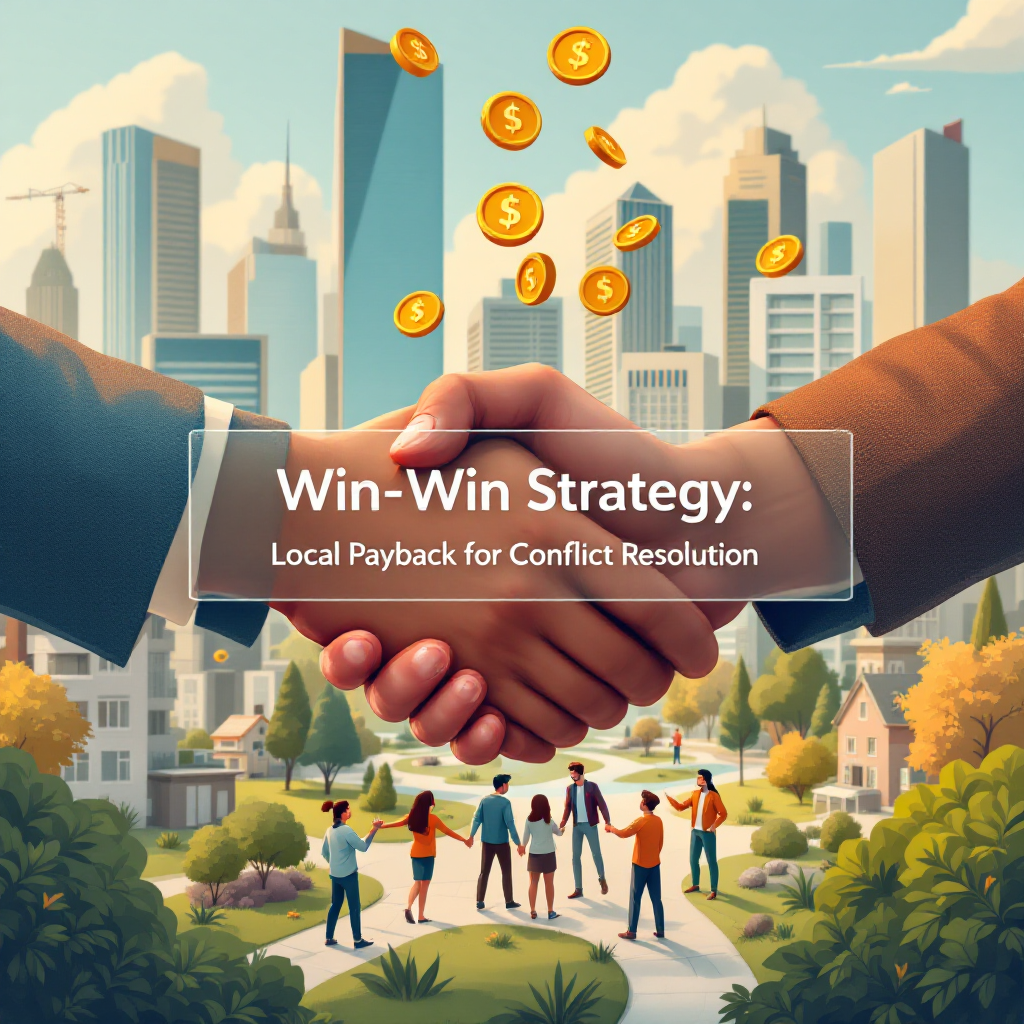
What is Sangsaeng Payback? The Beginning of a New Collaboration
How can conflicts with residents be resolved in local development projects? Did you know that Sangsaeng Payback could be the answer?
In recent times, whenever large-scale development or public projects are pursued in our society, clashes with local residents often arise. Projects like new incineration facilities, industrial complex construction, and environmental infrastructure, although necessary for the community, are often perceived by residents as sources of inconvenience and risk. In these situations, traditional simple monetary compensation is insufficient to alleviate residents’ concerns. This is exactly where the innovative concept of Sangsaeng Payback draws attention.
Definition and Meaning of Sangsaeng Payback
Sangsaeng Payback is a comprehensive cooperation program designed not only to compensate the negative impacts of local development projects on residents but also to revitalize the local economy and create communal value. The term combines ‘Sangsaeng (Synergy)’ with ‘Payback’ to emphasize going beyond mere compensation toward creating an ecosystem where residents, businesses, and the government grow together.
While traditional payback systems provide direct financial benefits to individual consumers, Sangsaeng Payback focuses on generating inclusive value for the entire community. This approach is particularly effective in resolving conflicts and enhancing project acceptance in cases involving environmental facilities or large-scale developments expected to face resident opposition.
Why Sangsaeng Payback Is Necessary
Modern local development involves numerous stakeholders. While the economic gains of projects benefit corporations and the nation, residents bear the brunt of side effects such as environmental pollution, traffic congestion, and increased noise. To address this imbalance, Sangsaeng Payback is designed to ensure that residents reap tangible benefits from development projects.
At its core, Sangsaeng Payback shifts from ‘one-sided compensation’ to ‘mutual cooperation.’ Through multifaceted approaches—including improving residents’ living environments, stimulating the local economy, and creating jobs—it creates a structure where both residents and project initiators gain advantages.
Real-World Example of Sangsaeng Payback
The new incineration facility project in Paju City stands as a prime example of Sangsaeng Payback in action. In this project, Sangsaeng Payback extends beyond simple financial compensation to a comprehensive program covering improvements to residents’ living environments, regional economic activation, and job creation. Given the nature of environmental facilities, alleviating residents’ concerns requires transparent operational systems coupled with tangible benefits for the community.
In this way, Sangsaeng Payback functions as a concrete mechanism for building trust with local communities and is gradually establishing itself as a core strategy for long-term regional development.
Paju City Incineration Facility Construction Project: A Concrete Model of Win-Win Payback
Beyond simple compensation schemes, this strategy revitalizes both the local environment and economy. Let’s explore how the win-win payback approach in Paju City engages with the community in a truly collaborative way.
A New Solution to Environmental Facility and Local Conflicts
Environmental facilities are essential to society but often stir sensitivities among nearby residents. The Paju City incineration facility project introduces an innovative approach called win-win payback to resolve these conflicts. It goes beyond mere monetary compensation, presenting a collaborative value creation model that fosters growth for the entire community.
What stands out in Paju’s example is that the facility’s capacity, proposed during the evaluation phase, isn’t just a number. It serves as a foundational condition to thoroughly anticipate environmental impacts and marks the transparent decision-making process vital for building trust with residents.
A Multi-Layered Collaborative Program Composed of Win-Win Payback
The win-win payback program advanced by Paju’s incineration project operates on several levels:
First, improving living environments. Focused on environmental enhancements directly affecting daily residents, this raises local acceptance and minimizes negative facility impacts.
Second, revitalizing the regional economy. Through programs like purchasing local agricultural products, expanding services within the community, and prioritizing transactions with local businesses, the economic benefits are returned to the community.
Third, job creation. Employment opportunities generated by the facility’s operation and related industries are given preferential access to local youth and unemployed individuals, expanding job prospects in the area.
Core Elements of Transparency and Trust
Transparent decision-making is essential for operating the win-win payback program successfully. Paju City strengthens resident engagement and communication at every stage—from deciding facility size and management methods to planning community returns.
This transparency resolves residents’ concerns and lays the groundwork for genuine coexistence beyond simple compensation. When community members participate in decision-making and share in outcomes, win-win payback evolves into a trust-based partnership between the community and corporations.
Locally Tailored Win-Win Payback Strategy
The Paju case illustrates that win-win payback isn’t a one-size-fits-all compensation model but a customized framework that respects the unique characteristics and needs of the community. By comprehensively analyzing Paju’s industrial structure, demographics, and environmental issues, the program delivers tangible value to the community.
This approach stands as a benchmark for large-scale development projects in other regions, promising a new standard that minimizes conflicts with locals while pursuing mutual benefits.
A Commitment Toward Sustainable Development
The win-win payback promoted by the Paju incineration project aims beyond short-term compensation, serving as a strategy to drive long-term regional development. By continuously providing economic and social value to the community throughout the facility’s operational lifespan, it simultaneously enhances residents’ quality of life and invigorates the local economy.
This is not just a policy—it is a new model of value creation crafted collectively by all community members, setting the direction for future major development projects in our society.
Revitalizing Local Economies and Digital Innovation: The Evolution of Win-Win Payback
From hometown love donation programs to digital resident tourism cards, what fresh breeze is Win-Win Payback bringing to local economies? At the heart of recent regional development policies lies a new paradigm seeking not just simple rewards but genuine economic revitalization. This is the concept of Win-Win Payback, driving innovative change through the fusion of local economies and digital technology.
The Synergy Between Win-Win Payback and the Hometown Love Donation Program
The hometown love donation program allows donors to contribute to a chosen municipality while receiving tax deductions, with funds directed toward local welfare, culture, and environmental projects. This aligns perfectly with the core principles and context of Win-Win Payback. As seen in events where Chungbuk Province and Sejong City enhanced the program by encouraging mutual donations and sharing best practices, models pursuing mutual benefits through inter-regional collaboration are spreading.
The true value of Win-Win Payback lies not merely in the exchange of money. It creates a virtuous cycle where local residents actively engage in their community’s development, enjoying tangible benefits in the process. This system not only strengthens community bonds but also achieves economic revitalization simultaneously.
Creating New Value Through Digital Technology
The 'Digital Tourist Resident Card' is an innovative example that modernizes the Win-Win Payback concept. By granting tourists honorary local resident status, this system offers discounts across lodging, dining, sightseeing, experiences, and shopping, thereby simultaneously promoting economic activation and attracting visitors.
Operating Win-Win Payback via digital platforms offers distinct advantages:
- Enhanced Transparency: Real-time tracking of donations and benefits
- Improved Accessibility: Convenient use through mobile applications
- Personalized Services: AI-driven recommendation systems tailored to individual needs
- Maximized Efficiency: Automated systems reduce administrative costs
Tailored Economic Revitalization Strategies for Each Region
Like Namyangju City’s customized job creation agreement, Win-Win Payback is evolving into region-specific programs that reflect local characteristics and citizen needs. Through multifaceted approaches—such as buying local agricultural products, expanding youth employment, and supporting small businesses—it generates concrete economic effects.
Especially in projects that raise concerns among residents, such as environmental facilities or large-scale developments, Win-Win Payback serves as a key tool to resolve conflicts and enhance acceptance. The Paju City incineration facility project exemplifies how transparent operations and tangible local benefits earn residents’ trust.
Pursuing Long-Term Sustainability Through Win-Win Payback
The ultimate aim of Win-Win Payback is not a short-term reward system but a program that drives regional development from a long-term perspective. By evolving into a sustainable model that pursues both profit and communal value, it creates an ecosystem where local residents, businesses, and governments grow together.
Advancements in digital technology are expected to accelerate this evolution further. Innovations like analyzing local economic trends through big data, transparent donation management using blockchain technology, and forming virtual local communities in the metaverse are becoming increasingly feasible.
Ultimately, Win-Win Payback is not just a policy but a new economic ecosystem where every community member participates and benefits. As it advances into a more sophisticated and personalized system combined with digital innovation, it will undoubtedly become the future standard model for revitalizing local economies.
The Key to Success: Transparency and Customized Strategies
Where do the most conflicts arise in regional development projects? The answer is the lack of trust between residents and project promoters. To bridge this gap, Win-Win Payback emphasizes two core elements: transparent decision-making and tailored strategies. Let’s explore how these two factors earn the trust of local residents and drive project success.
Transparency: The First Step to Building Trust
Win-Win Payback goes beyond a simple compensation system by placing transparent decision-making processes at its core. As seen in the case of the new incineration facility project in Paju City, clearly disclosing that "the capacity proposed at the evaluation stage is a prerequisite to adequately predict environmental impacts" helps alleviate residents’ concerns step by step.
Transparency is put into practice through the following concrete measures:
First, disclosure and explanation of information
Providing clear explanations backed by scientific evidence for every issue residents raise. When environmental impact assessments, facility operation plans, and safety management standards are explained in a way that residents can understand, vague anxieties transform into concrete subjects for review.
Second, decision-making based on resident participation
Win-Win Payback requires processes where residents not only are consulted but actively participate and have their opinions reflected—not unilateral decisions by the government and corporations. This approach makes residents partners in the project rather than mere beneficiaries, fostering their sense of responsibility.
Third, continuous monitoring and public disclosure
It’s crucial to regularly check operation conditions even after project completion and openly share the results with residents. This verifies whether promised environmental standards are maintained and if regional economic revitalization plans are being implemented.
Customized Strategies: Design Reflecting Regional Characteristics
Equally important alongside transparency is developing tailored programs. Since every region has different environments and characteristics, Win-Win Payback must be designed to fit each locality.
Understanding regional characteristics
First, an in-depth analysis of local population makeup, industrial structure, economic level, and cultural traits is essential. Naturally, a rural area differs from an urban one; a community with many young residents differs from one facing aging demographics—the forms of Win-Win Payback required will inevitably vary.
Process for gathering residents’ needs
As demonstrated by Namyangju City’s region-specific job creation example, dedicating sufficient time to understand exactly what residents want is indispensable. Whether they seek employment, educational facilities, or cultural institutions, the contents of Win-Win Payback should be determined accordingly.
Designing a multi-layered benefit structure
Win-Win Payback should include multiple tiers of benefits rather than a single form of compensation. A combination of direct financial rewards, creation of local youth jobs, preferential purchase of local agricultural products, support for small businesses, and establishment of cultural facilities can collectively drive balanced development throughout the region.
The Synergistic Effect of Transparency and Customized Strategies
What’s fascinating is that these two elements do not function separately but mutually strengthen each other. When residents and project promoters consult with transparent information disclosure, more sophisticated tailored strategies emerge. Conversely, well-designed customized programs provide rich, concrete content to be transparently explained.
Within this virtuous cycle, residents gain confidence that their opinions are reflected and their regional characteristics are respected. This is precisely why Win-Win Payback can become a new paradigm that transcends mere compensation, pursuing collaborative value creation with local communities.
Checklist for Practical Implementation
To successfully introduce Win-Win Payback, make sure to verify the following:
- Is there a decision-making structure that includes all stakeholders?
- Are you prepared to quantitatively explain environmental impacts, economic effects, and social changes?
- Has the program been designed through thorough consultation with local residents?
- Does the plan include not only short-term compensation but also long-term regional development considerations?
- Are monitoring and evaluation plans established for after project completion?
Combining transparency and customized strategies, Win-Win Payback must become a standard essential in regional development projects. This is the path toward a truly win-win society.
Creating the Future with Win-Win Payback: A Path to Growth with Local Communities
Imagine win-win payback not as mere rewards but as a creator of sustainable value—how digital technology and AI can transform the future of our local communities. We are now entering an era beyond traditional one-sided compensation systems, embracing a new economic model where all stakeholders grow together.
New Possibilities Unlocked by Digital Technology
The future of win-win payback is deeply intertwined with digital innovation. Moving beyond offline-centered reward systems, mobile applications and AI-powered personalized platforms are fostering environments where residents and businesses can communicate in real time and receive tailored benefits.
As demonstrated by innovative examples like digital tourist resident cards, win-win payback uses data analysis to precisely understand the needs of local residents and visitors, providing customized services. This goes beyond simple benefit provision—it creates a virtuous cycle that revitalizes the regional economy.
Realizing AI-Based Customized Win-Win Payback
For win-win payback to unleash its true potential, leveraging artificial intelligence is essential. AI analyzes local consumption patterns, characteristics of regional industries, and seasonal economic changes to design the most effective collaborative programs.
For instance, one area might focus on invigorating agriculture, while another prioritizes tourism development through win-win payback initiatives. This data-driven approach allows regional development efforts to maximize benefits to residents while minimizing adverse impacts.
The Evolution Toward Sustainability in Win-Win Payback
The future of win-win payback will transcend mere economic gains, evolving into comprehensive programs that also consider environmental and social sustainability. As seen in Paju City’s new incineration facility project, areas needing environmental infrastructure can achieve environmental improvement and economic revitalization simultaneously through win-win payback.
By establishing transparent operational systems, environmental monitoring, and involving local residents directly in oversight, true collaboration based on trust becomes possible. This is the most effective way to minimize community resistance and foster cooperation in development projects.
A Long-Term Perspective on Regional Development Models
The true success of win-win payback is not measured by short-term results. Its value emerges as a long-term regional development program that endures for 5, 10, even multiple generations.
This includes investments in job creation for future generations, strengthening local educational infrastructure, and preserving cultural heritage. When win-win payback evolves from simple rewards into a strategic tool that enhances local competitiveness, a genuine era of mutual growth between communities and businesses dawns.
Building an Ecosystem Involving All Stakeholders
The future of win-win payback lies in creating an ecosystem where governments, businesses, residents, and community organizations actively participate. Clarifying each stakeholder’s roles and responsibilities and maintaining continuous communication through regular councils is vital for ongoing improvements.
When real-time feedback systems via digital platforms, resident-driven decision-making structures, and transparent performance disclosures operate cohesively, win-win payback becomes not just policy but a new culture within local communities.
Closing Thoughts: An Invitation to an Era of Cooperation
Win-win payback is no longer a choice but a necessity. To sustain and advance local communities amid rapid change, transitioning to a new economic paradigm where all actors grow together is unavoidable. Powered by the sophistication of digital technology and AI, win-win payback will shine as a beacon illuminating the future of our regions.
The win-win payback model we build today will lay the foundation for better communities for generations to come.
Comments
Post a Comment