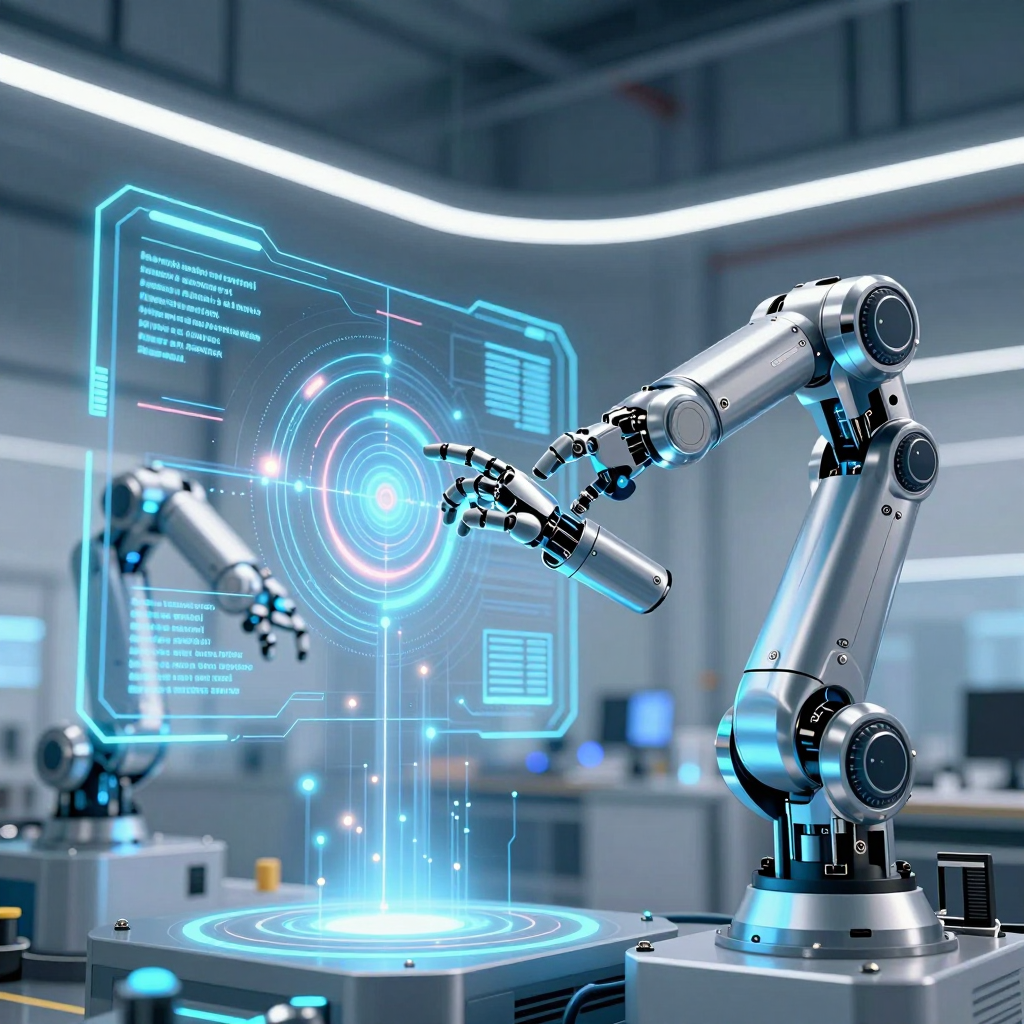
Section 1: Physical AI: A New Revolution Changing Reality
What kind of future awaits when machines can see, understand, and act on their own? Let’s explore the moment reality transforms with the rise of Physical AI.
The Birth of AI That Perceives the Physical World
Until now, artificial intelligence has largely been confined to digital environments. But Physical AI breaks down these barriers completely. Physical AI represents the next-generation AI systems that enable machines to autonomously perceive, understand, reason about, and interact with the physical world.
Going beyond mere data processing, robots and industrial machines can now make decisions and act independently within complex real-world environments. This marks a fundamental turning point in the history of automation technology and redefines the role of Edge AI entirely.
The VLA Model: Seeing, Understanding, and Acting
At the core of implementing Physical AI lies the VLA (Vision-Language-Action) model, which integrates three key capabilities.
First, through visual information processing (Computer Vision), it recognizes the surrounding environment via cameras and sensors. Next, it uses language processing to grasp human instructions and commands. Finally, the robot control capability converts this information into real physical actions.
For example, if given the command "Pick up the book next to the glass," the VLA model visually identifies the locations of the glass and the book, understands the intent behind the command, then plans and executes the optimal action path to pick up the book without touching the glass.
Abstract Prediction: The Era of Common Sense Machines
An innovative theory proposed by Meta’s Yann LeCun has opened the door to granting robots true "common sense." Traditional approaches inefficiently predict video frames at the pixel level, but the new paradigm is fundamentally different.
Its core lies in designing robots to predict future states in an abstract feature space. The robot learns intuitively that pushing a glass could break it, spilling water causes it to flow, and heavy objects must be moved slowly. This signifies a profound understanding of physical laws in the real world, enabling robots to respond rationally even in unforeseen situations.
Edge AI: Essential for Real-Time Decision Making
For Physical AI to operate effectively in the real world, Edge AI technology is absolutely indispensable. The moment a robot acts, any communication delay with the cloud can prove critical.
A car encountering an obstacle cannot wait for a cloud server’s response, just as an industrial robot must respond immediately when detecting a hazardous situation during operation. Therefore, Physical AI adopts the three-tier hybrid architecture (Cloud-Premise-Edge) as its standard.
Instead of sending all data to the cloud, processing and judgment happen instantly on the robot’s onboard processor or on edge servers within the factory. This approach minimizes latency, reduces energy consumption, and addresses privacy concerns. Edge AI has become not a choice but a foundational technology for realizing Physical AI.
Rapid Expansion of the Industrial Ecosystem
The adoption of Physical AI is accelerating in automotive, manufacturing, and robotics industries. In particular, the automotive sector has achieved practical agentic AI, where autonomous vehicles go beyond merely following commands to perceiving situations and making independent judgments and actions.
An integrated ecosystem spanning chipsets, software, development tools, and services has also been established in industrial fields. Various devices like smart cameras, drones, industrial media hubs, and video collaboration systems operate independently based on Edge AI, dramatically boosting overall industrial efficiency.
2026: The Dawn of the Robot Labor Era
The maturation of Physical AI signals more than just technological progress—it heralds the full-scale dawn of the robot labor era. With real-time decision-making capabilities established at the edge, autonomous vehicles, smart factories, and industrial robots can achieve human-level situational awareness and responses.
This represents a turning point that will materially impact economic and industrial structures across the board. We now stand at the gateway of a revolution where machines truly become active agents in reality—and this transformation is already accelerating all around us.
VLA Model: The Magic Connecting Vision and Language
How does the VLA model—an AI that understands language and images simultaneously—instill intuitive common sense in robots and predict that a glass will break? The answer to this question signifies a fundamental transformation in how artificial intelligence interacts with the physical world.
The Concept and Mechanism of the VLA Model
The VLA (Vision-Language-Action) model is the core technology driving physical AI. While traditional AI systems processed text and images independently, the VLA model integrates three capabilities into one system: computer vision to handle visual information, natural language processing to understand and interpret language, and control of a robot’s physical actions.
This integration is more than just a technical merger. Through the VLA model, a robot can directly translate human language commands and visual information from its surroundings into physical actions. For example, it means that a robot can immediately execute a robotic arm movement by simultaneously processing the voice instruction “move the box carefully” along with the location of the box and surrounding environment captured on camera.
Abstract Prediction: Modeling Common Sense
The groundbreaking theory introduced by Meta’s Yann LeCun completely reshaped the AI paradigm. Previous methods tried to predict the next video frame at the pixel level—like attempting to perfectly match millions of colored dots one by one. This approach was both computationally massive and inefficient.
The new approach is fundamentally different. It is designed to predict future states in an abstract feature space. Rather than focusing on precise pixel positions, it teaches the model high-level concepts such as “what properties does this object have, and how will it change after this action?”
This allows robots to acquire intuitive common sense about the real world. Consider the scenario of pushing a glass. A robot equipped with the VLA model can understand:
- Glass is a hard material but fragile under impact.
- Pushing it quickly increases the likelihood of it toppling.
- A toppled glass is very likely to break.
These causal relationships and physical commonsense are not explicitly programmed. Instead, they are naturally learned through training data and the abstract prediction model. This is the very mechanism by which machines gain human-level intuition.
The Synergy of Edge AI and the VLA Model
The power of the VLA model is maximized when run locally at the edge. In Edge AI environments, robots can make immediate decisions without the latency of cloud communication. In situations where a robot must react within milliseconds upon detecting the risk of a glass breaking, it cannot afford to send data to the cloud and wait for a response.
With on-device processing inside the robot or real-time analysis on an edge server within factories, the VLA model enables truly autonomous actions. This is not merely a matter of technical convenience but an essential requirement for robots to perform human-level judgment in actual industrial settings.
The Turning Point Toward the Future Era of Robotics
The maturation of the VLA model and abstract prediction technology marks the evolution of robots from mere automated machines to truly intelligent agents. Robots no longer mechanically follow orders; they perceive situations, make judgments, and act autonomously based on common sense.
This shift is already impacting various industries such as autonomous driving, industrial robots in smart factories, and logistics automation. The perfect integration of vision, language, and action brought by the VLA model heralds the full-fledged beginning of the robotic labor era starting in 2026.
Section 3: Edge-Cloud Hybrid—The Hidden Architecture Enabling Real-Time Decisions
The Limits of Cloud-Centric Systems and What Lies Beyond
Imagine your self-driving car suddenly detects a pedestrian. What if the vehicle had to wait several seconds just to communicate with a cloud server? This is precisely where the harsh reality for physical AI becomes clear.
The traditional method of sending all data to a central cloud server and waiting for a response is fatal for tasks in the physical world that demand real-time performance. Whether a robot is picking up an object, a car is making an emergency stop, or industrial machinery detects a hazard—delays are simply unacceptable in these moments. This necessity gave birth to a new paradigm called Edge AI, which further evolved into the three-tier hybrid architecture (Cloud-Premise-Edge) as the industry standard.
Structure and Roles of the Three-Tier Hybrid Architecture
Deploying physical AI in the real world requires an organic system where three layers work in harmony.
First Layer: Edge refers to processors embedded within robots or vehicles. This is the frontline where the most urgent decisions happen. Equipped with a lightweight version of the VLA (Very Large AI) model, it instantly converts visual data captured by cameras into actions. For example, when a robot arm picks up an item, sensor signals are processed on-device in real time to adjust the grip strength of its fingers. This entire process must unfold within milliseconds.
Second Layer: Premise represents local edge servers within factories or buildings. Acting as a mid-level hub for Edge AI, it consolidates data collected from multiple robots or machines. Beyond real-time decision-making on individual devices, it handles higher-level tasks like optimizing entire production lines or detecting errors. It enables more complex analyses without suffering from cloud communication delays.
Third Layer: Cloud serves as the central repository for long-term data storage, model updates, and enterprise-wide analytics. Data aggregated at the premise level is gradually sent to the cloud for in-depth machine learning model retraining. Once new models are developed, they are redeployed back to the edge, creating a cyclical structure.
Why This Architecture Is Essential
The reasons that hybrid architecture is not optional—but mandatory—in physical AI systems are clear.
Overcoming Latency: Every moment a robot interacts with the physical world, relying on cloud round-trip communication risks degraded performance and safety threats. By processing data at the edge and premise layers, millisecond-level response times are achievable.
Energy Efficiency: Transmitting all data wirelessly to the cloud consumes massive power. Processing only necessary data locally and sending results alone dramatically reduces energy consumption.
Network Independence: Robots must keep operating even in unstable internet conditions. The hybrid structure allows autonomous operation at edge and premise levels, even if cloud connectivity fails.
Data Security and Privacy: Sensitive manufacturing data or personal information need not be entirely offloaded to external clouds. By selectively processing only required information, security risks are minimized.
Real-World Implementation and Expansion
This three-tier hybrid architecture is already being proven in industrial settings. Vision-based quality inspection systems in smart factories detect defects in real time from edge cameras on-site. Autonomous vehicles analyze their surrounding environment via onboard processors to generate instant driving commands. These examples showcase how the harmony between Edge AI and cloud computing brings physical AI to life.
Ultimately, sending every bit of data to the cloud isn’t the answer—simply because the physical world cannot tolerate delays. The three-tier hybrid architecture is the hidden framework that enables real-time performance and efficiency simultaneously by optimizing each layer’s role.
4. Expanding Industrial Ecosystem: From Snapdragon to Smart Factories
How does Qualcomm’s integrated AI ecosystem connect cars, robots, and factories, and how is agentic AI transforming the industrial paradigm? The answer to this question holds the key to understanding the magnitude of the ongoing industrial revolution.
Industrial Integration Strategy through Edge AI
Qualcomm’s strategy is simple yet powerful: to link diverse physical environments—cars, factories, and robots—into a unified technology stack. At the heart of this approach lies Edge AI. Only when real-time processing occurs at the edge can cars instantly respond to unpredictable road conditions, robots perform tasks beyond preset patterns on factory floors, and smart factories operate autonomously without relying on cloud latency.
This Edge AI strategy is not merely a technical choice but an essential condition for ensuring industrial reliability and safety. In environments where communication delays with the cloud are unacceptable, on-device processing becomes inevitable, enabling real-time decision-making across all devices.
Automotive Domain: The Rise of Agentic AI
The automotive industry exhibits the most visible transformation. Whereas AI in vehicles once played a supportive role—such as driver assistance and safety alerts—now, agentic AI is becoming a reality. This means AI transcends being a mere tool; it perceives situations, makes context-aware judgments, and independently takes appropriate actions.
The Snapdragon Digital Chassis platform serves as the core hardware enabling this agentic AI. What’s particularly remarkable is its scale of adoption: it is already integrated into the roadmaps of hundreds of millions of vehicles, rapidly permeating the global automotive ecosystem. This signals more than just technological adoption; it indicates a fundamental paradigm shift across the entire automotive industry.
Cars equipped with agentic AI do not merely follow driver commands—they predict road conditions, anticipate the behaviors of other vehicles and pedestrians, and autonomously determine optimal routes and speeds. All of these processes unfold within milliseconds, powered by the formidable computational prowess of Edge AI.
Industrial Sector: An Integrated Ecosystem from Chipsets to Services
The edge AI strategy in industry has evolved beyond chipsets alone. An encompassing industrial edge AI ecosystem—from chipsets and software to development tools and comprehensive services—is already established.
The range of devices encompassed by this ecosystem is vast. Smart cameras perform immediate video processing on-site; drones autonomously judge and act mid-mission without cloud connectivity; industrial media hubs and video collaboration systems manage massive data volumes efficiently while minimizing latency.
The core value connecting this diverse array of devices is clear. First, reducing cloud dependence achieves operational independence. Second, minimizing latency enhances real-time performance. Third, cutting energy consumption boosts economic efficiency. All three factors are crucial in determining the competitiveness of industrial robots and smart factories.
Realizing Smart Factories: Autonomous Industrial Spaces
Smart factories represent the ultimate destination of these Edge AI technologies. When industrial robots, automated equipment, monitoring cameras, and collaboration systems are all empowered by Edge AI, factories no longer wait for centralized cloud computing—they autonomously perceive, decide, and act.
For example, if an unpredictable event occurs on one production line, robots and equipment on-site immediately detect it; Edge AI servers process judgments in real-time; and robots on other lines cooperate to resolve the issue. Because every step unfolds within milliseconds, production delays are minimized and safety is maximized.
This fundamentally differs from past smart factory concepts. Previously, all data was sent to the cloud for processing, and execution results were returned. Today’s Edge AI-based smart factories autonomously make decisions and act locally. This is the true face of the industrial ecosystem in the age of physical AI.
The Meaning of an Integrated Ecosystem
What is the ultimate significance of Qualcomm’s integrated ecosystem? It is the democratization of technology. In the past, only large corporations with vast capital could afford advanced automation technologies. However, with standardized chipsets, development tools, and systematic service support in place, small and medium manufacturers can now adopt cutting-edge automation technologies at accessible costs.
Moreover, this ecosystem fosters cross-industry synergy. Agentic AI technologies developed for automobiles diffuse into industrial robots and smart factories, while factory-acquired data and experiences refine automotive technologies. This virtuous cycle elevates the competitiveness of the entire industrial landscape.
By 2026, this expanding industrial ecosystem will begin delivering tangible results. As Edge AI matures and agentic AI spreads, cars, robots, and factories will no longer be isolated systems but will be reorganized into a single integrated intelligent ecosystem.
The Arrival of 2026: The Dawn of the Robot Labor Era and Its Significance
As robots equipped with real-time decision-making enter the workplace in 2026, let’s explore how this will become a pivotal 'inflection point' transforming our lives and industries at large.
The Turning Point Made Possible by the Maturity of Edge AI Technology
2026 is not merely a continuation of technological advancement. It marks the moment when physical AI moves beyond theoretical possibility to start functioning effectively in the real world. At the heart of this lies the evolution of Edge AI.
Until now, cloud-based AI was powerful but had a fatal flaw: latency. Even a delay of a few seconds for a car to detect an obstacle and hit the brakes can be life-threatening, and if a factory robot takes minutes to judge a hazardous situation, industrial efficiency plunges.
Edge AI fundamentally overcomes these limits. Because decision-making happens within the robot itself or on edge servers inside the factory in real time, there’s no need to wait for communication with the cloud. Robots can instantly perceive, assess, and act on situations on-site.
A Wave of Autonomy Across Industries
The significance of 2026 appears simultaneously across three major industrial sectors.
In the automotive industry, agent-based AI becomes a reality. Beyond merely assisting driving, AI comprehensively perceives road conditions, makes judgments, and executes maneuvers. Integrated technology stacks like the Snapdragon Digital Chassis platform have already been adopted for vehicle roadmaps numbering in the hundreds of millions, rapidly spreading throughout the global automotive ecosystem.
In smart factories, a full-fledged industrial edge AI ecosystem goes live. This complete ecosystem covers everything from chipsets to software, development tools, and services. Devices such as smart cameras, drones, and industrial media hubs operate with minimal reliance on the cloud, all while reducing latency and energy consumption.
Industrial robots cease to be mere tools for programmed repetitive tasks. Through VLA models, robots emerge that translate human language and visual information directly into actions. These robots possess abstract predictive capabilities and intuitively understand real-world physical laws—like the common sense that pushing a glass can break it.
Fundamental Shifts in Economic and Industrial Structures
The maturity of these technologies carries profound economic implications. The dawn of the robot labor era is far more than just an evolution in automation.
Robots now capable of human-level situational awareness and response are no longer tools confined to specific tasks. They autonomously decide within complex environments, adapt to unforeseen circumstances, and adjust their behaviors in real time. This will fundamentally transform labor across a broad spectrum of industries—from manufacturing to logistics, delivery, construction, and medical assistance.
The Nature of the Inflection Point: An Irreversible Course
To grasp the nature of 2026’s inflection point, we must recognize this is not a simple, gradual evolution. Just as the automotive revolution rapidly diminished the carriage industry, the widespread deployment of robots with autonomous decision-making will reshape the entire labor market, supply chains, and industrial competitive landscapes.
The speed and scale of this change differ from previous industrial revolutions. Edge AI technology has matured fully, industrial ecosystems are ready to absorb it, and strong economic incentives drive this transformation forward. In 2026, this change will manifest as an unstoppable reality.
Preparing for the Future
The robot labor era ushered in by 2026 is not merely a technological triumph. It signals the onset of socio-economic transformations we must face. The advent of robots equipped with real-time decision-making and autonomous behavior—enabled by Edge AI—will fundamentally reconstruct our workplaces, economies, and ways of life.
How we prepare for and respond to this inflection point will be the key factor determining the world beyond 2026.
Comments
Post a Comment