 \n
\n
1. The Revolutionary Convergence of Agentic AI and Low-Code
A world is emerging where AI independently judges and executes tasks without complex coding. How are Agentic AI and Low-Code transforming the landscape of automation?
A New Era of Automation: From Code to Intelligence
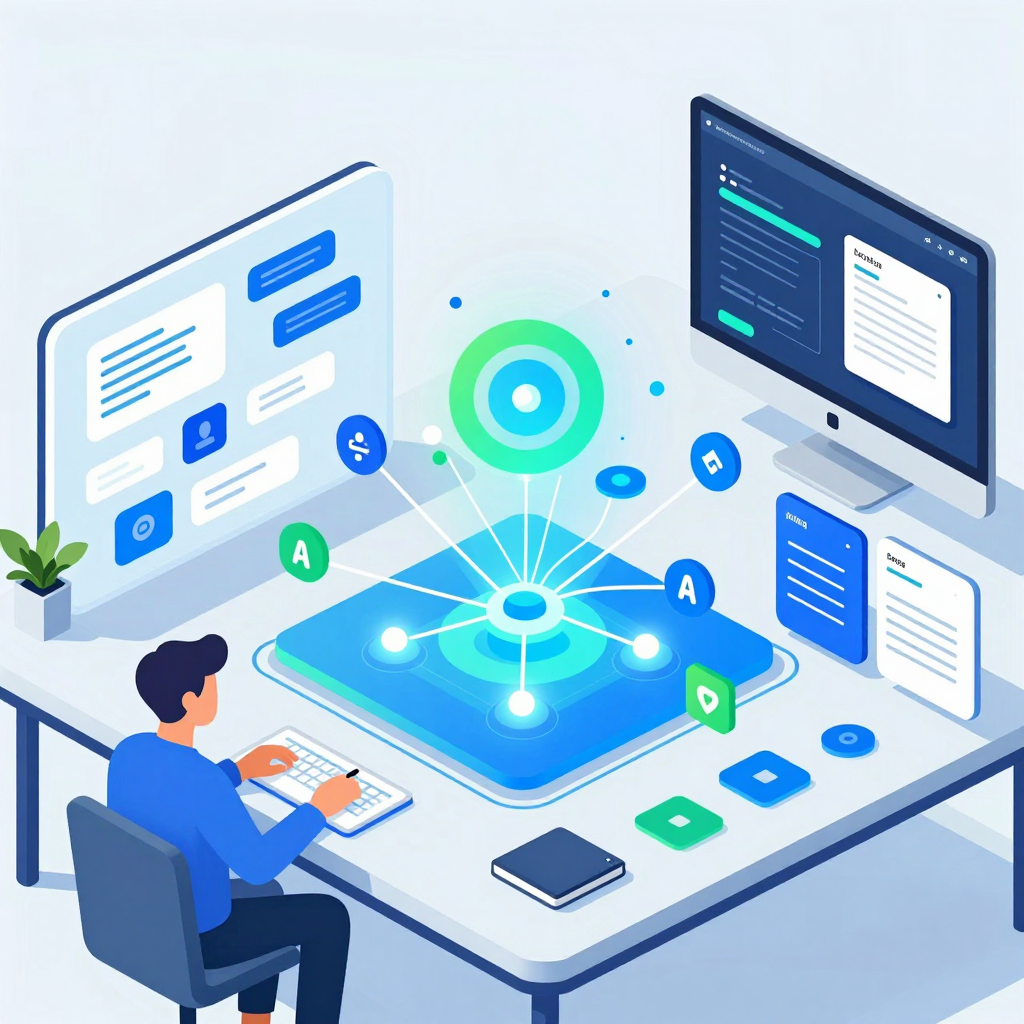
In recent years, enterprise automation has already been riding a wave of innovation thanks to the rise of Low-code platforms. Now, however, we have entered the next phase. The fusion of Agentic AI with Low-code development environments is evolving beyond simple node connections to a level where AI autonomously evaluates and executes tasks.
This is not just a technology upgrade. It fundamentally redefines who can build automation solutions.
The Synergy of Low-Code Platforms and AI Agents
Specialized AI Agents: The Rise of Sub-agents
One of the groundbreaking innovations presented by cutting-edge AI platforms is the concept of Sub-agents. Platforms like Claude Code offer sub-agents specialized for particular tasks, each equipped with independent context windows, custom system prompts, and access to specific tools.
These Sub-agents operate concurrently without the context overhead of the main task. For instance, they handle complex functions such as test execution or document retrieval in separate contexts, returning only the results to the main conversation. This approach maximizes context efficiency and mirrors the multi-workflow management style found in Low-code platforms.
Deterministic Control Through Hooks
Another pivotal innovation of Agentic AI platforms is the mechanism called Hooks. Hooks allow deterministic code injection into agent behaviors. When core business logic is needed even within Low-code environments, Hooks enable powerful control with minimal coding. This seamlessly combines the flexibility of Low-code with the precision of programming.
The Spread and Practical Applications of Low-Code Platforms
Democratizing Visual Workflow Construction
Open-source workflow platforms like n8n integrate hundreds of applications and services through visual node connections. Standardizing data in JSON format enables smooth interaction between disparate services, while functional nodes like Code, IF, and Wait facilitate sophisticated automation.
The hallmark of these Low-code platforms lies in their drag-and-drop, intuitive UI—empowering users without programming experience to build complex automation logic.
Expansion into the Voice Agent Field
The democratization of Low-code is also extending into voice-based AI agents. Companies like Voicelurn are establishing ecosystems for building voice agents via Low-code, enabling developers to create complex conversational flows through clicks and prompt inputs. This facilitates AI voice agent development without heavy coding.
Breaking Down Technical Barriers and Market Transformation
The most significant implication of this technological fusion is the dramatic reduction of technical entry barriers. Traditionally, building automation solutions was the domain of skilled developers. But the confluence of Agentic AI and Low-code now empowers business users without coding skills to create AI-driven automation solutions themselves.
Combining intuitive drag-and-drop UIs with autonomous AI agents leads to transformative changes such as:
- Boosted Development Productivity: Building automation workflows that used to take weeks is now achievable in days
- Increased Business Agility: Rapid deployment of automation solutions responsive to market shifts
- Democratization of the Enterprise Automation Market: Enabling organizations of any size to harness AI-powered automation benefits
Automation is no longer solely the IT department’s stronghold. Business teams now hold the tools to optimize their own workflows, enhance customer experiences, and reduce operational costs firsthand.
2. AI Sub-Agents: The Power of Independence and Expertise
The cutting-edge AI platform Claude Code leverages sub-agents to handle tasks in parallel—from test execution to document retrieval. How does this hidden technology maximize work efficiency?
The Role of Sub-Agents in Low-Code Environments
Traditional automation systems required all tasks to be processed sequentially within a single context. However, the advent of sub-agents breaks these constraints. On platforms like Claude Code, sub-agents each possess independent context windows, custom system prompts, and specific tool access permissions. This means that even in low-code platforms, complex automation workflows can be designed intuitively.
Consider an order processing flow in an e-commerce platform. Previously, one main agent had to sequentially validate orders, check inventory, and process payments. With a sub-agent structure, specialized sub-agents handle each task concurrently. Only results are returned to the main process, drastically reducing overhead in the main context.
Maximizing Efficiency Through Specialized Agents
The greatest advantage of sub-agents lies in their expertise. Each agent is optimized with settings tailored to specific tasks. A test execution agent accesses only tools necessary for code validation, while a document retrieval agent uses prompts optimized for database queries.
When combined with a low-code automation platform, this structure offers the following benefits:
Time savings through parallel processing – Multiple agents work simultaneously, significantly cutting down total workflow execution time. While tests run, documents can be searched and data refined at the same time.
Maximized context efficiency – Agents focus solely on their tasks, eliminating context overhead caused by irrelevant information. This means a limited token budget is used more effectively.
Reduced error rates – Specialized agents handle domain-specific tasks more accurately, preventing error propagation in complex automation workflows.
Deterministic Control via Hooks
Claude Code’s Hooks feature is an innovative tool that combines low-code platform flexibility with deterministic control. Hooks allow the injection of deterministic code at specific points in an agent’s operational flow.
This capability is crucial in practice. When complex business logic exceeds what low-code platforms alone can process, Hooks enable powerful control with minimal coding. For instance, after AI automatically categorizes customer data, a Hook can trigger additional verification only under certain conditions.
Real-World Applications
In enterprise environments, sub-agent architectures are applied across customer service automation, data processing pipelines, report generation, and more. Especially with the fusion of low-code platforms’ visual, node-based interfaces and the autonomy of sub-agents, even non-developers can build sophisticated automation solutions independently.
The independence and expertise of sub-agents represent more than just a technical improvement—they are a revolutionary shift that fundamentally transforms organizational work efficiency.
3. Hooks: The Secret to Maximum Control with Minimal Code in Low-Code Automation
Thanks to the Hooks feature that allows decisive code injection, even Low-Code platforms can effortlessly manage complex business logic. Let’s uncover how this is possible.
The Paradox of the Low-Code Era: Balancing Freedom and Simplicity
The biggest advantage of traditional Low-Code platforms has been their intuitive drag-and-drop interface. However, this simplicity simultaneously reveals its limits—just connecting nodes cannot satisfy all of a business’s unique requirements.
Hooks, as introduced by cutting-edge platforms like Claude Code, offer an innovative solution to this paradox. They break free from the binary choice of writing either all the code or none at all, enabling minimal code to be injected exactly when needed.
What Are Hooks?: A New Way to Achieve Decisive Control
Hooks provide an interface to insert deterministic code at intermediate points within an agent’s workflow. This goes beyond simple conditional branches and means that complex business logic can be directly executed within a Low-Code environment.
Consider an automated order processing workflow. Basic node connections might only handle receiving order data and passing it to a payment system. But real-world business demands more intricate conditions such as:
- Calculating discounts based on a customer’s creditworthiness
- Adjusting shipping schedules depending on inventory levels
- Varying pricing according to promotional periods
Hooks come into play precisely when you want to implement domain-specific business logic accurately. The main workflow remains node-based Low-Code, while essential calculations and decision-making processes are handled with code.
How Hooks Actually Work in Low-Code Platforms
The power of Hooks in Low-Code automation lies in selective code injection at various stages of a workflow:
- Most data flows are managed visually via node connections—API calls, database queries, and conditional splits are arranged intuitively.
- Only at points requiring core business logic is code inserted through Hooks—whether it’s complex algorithms, custom data transformations, or special validation rules.
- Code execution results feed directly back into the main workflow, enabling subsequent nodes to proceed based on that output.
This structure’s biggest advantage is that it simultaneously boosts development productivity and code quality. Simple tasks are implemented rapidly, while intricate parts are finely controlled.
The Synergy Between Agentic AI and Hooks
Hooks hold a special position in the fusion of Agentic AI and Low-Code. When AI agents autonomously assess and perform tasks, Hooks serve as a safety mechanism that precisely reflects human intent.
For example, imagine a voice agent handling customer support. While the agent automatically analyzes conversations and responds, Hooks ensure specific business rules are enforced for critical decisions like refunds. These rules might include limits on refundable amounts, approval steps in the refund process, and methods for data recording.
Through Hooks, AI autonomy harmonizes perfectly with human oversight.
The Importance of Hooks When Choosing a Low-Code Platform
Open-source workflow platforms like n8n provide Code nodes with the same philosophy. They integrate hundreds of applications via node-based design yet allow JavaScript code snippets to be written at specific points.
When selecting a Low-Code platform, consider these criteria:
- How granular and precise is the code control?
- How naturally are code and node-based workflows integrated?
- Are there well-documented interfaces and UI features enabling even business users—not just developers—to use Hooks?
Only when these factors are met can you truly have a Low-Code platform that lowers technical barriers while embracing all the complexity of your business needs.
Conclusion: Achieving Maximum Flexibility with Minimal Code
Hooks are more than a technical feature—they represent a paradigm shift that breaks down unnecessary boundaries between no-code and full-code development. Business users can intuitively build most workflows while calling on developers only to fine-tune specific logic at critical moments.
This is exactly why Low-Code platforms are democratizing enterprise automation. Hooks stand at the heart of transforming complexity into simplicity—and simplicity into sophistication.
The World of No-Code/Low-Code Platforms and Voice Agents
What if anyone could build automation and conversational agents with just a few clicks? How will our everyday lives change? That answer is now becoming a reality. Innovative platforms like n8n and VoicRun are connecting hundreds of applications and voice AI, opening the formerly developer-exclusive realm of automation to everyone.
The Infinite Potential of Low-Code Workflow Platforms
Open-source workflow platforms like n8n truly embody the meaning of Low-Code development environments. These platforms aren’t just toolkits; they are ecosystems that visually connect well over 200 applications and services. Without learning complex programming languages, you can create powerful automation solutions by expressing workflows with nodes and arrows.
The key to this innovation lies in data standardization through JSON format. Different systems and services speak a common language, enabling Slack, Google Sheets, email clients, payment systems, and more to merge seamlessly into a single, integrated workflow.
Especially, the various nodes built into Low-Code platforms enhance business flexibility. You can add custom logic with Code nodes only when needed, create conditional branches with IF nodes, and control timing with Wait nodes. Just by combining these elements, you can automate almost all manual work.
Entering the Era of Voice Agents
But automation innovation doesn’t stop there. Companies like VoicRun are building ecosystems where voice agents can be created in a Low-Code way. This leap goes beyond simple automation to offer an automation experience capable of real-time conversation with AI.
The process of building voice agents is astonishingly intuitive. Simply design complex dialogue flows through drag-and-drop, then input prompts that define your AI agent’s personality and responses. This gives birth to intelligent voice assistants operating 24/7 across countless fields—customer service, sales support, appointment booking, and more.
These voice agents go far beyond reading fixed scripts. Supported by Low-Code platforms, they connect with backend systems to fetch real-time information, respond improvisationally to customer questions, and take necessary actions. Voice agents that check and book reservations on the spot, or financial advisory agents that retrieve and explain account statuses in real time, are no longer science fiction but present-day realities.
The Collapse and Democratization of Technical Barriers
The greatest impact of this technological fusion is the dramatic lowering of technical entry barriers. The combination of intuitive UIs and Low-Code simplicity empowers business users with zero coding experience to build enterprise-grade automation solutions.
Marketing teams can automate entire campaign workflows from customer data collection to email dispatch; HR teams can connect applicant management systems; sales teams can create tracking systems by deal stages. Because each department understands its tasks best, automations built on Low-Code platforms are faster and more flexible than traditional IT development.
With boosts in both development productivity and business agility, the pace of innovation across organizations is accelerating. From small startups to massive enterprises, an era is dawning where every organization can reap the benefits of AI-driven automation.
Section 5: The Democratization and Future of the Automation Market
In an era where you can build AI automation without knowing how to code, which businesses stand to gain the most? Let’s explore the horizon of productivity and agility crafted by intuitive UIs and autonomous AI.
The Door Opened by Low-Code Platforms to Technological Democratization
Until now, creating automation solutions was the exclusive domain of developers. Complex coding and system knowledge were essential, forcing even the most innovative business users to depend heavily on technical teams. However, the fusion of Low-Code environments with Agentic AI is fundamentally reshaping this landscape.
Open-source workflow platforms like n8n integrate hundreds of applications and services through a visual node-connection approach. Thanks to data standardization in JSON format, seamless interaction between disparate services has become possible, enabling users to build advanced automation themselves via various function nodes like Code, IF, and Wait. Today, complex business processes can be automated with nothing more than an intuitive drag-and-drop UI.
Who Gains the Most? The Beneficiaries of This Transformation
Marketing and Sales Teams: They can design automation for repetitive tasks such as customer data integration, email campaign management, and lead scoring directly on Low-Code platforms. This unlocks agility, allowing swift responses to market changes without waiting for developer support.
Finance and Operations Teams: They streamline rule-based workflows like invoice processing, data validation, and reporting automation. Through decisive code injection with hooks, even core business logic can be implemented with minimal coding.
Customer Service Teams: The rise of voice agents has led companies like VoiceRun to foster ecosystems that build AI voice agents on Low-Code platforms. Complex conversational flows can be configured with clicks, and prompts entered straightforwardly—intelligently automating customer interactions.
New Productivity Driven by AI Agents’ Autonomy
Traditional node-based workflows follow preset paths. But with Agentic AI entering Low-Code environments, everything changes. Cutting-edge AI platforms like Claude Code introduce Sub-agents—specialized mini-agents each possessing an independent context window, custom system prompts, and specific tool access.
These agents operate in parallel without burdening the main task’s context overhead. They handle complex subtasks such as test runs or document searches in separate contexts and return only results to the main conversation, maximizing context efficiency. The result? A powerful synergy that simultaneously elevates development productivity and business agility.
Ongoing Democratization of the Enterprise Automation Market
The core value of this technological union lies in the dramatic lowering of the technical entry barrier. Business users without coding experience can now directly build AI-powered automation solutions, making the democratization of the enterprise automation market a reality.
What once demanded multimillion-dollar system integration costs and months-long development now can be prototyped by anyone in just a few weekend hours. This isn’t just about cost cutting—it’s about revolutionizing the speed of innovation across entire organizations.
The Coming Horizon: When Technology and Business Boundaries Blur
As intuitive UIs combine ever more deeply with AI agents’ autonomy, the boundaries between technical and business teams will increasingly fade. In Low-Code environments, developers will no longer be the sole problem solvers; domain experts will directly translate their knowledge into automation solutions.
An organization’s agility and innovation capability will hinge less on the size of its developer resources and more on the technical proficiency shared by all its members. This is the future of the automation market sketched by Agentic AI and Low-Code, working hand in hand.
Comments
Post a Comment