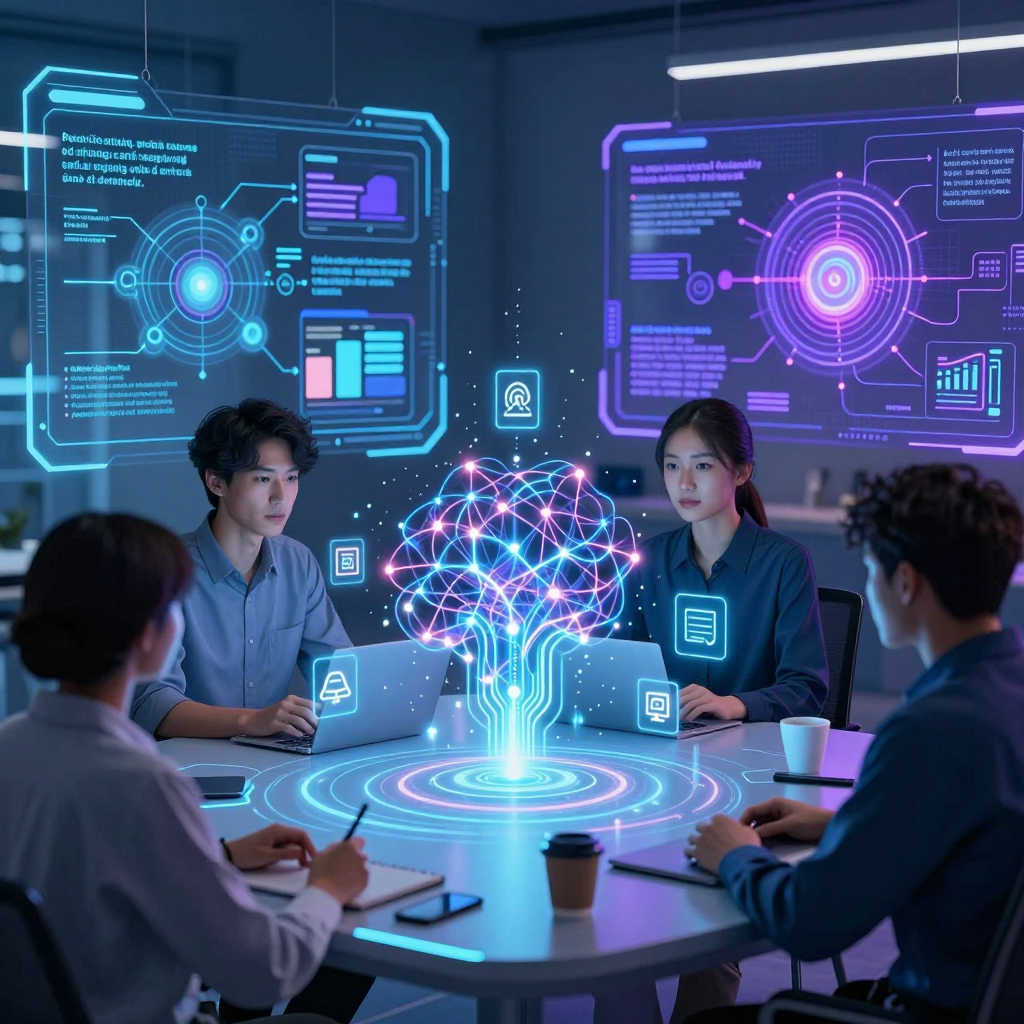
The Astonishing Transformation of AI Agents in 2026
Beyond simple automation systems, AI capable of creative and autonomous decision-making has emerged! What exactly is this revolutionary technology?
The most groundbreaking innovation in AI technology for 2026 is the paradigm shift to Generative AI Agents. Moving beyond the basic automation systems we once knew, advanced agent systems equipped with creativity and reasoning abilities are now emerging.
Expanding the Concept of AI Agents: Adding Generative Abilities
Traditional AI agents were software systems that perceived their environment, made decisions, and acted to achieve goals. However, generative AI agents add a whole new dimension: generative capabilities and high-level reasoning.
Generative AI Agents utilize large language models (LLMs) as cognitive engines, enabling them to generate text, images, and speech. They don’t merely respond to information; they combine creativity and reasoning to autonomously perform complex tasks.
Revolutionary Architecture: Continuous Reasoning-Action Loops
What fundamentally sets Generative AI Agents apart is their technical architecture. They operate through a continuous reasoning-action loop.
Specifically, LLMs integrate perception, reasoning, planning, and action execution to automatically complete multi-step tasks. This is not a one-off command execution—it dynamically detects changes in the environment and adapts throughout the process.
Even more astonishing is their self-correction mechanism. By observing task outcomes and instantly incorporating feedback, they can dynamically adjust their next steps. This ability allows agents not simply to follow fixed procedures but to continuously refine strategies for more effective results.
Moreover, their tool integration capability makes these agents powerfully practical. They can access external resources like APIs, databases, and code execution environments to perform actual business operations.
Extended Context Persistence: Handling Long-Term Tasks
Another challenge traditional AI struggled with was context persistence. Generative AI Agents can now handle complex tasks spanning minutes to days—not just single interactions.
This means agents can independently manage work requiring long-term context, such as scheduling, project tracking, and data analysis. They remember information from earlier steps and make subsequent decisions informed by that knowledge, evolving into truly ‘intelligent’ systems.
Expanding into Enterprise Workflows
The application scope of Generative AI Agents is rapidly broadening. Initially limited to content creation, research support, and customer communication, they now automate scheduling, project management, data analysis, and report generation—real enterprise-level tasks.
Notably, these agents have evolved beyond mere tools to serve as reliable digital coworkers. This represents a fundamental shift in knowledge work paradigms, redefining how organizations operate.
2026 is poised to be the year when Generative AI Agents transcend technical innovation to become essential players in practical work environments.
2. What Are Generative AI Agents?
Let’s delve into the core principles of AI agents that leverage large language models as cognitive engines to autonomously generate text, images, and speech.
Definition and Essence of Gen AI Agents
Generative AI Agents (hereafter Gen AI agents) represent an evolved generation of intelligent systems, taking the traditional concept of AI agents to the next level. While conventional AI agents were software systems that perceived an environment, made decisions, and acted to achieve goals, Gen AI agents add an exciting new dimension: generation capabilities coupled with higher-order reasoning.
Specifically, Gen AI agents are advanced agents that utilize large language models (LLMs) as cognitive engines to create text, images, and audio. They transcend the mere response to information and rule-based operation, uniquely fusing creativity and reasoning to autonomously perform complex tasks.
How They Differ from Traditional Agent Systems
The fundamental distinction of Gen AI agents lies in their architecture. Whereas traditional agent systems relied on static rules and pre-programmed logic, Gen AI agents operate with groundbreaking capabilities such as:
Continuous Reasoning-Action Loops
LLMs integrate perception, reasoning, planning, and action execution to autonomously complete multi-step tasks. This means the agent actively reevaluates the situation at each stage and dynamically selects the optimal next action.
Tool Integration
Gen AI agents are not isolated systems. They access a variety of external resources—including APIs, databases, code execution environments, and external applications—to perform real-world tasks. This bridges theoretical intelligence with practical execution.
Self-Correction Mechanisms
After completing tasks, the agent observes outcomes and immediately incorporates feedback to readjust subsequent steps dynamically. It possesses self-improving capabilities that detect errors and explore corrective measures autonomously.
Context Persistence
Gen AI agents handle complex workflows extending from minutes to days, maintaining contextual awareness across stages. This enables them to push toward long-term objectives without losing track of prior interactions.
Roles and Expectations in Practice
One of the most captivating features of Gen AI agents is their role as a "reliable digital coworker." Far beyond simple automation tools, these agents are poised to fundamentally transform knowledge work paradigms.
Their application scope is rapidly expanding—automating enterprise tasks such as content creation, research assistance, customer communication, scheduling, project management, data analysis, and report generation. In the future, agents won’t just handle repetitive work but will also take on intricate assignments demanding creativity and judgment.
This evolution is expected to profoundly impact organizational workflows and human workforce composition. As Gen AI agents establish themselves as digital colleagues, humans will be empowered to focus more on strategic and creative endeavors, setting the stage for a new era of collaborative intelligence.
Section 3. The Secrets of Technical Architecture: Continuous Reasoning and Self-Correction Mechanisms
Curious about how AI plans complex multi-step tasks, autonomously adjusts its actions, and even leverages external tools? The revolutionary core of the 2026 Gen AI Agent lies in its continuous reasoning-action loops and self-correction mechanisms. This section unveils the inner workings of next-generation Agent technology in full detail.
The Agent’s Integrated Cycle of Perception, Reasoning, and Action
Unlike traditional simple automation systems, modern Gen AI Agents utilize large language models (LLMs) as cognitive engines to integrate perception, reasoning, planning, and action execution. It operates much like a skilled professional analyzing assigned tasks, drafting an execution plan, and adjusting course whenever needed.
Specifically, the operational flow of a Gen AI Agent follows these steps:
- Perception: The Agent gathers information about the current situation, user requests, and results from prior tasks.
- Reasoning: The LLM synthesizes this data to grasp the problem’s essence and derive solutions.
- Planning: It formulates a detailed multi-step action plan to achieve complex goals.
- Action: The Agent carries out actual work based on the plan.
By continuously repeating this loop of four elements, the Agent can autonomously manage long-term projects spanning days.
Tool Integration Capabilities: The Agent’s Hands and Feet
The reason why innovative Gen AI Agents effect meaningful change in the real world is their rich tool integration capabilities. Agents do far more than generate text—they gain direct access to and leverage external resources.
These tools include:
- API Integration: Real-time communication with cloud services, databases, and external platforms
- Database Access: Searching, querying, and updating essential information
- Code Execution Environments: Performing complex computations and data processing with programming languages like Python and JavaScript
- File System Manipulation: Creating, editing, and retrieving documents
For example, a scheduling Agent can check actual calendars via calendar APIs, notify participants through email APIs, and secure meeting rooms by interfacing with reservation systems. Thanks to this, Agents can perform integrated operations across the entire digital ecosystem.
Self-Correction Mechanisms: The Agent’s Learning and Adaptation
One of the most groundbreaking traits of Gen AI Agents is their ability to check and adjust their actions in real time during task execution. Let’s explore the mechanism that makes this possible.
When an Agent performs a particular action, it immediately observes the outcome. For instance:
- If the result returned from a database query does not meet expectations, the Agent modifies the query conditions.
- If an API call returns an error code, the Agent alters the request format or tries a different approach.
- If a specific section of a generated report is incomplete, the Agent gathers additional data to supplement the content.
This instant feedback incorporation process allows the Agent to reach its goals through iterative attempts and improvements—even if the first try is not perfect. It’s akin to how an experienced professional learns from their mistakes.
Context Persistence: The Foundation for Long-Term Task Handling
Traditional chatbots and simple AI systems optimized for one-time interactions pale in comparison to Gen AI Agents, which possess context persistence that supports complex tasks spanning minutes to days.
This means Agents remember and utilize:
- Prior conversation and task context: The full intent and background of the original request
- Intermediate outputs: Information generated or gathered at each stage
- User preferences and constraints: Specific format preferences, budget limits, time restrictions, etc.
- Progress status: What has been completed and what’s next
For example, a marketing campaign planning Agent continuously references initial budget limits, target audiences, and brand tone & manner over multiple days to develop a consistent campaign strategy.
Complexity and Subtle Differences in Architecture
As is typical with cutting-edge technology, its implementation details are highly nuanced. The same Gen AI Agent architecture can behave very differently depending on system prompts and the tools available.
This means:
- Impact of system prompts: Instructions like “act cautiously” versus “act quickly” prompt the Agent to make drastically different decisions under the same circumstances.
- Scope of accessible tools: Access to certain APIs or databases determines the Agent’s effective capabilities.
- Importance of prompt engineering: Even with identical goals, how you phrase requests greatly influences the Agent’s performance.
Therefore, effectively utilizing Gen AI Agents requires more than simply adopting the technology—it demands meticulous configuration and tuning.
The architecture of Gen AI Agents transcends mechanical rule-based systems by imbuing AI with human-like abilities of reasoning, adaptation, and self-correction. This marks a pivotal shift from mere automation to intelligent partnership, standing out as the most significant technological evolution in enterprise environments come 2026.
Section 4: Digital Colleagues in Reality: Practical Applications in the Workplace
From content creation to project management, discover the astonishing scene where AI now thrives as a trusted digital colleague.
How AI Agents Are Redefining the Boundaries of Work
As of 2026, generative AI agents are no longer just technologies confined to labs. They have firmly established themselves as trusted digital coworkers collaborating alongside human employees in real business environments. This goes beyond mere automation tools — it signifies that agent technologies equipped with creativity and reasoning abilities are fundamentally reshaping how employees work.
A New Level of Enterprise Workflow Automation
Gen AI agents are no longer limited to isolated tasks. They autonomously handle complex, multi-layered assignments demanded by today’s dynamic business landscape.
In the content creation arena, they do more than just generate marketing materials, email campaigns, and social media posts; they consistently craft tailored content optimized for target audiences while maintaining brand voice. In schedule management, they coordinate intricate calendars among multiple stakeholders, automatically detect conflicting appointments, and propose optimal meeting times.
Agents shine spectacularly in project management. They oversee the entire project lifecycle, provide team members with real-time status updates, proactively identify potential risks, and automatically detect when resource reallocations are necessary. When it comes to data analysis, they process vast volumes of both structured and unstructured data to extract meaningful insights, even automatically generating visual reports essential for decision-making.
Report writing showcases true intelligent automation. Agents don’t merely list data; they interpret its significance, highlight key findings within the business context, and organize reports in formats that are easy for both executives and practitioners to understand.
What Makes a Digital Colleague Truly Reliable?
For Gen AI agents to be recognized not simply as automation tools but as "reliable digital coworkers," several essential elements must be met.
Continuous reasoning and self-correction capabilities form the core of their trustworthiness. When encountering unexpected situations mid-task, agents reassess the circumstances through reasoning, review their outcomes, and instantly incorporate feedback to dynamically adjust their next steps. This cyclical process enables agents to autonomously handle variables that initial designs alone could never anticipate.
Tool integration capability is equally critical. Agents must seamlessly integrate into existing work systems, accessing databases via APIs, communicating with necessary platforms, and performing computations directly within code execution environments. Only then can agents become genuine collaborators who leverage an organization’s entire digital infrastructure.
Handling Complex Tasks in Real-World Scenarios
Reality at work is never simple. The concept of contextual persistence reflects this truth. Gen AI agents don’t just interact once; they manage multifaceted projects spanning minutes to days.
Take a marketing campaign as an example. The agent consistently handles every phase: gathering market research at the initial planning stage, devising the campaign’s strategy, generating creative content, managing schedules, monitoring progress, and adjusting strategies as needed. Throughout, it maintains the relationships between past decisions and present conditions, making informed choices within the full project context.
Revolutionizing Organizational Productivity
Introducing Gen AI agents transforms not only individual task efficiency but also workplace culture as a whole. With repetitive and time-consuming duties automated, human employees can now focus on more creative and strategic efforts. In this new collaborative model between agents and humans, organizations produce higher-quality outcomes at faster speeds than ever before.
This is the essence of the digital revolution witnessed on-site in 2026. From content to project management, AI agents are now working alongside us as trusted members of the team.
Challenges and Obstacles: The Journey Toward Agent Stability and Scalability
What technical hurdles still remain? Despite the revolutionary potential of Generative AI Agents, there are still unresolved issues to address before large-scale deployment in real-world production environments. Let’s explore the cutting-edge technological innovations and future outlooks essential for implementing a stable production environment.
Technical Challenges in Agent Deployment
Introducing Gen AI Agents into actual business environments is a challenging journey bridging the gap between theory and practice. What might appear as a simple architecture often encounters countless variables in real-world scenarios.
Prompt engineering is the first major challenge. The system prompt directing an Agent’s behavior can drastically impact overall performance with even subtle word choices. Using the same Agent architecture, entirely different outcomes may result depending on the prompt, undermining reproducibility and reliability.
Memory management is another crucial hurdle. For Agents handling complex tasks spanning from minutes to days, maintaining accurate long-term context and state information is vital. Issues like token explosion from accumulated memory, loss of key information, and contextual distortion over time directly degrade the Agent’s performance.
Coordinating Complex Components to Ensure Stability
Gen AI Agents do not operate solely on a single engine like an LLM. They rely on the sophisticated interplay of multiple components—prompt engineering, memory management, error handling, and safety guardrails—to function reliably.
Error handling mechanisms are especially critical. When an Agent accesses external tools (APIs, databases, code execution environments), how it manages unpredictable errors becomes pivotal. Whether it’s network failures, delayed API responses, or data format mismatches, the Agent must detect these issues and either recover automatically or report appropriately to users.
Safety guardrails are indispensable. When granting an Agent access to tools, clear boundaries must be set to determine which actions are permitted or restricted. For example, data deletion might require an approval process, or sensitive information access must be pre-filtered.
The Paradox of Identical Architectures, Divergent Performance
What’s even more fascinating is that, despite having the same Agent architecture, entirely different behaviors can emerge based on the configuration of available tools. The capabilities of an Agent hinge on which APIs and databases it can access and what permissions it holds.
This paradoxically limits scalability. Applying an Agent optimized for one domain to another often requires a complete redesign of the system. Therefore, creating Agents that are both universally adaptable and domain-specific has emerged as a crucial technological challenge for 2026.
The Direction of Technological Innovation in 2026
Resolving the dissonance between stability and scalability is expected to be the central focus of Agent technology development in 2026.
Adaptive prompt automation will alleviate the burden of manual prompt engineering. Agents will dynamically adjust their prompts during tasks and optimize performance based on real-time metrics.
Hierarchical memory architectures will enhance efficiency by distinguishing between short-term and long-term memory. Information needed for current tasks will be quickly accessible, while long-term learned knowledge will be stored in compressed form.
Automated safety verification frameworks will inspect every Agent action in real time to proactively block regulatory violations or risky behaviors, significantly boosting trustworthiness in production environments.
Evolving Into a Trustworthy Digital Colleague
Ultimately, the goal of all these technological efforts is to evolve Agents from simple automation tools into reliable digital colleagues. Overcoming present challenges will empower organizations to fundamentally transform the paradigm of knowledge work.
The year 2026 is poised to be a period of the most vigorous innovation aimed not only at recognizing technological limits but boldly overcoming them.
Comments
Post a Comment