 \n
\n
1. The Revolution of Edge AI: The Dawn of Physical Artificial Intelligence
What if AI that understands language and actions, and interacts with the physical world, were embedded in edge devices? How would our daily lives change? This scenario is no longer a distant future. With groundbreaking technologies like NVIDIA’s Project GR00T, Edge AI is evolving from mere data processing into a genuine era of physical artificial intelligence.
The Fusion of Edge AI and Multimodal Generative AI
Traditional AI systems relied heavily on cloud data centers. However, Edge AI fundamentally disrupts this paradigm by embedding powerful AI models directly into edge devices—robots or smart gadgets themselves.
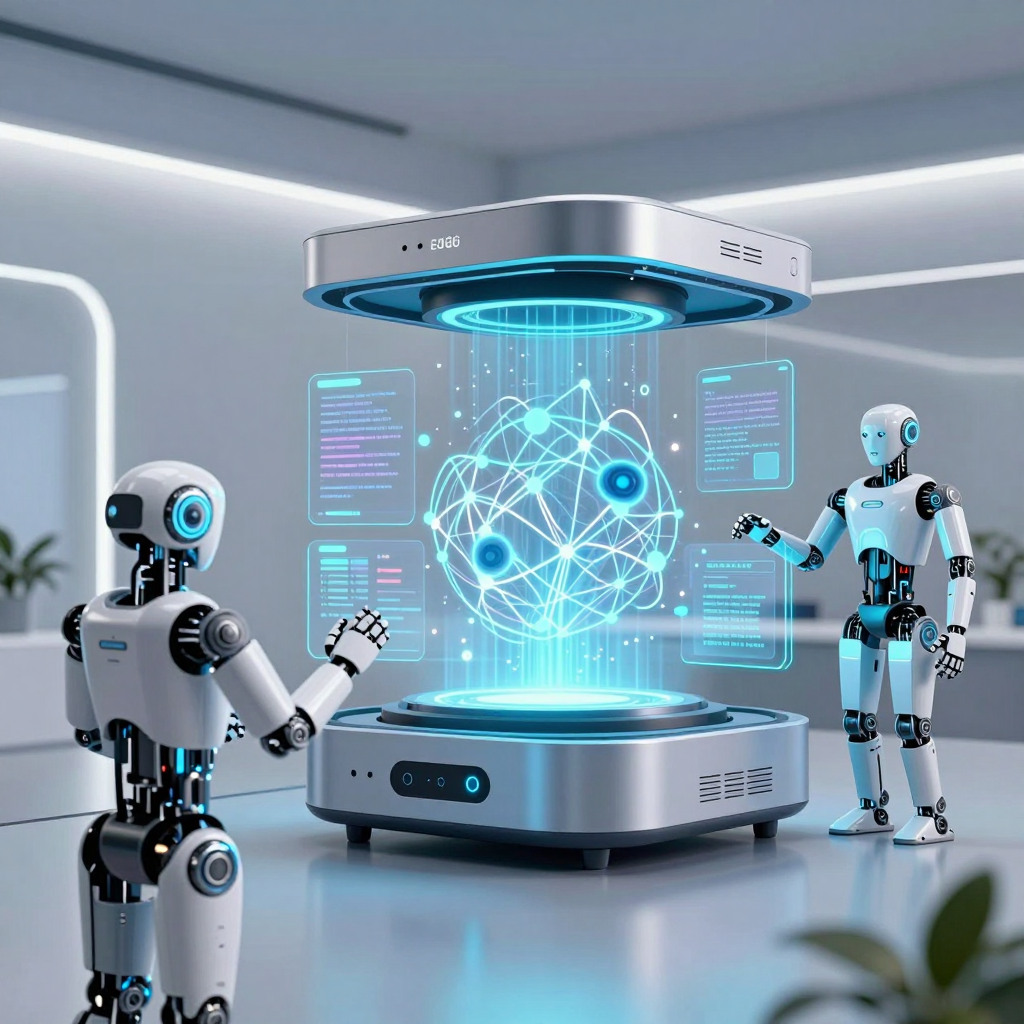
NVIDIA’s Project GR00T stands as a remarkable embodiment of this Edge AI vision. It transcends simple robot control models by equipping edge devices with multimodal generative AI capable of understanding language, behavior, and interacting with the physical world. In other words, robots can comprehend natural language commands, visually perceive their surroundings, and act wisely accordingly. This represents a revolutionary leap, defining a new paradigm in AI-powered edge computing.
A Dual System Mimicking Human Cognition
The design philosophy behind GR00T is truly fascinating. Just as the human brain operates via two modes of thinking, GR00T is engineered with a dual-system architecture.
System 2 manages high-level reasoning. Built on a vision-language model (VLM) that combines large language models (LLM) and vision models, it interprets visual cues alongside natural language commands. For example, when given a simple command like “clean the room,” System 2 autonomously breaks it down into concrete sub-tasks such as “put toys in the box” and “wipe the desk,” then formulates a plan.
System 1 handles low-level motor control. A key innovation here is that instead of predicting absolute joint angles, it forecasts State-Relative Action Chunks—relative behavioral modules. This approach enables the robot to flexibly adapt when its position shifts due to external shocks or unexpected obstacles, maintaining the overall flow of its movements.
Groundbreaking Performance Boost in Edge Devices
The realization of Edge AI hinges on hardware innovation. The edge devices running GR00T are equipped with 128GB of LPDDR5X memory and a memory bandwidth of 273GB/s. This empowers them to perform real-time inference using models with billions of parameters—all while constrained by limited power and space inside the robot.
This leap in performance is critical. It means data streaming from high-resolution cameras, LiDAR, and other sensors can be processed instantly without lag. Real-time processing allows the robot to respond immediately to environmental changes, drastically improving both safety and efficiency.
Causal Reasoning in Vision-Language-Action Models
At the heart of state-of-the-art Edge AI lies the Vision-Language-Action (VLA) model. This goes beyond mere visual data processing; it entails causal reasoning through linguistic cognition, enabling actions to be decided based on understood cause-and-effect relationships.
Consider a scenario where a car passes down an alley and notices a rolling ball. Traditional systems might treat the ball simply as an obstacle. The VLA model is different—it reasons causally, anticipating “a child is likely to follow behind the ball.” Based on this inference, it proactively reduces speed and exercises caution. This is the authentic intelligent physical interaction that Edge AI brings to life.
Such capabilities of Edge AI promise to profoundly transform our everyday experiences. From autonomous vehicles to smart robots and intelligent industrial machines, all devices interacting with the physical world will soon possess safer, more efficient, and predictively intelligent cognitive abilities. The future is closer than ever.
The Secret Behind the Dual-System Architecture Mimicking the Human Brain
What is the principle that enables large language models combined with vision models to break down complex commands into specific actions, and for low-level motor control to adapt to unexpected situations? Nvidia’s Project GR00T offers an answer inspired by the dual-system structure of human cognition. Let’s explore how this innovative approach is redefining the frontiers of Edge AI.
The Cognitive Framework of Edge AI: High-Level Reasoning in System 2
The first layer of GR00T, System 2, emulates the way humans consciously think and make decisions. This layer is based on a vision-language model (VLM) that combines large language models (LLMs) with vision models, comprehensively interpreting visual data and natural language commands to perform high-level reasoning.
For instance, when a user commands “Clean the room,” System 2 does not merely accept the order at face value; instead, it strategically breaks it down into concrete sub-tasks such as “Put the toys on the floor into the box,” “Wipe the desk,” and “Take out the trash.” This mirrors how a human naturally formulates detailed plans when faced with a complex task.
This advanced reasoning capability marks Edge AI’s evolution from a simple command execution machine to a truly intelligent system. The ability for robots or edge devices to understand user intent and independently formulate contextually appropriate plans signifies a paradigm shift in automation technology.
Adaptive Motor Control: The Flexibility of System 1
While System 2 decides ‘what to do,’ System 1 is responsible for ‘how to do it.’ This layer handles low-level motor control using a fundamentally different approach from conventional robotic controls.
The core lies in State-Relative Action Chunks prediction. Whereas traditional robotics control predefines absolute joint angles that must be reached, GR00T’s System 1 predicts movements relative to the current state. Much like how a human can move their arm with eyes closed, System 1 enables the robot to flexibly respond to unforeseen circumstances.
The practical benefits of this design are striking. When a robot’s position shifts due to an external impact, or when it encounters unexpected obstacles, System 1 automatically adjusts by continuing the motion flow from its current state without needing to replan from scratch. This is a critical mechanism allowing robots to achieve robust and reliable performance.
Hardware Foundations Enabling Real Interaction with the Physical World
For the dual-system architecture to function effectively, a powerful hardware foundation is indispensable. The Edge AI device running GR00T is equipped with 128GB of LPDDR5X memory and 273GB/s memory bandwidth, enabling real-time inference of models featuring billions of parameters within the limited power and space constraints inside a robot.
This represents a complete departure from traditional cloud-based processing. Even when multi-GB data streams pour in per second from various sensors like cameras and LiDAR, Edge AI processes it with zero latency, facilitating immediate responses. Without network delay or reliance on cloud servers, robots achieve true independence.
The Innovation Brought by Mimicking the Human Cognitive System
Ultimately, the profound significance of GR00T’s dual-system architecture lies in how precisely AI can imitate human cognition. Just as slow, deliberate thinking (System 2) harmonizes with quick reflexes (System 1), Edge AI now performs strategic thinking and instantaneous reactions simultaneously.
This realization of physical intelligence is not merely a technological leap but the birth of genuinely intelligent systems that possess cognitive and behavioral abilities comparable to humans. The adaptability and autonomy forged by the dual-system architecture are poised to revolutionize robotics, automation, autonomous driving, and many other industries.
Section 3: Real-Time Intelligence Powered by Robust Hardware
What if robots could comprehend complex commands and act on them with pinpoint accuracy in the blink of an eye? This isn’t just a triumph of smart software. The real hidden hero behind this miracle is an Edge AI device equipped with 128GB of LPDDR5X memory and a blazing-fast 273GB/s memory bandwidth.
How Hardware Innovations in Edge AI Are Transforming the Game
Traditional AI systems have relied heavily on cloud data centers for powerful inference. But the rise of Edge AI has completely upended this paradigm. With powerful hardware embedded directly within edge devices, physical AI systems—like robots and autonomous vehicles—can now run models with billions of parameters in real time, all without any cloud connectivity.
Consider NVIDIA’s Project GR00T and its vision-language-action (VLA) model. This model analyzes high-resolution video input from cameras, understands natural language commands, and issues precise orders to every joint of a robot—all executed within milliseconds. The secret to enabling such feats lies in the revolutionary hardware specifications of the edge device.
Infinite Performance Within Limited Space
Edge devices like robots and self-driving cars face one fundamental constraint: limited power and physical space. Unlike massive data center servers, they can’t accommodate large cooling systems or heavy power supplies.
In this context, 128GB of LPDDR5X memory offers a groundbreaking solution. Designed for low power consumption, LPDDR5X delivers a staggering bandwidth of 273GB/s. This means it can process the flood of data from high-resolution cameras, LiDAR, IMU sensors, and more, all without delay. Simultaneously, it can hold multiple large-scale neural networks—language models, vision models, and motion control models—in memory at once.
The Technical Significance of Real-Time Inference
To better grasp the real-time inference capabilities of Edge AI devices, let’s explore the dual-system architecture in GR00T.
System 2, the vision-language model handling high-level inference, performs complex calculations. When a user commands, “Clean the room,” this system first assesses the current room state from camera input, understands the command’s nuance, and then breaks it down into concrete subtasks like “put toys into the box” and “wipe the desk.” Every step passes through billions of parameters.
Meanwhile, System 1, responsible for low-level motor control, predicts state-relative action chunks—joint movements based on the robot’s current state. This adaptive approach allows the robot to dynamically react to external shocks or unexpected obstacles.
For all these operations to occur without latency inside the robot, enormous memory bandwidth is essential. Without 273GB/s bandwidth, bottlenecks between the CPU and memory would cripple real-time performance.
Why Edge AI Is Indispensable
What if all this processing had to be sent to the cloud? Network latency, bandwidth limits, and privacy concerns would inevitably arise. By contrast, an Edge AI device with powerful hardware solves all these issues. The robot perceives its environment in real time, reacts instantly, and processes sensitive data entirely on-board without sending anything external.
As emphasized at CES 2026, this Edge AI-driven edge computing is setting new standards for safety and efficiency. It’s why autonomous vehicles can dodge obstacles with zero lag, robotic arms can perform precise movements, and autonomous agents can plan and execute in real time—thanks entirely to this cutting-edge hardware foundation.
The era of AI interacting seamlessly with the physical world has arrived. At its core lies the hardware breakthrough of 128GB LPDDR5X memory paired with an ultra-high-speed 273GB/s bandwidth.
Section 4: Understanding Causality Beyond Objects with Vision-Language-Action Models
A Leap from Simple Recognition to Causal Reasoning
Imagine your autonomous car navigating through a narrow alley. Suddenly, a ball rolls onto the street. Traditional AI systems would simply detect it as an obstacle and calculate a route to avoid it. But a truly intelligent system asks a different question: "What might be behind the ball?"
This is the revolutionary innovation realized by the Vision-Language-Action (VLA) model. Emerging at the cutting edge of Edge AI, the VLA transcends mere perception and reaction—it understands the causal relationships of the world and acts accordingly as a genuinely intelligent system.
Definition and Features of the VLA Model
The Vision-Language-Action model integrates three core capabilities. First, it instantly processes real-time data from cameras and sensors through visual information processing. Second, it performs linguistic reasoning to infer causality in the situation. Third, based on this reasoning, it makes concrete decisions and executes actions.
This approach remarkably mirrors human thinking. When we see a ball, we unconsciously assume, “There might be a child behind that ball,” and quickly slow down. Similarly, the VLA model performs causal reasoning to take proactive measures.
A Real-World Example of Causal Reasoning
Let’s take a deeper look at the ball-in-the-alley scenario. An autonomous vehicle equipped with an Edge AI-based VLA model undergoes the following thought process when it sees a rolling ball:
Step 1: Visual Information Gathering
High-resolution cameras capture the ball’s position, speed, and its surrounding environment.
Step 2: Linguistic Causal Reasoning
“A ball is rolling out” → “The ball was likely pushed by someone” → “That someone is probably a child” → “The child could suddenly run out after the ball” → “Therefore, exercise caution and slow down preemptively.”
Step 3: Action Decision
Based on this causal inference, the vehicle immediately reduces speed and heightens its vigilance to monitor the surroundings for unexpected events.
All of this unfolds within milliseconds—this is the essence of Edge AI.
The Power of VLA Enabled by Edge AI
The practical realization of the VLA model owes itself to groundbreaking hardware innovations in Edge AI. Systems like NVIDIA's Project GR00T boast 128GB LPDDR5X memory and a 273GB/s memory bandwidth, enabling the real-time execution of colossal language models with billions of parameters directly on edge devices such as robots or autonomous cars.
This eliminates the need to send data to cloud servers and wait for responses. The torrent of data from high-resolution cameras and LiDAR is processed without delay, enabling immediate action. Such low latency is absolutely critical in safety-sensitive applications like autonomous driving and robotic control systems.
Diverse Applications of the VLA Model
The causal reasoning capabilities of the VLA model are revolutionizing fields far beyond autonomous driving.
Humanoid Robots: Upon receiving a command like “Clean the room,” the VLA model autonomously breaks it down into concrete tasks such as “put toys into the box,” “sweep dust,” and “wipe the desk.” Even when unexpected situations arise during these tasks, the VLA model understands the broader context and adapts flexibly.
Industrial Robots: Rather than merely interpreting sensor data like “temperature has risen,” these robots infer causality—“The temperature rise may be due to bearing wear”—and proactively suggest maintenance.
Medical Robots: By comprehensively analyzing a patient’s facial expressions, gestures, and vocal signals, these robots understand not just physical but emotional states and respond appropriately.
Technical Foundation: Multimodal Generative AI
The strength of the VLA model lies in its multimodal generative AI architecture. It simultaneously processes and learns interrelations among diverse data modalities such as text, images, video, and speech.
Vision-language models (VLMs) combine vision networks that comprehend visual inputs with large language models (LLMs) handling language. This seamlessly links visual information like “a ball rolling out” with language-based causal reasoning such as “a child could be running after it.”
This multimodal integration perfectly parallels how the human brain synthesizes multiple sensory inputs to understand the world.
Robustness Through Adaptive Control
To operate reliably in real-world environments, the VLA model employs the State-Relative Action Chunks technique. Instead of instructing precise joint angles of a robot, it commands relative changes from the current state.
For example, if a robot trying to pick up an object is slightly displaced by an external force, absolute coordinate commands would fail, halting the operation. Using relative action chunks, the robot dynamically adjusts the command—“move forward 30cm and grasp now”—regardless of its displaced position. This provides strong resilience against real-world uncertainties and variables.
New Edge AI Trends in 2026
At CES 2026, AI-powered Edge AI trends focus on safety and efficiency. The demand is not just for smarter AI but trustworthy and explainable AI—needs that the causal reasoning abilities of VLA models precisely fulfill.
Simultaneously, emphasis is placed on building scalable platforms, utilizing eco-friendly energy, and integrating autonomous control technologies. These trends signal that VLA technology must drive not only technical innovation but also socially meaningful change.
Conclusion: The Era of AI That Understands Causality
Predicting the child behind the rolling ball is an extraordinarily human trait. That Vision-Language-Action models endow machines with this ability signifies that Edge AI is no longer just about boosting computational speed—it replicates human cognitive processes themselves.
These transformations exemplified by VLA models herald a fundamental shift in how we interact with technology. Machines no longer simply await explicit commands. They comprehend context, grasp hidden intent, and respond proactively as intelligent partners. This is the future shaped by Edge AI and VLA models.
CES 2026 and the Future of AI: New Innovations Driven by Autonomous Agents
How will autonomous agents, poised to handle a significant portion of corporate decision-making by 2028 alongside AI-powered edge computing focused on safety and efficiency, transform our lives? CES 2026 provided a clear stage to answer this question.
Edge AI at the Heart of Technological Innovation
The most remarkable trend at CES 2026 was how AI-based edge computing moved beyond a mere technological concept to become central in practical industrial applications. Unlike traditional cloud-centric AI, Edge AI processes data directly on devices, minimizing latency and enabling real-time decision-making.
The value of Edge AI emphasized at the exhibition can be summarized in three key aspects. First, safety: processing data locally on edge devices limits external network transmissions, significantly reducing risks of personal data breaches. Second, efficiency: hardware advancements now allow models with billions of parameters to run within the limited power environment of robots, achieving both high performance and low energy consumption. Third, scalability: with standardized hardware platforms and open software ecosystems, rapid adaptation across various industries and fields has become achievable.
Autonomous Agents: From Simple Tools to Decision-Making Partners
CES 2026 also heralded another crucial shift—the rise of Agentic AI. Whereas traditional generative AI mainly responded to user queries or executed given tasks, Agentic AI is fundamentally different. It autonomously sets goals, formulates plans, and interacts with external tools to perform complex tasks independently.
The proliferation of such autonomous agents is expected to fundamentally transform corporate environments. The projection that by 2028 autonomous agents will handle about 15% of corporate decisions is more than just a statistic; it signals a redefinition of human decision-makers' roles and a transition to a data-driven decision-making culture at the core of organizations.
Merging Green Energy with Autonomous Control Technologies
Another striking highlight of CES 2026 was how Edge AI technology is transcending mere performance improvements to embrace sustainability. The fusion of eco-friendly energy technologies with autonomous control means robots and edge devices can self-optimize their energy efficiency.
For example, robots can dynamically adjust operations according to fluctuations in renewable energy supply—from solar or wind—and automatically modify their tasks based on battery status. This represents a vivid example of how the autonomy of edge computing is expanding into energy systems themselves.
The Importance of Scalable Platforms
The future of Edge AI depends not only on technological advancements but also on the creation of scalable platforms. As highlighted at CES 2026, hardware standardization and open software ecosystems must progress hand in hand to enable swift adoption across diverse industries.
For Edge AI technology to thrive successfully in manufacturing, healthcare, logistics, agriculture, and more, industry standards need to be established and robust developer communities built. CES 2026 clearly signaled that such ecosystem formation is already underway.
Preparing for the Future
Ultimately, the message from CES 2026 is unmistakable. Edge AI and autonomous agents are not distant futuristic notions—they are already here, and both businesses and individuals must prepare for this transformation.
A world where safe and efficient Edge AI technologies become ubiquitous and autonomous agents actively participate in decision-making is coming faster than one might expect. The key is to understand this change and ready organizations and individuals accordingly. After all, 2028 is not far away.
Comments
Post a Comment