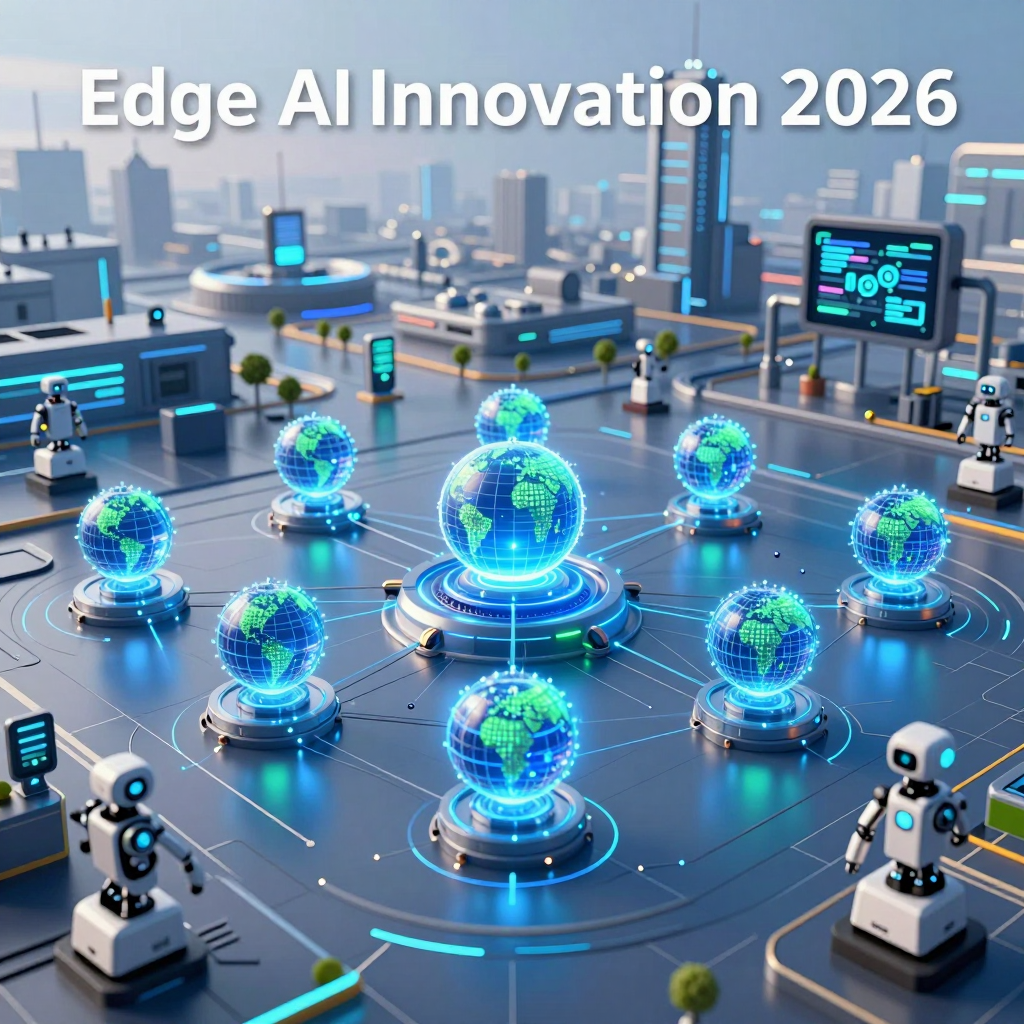
1. The New Wave of Edge AI: Why Distributed AI Will Shine in 2026
What if real-time AI inference happened across more than 4,200 locations worldwide? How would our everyday lives change? Let’s uncover the secret behind how Edge AI is evolving beyond simple inference into a global, distributed infrastructure.
The Great Shift from Cloud-Centric to Distributed AI
For decades, AI inference relied heavily on centralized architectures. All data funneled to massive cloud data centers, and user requests had to make the round trip there and back. But this approach has a fatal flaw: network latency.
Imagine self-driving cars dodging obstacles, game characters responding instantly online, or medical scenarios demanding immediate diagnosis. Even millisecond delays can be critical in these moments. Edge AI is the technology designed to tackle this challenge at its root.
The core philosophy of Edge AI—"Perform inference where the data is generated"—is simple yet powerful. No longer do we need to send data to a central hub. Instead, processing happens instantly, as close to the user as possible, with results returned right away.
Akamai Inference Cloud: A Real-World Distributed Edge AI Example
Moving from concept to reality, Akamai’s approach stands out. With over 4,200 Edge Points of Presence (PoPs) globally, Akamai doesn’t just scatter servers everywhere—they form a unified Edge AI infrastructure.
From high-performance GPU-accelerated cloud core data centers to edge locations around the world, AI inference workloads are deployed and scaled flexibly within a consistent environment.
This distributed architecture comprises three layers:
GPU-Accelerated Infrastructure: The nerve center data centers running heavy, complex AI models. High-performance GPUs tackle large-scale inference workloads here.
Edge AI Architecture: The global network of edge locations housing lightweight models and real-time inference workloads close to users, where speed is crucial.
Distributed AI Service Layer: Services like generative AI, recommendation engines, search, and conversational agents optimized by region and user behavior patterns operate here.
How Edge AI Is Transforming Industries Today
This distributed Edge AI technology is already driving tangible change across many sectors.
In the realm of Generative AI, personalized content creation hits new heights, instantly adapting to user location, preferences, and real-time context. Data analytics speed up, analyzing user behavior on the fly to deliver tailored responses.
The gaming industry experiences Edge AI’s impact earliest and most clearly. Response times directly affect the quality of gameplay. From matchmaking and cheat detection to intelligent NPC behavior, everything is processed swiftly and without delay.
Perhaps most revolutionary is in Physical AI. In the era of autonomous and collaborative robots, a trifecta of on-device AI, Edge AI, and cloud AI is indispensable. Robots must make decisions locally without network lag. Especially for collaborative robots working near humans, real-time, delay-free judgment is a matter of safety. Edge AI equips robots with the safety mechanisms to adjust speed and detect hazards instantly.
The Next Frontier: Edge AI Gateways and WebAssembly Era
Edge AI’s evolution shows no signs of slowing down. As we approach 2026, even more refined technologies emerge.
Edge AI Gateways are intelligent portals that automatically route user requests to the most optimal inference node, considering factors like user location, network latency, and model specifics. This ensures the fastest response no matter where the user is.
WebAssembly as a Service (WaaS) dramatically reduces developer overhead. Lightweight code executes directly on the edge, enabling rapid deployment of AI preprocessing and postprocessing logic. A new era dawns where distributed Edge AI benefits are accessible without complex infrastructure setups.
Conclusion: An Invitation to the Era of Distribution
By 2026, Edge AI moves far beyond the limited idea of “running on the device.” It evolves into a dynamic infrastructure distributed across entire networks.
The convergence of advanced edge accelerators, global distributed architectures, and the rise of Physical AI means ultra-low latency real-time AI services become not just desirable but essential. The futuristic tech we imagine—perfectly responsive autonomous driving, impeccably personalized content, instantaneous, on-site AI decisions—all build upon this distributed Edge AI revolution.
2. Distributed Edge AI Architecture: Beyond the Limits of Centralization
How is the frustrating network latency of conventional AI services overturned by "AI inference near the data source"? Let’s uncover the answer through Akamai’s groundbreaking edge AI architecture.
The Fundamental Limitations of Centralized Cloud AI
Traditional cloud-centric AI models inherently suffer from clear weaknesses. Sending all data to a central data center for processing and receiving the results inevitably incurs network latency. This delay becomes critical in fields requiring real-time decision-making, such as autonomous driving, game matchmaking, and robotic control.
An even more serious issue is the waste of bandwidth. Increased network load from unnecessary data transfers lowers the overall system efficiency and poses privacy risks by concentrating all user data in a central location.
Paradigm Shift Realized by Edge AI
Edge AI technology offers a fundamental solution to these challenges. The simple yet powerful concept is “performing inference where the data is generated.”
Akamai’s distributed edge AI architecture leverages every point between on-device execution and centralized cloud processing. Built on more than 4,200 edge PoPs (Points of Presence) worldwide, it processes data at locations closest to users.
This goes beyond simply “running AI locally.” It means deploying AI inference workloads across a unified infrastructure—from cloud core to global edge—with consistent environments and flexible scalability. This is the most revolutionary alternative to centralized architectures.
The Three-Tier Structure of Edge AI Infrastructure
Akamai’s Inference Cloud is designed in three tiers to maximize efficiency.
First, the GPU-accelerated infrastructure tier consists of powerful GPU-based core data centers handling complex model training and large-scale batch processing.
Second, the edge AI architecture tier comprises a globally distributed network of edge locations. User requests are immediately processed at the nearest edge node, minimizing latency.
Third, the distributed AI service layer strategically deploys generative AI, recommendation engines, search, and conversational agents tailored to regional characteristics. This allows operation of AI models optimized for local user behaviors, preferences, and languages.
This three-tier design not only guarantees ultra-low latency real-time inference but also offers integrated model protection and API security. Since data is processed solely at distributed edges, central security vulnerabilities are drastically reduced.
The Real Impact of Edge AI Architecture
The changes brought by this distributed framework are tangible and profound. In the generative AI domain, real-time data analysis enables personalized content creation and context-aware responses within milliseconds.
In the gaming industry, where responsiveness is vital, edge AI plays a key role in matchmaking, cheat detection, and NPC AI. By processing game logic at the edge closest to players, it ensures fairness in competitive gaming and dramatically enhances the quality of the gaming experience.
Distributed Edge AI does not merely improve speed—it enables an entirely new class of service models.
The Heart of Edge AI Infrastructure: From GPUs to Distributed AI Services
What kind of synergy emerges when high-performance GPU-accelerated data centers, global edge networks, and AI services tailored to regional characteristics combine? The most innovative transformation in the Edge AI ecosystem by 2026 lies not merely in technological evolution but in a paradigm shift across the entire infrastructure. Beyond the era of centralized cloud computing, a dynamic AI infrastructure distributed across the network is emerging.
The Three-Layer Structure of Edge AI Infrastructure: Core Architecture Analysis
Akamai’s Edge AI inference cloud is designed with a sophisticated three-layer structure. Each layer performs distinct roles while organically interconnecting.
The GPU-accelerated infrastructure layer acts as the computational engine of the Edge AI system. Core data centers equipped with high-performance GPUs handle complex model training and advanced inference tasks. This serves as a foundation providing sufficient computing power close to where data is generated, going beyond simple local inference. The parallel processing capability of GPUs rapidly manages large-scale matrix operations, enabling ultra-low latency—a critical requirement for real-time AI services.
The Edge AI architecture layer leverages Akamai’s network of over 4,200 global edge Points of Presence (PoPs). These are not mere network nodes but a distributed computing infrastructure capable of executing AI inference directly at the location closest to the user. By performing model inference where data originates, this layer drastically reduces network latency. Its significance lies in enabling AI inference workloads to be deployed and flexibly scaled uniformly from the cloud core to the global edge. This means developers can deliver consistent AI services worldwide on edge nodes with a single deployment.
The distributed AI service layer realizes the business value of Edge AI in practice. Advanced AI services such as generative AI, recommendation engines, search services, and conversational agents are deployed according to regional characteristics. This doesn’t simply mean running the same model everywhere; it means providing optimized versions tailored to each region’s language, culture, and user behavior patterns.
The Synergy of the Three Layers: Achieving Ultra-Low Latency Real-Time Inference
The true value of this three-layer structure lies in the interplay among its layers. The GPU-accelerated infrastructure delivers powerful computational capabilities, the global edge network distributes these capabilities close to users, and regionally specialized AI services generate real business value, creating a virtuous cycle.
This synergy is especially potent in applications where real-time response is crucial. When a user request occurs, the Edge AI infrastructure performs inference at the nearest edge node, reducing round-trip latency to milliseconds. At the same time, if complex computations are required, requests can be routed to the central GPU-accelerated data center to ensure accuracy.
Unified Security: Combining Model Protection with API Security
Another distinguishing feature of the Edge AI infrastructure is its integrated approach to model protection and API security. Since models reside on edge nodes, intellectual property protection is even more crucial than in traditional cloud systems.
Akamai’s infrastructure encrypts models deployed at the edge, controls API access, and monitors usage. It also secures communication between the cloud core and edge nodes, preventing model or data exposure during transit. This integrated security framework enables enterprise customers to confidently deploy Edge AI.
Differentiated Value: Flexibility and Scalability
The ultimate value of Edge AI infrastructure lies in its flexibility and scalability. Organizations can operate multiple AI services concurrently on the same infrastructure and automatically scale resources based on user count and request volume. They can deploy different models regionally or update models in real time.
These capabilities suggest that by 2026, Edge AI will revolutionize not just technological improvements but the very way AI services are delivered across industries.
Section 4: From Real-Time Gaming to Autonomous Robots, the Real-World Applications and Innovations of Edge AI
From personalized content generated by generative AI to cheat detection, and the on-site decision-making executed by physical AI-powered robots—the vivid stories of Edge AI transforming future industries are unfolding. Let’s explore how Edge AI is breaking away from theoretical technology to revolutionize actual business operations and user experiences.
Real-Time Personalized Services Evolving with Generative AI
The most immediate application of Edge AI lies in the realm of generative AI. In traditional centralized cloud environments, user requests had to travel to distant data centers, inevitably causing response delays. However, with the advent of Edge AI technology, these limitations are being overcome.
By performing inference directly at edge locations regionally, real-time data analysis has become possible. Data input by users is analyzed and processed on the spot, virtually eliminating time loss caused by network latency. This means that the quality and speed of personalized content generation can be enhanced simultaneously.
Moreover, Edge AI can grasp the user's context and situation to deliver tailored responses. By instantly reflecting personal preferences, regional cultural traits, and real-time situational information, Edge AI can provide an experience so seamless it feels like having a dedicated expert right beside you.
Edge AI Driving Innovation in the Gaming Industry
Edge AI’s role in gaming has grown beyond a mere supplementary technology to a core element that shapes the fundamental gaming experience. In multiplayer online games, reaction speed is the crucial factor determining both engagement and fairness.
The matchmaking system is a prime example. Connecting suitable opponents among millions of players worldwide demands immense computational power. Leveraging Edge AI, regional edge nodes consider players’ skills, preferences, and latency holistically to create optimal matchups in real time. This significantly boosts game responsiveness and prevents player churn caused by unfair matchmaking.
Cheat detection is another critical role for Edge AI. By detecting and blocking suspicious gameplay patterns as they occur, a healthy gaming environment is maintained. Even minimal delays can undermine detection accuracy, making Edge AI’s low-latency characteristic indispensable in this domain.
The operation of NPC (Non-Player Character) AI also determines immersion. Edge AI-powered NPCs rapidly perceive players’ actions and respond naturally, crafting a richer and more vivid game world. This satisfies both the fun and challenge that gamers crave.
Physical AI: The Era of Robots Making Their Own Decisions
Yet, the true value of Edge AI shines most brightly in the realm of physical AI. As autonomous and collaborative robots become widespread, Edge AI has become a vital technology directly linked to safety and human lives, far beyond mere efficiency.
Modern advanced robotic systems employ a triple-layered architecture: on-device AI, edge AI, and cloud AI—each layer designed to perform distinct roles.
On-device AI processes information from the robot’s sensors at lightning speed. It instantly handles obstacle detection, emergency stops, and basic motion control without network connectivity. This guarantees fundamental robot safety even if the network connection fails.
Edge AI takes on more complex decisions. Analyzing the robot’s operational status, surrounding environment, and interactions with other robots or humans at nearby edge servers, it dynamically adjusts the robot’s speed and actions in real time. Particularly for collaborative robots operating near humans, Edge AI’s low-latency judgment functions as a safety mechanism that proactively prevents life-threatening accidents.
Cloud AI manages long-term learning and optimization. It collects data from robots’ activities to continuously improve models, then deploys the updates back to edge and on-device layers.
Through this triple structure, robots can make immediate decisions on-site without network delays. Whether it’s a collaborative robot on a car assembly line sensing human worker movements and instantly adjusting its speed, or an autonomous warehouse robot navigating unexpected obstacles while continuing its tasks—Edge AI is making these real-world scenarios possible.
How Edge AI is Transforming the Industrial Ecosystem
From gaming to robotics, the common thread in Edge AI’s real-world applications is that latency directly affects the quality of experience—deciding victory or defeat in games, and safety in robotics.
Therefore, by 2026, Edge AI will no longer be optional but a fundamental infrastructure in industrial settings. As globally distributed Edge AI infrastructures like Akamai’s global edge network expand, the potential of real-time AI services will explode exponentially.
In practice, Edge AI already delivers tangible value in business—boosting user satisfaction, operational efficiency, and above all, safety. This is precisely why Edge AI commands attention as a pivotal technology shaping the future of industry, far beyond being a mere technological trend.
Section 5: The Next-Generation Technology Roadmap Defining the Future of Edge AI Beyond 2026
What are Edge AI Gateways and WebAssembly as a Service (WaaS)? These two technologies are the revolutionary forces set to completely reshape the Edge AI ecosystem beyond 2026. Let’s explore the next phase of ultra-low-latency AI services unfolding directly in developers' hands, along with the technologies and prospects driving this transformation.
Edge AI Gateway: The Intelligent Traffic Control System
Until now, AI inference requests were simply sent to the nearest server or funneled into a central cloud. Akamai’s Edge AI Gateway fundamentally changes this paradigm.
At its core, the Edge AI Gateway intelligently analyzes user requests and routes them to the optimal inference nodes by considering dozens of variables such as location, network latency, and model characteristics. For instance, match-making requests in games—where ultra-low latency is critical—are routed to the closest edge server, while complex computations for personalized recommendations are simultaneously handled by GPU-accelerated core data centers.
This is more than simple load balancing—it marks the beginning of dynamic infrastructure optimization. The Edge AI Gateway continuously monitors real-time network conditions and model loads, instantly adjusting processing paths based on request characteristics. As a result, over 4,200 edge Points of Presence (PoPs) worldwide and cloud cores operate as a single, unified AI inference platform.
WebAssembly as a Service (WaaS): A Developer-Centric Revolution in Edge Deployment
WebAssembly is already known as a technology for running lightweight code on browsers and edge environments. However, WebAssembly as a Service (WaaS) reinvents this concept entirely from the perspective of AI service deployment.
WaaS provides an environment where developers write AI model preprocessing and postprocessing logic as lightweight code and deploy it instantly across global edge infrastructure. While optimizing and deploying AI models previously required infrastructure specialists, the WaaS era empowers application developers to build and operate edge AI services themselves.
Take real-time content personalization as an example: developers can create user behavior analysis logic with WaaS, deploy it to edge servers, and receive responses within mere milliseconds. Deployment is simplified to the point where just a few clicks distribute code across the worldwide edge network.
Impact of the Edge AI Technology Roadmap on Industries
What changes when these two technologies converge? First, the barrier to entry significantly lowers. Even small startups can launch global-scale ultra-low-latency AI services without heavy infrastructure investments. Second, real-time demands are met: autonomous robots operate safely without network delays, cheating detection in games happens within milliseconds, and medical devices make instant decisions.
Third is the simultaneous achievement of personalization and privacy. Since personalized AI inference occurs at edges near users—without sending data to central clouds—sensitive information is naturally protected and regulatory compliance is effortlessly maintained.
The Reality Beyond 2026: From Technology to Infrastructure Foundation
Ultimately, post-2026 Edge AI sheds the limited concept of “running on devices” and evolves into a fully distributed dynamic infrastructure spanning entire networks. The intelligent routing of Edge AI Gateways combined with the developer-friendly nature of WaaS will make ultra-low-latency real-time AI services a baseline expectation rather than an option.
Developers will move beyond merely training AI models to entering an era where they build intelligent services that leverage global edge infrastructure to provide immediate responses right next to users. This represents the democratization of AI technology and the true dawn of the hyperconnected age.
Comments
Post a Comment