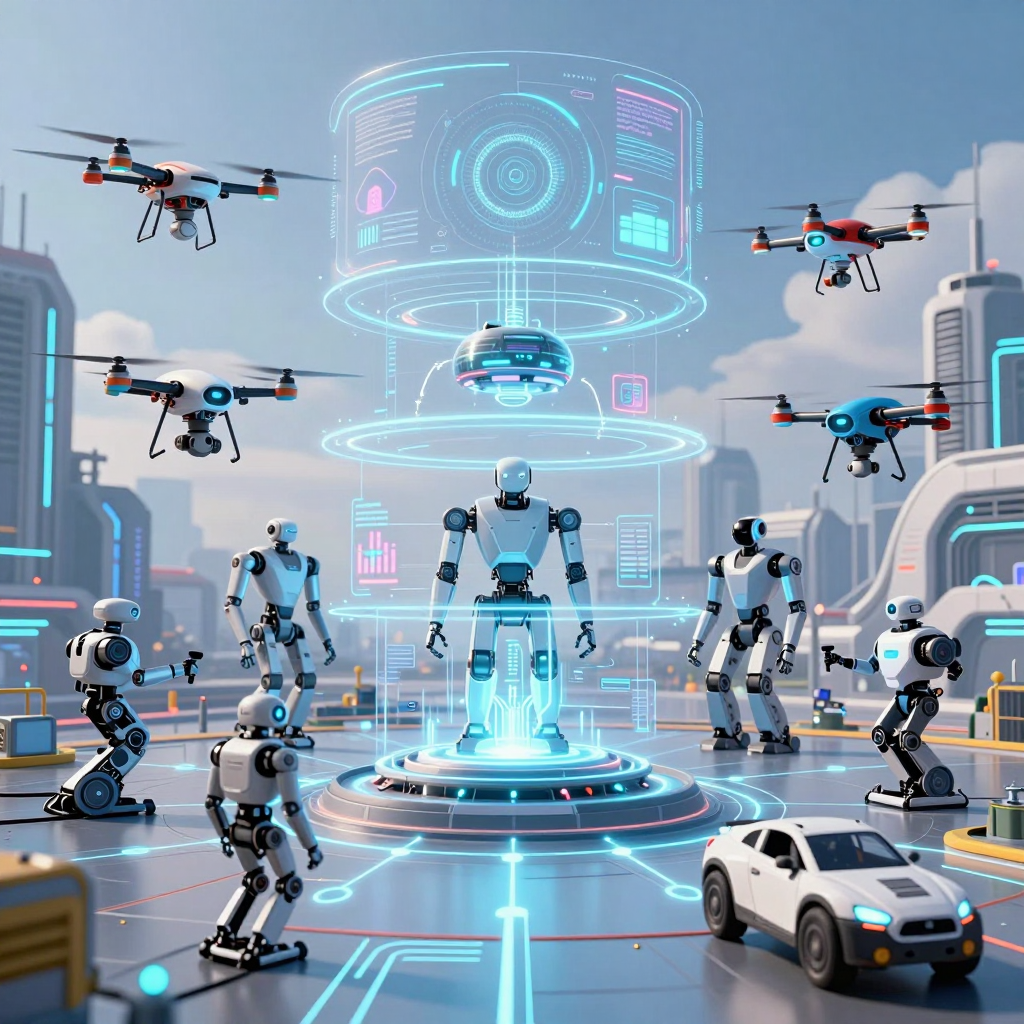
The New Wave of MLOps: What Is Physical AI?
Traditional MLOps, focused solely on data and software, is facing a new challenge—controlling AI systems operating in the real physical world. What groundbreaking innovations will Physical AI bring?
Over the past few years, MLOps has mainly concentrated on optimizing data pipelines and automating model training. Every effort was poured into streamlining the software-centric cycle of data collection, cleansing, learning, and deployment. But now, the landscape is changing. With AI systems like drones, robots, and autonomous vehicles rapidly spreading in the real physical world, the scope of MLOps is expanding beyond data centers to complex multi-agent systems operating in the physical realm.
The Meeting of Physical AI and MLOps: A Paradigm Shift
Physical AI is not just about “better robotics control.” It refers to a comprehensive operational framework that ensures AI systems function reliably in real physical environments—not virtual data spaces. While conventional MLOps optimized software metrics such as accuracy, throughput, and latency, Physical AI-based MLOps faces the critical challenge of guaranteeing physical reliability, safety, and reproducibility in real-world conditions.
This shift is not merely a technical expansion. It raises fundamental architectural questions: How should a system react when a computer vision model fails to accurately capture position data from cameras, sensor noise escalates, or unpredictable environmental factors arise?
The Complexity of the Real Physical World: Why We Need Physical AI
Traditional MLOps centered on building “reproducible data pipelines”—the assumption that training on the same data yields the same model, and deploying that model delivers consistent performance. The real world, however, shatters these assumptions effortlessly.
Drones respond differently as weather changes, robots adapt to subtle terrain variations, and sensors emit varying signals depending on environmental conditions. The complexity deepens as multiple robots or drones operate together. Here emerges a distributed decision-making problem, where each agent must act independently yet harmonize toward a shared goal.
At this juncture, MLOps no longer asks, “How accurate is the model?” but instead probes, “How reliably does this system perform in the real world?” New operational challenges arise—managing sensor data quality, responding to unforeseen situations, and ensuring systemic stability on an entirely new level.
MLOps in the Era of Physical AI: New Domains of Responsibility
Physical AI-driven MLOps demands unprecedented advancements in data quality management. Beyond merely reducing labeling errors, it requires building an intelligent feedback loop that automatically detects where system performance degrades and prioritizes data reinforcement in those areas. This envisions a future where “AI supervises AI” in operational models.
To manage such complex systems effectively, Kubernetes-centered infrastructure standardization is accelerating rapidly. Open-source solutions like Kubeflow and Ray, built on Kubernetes, enable distributed training scheduling, reproducible data pipelines, and GPU resource optimization—demonstrating that the practical standard for AI infrastructure has already begun to take shape.
In this new era, MLOps is no longer just the responsibility of data and ML engineers. System architects, robotics experts, safety engineers, and professionals from diverse fields must collaborate to design distributed decision-making architectures and establish an operational ecosystem that guarantees multi-platform reliability.
This is the frontier MLOps will face by 2026. Amid a challenge that demands both technological innovation and complete operational overhaul, Physical AI emerges not as a mere tech trend, but as a core pillar leading a paradigm shift across the entire industry.
2. Three-Tier Architecture: How the Brain of a Robot Swarm Works
From the local layer to the decision-making layer, the secret to how multi-robot systems overcome complexity while maintaining linear decision logic lies in hierarchical separation. How does this unique design principle guarantee system scalability?
Why Divide into Three Tiers: Preventing the Explosion of Complexity
In traditional centralized control systems, every additional robot exponentially increases the complexity of the central controller’s decision logic. Controlling 10 drones versus 100 drones requires fundamentally different levels of complexity.
The key to Physical AI-based swarm robot control is solving this problem through hierarchical separation. Physical AI systems adopt a distributed decision-making architecture composed of local, mid, and decision tiers, each with clearly defined responsibilities, ensuring system scalability.
Local Tier: Autonomous Sensing of Individual Robots
The local tier interfaces each platform (drones, wheeled robots, legged robots, etc.) directly with the physical world. This tier performs the following functions:
- Sensor data processing and real-time signal filtering
- Self-position estimation using GPS, IMU, and LiDAR
- Obstacle detection and collision avoidance
- Motor control and feedback via encoders
Crucially, the logic here depends only on the physical characteristics of each individual robot. So when a new robot is added, only the local tier tailored to that robot’s sensors and motors needs development, without impacting the upper-tier logic at all.
Mid Tier: The Translator of Decision and Execution
The mid tier acts as a mediator linking the local and decision tiers. Its role is highly specific.
When receiving high-level abstract commands like “move to target point A” or “track enemy target,” it translates these into low-level commands executable by each robot. For example, the order to “advance while maintaining formation” is interpreted differently according to each robot’s physical traits:
- Fast wheeled robots increase forward speed
- Slower legged robots adjust their stride
- Drones maintain altitude while moving in sync
The mid tier also collects sensor data from each robot and transfers state information to the decision tier, functioning similarly to data normalization in an MLOps pipeline.
Decision Tier: Tactical AI/LLM Decision-Making
The decision tier serves as the system’s “brain,” where AI/LLMs analyze the overall situation and make tactical decisions.
- Threat assessment of the current environment
- Planning optimal routes and strategies to achieve objectives
- Assigning roles to each robot (“reconnaissance,” “attack,” “support”)
- Real-time responses to changing conditions
A key feature of this tier is that it is platform-agnostic and reusable. The decision logic works identically whether the robots are drones or ground units, whether there are 1 or 1,000 machines.
The Secret to Scalability: Maintaining Linear Complexity
The greatest strength of this three-tier architecture is that complexity growth remains linear.
As the number of robots grows from 10 to 100 to 1,000, the decision tier’s algorithm remains fundamentally the same. What increases is the volume of state information processed—not the complexity of the decision logic itself. Much like a classroom’s management principles don’t change as the class size grows, clear hierarchical separation keeps the system manageable.
Bridging with MLOps: Reliable AI Systems
For Physical AI-based multi-robot systems to function reliably in the real world, continuous performance monitoring across all tiers is essential. This is the role of modern MLOps.
If the AI model in the decision tier underperforms in a new environment, the MLOps pipeline prioritizes collecting that environment’s data for retraining. Should the mid tier’s command translation produce errors, its logic for that robot type is revalidated. This “AI monitoring AI” approach is a forward-looking operating model and a core mechanism enabling dependable performance in complex multi-agent systems.
Real-World Case: China’s Military Swarm Control System
Publicly released training footage from China’s military reveals this three-tier structure working seamlessly. When a reconnaissance robot detects enemy position (local tier sensor collection), the information passes through the mid tier to the decision tier, which then issues an “attack start” command. Attack robots translate this high-level order into instructions tailored to their weapons systems (mid tier) for precise strikes. Simultaneously, supply robots transport ammo and materials.
All of this happens as situation-aware autonomous collaboration, with no need for centralized micromanagement—each robot plays its role perfectly.
Conclusion: Principles for Scalability and Reliability
The three-tier architecture is more than a technical design; it embodies a fundamental philosophy for designing and operating complex multi-agent systems. By clearly separating responsibilities across tiers, ensuring scalability, and maintaining reliability through MLOps, this approach is poised to become the next-generation standard architecture across various Physical AI domains—robot swarms, autonomous driving, drone formations, and industrial automation alike.
The Power of Autonomous Collaboration: Real-World Case of Collective Robot Operations
In training videos released by the Chinese military, one striking scene repeats itself: as soon as a reconnaissance robot identifies enemy positions, an attack robot follows up with precision fire, and a supply robot transports ammunition and materials—all coordinated as if they were a single living organism. How could this be possible under a simple centralized command system? In reality, a far more sophisticated situation-sharing based autonomous collaboration mechanism is at work.
Paradigm Shift from Centralized Command to Distributed Autonomous Collaboration
Traditional robot control systems relied on a unified framework where all commands emanated from a central headquarters. However, this approach has inherent limitations. As the number of platforms increases, communication delays accumulate, adapting to real-time changes becomes difficult, and any failure at the central system can cripple the entire operation.
The essence of Physical AI-driven collective robot operations lies in a structure where each unit possesses autonomous execution capabilities based on a shared understanding. Reconnaissance, attack, and supply robots share the same situational information but independently exercise judgments tailored to their distinct roles. This means every robot simultaneously receives the command center’s situational awareness and autonomously performs its function within that context.
The Three-Layer Architecture: Foundation of Autonomous Collaboration
The enabler of this autonomous collaboration is the three-layer architecture consisting of the Local Layer, the Middle Layer, and the Judgment Layer.
At the Local Layer, each robot independently processes immediate physical world data through its sensors. The reconnaissance robot’s cameras, the attack robot’s distance sensors, and the supply robot’s load detectors all operate autonomously, producing precise data. This information is integrated with immediate safety functionalities such as location estimation and collision avoidance, creating a foundation for rapid robotic reaction.
The Middle Layer collects all this data and converts high-level tactical decisions made by AI/LLM into actionable instructions for each robot. For example, the abstract command "Neutralize the target" gets translated into specific movement paths and firing angles understandable by the attack robot.
At the Judgment Layer, an AI system analyzes information collected from all robots to make overarching tactical decisions. It synthesizes enemy location data from reconnaissance units, ammunition status from attack units, and availability of supplies from supply units to decide the next course of action.
Automatic Functional Allocation: Efficiency Driven by MLOps Reliability
For these three layers to collaborate seamlessly, the reliability of information transmitted by each robot is absolutely critical. Erroneous location data might misguide the attack robot’s firing, and inaccurate sensor readings could result in collisions.
Hence, modern collective robot systems integrate MLOps-based data management frameworks deeply within their operation. Combining automated labeling and human validation ensures continuous accuracy of sensor data. Especially when performance degrades or new environmental conditions emerge, prioritized data augmentation in those areas proactively strengthens the system’s weaknesses.
This represents the real-world application of a forward-looking operational model where "AI supervises AI." The AI model itself evaluates the reliability of input data, identifies uncertain zones, and autonomously requests required training data—an advanced embodiment of MLOps.
Field-Proven Maximization of Efficiency
The greatest advantage of autonomous collaboration in collective robots is the dramatic improvement in scalability. Within the three-layer architecture, judgment logic is reusable regardless of platform type. This means the same tactical logic designed for operating 10 robots can apply seamlessly to 100 units. Since the complexity of judgment logic does not increase linearly with the number of platforms, the operational difficulty of MLOps does not proportionally escalate either.
This core principle applies equally to collective autonomous driving, drone swarm management, and industrial automation. Even when the functions of reconnaissance, attack, and supply are replaced by different roles in each domain, the fundamental collaboration framework and data management principles remain universally applicable.
Section 4: AI Monitoring AI: The Convergence of MLOps and Physical AI
Could the futuristic AI operation model—where "AI monitors AI"—that detects performance degradation and environmental changes in real-time while augmenting data be the key to Physical AI reliability?
A New Operational Paradigm in the Era of Physical AI
Physical AI systems like robots and drones operating in the real world face unique challenges that software alone cannot solve. Sensor errors, unpredictable environmental shifts, and entry into novel scenarios can expose the entire system to risk. To overcome these challenges, an advanced MLOps operation model—where “AI monitors AI”—is gaining attention.
This goes beyond merely monitoring AI model performance; it establishes a self-improving system where the AI detects its own weaknesses and compensates for them. It signals a shift from passive data management to an active MLOps ecosystem where machine learning models identify performance degradation points and adapt autonomously.
A Hybrid Strategy Combining Automated Labeling and Human Review
Ensuring the reliability of Physical AI systems demands sophisticated MLOps-based data management. Central to this process is balancing automation with quality assurance.
Automated labeling technologies rapidly process massive amounts of sensor data. Manually labeling thousands of drone-captured images or colossal volumes of motion data collected by robot sensors is practically impossible. AI-driven automated labeling solves this data explosion while maintaining a baseline accuracy.
Yet automation alone is not enough. Human inspectors verify the trustworthiness of automated labels, prioritizing data reinforcement especially in performance-degrading segments or newly emerged environmental conditions. This reflects an intelligent resource allocation in MLOps beyond simple quality control.
Real-Time Detection of Performance Drops and Data Augmentation
In complex environments like battlefields, the most perilous moments for Physical AI systems occur when model performance suddenly falters. For instance, drone vision systems in low-light conditions or autonomous navigation robots on unfamiliar terrains may encounter unexpected errors.
The “AI monitoring AI” MLOps model detects such performance drops in real-time. The AI continuously assesses its confidence level and flags situations where this confidence dips below set thresholds. Once a problem segment is identified, that data is immediately extracted and prioritized for human review.
The curated problem-solving data then feeds into a dedicated retraining pipeline, focusing on shoring up the model’s weaknesses. Ultimately, this creates a self-evolving MLOps system that adapts to changing environments.
A Continuous Feedback Loop to Ensure Reliability
The true value of this model lies in establishing a closed feedback loop. When data collected from the field → AI performance evaluation → problem detection → human inspection → retraining → deployment forms a seamless cycle, Physical AI systems grow more robust over time.
Especially in domains like autonomous robots, drone swarm operations, and industrial automation, edge cases that initial training data cannot cover continuously emerge during real-world operation. Where traditional approaches react after the fact, advanced MLOps transforms these problem scenarios into valuable assets for model improvement.
The Advancement of MLOps as a Sufficient Condition for Physical AI
In conclusion, building trustworthy Physical AI systems today cannot rely solely on hardware capabilities or initial algorithm design. The lifeblood of Physical AI has become an MLOps framework integrating continuous monitoring, adaptive data collection, and automated retraining.
The phrase “AI monitors AI” is not mere rhetoric—it encapsulates an indispensable operational philosophy for stable modern AI systems. The widespread adoption and standardization of such advanced MLOps approaches are poised to become the foundation that enables Physical AI to safely proliferate across industrial environments.
5. AI Infrastructure Innovation Unlocked by Kubernetes Standardization
From distributed learning to multi-cluster operations, what role does Kubernetes-centric infrastructure, powered by Kubeflow and Ray, play in the era of Physical AI? Let’s explore the future that infrastructure standardization will bring.
The Convergence of the Physical World and Digital Infrastructure
For a Physical AI-based swarm robotics control system to function in reality, a robust digital backbone is indispensable. Imagine hundreds of drones and dozens of robots simultaneously requesting decisions, with each sensor’s data streaming in real-time. To reliably operate such a large-scale distributed system, simple server setups just won’t cut it. This is exactly where Kubernetes-centered AI infrastructure becomes a game changer.
Kubernetes: The De Facto Standard for AI Infrastructure
Interestingly, the leading tools in today’s open-source AI ecosystem share a common foundation. Frameworks like Kubeflow and Ray, designed to provide essential functions such as distributed learning scheduling, data pipeline reproducibility, GPU resource sharing and optimization, and multi-cluster operations for large-scale AI model training and inference, are all built on Kubernetes. This is no coincidence—it signifies that Kubernetes has implicitly become the real-world standard for AI infrastructure.
This standardization is not just a technical preference but a fundamental prerequisite for building scalable MLOps ecosystems. Only on a standardized infrastructure can AI model training, deployment, and monitoring be conducted consistently and reliably.
An Operational Philosophy Centered on Reproducibility
Kubeflow Pipelines matter not merely for “automation” but fundamentally for “reproducibility.” When the AI model training process can be perfectly reproduced, it becomes possible to identify issues and validate improved models. Especially for Physical AI systems that control real-world objects, reproducibility transcends convenience—it is the bedrock of safety and reliability.
The emerging strategy adopts IR YAML as the standard artifact and operates at the Namespace level. This approach:
- Manages all MLOps pipelines declaratively, facilitating version control.
- Prevents conflict when multiple teams work simultaneously through Namespace-based isolation.
- Preserves every step of the training process in a reproducible manner.
Scalability of Infrastructure in the Physical AI Era
In Physical AI swarm robotics control systems, Kubernetes-based infrastructure shows special value because such systems demand not only model training and deployment but also continuous real-time decision-making and model updating.
Distributed training scheduling efficiently handles massive sensor data collected from multiple robotic platforms, while multi-cluster operations allow independent computing environments by region or mission while sharing centralized control logic. This naturally implements the three-tier Physical AI architecture (local layer – intermediate layer – decision layer) even at the infrastructure level.
A Virtuous Cycle of MLOps and Infrastructure Standardization
Kubernetes-centric infrastructure standardization advances MLOps maturity. In a standardized environment:
- Data pipelines are consistently configured, enabling advanced data quality management where AI monitors AI.
- When model performance degrades, it becomes systematic to decide which segment of training data to reinforce first.
- The adaptation process to new environments is automated, significantly reducing operational complexity.
This enhanced MLOps fundamentally strengthens the reliability of Physical AI systems; when robots face unforeseen situations, the central system can rapidly respond and update models.
The Future of Infrastructure: From Standardization to Personalization
An intriguing insight is that Kubernetes-centered standardization paradoxically enables finer personalization. Once the foundation is standardized, customizing to each organization’s specific needs becomes far more efficient. For instance, deploying Ray for batch learning of drone swarms and Kubeflow for precise robotic arm control can be optimized, yet both systems collaborate seamlessly atop the same Kubernetes cluster.
Conclusion: AI Innovation Begins with Standardization
For hundreds or thousands of autonomous agents to cooperate in the Physical AI era, their supporting infrastructure must handle matching levels of complexity. Kubernetes-centric AI infrastructure standardization boldly confronts this challenge. By simultaneously ensuring reproducibility, scalability, and reliability from an MLOps perspective, it lays the true foundation for physical world AI innovation.
Comments
Post a Comment