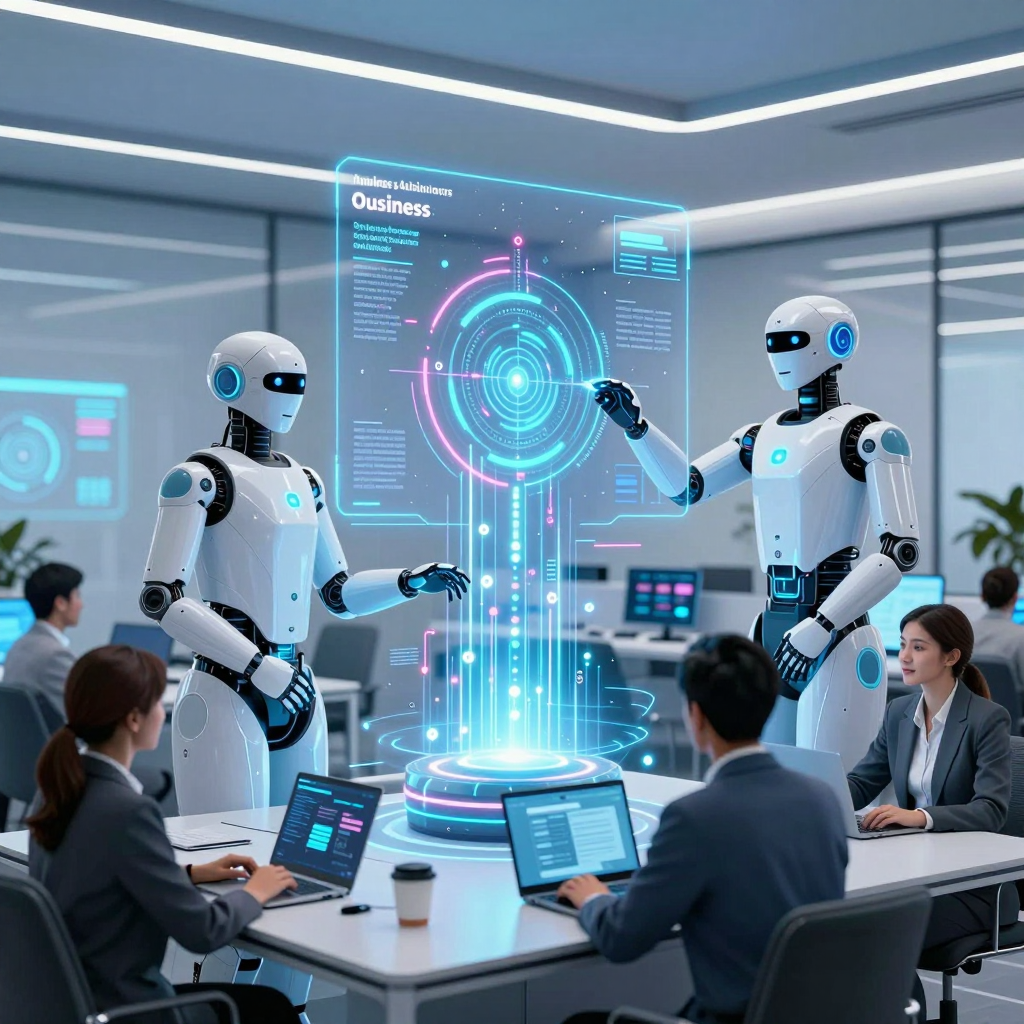
1. AI Agents Revolutionize the Landscape of Technological Innovation
In 2026, AI agents—capable of executing tasks autonomously beyond simple generative AI—take center stage in technological innovation. What profound impact will this shift have on our daily lives and industries?
Over the past few years, generative AI has faithfully acted like a smart assistant, answering our questions and composing text. But 2026 surpasses that. According to leading global reports such as Gartner and IDC, the top tech trend of the year is the dawn of the AI agent era.
The Fundamental Difference Between AI Agents and Traditional Generative AI
Conventional generative AI was passive. It responded when asked, resembling an evolved information retrieval tool. In contrast, AI agents evolve into autonomous operators. This is not just an incremental feature but a fundamental transformation of AI’s essence.
For example, traditional generative AI works like this:
- User: “Can you analyze the sales data for this quarter?”
- AI: “The analysis results are as follows…” (providing results only)
Meanwhile, AI agents operate as follows:
- User: “Can you analyze the sales data for this quarter and prepare a report?”
- AI Agent: autonomously accesses the database → gathers necessary information → analyzes data → writes the report → sends the email automatically (carrying out every step independently)
This is true work automation. AI agents, equipped to directly use tools, execute tasks, and seamlessly proceed to the next steps, are set to fundamentally transform how businesses operate.
The Industrial Revolution Brought by AI Agents
This is more than a technological adoption issue. Gartner’s analysis emphasizes that companies preparing for the AI agent era must organize and structure internal data and establish new work cultures. Even firms with advanced AI technology will falter without a robust data infrastructure.
Notably, the concept of AI-ready Data is emerging as equally critical technology alongside AI agents. Without refined data that AI can genuinely utilize, no matter how powerful an AI agent is, its potential cannot be realized.
This forces companies into strategic choices. It’s not just about adopting new AI tech tools; it demands a comprehensive overhaul of data governance at the enterprise level and reorganizing the organization to be AI-ready.
Section 2: The Fundamental Difference Between Traditional AI and AI Agents
Why are AI agents called "autonomous task executors" rather than mere chatbots? Let’s explore the entirely different value and roles they provide compared to traditional AI.
The Evolution from Passive AI to Autonomous AI
The generative AI we have experienced over the past few years has essentially been a reactive system. It answers questions or generates text when prompted, like a highly intelligent assistant attentively listening to your queries.
In contrast, AI agents operate as proactive systems. They go beyond simply responding; they use tools directly and independently carry out tasks as true agents. This is why they are hailed as a revolution across the tech industry.
Understanding the Difference Through Concrete Examples
Imagine the role of a traditional generative AI concretely. When you ask, "Analyze last quarter’s sales data," this AI offers analysis based on general methodologies. However, accessing actual databases or gathering necessary information remains the user’s responsibility.
By contrast, an AI agent handles the entire process automatically. Given access permissions, it independently collects data, cleans it, performs analysis, and even executes follow-up actions. For instance, if it detects a sharp sales decline, it might automatically notify the sales team or generate related reports.
This is not just an added feature; it represents a complete paradigm shift in task automation.
The Difference in Autonomy and Decision-Making Ability
In traditional AI-based tech solutions, AI acted as an "advisor." It provided the best recommendations, but final decisions and execution rested with humans.
AI agents go one step further. Within predefined rules and goal scopes, they make decisions autonomously and act accordingly. While critical decisions still often require human approval, routine and clear-cut tasks are fully automated.
New Standards of Reliability and Traceability
In the age of AI agents, mere "outputs" are no longer sufficient. It is crucial to know what data and processes led to a result. This is precisely why RAG (Retrieval-Augmented Generation) technology has become central.
RAG ensures that AI agents don’t rely solely on learned patterns but make grounded decisions by referencing real data sources. This is especially vital in industries where evidence-based decision-making is mandatory, such as finance, healthcare, and law.
Practical Impact in Corporate Environments
While traditional generative AI contributed to productivity gains, AI agents reshape cost structures themselves. Tasks previously handled by dozens can be managed by a few agents, allowing human resources to focus on creative and strategic work.
Moreover, AI agents operate 24/7 with consistent quality, without fatigue, vacation needs, or human errors. This explains why, starting in 2026, AI agents are rapidly expanding beyond pilot projects to become companies’ core tools for task automation.
The difference between traditional AI and AI agents ultimately marks a shift from being a "support tool" to becoming an "independent worker," and this is the true significance of the tech revolution in 2026.
Section 3: Transforming Corporate Organization and Data Culture
To unleash the full potential of AI agents, it’s essential to go beyond merely adopting technology; organizing data within the company and cultivating a new work culture are critical. But what lies at the heart of this transformation?
Many companies overlook a crucial point: no matter how advanced the AI technology, it becomes useless if the organizational soil for it to operate on isn’t prepared. To successfully embrace the era of AI agents in 2026, innovation in organizational structure and data management systems is as important as technological advancement.
The Necessity of a Data-Driven Organizational Culture
According to Gartner’s analysis, companies preparing for the AI agent era must organize and structure internal data and build a new work culture. This is far more than just upgrading systems.
Previously, even if data was scattered across departments, HR managers or analysts could manually gather the information. But with AI agents automatically executing tasks, data must be refined into forms that machines can read and understand. This demands an organizational culture that recognizes the value of data and treats it as a public asset to be managed collectively.
AI-Ready Data: An Asset as Crucial as Technology
A key point is that AI-Ready Data — refined data usable by AI — is emerging as vital a resource as the AI agents themselves. Even companies with cutting-edge AI technology can’t achieve optimal performance without solid data infrastructure.
This is the very challenge many companies face. Despite adopting the latest AI tech, most fall short of expectations because of a lack of high-quality data for training. When data is chaotic, error-ridden, duplicated, and unstandardized, no matter how sophisticated the AI agent is, it inevitably makes flawed decisions.
Organizational Transformation and Data Governance
Therefore, the primary preparation companies must undertake before 2026 is building a robust data governance framework, which includes:
- Building a Data Catalog: A system that clearly identifies all corporate data, its locations, and how it is managed
- Automating Data Quality Management: Ensuring accuracy, consistency, and completeness through automated processes
- Managing Access Rights and Security: Mechanisms to control AI agents’ access only to necessary data
- Standardization and Integration: Converting disparate departmental data into unified formats
The Importance of Work Culture Innovation
Equally vital as technical readiness is the mindset shift among employees. As AI agents automate tasks, frontline workers will no longer spend time on simple data entry or information gathering. Instead, they must shift to roles validating AI-generated outputs, handling exceptions, and making strategic decisions.
This calls for a complete redesign of organizational workflows. Team roles, performance evaluations, and decision-making processes all must be realigned around AI. Particularly, jobs relying heavily on data input and repetitive checking will decline in necessity, while roles ensuring data reliability and overseeing AI decisions will rise.
Reality and Opportunity for Korean Companies
Korean companies have a unique chance. Due to stringent regulatory environments, deploying AI agents based on on-premises Large Language Models (LLMs) and internal systems rather than cloud-based AI is inevitable. This situation significantly amplifies the importance of data organization and governance. Only organizations with fully controlled internal data environments can truly harness the value of AI agents.
Success in 2026 won’t depend on how fast you adopt the latest technology. True competitive advantage will belong to companies that redesign their organizations based on data and internalize a culture of working collaboratively with AI.
AI Supercomputing Infrastructure — A Life-or-Death Tech War
The explosive spread of AI agents by 2026 is an unavoidable reality. Yet, there is one critical fact most companies overlook: no matter how advanced the AI model is, without powerful computing infrastructure to run it, it’s completely useless.
The Limits of Existing IT Infrastructure and New Demands
For decades, companies have built IT infrastructures based on general-purpose servers. These legacy systems were optimized to efficiently handle predetermined tasks. However, the era of AI agents introduces entirely different requirements.
The massive scale of machine learning training, real-time inference, and continuous data processing performed by AI agents demand a computational capacity that traditional CPU-based infrastructure simply cannot handle. This isn’t about wanting “faster performance”—it means a fundamentally different computing architecture is needed.
Rapid Spread of Hybrid Computing Architectures
Gartner’s latest analysis vividly exposes corporate urgency. By 2028, 40% of enterprises will adopt hybrid computing architectures integrating GPUs, HPC (High-Performance Computing), and AI ASICs, a more than fivefold increase from 8% in 2024.
This rapid transformation is not just a tech trend. It is a turning point for corporate competitiveness, for these reasons:
The Central Role of GPU Technology
GPUs (Graphics Processing Units) are the core computational engines powering AI agents. Unlike traditional CPUs, GPUs execute parallel processing with thousands of small cores, boosting AI model training and inference speeds by over 100 times. This explains why tech companies pour massive investments into GPU development.
The Role of HPC and AI ASICs
High-Performance Computing (HPC) handles extremely complex computations, and AI-specific chips (ASICs) offer optimized performance tailored for AI workloads. Combining them in a hybrid structure allows AI agents to execute diverse tasks swiftly and efficiently.
Infrastructure Transformation as a Survival Strategy
Investing in AI supercomputing infrastructure is no longer optional—it is a critical survival strategy. Here’s why:
First, speed means survival. Even if companies use the same AI agents, those lacking infrastructure will process tasks three to five times slower, losing ground in data analysis, customer response, financial operations, and every other area.
Second, the paradox of cost efficiency. Initial infrastructure investments are undoubtedly high. But with well-functioning AI agents, annual savings on labor and operations can reach tens of billions of Korean won. On the flip side, adopting AI without adequate infrastructure results in minimal returns on investment.
Third, data utilization limits. No matter how rich a company’s data is, without computing power to process it, it remains merely stored data. In the AI agent era, infrastructure to leverage data is as critical as the data itself.
The Reality and Challenges for Korean Companies
Many Korean companies still underestimate the gravity of this shift. The unique characteristics of the domestic IT environment—regulations, security concerns, and legacy system complexity—have complicated cloud-based infrastructure adoption.
But things are changing. With on-premises AI supercomputing infrastructure becoming realistic, Korean enterprises now have opportunities to secure the tech infrastructure they need while maintaining security and autonomy. Open-source solutions, domestic HPC expertise, and government support policies synergize to pave a unique Korean path for AI infrastructure transformation.
Conclusion: The Time for Decision Is Now
As the AI agent era formally begins in 2026, whether a company is prepared with the right infrastructure will determine its future. By 2028, when 40% of enterprises shift to hybrid architectures, those who move swiftly will secure clear competitive advantages.
For companies looking to implement AI agents, the question can no longer stop at “Which AI model should we choose?” The more fundamental question must be: “Is the infrastructure ready to run that AI?” This will be the first decisive criterion separating AI winners from those left behind in 2026.
Section 5. Korean Companies Leading the Future and Their Core Technology Strategies
The adoption of on-premises LLM and RAG technologies optimized for the domestic environment, along with automation of key tasks through AI agents, is becoming a reality. We invite you to step into that future scene.
Differentiated AI Strategies for Korean Companies
Unlike global tech giants moving toward cloud-based AI agents, Korean companies must pursue strategies that leverage their unique competitiveness. Embracing stringent regulatory environments and high security standards as assets, building on-premises LLMs (Large Language Models) will be the key pathway for expanding AI agents domestically.
While cloud-based solutions excel in scalability, on-premises LLMs offer the advantages of protecting sensitive company information and enabling real-time control. This will hold particularly critical value in regulated industries such as finance, healthcare, and manufacturing.
RAG Technology: The Core of Evidence-Based Automation
The importance of RAG (Retrieval-Augmented Generation) technology is rising in tandem. More than a simple information retrieval tool, RAG enables AI agents to support decision-making by finding real-time evidence from internal databases and documents, making ‘evidence-based automation’ possible.
For instance, a contract review AI agent can search similar cases in a past contract database, analyze the current contract based on those clauses, and highlight risk factors. Every decision in this process is traceable, and compliance is automatically verified. Without RAG technology, this level of automation would be impossible.
Core Task Automation Is Now a Reality
2026 will mark the first year where AI agents move beyond pilot projects to become actively integrated into real business process automation within companies. Repetitive, data-centric tasks will be the initial focus.
- Sales Management: Automatically proposing next sales strategies by comprehensively analyzing customer data and sales records
- Compliance Monitoring: Real-time monitoring of transaction patterns and regulatory changes to automatically alert compliance risks
- Human Resources: Automating the entire process from job posting creation, applicant evaluation, to interview scheduling
- Customer Service: Automatically classifying complex customer inquiries and routing them to the appropriate departments
This automation does not just enhance efficiency; it frees employees from repetitive work, allowing them to focus on creative and strategic tasks.
Three Essentials Korean Companies Must Prepare For
To successfully implement AI agents based on on-premises LLM and RAG technology, Korean companies must prepare in three critical areas.
First, securing AI-ready Data. No matter how advanced the AI agent technology, unrefined data cannot produce accurate results. Systematically organizing and structuring core company data must begin immediately.
Second, building a hybrid computing infrastructure. Operating large-scale LLMs on-premises requires a high-performance environment integrating GPUs, HPC, AI ASICs, and more. With projections that 40% of companies will adopt such infrastructure by 2028, early investment will decide competitive advantage.
Third, improving organizational culture and processes. AI agents fundamentally change existing work methods. New guidelines are needed regarding who makes decisions and how to verify automated outcomes. Companies that simultaneously drive technological adoption and organizational transformation will achieve true success.
Tech Leadership: The New Challenge for Korean Companies
The adoption of AI agents by Korean companies in 2026 will be a pivotal moment determining competitiveness for the next decade. Now is the time for tailored strategies that embrace global tech trends while leveraging strengths unique to the domestic environment.
When the four elements—on-premises LLMs, RAG technology, AI-ready Data, and hybrid infrastructure—work organically together, Korean companies can emerge as leaders in a true AI agent era, characterized by safety and autonomy.
The future is not something to wait for. Companies that prepare now will lead the market in 2026 and beyond.
Comments
Post a Comment