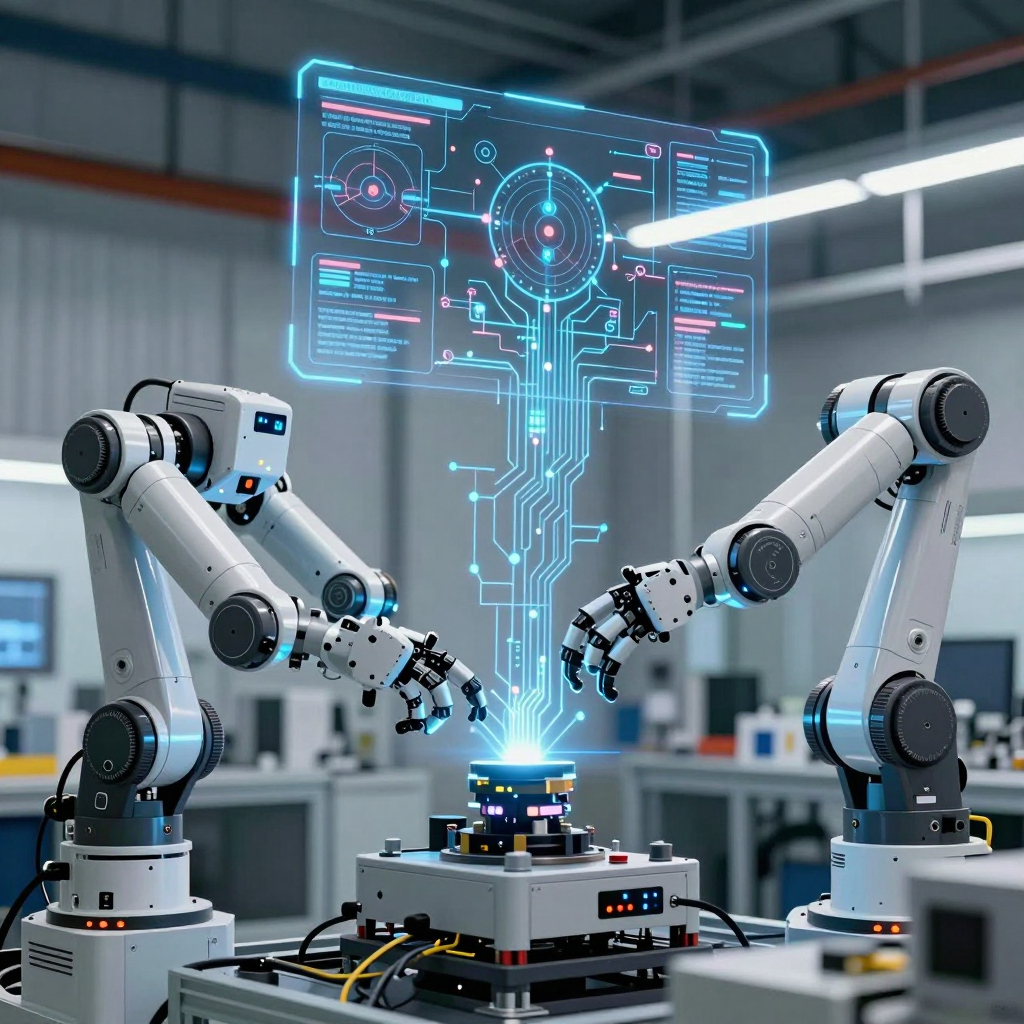
1. Physical AI: The Innovation Extending Beyond Software into Reality
What if artificial intelligence could break free from the screen to move and make decisions on its own? In 2026, Physical AI will provide the answer.
The Evolution from Software AI to Physical AI
The AI advancements we've witnessed in recent years have mostly remained within the digital realm. Chatbots generated text, and algorithms analyzed data—that was the extent. But today's AI technology is at a fundamental turning point. Physical Artificial Intelligence transcends the boundaries of mere software by integrating with physical devices, enabling AI to independently perceive, judge, and act within the real world.
This is innovation far beyond simple automation. While traditional AI focused only on "thinking," Physical AI evolves into intelligence that thinks, moves, and learns.
How Physical AI Works: From Sensing to Action
To understand how Physical AI operates, we must examine its core structure. The system follows a cyclical loop of "Sensing → Judging → Physical Action → Feedback."
First, it senses the surrounding environment through multiple sensors: cameras gather visual data, distance sensors detect positions, and touch sensors perceive physical contact. These sensor signals are not mere raw data. A perception module interprets them into meaningful information to answer "What is there?", "Where is it?", and "What is the current situation?"
The next step is decision-making. Based on perceived information, AI algorithms select the optimal action. This is not just rule-based reaction; it employs reinforcement learning and large language model-based reasoning to make customized decisions in complex scenarios. Finally, the chosen decision is executed as real physical action through actuators and control systems. The result loops back as feedback, allowing the system to continuously learn and improve.
The Core Components of Physical AI
For a Physical AI system to function properly, four main modules must work harmoniously.
Hardware Module: The Physical Foundation
First, the hardware module made up of structure, materials, actuators, and sensors. This is not just a collection of mechanical parts. Because mechanical design defines the physical system’s capabilities, the hardware itself largely determines AI performance. Efficient robotic arm structures, sensitive touch sensors, and powerful motors all provide the groundwork for AI algorithms to unfold their full potential.
Perception Module: The Eyes that Understand the Environment
The perception module converts sensor data into meaningful information. Using computer vision technologies, it detects objects and estimates postures, while sensor fusion combines data from multiple sensors. Advanced techniques like SLAM (Simultaneous Localization and Mapping) allow robots to locate themselves and map unfamiliar environments. As a result, Physical AI acquires the ability to accurately perceive real-world spaces.
Decision-Making Module: The Heart of Intelligence
The decision-making module reveals the true intelligence of Physical AI. It is the core engine that decides what action to take based on perceived information. Reinforcement learning optimizes actions through trial and error, behavior planning algorithms break down complex tasks step-by-step, rule-based control provides clear guidance where stability is crucial, and large language model-based reasoning flexibly handles novel situations. This module simultaneously handles goal setting, action selection, priority ranking, and risk evaluation.
Control Module: The Hands and Feet Executing Plans
The control module transforms the decisions into actual physical movements. It manages precise motor control, force adjustments, and sequence coordination, integrating the entire system workflow.
How Physical AI is Changing Reality
Physical AI is no longer a theoretical concept; it is already transforming industries and everyday life.
The automation industry is the most direct beneficiary of Physical AI. Robots are no longer confined to simple repetitive tasks; they adapt autonomously to complex environments and perform jobs independently.
In autonomous vehicles, Physical AI is indispensable. It must recognize road conditions in real time, weigh hundreds of variables, and immediately execute physical actions such as accelerating, braking, or steering.
Smart factories employ Physical AI-powered robots that detect subtle features of individual components, conduct precise assembly, and inspect quality instantly.
The logistics industry is fundamentally reinvented. Recognizing intricately arranged boxes, deciding the optimal pickup order, and handling them delicately without damage—all these processes become automated.
In healthcare, surgery-assisting robots powered by Physical AI physically execute human doctors’ decisions while adapting in real time to changes in patients’ conditions.
Why Is Physical AI Spotlighted Now?
The reason Physical AI stands out as the key technology of 2026 is clear. Traditional software-based AI was limited to information processing—analyzing data, generating text, recognizing images. But Physical AI directly solves problems and creates value in the physical world.
This represents not only a technological evolution but also an economic and industrial transformation. Manufacturing productivity soars, logistics costs drastically drop, and medical service accuracy improves. Ultimately, Physical AI is not just another automation technology; it is a strategic innovation setting a new standard for industrial competitiveness.
In the future, competitive advantages between nations will no longer hinge on how much data is processed or the sophistication of algorithms developed. The core lies in how effectively AI technologies operate within the real world to generate tangible economic value. This is why Physical AI is heralded as the technology that will shape the industries of tomorrow.
2. The Mysterious Working Principles of Physical AI: From Perception to Action
Beyond simple data analysis, what is the secret behind AI's ability to see, hear, and act directly in the real world? Let’s delve into the hidden technologies within the circular loop of ‘Perception → Decision → Action → Feedback.’
The Moment AI Meets the Real World
Traditional software-based AI was mostly confined to dark server rooms in data centers. It analyzed text, recognized patterns, and made predictions—nothing more. But Physical AI boldly breaks free from these constraints.
Now, AI uses sensors as eyes, cameras as sensory organs, and actuators as limbs to autonomously complete the cycle of ‘Perception → Decision → Physical Action → Feedback’ directly in the physical world. This is exactly why Physical AI is revolutionary.
Understanding Physical AI’s Operating Mechanism Through a 4-Step Circular Loop
The operation of Physical AI remarkably resembles how humans interact with their environment. Let’s explore each step in detail.
Step 1: Perception – Sensor Technology as AI’s Eyes and Ears
The first step of a Physical AI system is the perception module that gathers information from the real world. But this is not just about snapping pictures with a camera.
It requires highly sophisticated intelligence to interpret sensor data into meaningful information. Computer vision technology detects objects, estimates posture, and sensor fusion integrates information from multiple sensors.
Additionally, SLAM (Simultaneous Localization and Mapping) technology enables robots to identify their location in unfamiliar environments while mapping the surroundings at the same time. Ultimately, the perception module answers three crucial questions: ‘What is there?’, ‘Where is it?’, and ‘What is its current state?’
Step 2: Decision Making – Where AI’s Brain Starts Working
Once information is gathered, AI must decide what to do next. This is the role of the decision-making module.
Reinforcement learning algorithms learn the optimal behavior through trial and error, while behavior planning systems logically structure complex multi-step tasks. Rule-based control strictly follows predefined rules in safety-critical situations, and the latest large language model (LLM)-based reasoning can even understand and make judgments about complex scenarios expressed in natural language.
In this module, goals are set, optimal options are chosen among multiple behaviors, and priorities and risks are comprehensively considered—much like how the human brain analyzes situations and makes decisions.
Step 3: Physical Action (Control & Execution) – When Decisions Become Reality
When the decision-making module concludes ‘this is how to act,’ it is now time to turn that into real action. This responsibility lies with the control module.
It delivers precise signals to actuators such as motors so the robot’s arms move and legs take steps. The control module goes beyond simply sending commands; it integrates and manages the entire system’s physical processes, coordinating all components to operate harmoniously.
Step 4: Feedback and Learning – The Improvement Mechanism Completing the Loop
After action execution, the results are sensed again by sensors. This feedback information returns to the AI system and influences the next decision.
If a robot tries to pick up an object but drops it, that failure experience is processed by the reinforcement learning algorithm so that the next attempt grasps with stronger force. Through continuous feedback and learning, AI adapts to the environment and steadily improves performance.
The Co-Evolution of Physical Design and AI
An intriguing aspect of Physical AI is that the hardware itself fundamentally determines how AI operates. The physical form, composed of structure, materials, actuators, and sensors, defines the range of behaviors this system can perform.
For example, changing the length and strength of legs leads to completely different performance outcomes even with the same AI algorithm. Therefore, modern Physical AI development involves software and mechanical engineers collaborating closely to co-design and optimize the physical entity together with AI algorithms.
Adaptive Intelligence Facing Complex Realities
The key distinction that separates simple repetitive automation from Physical AI is that it can autonomously respond to complex real-world situations.
Conventional robots only repeated tasks in fixed environments. However, Physical AI has evolved into systems possessing autonomy, adaptability, judgment, and even collaboration capabilities with humans in unpredictable, dynamic spaces.
When sorting randomly placed items in a warehouse—where every object is different and locations are unpredictable—Physical AI robots repeatedly cycle through perception, decision, action, and feedback to produce optimal results tailored to each moment’s unique circumstances.
Key Takeaway: Why This Loop is Revolutionary
The circular process of ‘Perception → Decision → Action → Feedback’ may seem simple, but it represents a fundamental paradigm shift from digital AI to Physical AI.
While software AI only existed in the virtual data world, Physical AI perceives, judges, and solves problems directly in the real world. This foundation enables fundamental efficiency innovations across manufacturing, logistics, healthcare, services, and every industry.
It is now clear that Physical AI is not just a technology but a core competitive advantage that will shape the future of industry.
3. The Four Core Modules of Physical AI: From Hardware to Control
How can Physical AI perceive and respond to complex real-world situations? Let’s explore the mechanism behind how the hardware, perception, decision-making, and control modules organically harmonize.
The fundamental reason Physical AI differs from simple machine automation is clear. This next-generation technology operates like a living organism, with four core modules perfectly integrated. Unlike traditional AI, where each module is optimized independently, Physical AI functions as a unified intelligent system.
The First Foundation: The Role of the Hardware Module
Every Physical AI begins with hardware. Comprising structure, materials, actuators, and sensors, this module might seem like just a physical shell—but it is the essential foundation that defines what AI can actually do in the real world.
No AI algorithm can unleash its full potential without excellent mechanical design. For example, if a robot arm’s actuator can be controlled with 0.1mm precision, it can be used in medical surgery; but if it moves only within several millimeters, its use is limited to logistics automation. Thus, the physical characteristics of hardware set the first boundary for the tasks and accuracy AI can achieve.
The Second Sense: The Perception Module
If hardware is the body, the perception module is the eyes and ears of Physical AI. It transforms the vast data collected from sensors into meaningful information.
The perception module employs advanced technologies such as:
Computer Vision, which analyzes camera data to detect objects and determine their location and posture—enabling a robot in a warehouse to pick out exactly the needed items from thousands on a conveyor belt.
Sensor Fusion, integrating information from diverse sensors like cameras, LiDAR, ultrasonic, and infrared—making it possible for autonomous vehicles to operate safely even in dense fog.
SLAM (Simultaneous Localization and Mapping), which simultaneously localizes the device and maps the surrounding environment—allowing cleaning robots to efficiently navigate unfamiliar homes without getting lost.
At its core, the perception module accurately answers three crucial questions: “What is there?”, “Where is it?”, and “What is its current state?”
The Third Intelligence: The Decision-Making Module
Once information is perceived, the moment of choice arrives. The decision-making module embodies the true intelligence of Physical AI.
Modern AI employs various methods to handle decisions. Reinforcement learning allows the AI to discover optimal strategies through trial and error by interacting with its environment. Motion planning calculates the most efficient path from start to goal. Rule-based control executes fast and predictable decisions under clearly defined conditions.
What stands out in cutting-edge Physical AI systems is the integration of Large Language Model (LLM)-based reasoning. This enables AI to make complex, high-level decisions that require deep understanding and contextual thinking—like a medical robot judging a patient’s condition holistically to determine the optimal assistance movement.
This module performs multiple roles:
- Goal setting: What outcome is desired?
- Action selection: What actions should be taken to reach the goal?
- Priority judgment: When multiple goals conflict, which takes precedence?
- Risk assessment: What side effects could this choice bring?
The Fourth Execution: The Control Module
With decisions made, it is time to bring them into reality. The control module serves as the final executor, converting abstract judgments into physical actions.
It sends precise signals to actuators (motors, actuators, etc.) to perform the targeted movements. For instance, when commanded to “pick up an object,” it calculates exactly how much force each joint of a robot arm should apply and when. It also continuously receives sensor feedback to adjust in real time, ensuring the goal is met even under unexpected conditions.
Moreover, the control module acts as the integration manager of the entire system process. As the four modules operate at different speeds and time scales, this module harmonizes them into consistent, coordinated behavior.
The Harmony of Four Modules: The Power of Organic Integration
The true value of these four modules emerges not when they exist independently, but when they form an organic, continuous cyclical system.
The loop of sensing → judging → acting → feedback repeats endlessly, enabling Physical AI to adapt to environmental changes in real time. If a robot finds that an object is heavier than expected, it immediately perceives this; the decision module recalibrates to use greater force; the control module executes the updated command. All this happens within milliseconds, and humans experience the result as “natural movement.”
The complex real world is full of unpredictable variables. Yet, a perfectly integrated Physical AI system autonomously exercises adaptability, judgment, and autonomy amidst these variables, achieving its goals. This is why Physical AI is regarded as a next-generation intelligent system that goes far beyond mere machine automation.
Real-world Applications of Physical AI Revolutionizing Industries
From autonomous vehicles to smart factories and medical settings, let's dive into the future scenes shaped by Physical AI. Discover how this technology is transforming our everyday lives.
Autonomous Vehicles: The Critical Role of Real-time Decision Making
Autonomous vehicles represent the most iconic realization of Physical AI. This technology involves not just reaching a destination but perceiving, judging, and acting in real time amidst complex road environments.
These vehicles first sense their surroundings through sensors and cameras (perception module), identifying pedestrians, traffic lights, road signs, and the positions and speeds of other vehicles. This data is then analyzed by AI algorithms to predict potential hazards and determine the optimal course of action (decision-making module). Finally, brakes, acceleration, and steering systems execute these decisions physically (control module).
This cycle, repeated by the second, delivers stability and reliability that surpass human driving experience. Especially in unpredictable situations, AI’s swift reaction helps avoid dangers, leading to fewer accidents and a revolution in road safety.
Smart Factories: Merging Precision with Efficiency
In manufacturing, Physical AI maximizes both production efficiency and quality control simultaneously. Automation robots in smart factories go beyond simple repetitive tasks, autonomously handling complex assembly processes and quality inspections.
For example, automated robots detect the precise position and shape of components using cameras and sensors. Then, AI algorithms determine the optimal task sequence, and robotic arms assemble parts with millimeter-level precision. Should unexpected situations arise, the AI instantly analyzes them and adjusts the workflow.
Such adaptability offers flexibility impossible for traditional automation systems. Smart factories efficiently produce diverse products, slashing defect rates while boosting production speed. As a result, manufacturers secure cost efficiency and quality competitiveness in the global marketplace.
Healthcare: Innovations in Precision Surgery and Patient Care
In healthcare, Physical AI enhances human capabilities. Surgical assistant robots correct surgeons’ hand tremors and support highly precise operations with stable movements.
When a surgeon develops a surgical plan, the AI-driven robot analyzes 3D medical imaging to propose an exact surgical path. During surgery, it recognizes anatomical structures in real time and automatically adjusts movements to avoid unintended tissue damage. This leads to shorter operation times, faster patient recovery, and fewer complications.
Nursing facilities also benefit from patient monitoring robots that assist with 24/7 care. Continuously tracking vital signs, these robots rapidly detect emergencies and alert medical staff. Such Physical AI technologies elevate healthcare quality while significantly reducing staff workload.
Logistics Automation: Streamlining Complex Tasks
In logistics centers and warehouses, Physical AI automates complicated sorting and packaging tasks. Automated robots recognize products of various sizes and weights, optimizing delivery routes and storage locations.
For instance, AI-powered picking robots receive order information, locate exact items among thousands in storage, and retrieve them. They minimize damage caused by improper loading while maximizing processing speed. This reduces delivery errors, boosts customer satisfaction, and drastically cuts operational costs.
Service Industry: Natural Human Interaction
Physical AI creates value through natural interactions with people in customer service environments. Service robots greet guests and provide necessary information in hotels, restaurants, and retail stores, handling basic tasks seamlessly.
These robots sense customers’ facial expressions and tone of voice to understand their emotional state, adapting responses accordingly. By relieving human staff from repetitive duties, they enable focus on more creative and emotionally engaging work.
A New Benchmark for Industrial Competitiveness
What all these cases share is that Physical AI transcends simple automation to realize intelligent autonomy. Unlike traditional AI limited to data analysis, Physical AI solves problems and creates value directly in the physical world.
Now, adopting Physical AI technology is a decisive factor determining a company’s competitiveness. How quickly and effectively it is applied in industrial fields will shape a company’s position in the global market moving forward.
Section 5. A New Era of Industrial Competitiveness Unlocked by Physical AI
Physical AI, surpassing mere software, is reshaping the destiny of nations and corporations. Let’s explore the strategic significance and future vision this advanced technology brings across industries.
The Evolution of AI Technology: From Information Processing to Solving Physical Problems
Over the past decades, AI has primarily focused on analyzing data and recognizing patterns within software domains. However, as of 2026, AI technologies are facing a fundamental turning point. We have entered the era of Physical AI, breaking away from information-based AI to directly solve problems and create value in the tangible physical world.
The secret behind this shift lies in its simplicity. Physical AI enables what software AI could never do—direct action in reality. Robots sense their surroundings with sensors, AI assesses the situation, then physically moves to pick up objects, or autonomous vehicles process thousands of real-time variables on the road to navigate safely. This is the revolution of Physical AI.
Physical AI’s Transformational Impact Across All Industries
The future unlocked by Physical AI is not limited to specific sectors. It is expected to trigger revolutionary changes across virtually every industry.
Innovation in Manufacturing and Smart Factories
Smart factories represent one of the most mature fields of Physical AI application. While previous automation systems repeated pre-set patterns, AI-integrated robots autonomously adapt to environmental changes, maximizing efficiency, precision, and stability simultaneously. This goes beyond reducing production costs—it means a groundbreaking leap in manufacturing quality.
A New Dimension in Logistics Automation
Physical AI truly shines in complex logistics environments. It recognizes products of various sizes and shapes, autonomously determines optimal routes, and navigates unpredictable obstacles independently. This will fundamentally redefine logistics efficiency.
A Precision Revolution in Healthcare
In healthcare, where precise surgery is imperative, Physical AI complements human limitations. With tremor-free accuracy and infinite concentration, it assists in intricate surgeries, automates patient monitoring and care tasks, elevating the quality of medical services.
The Completion of Autonomous Driving
Autonomous vehicles stand as the ultimate testbed for Physical AI. Perfect integration of sensor fusion for precise environmental recognition, real-time decision-making in complex traffic, and safe physical control is essential. Only when all these elements work flawlessly does autonomous driving become a reality.
National Competitiveness and Corporate Future Strategies
The rise of Physical AI marks more than technical evolution—it sets a new benchmark for industrial competitiveness. Leading companies and governments vying for supremacy in technological rivalry are already investing massive resources into Physical AI development.
Competitive advantage hinges on three key factors:
First, Integrated Design Capability
Hardware, cognitive modules, decision-making algorithms, and control systems must harmonize perfectly. AI development alone is insufficient; integration with physical engineering is indispensable.
Second, Real-World Learning Data
While simulations in virtual environments matter, securing learning data that reflect real-world complexity ultimately decides competitiveness.
Third, Leadership in Ethical and Safety Standards
As Physical AI acts autonomously, companies and nations establishing clear standards for safety and ethics will earn market trust.
Reconfiguring the Future Industrial Ecosystem
Physical AI will not merely streamline existing industries; it will create entirely new industrial ecosystems.
Integrated teams comprising robot developers, AI algorithm engineers, physicists, designers, and ethics experts will generate the most innovative solutions. Traditional industry classifications and corporate organizational structures are expected to be reorganized accordingly.
Moreover, new industry standards and ecosystems centered on data, algorithms, and robot platforms will form, heralding countless new business opportunities atop Physical AI platforms—just as app ecosystems emerged with smartphones.
The Unprepared Will Be Left Behind
The most critical question today is no longer “Will Physical AI become reality?” It already is. The real question is, “Are we ready?”
Companies must invest in infrastructure, talent development, and organizational transformation to adopt Physical AI. Governments should foster policy environments that support technological development and secure competitive advantages globally. Individuals need to learn and adapt to new technologies amid this wave of change.
The new era unveiled by Physical AI has already begun. The corporations and countries driving this flow will dominate industrial competition over the next decade. Conversely, those who lag without preparation will fade into history. Physical AI is not just a technology—it is the fateful technology that will decide the future of industries.
Comments
Post a Comment