 \n
\n
The Tectonic Shift in the Middle East in 2026 and Iran: The US-Israel Military Operation Against Iran Begins
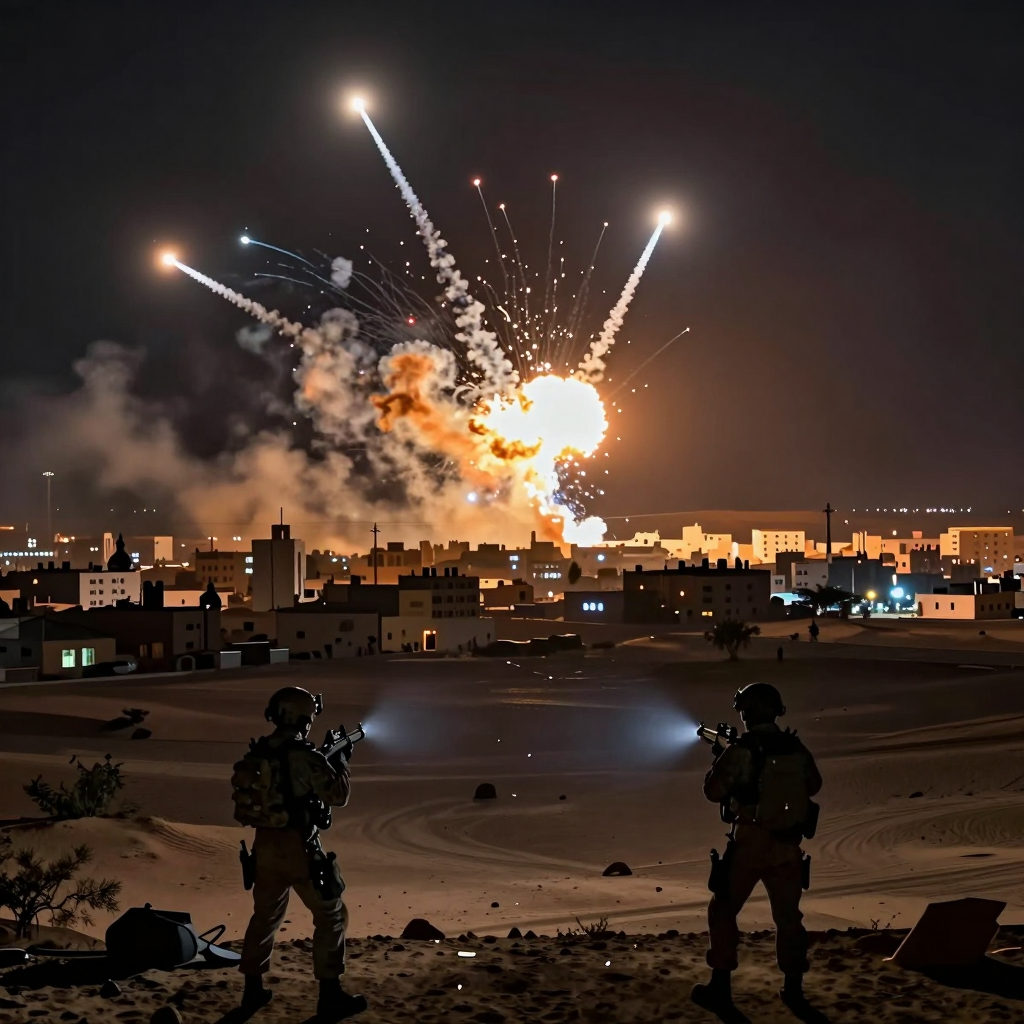
Why did the United States and Israel launch an unprecedented military operation against Iran on February 28, 2026? The answer goes beyond simple “retaliation”—it is the result of a collision of nuclear and missile capabilities, regional balance of power, and regime instability at a critical juncture. This operation was so significant in scale and purpose that President Trump himself labeled it a “major combat operation,” signaling the profound reverberations it would send throughout the Middle East and the world.
Operation Objectives and the “Imminent Threat” Narrative Against Iran
The explicit goals set forth by the US can be condensed into four major points: disrupting Iran’s nuclear capabilities, dismantling its missile program, neutralizing its naval power, and protecting US interests in the Middle East. Coupled with the phrase “eliminating an imminent threat,” this message strongly asserts a preemptive justification for military intervention.
Notably, the timing came shortly after an IAEA report revealed a verification gap regarding Iran’s suspension of uranium enrichment activities, illustrating that this operation was a confluence of intelligence, diplomatic, and military strategies being propelled simultaneously.
Strikes on Major Iranian Cities and the Signal of Targeting the Regime
Explosions were reported across critical hubs including Tehran, Isfahan, Qom, Tabriz, Karaj, and Bushehr, highlighting the operation’s wide reach. Even more striking was the indication that the highest leaders, including the Supreme Leader and the President, were targeted. Though it is known the Supreme Leader evacuated to a safe location beforehand, the mere signal that the command structure could be directly shaken injects severe instability into the regional deterrence framework.
Ultimately, this was not merely an assault on facilities, but a strike aimed at the very nervous system of Iran’s power structure.
Civilian Casualties and Communication Blackout Fuel Internal Instability in Iran
The true cost of war often erupts first in the home front. Schools were attacked with casualties reported, and long queues for gasoline formed in Tehran. The closure of airspace created an exodus of those trying to flee, paralyzing urban functions and amplifying social unrest.
Particularly revealing is the fact that internet connectivity plunged to just 4%, signaling that the conflict went beyond physical damage to include destruction of information and control infrastructure. The communication blackout not only threatens citizen safety but also forces the government to adopt harsher methods in managing public opinion and the situation, heightening internal tensions.
Iran’s Immediate Retaliation and the Reality of Regional Escalation
Iran quickly launched retaliatory missile strikes, even claiming attacks on US bases across multiple countries. Statements pledging to continue retaliation “until decisively repelled” suggest this clash may evolve from a one-time confrontation into a prolonged military conflict.
With proxy actors further compounding the equation, the battlefield risks becoming multilayered. Connections to armed groups in Iraq, Hezbollah, and the Houthis could transform the conflict from a bilateral fight into a regional proxy war.
The “Political Vacuum” on the Nuclear Issue and Uncertainty Over Iran’s Regime Change
Iran’s nuclear program remains both a cause of military conflict and a defining factor in the post-conflict world. Should variables like the absence of the Supreme Leader materialize, the past fatwa banning nuclear weapons development could weaken along with its political authority. In other words, this “attack aimed at stopping nuclear development” could paradoxically undermine the predictability of Iran’s nuclear policy.
At the same time, experts assess that an air campaign alone is unlikely to topple the regime. Even with resistance and political fractures inside Iran, meaningful regime change is likely only when internal dynamics converge with external pressures.
Fractures in Alliance Cooperation and a Diplomatic Window
The UK clearly refrained from participating in the strikes but reaffirmed its principle of preventing nuclear development. This does not indicate a complete split in Western goals but rather a difference in approach and degree of military intervention. Paradoxically, this gap in stance implies that diplomatic outlets—whether deterring further attacks or returning to negotiations—are not entirely closed.
The operation thrust the Middle East in 2026 not simply into a “crisis,” but into a phase of structural realignment. Now, the question narrows to one: Will this unprecedented intervention against Iran restore deterrence, or ignite further escalation? At this crossroads, the Middle East and the wider world will tread a fragile balance for the foreseeable future.
The Reality of Iran’s Military Operation: Unveiling Its Scale and Objectives
The goals appear clear—halting Iran’s nuclear development and dismantling its missile program. However, as this operation expands beyond a simple “facility strike” to simultaneous explosions across major cities and includes the Supreme Leader and the President as targets, its nature takes on a far more aggressive and politically charged dimension.
The ‘Scale’ of the Iran Operation: Striking Not Just One or Two Targets, But the Nation’s Core
This military intervention was designated a “major combat operation” by the U.S. President himself, highlighting its extensive scope. With explosions reportedly spreading across Tehran, Isfahan, Qom, Tabriz, Karaj, and Bushehr, the operation appears not merely focused on eliminating specific facilities but likely aimed at command and control centers, strategic infrastructure, and psychological impact simultaneously.
- Simultaneous Multi-City Strikes: Explosions erupted not only in the capital but also in cities known for religious, industrial, and military significance.
- Shaking Social Foundations: Damage to communication infrastructure, airspace closures, and long queues for fuel reveal how the military conflict could quickly spiral into social chaos.
The ‘Objectives’ of the Iran Operation: Nuclear, Missile, Naval Powers, and Protecting U.S. Interests
The officially stated aims are relatively clear-cut. Blocking nuclear capability and neutralizing “imminent threats” are front and center, supported by detailed military objectives underneath.
- Cutting Off Nuclear Capability: Preventing the development of nuclear weapons is the top priority.
- Dismantling Missile Programs: Aimed at weakening medium- and long-range strike capabilities.
- Neutralizing Naval Forces: Targeting axes that could threaten maritime routes and U.S. military activities in the region.
- Protecting U.S. Interests in the Middle East: Seen not as a one-time retaliation but as part of a longer-term plan to reset regional order.
The crucial point here is not just “what was destroyed.” The real aim lies in rendering targets incapable of operation or recovery.
Why the Supreme Leader Became the ‘Centerpiece’ of the Operation: Beyond Military Strikes, Targeting the Power Structure
The most sensitive aspect is the choice of targets. Reports indicate the strikes were aimed at the Supreme Leader and the President, with indications that the Supreme Leader was evacuated to a safe location before the attack. This suggests the operation has transcended nuclear and missile facilities to directly pressure the top decision-makers—the heart of the regime.
This approach brings two simultaneous impacts:
- Disruption of Command Systems: Severing the continuity of wartime command and control to slow response times.
- Maximizing Political Messaging: Signaling not merely “halt the program” but “hold the decision-makers accountable.”
Ultimately, while the operation appears to have clear military targets, its execution is far more complex. The widespread shocks across cities, the destabilization of communication and social systems, and pressure directly on the center of power intertwine, pushing the conflict beyond a military phase toward threatening regime stability and raising the risk of broader regional escalation.
Iran: Civilians Caught in Shock and Social Turmoil
The news that a school was bombed, killing at least 24 children and residents, etches the terrifying truth of "no exceptions in this war" even into the minds of those far from the front lines. The moment a space meant to be safe collapses, daily life instantly becomes a struggle for survival. Some families blame themselves for sending their children to school, while others pack their belongings amid the anxiety of an uncertain tomorrow.
The chaos doesn’t end with the roar of explosions. Internet connectivity plunges to just 4%, and mobile networks are cut across Tehran, leaving people in the dark. When the most basic communication—air raid alerts, evacuation instructions, confirmation of family members’ safety—is blocked, the city quickly becomes a place where no one knows what is happening or where. Rumors spread faster than news, and fear amplifies with unverified stories.
As a result, citizens’ behavior shifts toward primal survival instincts. The long lines for gasoline distribution in Tehran reflect not mere inconvenience but a desperate effort to secure “the last means of mobility.” With airspace closed and movement restricted, fuel directly equates to the chance of escape. Some try to flee the capital, others gather their families to lock their doors, and some endure isolation amid growing fear.
When civilian shock, communication blackouts, and essential resource anxiety collide simultaneously, Iran is not simply “at war”—it teeters on the edge of a societal standstill. And that void will inevitably begin to fill again, whether with greater anger, deeper resignation, or unexpected resistance.
Iran’s Powerful Counterattack and Signs of Expanding Regional Conflict
As retaliatory missile strikes commence, the Middle East plunges once again into a vortex of tension. The critical point of this crisis is that the structure for escalation capable of igniting a full-scale war is already firmly in place. With US and Israeli airstrikes underway, Iran promptly sought to regain the initiative through immediate military response, and the aftermath shows alarming signs of spreading beyond borders across the entire region.
Iran’s Retaliation: Signals Beyond ‘Symbolic Response’ Toward ‘Prolonged Conflict’
Iran’s Islamic Revolutionary Guard Corps (IRGC)-affiliated media claim that Iranian forces have struck 14 US military bases across Bahrain, UAE, Kuwait, Jordan, and Saudi Arabia. What demands particular attention is the tone of their statements. Tehran has conveyed that its retaliation will not be limited to a one-time act but will persist until its adversaries are “decisively defeated.” This is no mere gesture—it signals a deterrence strategy that accepts the prospect of a protracted conflict.
Iran’s Proxy Networks: The Frontlines Multiplying in Multiple Directions
The problem lies in the conflict not being confined to missile exchanges. Iran has long wielded influence in the region through proxy armed groups, and during crises, this network can act as a powerful lever for escalation.
- Iraqi Militias: An increase in attacks targeting US forces and related facilities could expand the war beyond “Iran-US” to a collapse of “security within Iraq.”
- Lebanese Hezbollah: Instability along Israel’s northern front could dramatically increase Israel’s defensive burden and push its response intensity even higher.
- Yemeni Houthi Rebels: Should threats to maritime trade routes resurge, fluctuations in energy and logistics prices would cause military clashes to trigger a shockwave across the global economy.
The risk of proxy war deepens as the number of attackers diversifies, blurring lines of responsibility and lowering the thresholds for retaliation. In other words, a minor incident could quickly spiral into a chain reaction, unleashing unforeseen escalations.
The ‘Escalation Trap’ Surrounding Iran: When Deterrence Breeds Anxiety
The most perilous phase right now is the mutual interpretation of each side’s moves as “preparations for escalation.” The US can simultaneously review both regional base defenses and additional strike options, while Iran gains incentives to choose even stronger retaliation to solidify internal unity. This dynamic pushes the conflict beyond mere military victories or defeats, entangling issues of regime stability, alliance trust, and regional dominance, which narrows paths to resolution even further.
Ultimately, the key question remains: Will Iran’s counterattacks remain within ‘manageable retaliation,’ or will multiple proxy fronts erupt simultaneously, leading to the persistent militarization of regional conflict? The Middle East now stands at that critical crossroads.
An Unpredictable Future: Internal Resistance and the International Community’s Dilemma (Iran)
Is regime collapse imminent? The current war surrounding Iran cannot be resolved by the "intensity of bombings" alone. Instead, the interplay of internal political conflicts, the spread of civilian resistance, and the distancing and pressure from allied nations make the future even more uncertain. Observing the three fissures unfolding simultaneously outside the battlefield vividly illustrates why the region’s next chapter is so unpredictable.
Cracks Within the Power Structure: War Invites Realignment, Not Unity (Iran)
External conflicts often strengthen internal regime cohesion, but in this phase, Iran faces the opposite danger. Issues surrounding the supreme leader’s safety, the legitimacy of nuclear policies, and accountability for wartime governance failures are all emerging simultaneously, heightening internal blame games among those in power. In particular, the longer the hardline stance justified by “security” persists, the more economic and social systems are strained, eroding governing legitimacy further. Even if the war does not end, the power structure is already under pressure to realign.
The Threshold Between Civil Resistance and Social Collapse: Daily Life Comes Before Fear (Iran)
Shocks such as airspace closures, fuel rationing queues, and communication blackouts may silence citizens temporarily but also mobilize anger. In Iran’s case, distrust accumulated since the economic crisis already existed, and the war adds a “matter of survival” on top. The key is not the mere scale of protests, but the everyday acts of defiance and spontaneous local networks that emerge when livelihoods are shaken. The greater the control exerted, the more resistance is likely to transform and go underground rather than disappear—this is the biggest variable.
The International Community’s Dilemma: Allied Divisions Determine the War’s Exit (Iran)
The more allies choose “principled support plus distancing” over full military engagement, the more complicated the war’s objectives become. On one hand, the emphasis grows on blocking Iran’s nuclear capability; on the other, voices demanding prevention of escalation and a return to negotiations gain momentum. This paradox destabilizes exit strategies. The stronger the military pressure, the slimmer the prospects for negotiation; the more the door to talks remains open, the blurrier the military objectives. How the international community defines “victory” ultimately determines the intensity and duration of clashes on the ground.
Conclusion: Collapse Is a Problem of ‘Convergence,’ Not Just ‘Time’ (Iran)
It is difficult to say if the regime will collapse immediately. What is certain, however, is that Iran’s future is not decided by bombings alone. Only at the moment when internal power realignment, sustained civilian resistance, and allied choices simultaneously converge will the door to regime change open. This is why the upheaval in the Middle East today is more dangerous and likely to endure even longer.
Comments
Post a Comment