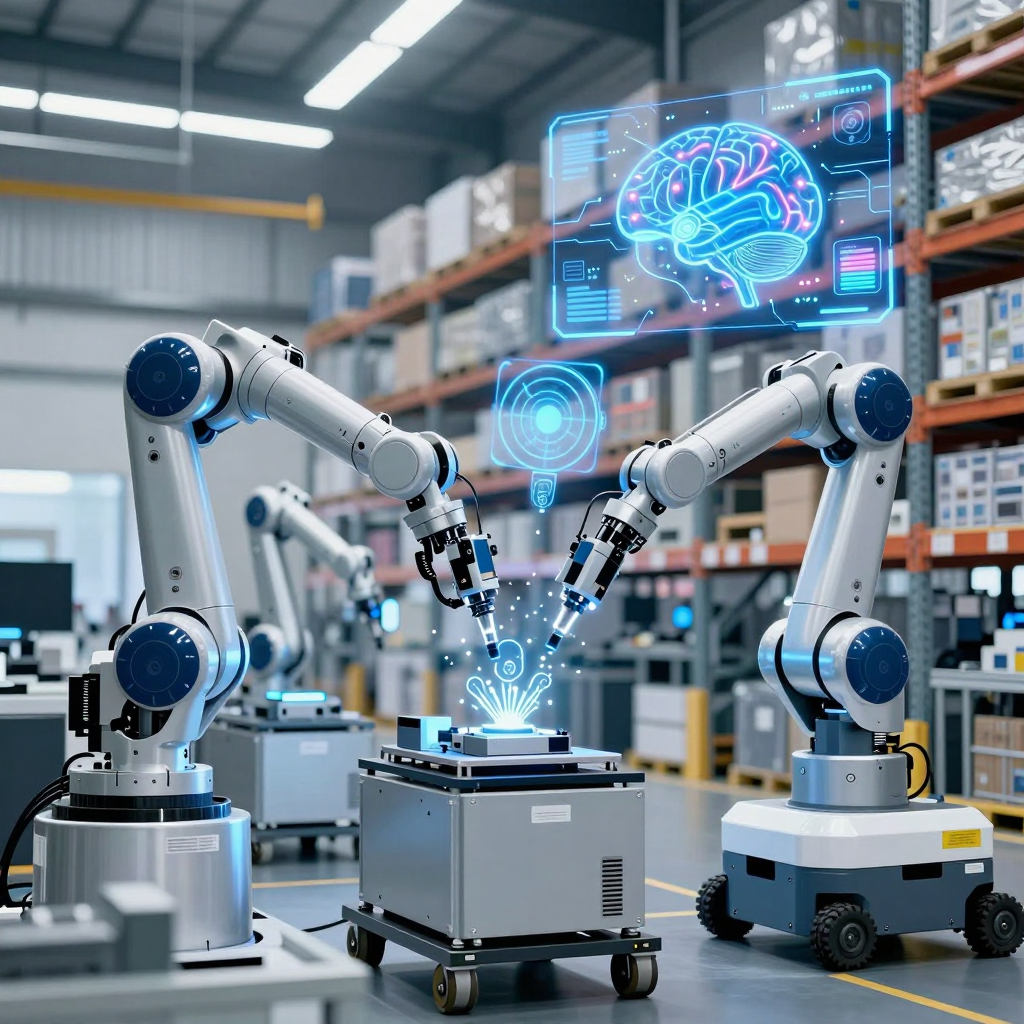
 \n
\n
2026 Through a Tech Lens: The New Era Unveiled by Physical AI and Humanoid Robots
Physical AI goes beyond simple automation to revolutionize entire industries! The future has already begun—aren’t you curious how this technology will transform our lives and industries? Emerging as 2026’s hottest tech keywords, Physical AI and humanoid robots are no longer just “robots doing tasks”; they are redesigning industry structures and business models themselves.
Tech Core: Why Physical AI Is Explained as ‘Brain·Virtual·Body’
Physical AI is best understood as a three-axis structure that completes robots as intelligent systems.
Brain: Robot judgment and reasoning
Traditional large language models (LLMs) have expanded into Vision-Language-Action (VLA) models, propelling robots beyond simple command execution to observing scenarios, understanding them, and independently planning next actions. In essence, they shift from “machines moving by fixed rules” to “workers reading on-site contexts.”Virtual: Learning engines that reduce failure
Combining a world model that reflects physical laws with Sim-to-Real (simulation to reality) technology allows massive learning and validation in virtual environments—eliminating the need for risky, repetitive real-world experiments. This fundamentally addresses the biggest costs in robot deployment: data scarcity, trial and error, and onsite tuning.Body: Hardware innovations built to endure the field
For humanoid and mobile robots to become “practically useful,” body efficiency and durability are paramount. The recent trend is shifting from hydraulics to electric, with components like axial flux motors and precision reducers driving simultaneous miniaturization and higher efficiency. The result? Robots that move longer, more precisely, and in more varied spaces.
Industry Transformation Driven by Tech: Restructuring Already Underway in Manufacturing, Logistics, and Healthcare
Physical AI and humanoid robots don’t appear “overnight”; instead, they infiltrate industries by quietly shifting standards on the front lines.
Manufacturing: Accelerating hyper-automation and mass customization
As robots perceive their environment through cameras and sensors, reconstructing tasks based on VLA models even when instructions change, production lines grow increasingly flexible—enhancing the economics of producing many varieties in small quantities.Logistics and Warehousing: Building the foundation for fully autonomous supply chains
When mobility (AMRs), manipulation (arms/grippers), perception (vision), and planning (models) converge, robots evolve beyond mere transporters to perform continuous workflows including picking, moving, and sorting. Supply chains become faster and more predictable.Healthcare and Caregiving: Empowering precision medicine and aging tech
Accuracy and safety are critical in medical and caregiving fields. Physical AI advances by perceiving patient conditions and environments, complying with standard procedures, and avoiding hazards—directly addressing caregiver shortages.
Tech Business Model: From Sales to Subscription, How RaaS Accelerates Adoption
The real inflection point in robotics lies not just in technology but in how it’s deployed. Moving from one-time hardware purchases to subscription services like Robot as a Service (RaaS) reduces companies’ upfront CAPEX burden and enables operating robots with a performance focus (uptime, throughput, quality). This shift speeds up robot adoption and strengthens suppliers’ competitiveness through continuous updates (software, models, maintenance).
Tech Challenges: Why Functional Safety, Cybersecurity, and Standardization Signal Maturity
As Physical AI embeds itself into industry cores, regulation and standards aren’t optional—they’re prerequisites. Particularly, functional safety, cybersecurity, and interoperability among heterogeneous robots (standardization) determine the final hurdles for field deployment. Paradoxically, the very prominence of these issues signals the market’s transition from an “experimental phase” to large-scale operational maturity.
Ultimately, in 2026, Physical AI and humanoid robots are no passing tech trends but a foundational infrastructure redefining how work is done and what industrial competitiveness means. The question going forward isn’t “what can robots do?” but rather “which industries will fastest absorb this change into their operating models?”
Deep Dive into the Three Pillars of Tech Physical AI: Brain, Virtual, Body
Embedding a brain into robots (Brain), training them flawlessly in virtual environments (Virtual), and driving the real world with electric motors (Body). When these three stages come together, Physical AI transcends “automation equipment” to become an entity that judges and adapts on its own. So, what’s the key? In short, intelligence (Brain) creates actions, virtual validation (Virtual) reduces failure costs, and hardware (Body) sets the ceiling for performance.
Tech Brain: From LLMs to VLA, Implanting ‘Common Sense and Reasoning’ into Robots
The Brain of Physical AI is evolving beyond simple controllers into a VLA (Vision-Language-Action) model that integrates language, vision, and action as one seamless whole. There are three key shifts:
- Multimodal Perception: Going beyond merely “describing” scenes captured by cameras and sensors, it understands objects’ positions, shapes, and relationships (e.g., a cup is on top of a book).
- Language-Based Planning: When given a goal like “Stack those boxes on the pallet without damage,” it autonomously devises and revises step-by-step task sequences.
- Action Generation: Ultimately, this reasoning must translate into executable behavior policies that control robot joint trajectories and force.
What’s often overlooked is that the goal is not “smart answers” but consistent, reliable behavior on-site. Since robots constantly face exceptions during tasks (slipping, occlusion, part tolerances, human interference), the Brain must handle uncertainty-aware reasoning and recovery strategies when failures occur.
Tech Virtual: Using World Models + Sim-to-Real to Complete Learning ‘Without Real-World Failures’
The Virtual pillar tackles the biggest bottleneck to large-scale Physical AI deployment: data and validation cost. Its core lies in two elements:
1) World Model
The robot learns its world as a “space governed by physical laws” to predict future states. For instance, it calculates in advance in simulation how objects will slide and rotate after being pushed or at what point a door might jam when pulled.
2) Sim-to-Real
This technology ensures performance remains robust when transferring from tens of thousands to millions of trials in simulation to reality. It typically involves:
- Domain Randomization: Deliberately shaking parameters like friction, weight, lighting, and sensor noise to build resilience against “real-world unpredictability.”
- High-Fidelity Physics Simulation: The closer factors like contact, friction, and elasticity mimic reality, the better the real-world transfer performance.
- Virtual Validation Pipeline: Automatically testing thousands of scenarios for specific tasks (e.g., box stacking) to deploy only the policies that meet safety and success criteria.
In summary, Virtual is a game changer for robot development. By preemptively “rehearsing” failures in simulation, it dramatically cuts down time, cost, and risk of field experiments while accelerating learning speed.
Tech Body: From Hydraulics to Electrics, Hardware Innovations Defining Humanoid ‘Real-World Performance’
Finally, Body is the physical foundation that delivers the force, speed, and precision that make even the smartest Physical AI work in reality. The recent trend centers on a switch from hydraulics to electric actuation.
- Advantages of Electric Actuation: Offers superior control precision, easier maintenance, miniaturization, and efficiency (power-to-output ratio). Electrification is almost indispensable, especially for humanoids with many joints requiring long hours of operation.
- Key Components:
- Axial Flux Motors: These provide higher torque density within the same volume, enabling smaller joint actuators without sacrificing force.
- Precision Gearboxes: Convert high-speed motor rotations into the low-speed, high-torque output required for tasks, while minimizing backlash to allow precise manipulation.
- Control Perspective Shift: Electrification isn't just swapping motors; it demands advanced torque control, impedance control (adjusting force ‘softly’ like a human), collision detection, braking, and integrated safety logic.
Ultimately, Body dictates the “quality of movement.” Even with the same Brain, differences in joint efficiency, thermal management, and gearbox precision critically impact task performance and durability.
Core Tech Summary: When the Three Pillars Align, Physical AI Sparks a ‘Revolution’
- Brain understands and plans the tasks,
- Virtual completes learning and validation without costly failures,
- Body transforms that intelligence into real-world power and precision.
As these three pillars mature together, Physical AI scales far beyond “improving a single robot’s capability” to become a technology that transforms entire industrial operations.
Industrial Sites and Business Models Realized through Technology: The Practical Deployment of Humanoid Robots
From mobile robotics to fully autonomous supply chains—humanoid robots have now become technology proven on the industrial floor today, not just a future promise. Hyundai Motor Group’s innovative robot, “MobED,” offers an intuitive example of how robots are transforming factories and logistics centers. At the same time, companies are redesigning business models by shifting robot adoption from “purchase” to “subscription.”
Industrial Deployment from a Tech Perspective: Changing Operations in Manufacturing and Logistics
The value of humanoid and mobile robots goes beyond simple task automation; it lies in eliminating operational bottlenecks on site.
- Manufacturing: As small-lot, multi-product manufacturing becomes common, fixed production line automation alone cannot keep up. Combining mobile robot platforms with humanoids allows workers to “reassign” tasks to robots instead of “relocating” processes, dramatically speeding up production changeovers.
- Logistics and Warehousing: Previously segmented steps such as picking, transport, loading, and inspection are seamlessly linked into a continuous process through collaboration between autonomous mobile robots and humanoids. This evolution culminates in a fully autonomous supply chain, where decision-making and execution from order to shipment increasingly revolve around robots.
The key is not just robot hardware. For robots to move autonomously on site, they must possess field-level judgment based on the VLA model: perceiving their surroundings (vision), understanding commands (language), and acting accordingly (control). As such intelligence advances, robots shift from performing “preset motions” to carrying out dynamic “situational responses.”
Hyundai Motor’s ‘MobED’: Mobility Expands the Scope of Robot Utilization
MobED is a mobile robot platform featuring four independently controlled wheels that enable omnidirectional driving. This mobility holds critical significance in industrial settings.
- Extends Workspace: Because the robot is not confined to a fixed cell, it can operate across multiple zones within factories and logistics centers.
- Reduces Infrastructure Dependency: It can partly replace or complement conveyor and fixed equipment-based logistics systems, cutting costs associated with on-site layout changes.
- Forms the Basis for Robot Collaboration: Standardizing the mobile platform allows the attachment of various modules (sensors, arms, loading devices, etc.) on top, expanding functionality.
Ultimately, MobED exemplifies not just the humanoid robot’s symbolic “human-like” appearance but highlights the practicality of mobile robotics with immediately quantifiable ROI on-site.
Business Models in the Tech Era: RaaS (Robot as a Service) Lowers Adoption Barriers
As technology matures, markets shift toward service-based models rather than product sales, and robotics is no exception. The rapid adoption of RaaS (Robot as a Service) is driven by clear reasons:
- Reduces Initial Capital Expenditure (CAPEX) Burden: Instead of buying and depreciating robots, companies convert costs into operating expenses (OPEX) through subscription fees.
- Service-Based Updates and Maintenance: Robot performance heavily depends on software upgrades (models, control, safety logic). RaaS incorporates these updates into contracts, mitigating operational risks for adopters.
- Scalability: In industries with fluctuating volumes such as peak and off-peak seasons, robot numbers can be flexibly increased or decreased, enabling more agile supply chain operations.
Consequently, companies are moving away from “owning” robots to purchasing the required performance and uptime. As humanoid robots become widely deployed in industry, this subscription-based model is likely to emerge as a dominant standard.
Challenges Left by Technology: Safety, Security, and Standards Determine the ‘Speed of Spread’
As more robots populate industrial floors, critical challenges become clear. Without ensured functional safety, cybersecurity, and interoperability standards for heterogeneous robots, the rate of robot adoption will be limited not by technology itself but by regulatory and risk management frameworks.
In other words, the current humanoid robotics race shifts focus from “who walks fastest” to “who enters and operates on site most reliably over the long term.”
Answers are already emerging in industrial sites and business models. The humanoid robot revolution is no longer about flashy demos but is being realized through a practical tech transformation combining mobile robotics and RaaS.
The Role of the K-Humanoid Alliance in Building the Domestic Tech Industry Ecosystem and Global Competition
Five hundred domestic companies and world-renowned robotics firms are gathering at COEX. This scene is not just a simple exhibition announcement; it signals that the ‘supply chain war’ of the Physical AI and humanoid robot era has officially begun in Korea. As global companies strive to dominate technology standards and markets, the way for Korea to survive is not through “individual company battles” but through building an ecosystem based on alliances.
Why the Tech Exhibition Hall Becomes a ‘Battlefield’ Rather Than Just a ‘Market’
Large-scale events like AW 2026 are more than product showcases—they are arenas where cooperation, procurement, and standards competitions happen simultaneously. Especially for humanoids, no single company can create everything.
- Brain (Intelligence): VLA models, robot operating software, data pipelines
- Virtual (Simulation): World models, digital twins, Sim-to-Real verification systems
- Body (Physical): Electric actuators, precision reducers, motors, sensors, batteries, safety designs
All three axes must align perfectly for a “robot that makes money in the real world” to exist. Therefore, the 500 companies gathering at COEX should be viewed not as mere participants but as puzzle pieces of the humanoid value chain.
Three Core Challenges the K-Humanoid Alliance in Tech Aims to Solve
The significance of a domestic alliance in global competition is clear: to create a structure that binds technology, shares risk, and accelerates speed.
1) Building an ‘Internalized Supply Chain’ Linking Components, Finished Products, and Services
For humanoids, electrification (motors and reducers) and precise control determine success or failure. When domestic parts suppliers and robot manufacturers join forces in joint R&D, they can reduce dependence on specific countries or companies and simultaneously improve cost, lead time, and quality stability.
2) Elevating Functional Safety and Cybersecurity to the ‘Product Design Stage’
Since humanoids move alongside humans, safety certification and security are not optional. If the alliance establishes a common architecture (safety control, certification processes, security update systems), companies won’t have to repeatedly start from scratch—dramatically accelerating commercialization speed.
3) Expanding the Market through Interoperability and Standardization
In real-world settings where heterogeneous robots, sensors, and operating software mix, “robots that connect well” get adopted faster than “robots that are merely well-made.” If the alliance leads common interfaces and data standards, domestic companies can sell individual products yet enjoy the ecosystem effect of expanding like a unified platform.
How the ‘Alliance Strategy’ in Tech Translates into Real Business
No matter how great the technology is, customers first consider deployment costs and operational risks. Here, the alliance acts as a catalyst to make subscription-based models like RaaS (Robot as a Service) a reality.
- As component reliability and maintenance systems improve, SLA (Service Level Agreement)-based contracts become possible, and
- As standardization progresses, customers face less vendor lock-in risk, making adoption easier.
Ultimately, the alliance’s role isn’t about “making more domestic robots” but about creating industrial-level conditions where companies can confidently subscribe to and operate robots.
Conclusion: As Global Giants Assemble, the Value of the ‘Domestic Alliance’ Grows
Now that global humanoid companies are exploring the Korean market, it’s the perfect time to sophisticate the domestic ecosystem. Platforms like AW 2026 increase competitive pressure but also provide an opportunity to accelerate collaborative speed. If the K-Humanoid Alliance takes the lead in supply chains, safety, and standards, Korea will no longer be a mere follower but a player shaping the rules of the global Physical AI market.
Tech Regulation, Standardization, and the Future: The Maturation and Challenges of the Physical AI Industry
At first glance, regulations on functional safety, cybersecurity, and heterogeneous robot interoperability may seem like “constraints.” However, in the realm of physical AI today, these regulations are more like gateways to new markets. This is because the moment robots move beyond factory demos into real-world industries where humans, infrastructure, and data intersect, buyers prioritize “trust” over mere “performance.” And regulators and standards serve as the mechanisms to prove this trust through numbers and certifications.
Functional Safety in Tech: The Prerequisite for Deploying “Moving AI” on Industrial Floors
Physical AI is not just software—it is a system that exerts force in the physical world. Even a tiny judgment error can instantly lead to physical accidents like collisions, pinching, or falls. Therefore, functional safety is more than a checklist—it becomes an engineering methodology to establish robots as recognized industrial equipment.
- Risk Analysis-Based Design: When a robot performs any task (moving, gripping, cooperating), risks are broken down into scenario units. Safety measures are then layered across control, mechanisms, sensors, and operational processes.
- Control Systems Compliant with Safety Grades: Features like emergency stop, speed/force limits, and protection stop must not just “exist” but be verified to meet specified performance levels.
- New Challenges in the Era of VLA/World Models: As models increasingly base behavior on learning, it becomes impossible to “test all cases.” Thus, safety cannot rely solely on AI accuracy but must be complemented by guardrails (safety boundaries), limited action spaces, and redundant sensing and control through system engineering.
Those who benefit most from stricter functional safety regulations are clear: companies equipped with the ability to produce components (motors, reducers, sensors), safety controllers, verification simulation, and test automation become key players, unlocking the bottleneck in industrial adoption and ascending the value chain.
Cybersecurity in Tech: The Moment Robots Become “Network Equipment”
Robots in the field are no longer isolated devices. To enable cloud updates, remote monitoring, process-data integration, and RaaS (Robot-as-a-Service) models, robots effectively become always-connected computing nodes. As connectivity grows, so does the attack surface, making security a non-negotiable delivery condition, not an option.
- Chain of Trust in Remote Updates/Model Deployment: Signature verification and integrity checks are essential to prove firmware, models, and configuration values have not been tampered with.
- Detection and Response During Operation: Once robots enter a factory internal network, breaches are no longer isolated incidents but potential downtime risks for the entire operation. Hence, operational security such as log/telemetry standardization, anomaly detection, and privilege separation becomes critical.
- Data Governance: Data collected by robots—through imaging and sensing—may contain personal information, trade secrets, or safety data. Minimizing data collection, onsite processing, and access control must be built in from the start.
As security regulations tighten, growth is not limited to “robot manufacturers” but extends to security solution providers, monitoring platforms, and certification/compliance services. Thus, the robot market catalyzes its expansion from a tech manufacturing industry to a service and operations industry.
Tech Standardization and Interoperability: Building a Supply Chain Where Heterogeneous Robots Work Together
Real industrial sites never consist of just one vendor’s robots. Moving robots, collaborative robots, humanoids, vision systems, and MES/WMS are all mixed. Companies choose multi-vendor strategies to spread cost, performance, and risk. In this context, interoperability standards are not just “nice to have” but become the infrastructure that determines the speed of adoption.
- Economic Value of Interface Standards: To avoid redeveloping entire systems whenever a robot is swapped, commands, status, maps, safety events, and task definitions must be compatible.
- Common Language for Sim-to-Real Validation: To transfer behaviors verified in virtual environments to actual robots requires abstracted layers for models, sensors, and actuators. Standardization directly reduces verification costs.
- Platform Dominance Built by Standards: Companies that secure standards don’t just sell “one robot at a time,” they become platform operators providing the connection rules of the ecosystem.
In essence, interoperability transforms robots from standalone devices into components of the supply chain. From that moment, the market moves beyond hardware specifications to compete in integration, operation, and scalability.
Why Do Tech Regulations Become Opportunities? Because ‘Trust’ Attracts Capital
The true reason physical AI is reshaping industries and capital markets is not just improved technology. It is because regulations and standards quantify trust, enabling the following transformative shifts simultaneously.
1) Clearer Purchasing Criteria Accelerate Adoption
When “safety certification/security compliance/interoperability” become measurable requirements, factories can move quickly from PoC to widespread deployment.
2) RaaS Becomes Feasible
Subscription models involve manufacturers bearing long-term operational responsibility. To do so, security, safety, updates, and monitoring systems must be standardized. Companies equipped with these systems generate recurring revenues and reset valuation benchmarks.
3) New Core Sectors Emerge—from Components and Verification to Security and Operations
Not only humanoid Body (electrification), Virtual (simulation/validation), Brain (VLA), but also regulatory compliance capabilities rise to the industry’s center. Physical AI becomes not a single product but an industrial ecosystem centered on regulation and standards.
The next battleground for physical AI is not “smarter robots,” but robots that are safer, more securely connected, and more easily mixed and matched. Regulations and standardization are not walls that make this path harder—they are the entry ticket and growth lever enlarging the market drastically.
Comments
Post a Comment