Israel-U.S. Coalition Strikes Iranian IRGC Bases... Growing Concerns Over Nuclear Program Resurgence
 \n
\n
Iran’s Surge in Tensions: The Prelude to Military Conflict
In response to attacks by Israel and the United States, Iran is preparing to retaliate. With airspace closed for six hours and military bases targeted, how far will the sparks of war spread?
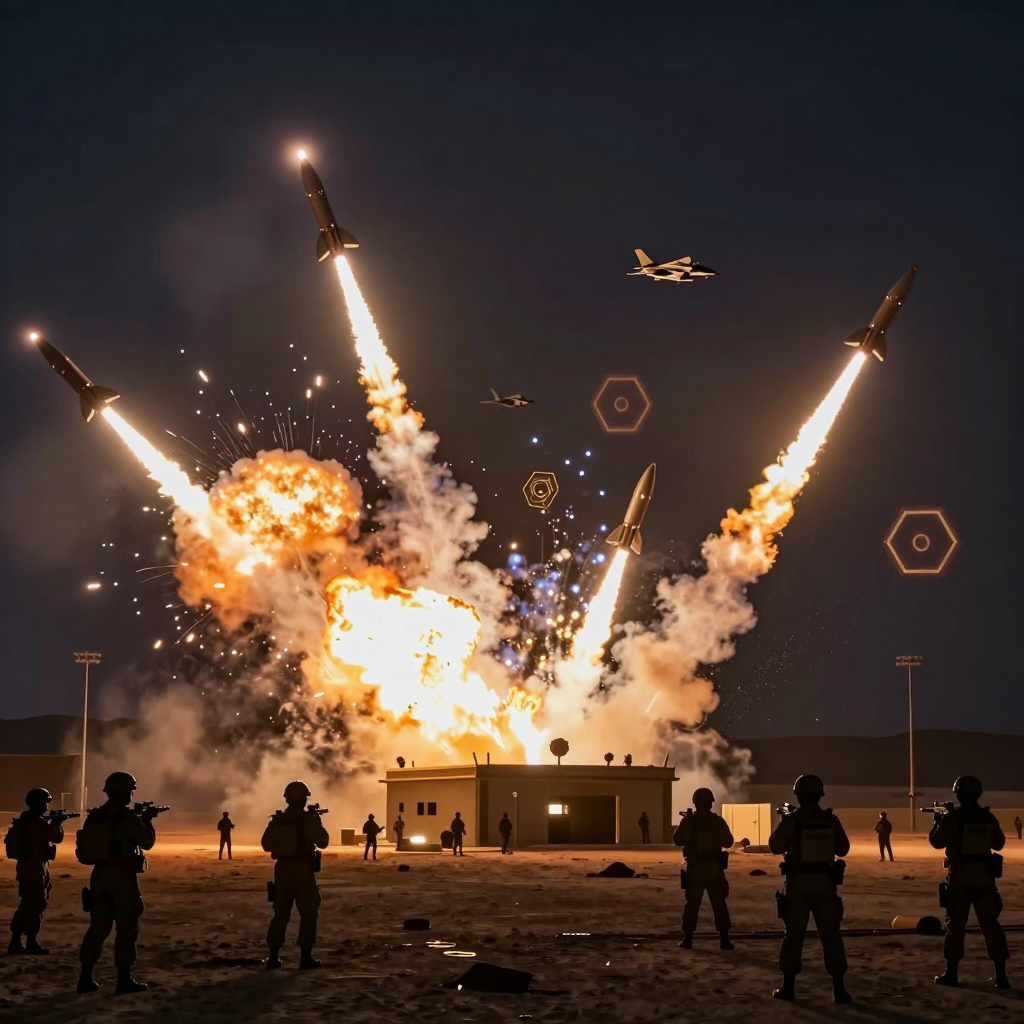
At the heart of this crisis is the fact that military tensions have escalated beyond mere warnings into actual strikes and casualty reports. As of February 28, Iran’s airspace was temporarily shut down across the country, and facilities linked to the Islamic Revolutionary Guard Corps (IRGC) were reportedly attacked. Notably, a massive explosion in Qom—the center of Shia Islam—was reported, signaling that these clashes are not merely border disputes but target highly symbolic and impactful locations.
Iran immediately called for an emergency UN Security Council meeting, signaling a move to broaden the front through diplomacy while internally reinforcing its preparations for retaliation. Measures like airspace closure are typically read as preparations to reorganize air defense and command-control systems and brace for potential follow-up attacks. The critical question remains: will these heightened tensions end with isolated incidents, or solidify into a recurring cycle of airstrikes and retaliations?
There are three key points to watch going forward. First, whether additional strikes will remain confined to military bases or expand to critical infrastructure such as energy and communication networks. Second, whether Iran’s retaliation will take the form of direct military confrontation or asymmetric responses—indirect and unconventional tactics. Third, if all of this will be checked by international efforts to deter escalation or spiral faster due to mutual miscalculations. The current situation in Iran is at a stage where the spark has already caught fire; only the wind’s direction remains uncertain.
Iran’s Uncertain Nuclear Program: The Hidden Threat Beneath the Surface
The International Atomic Energy Agency (IAEA) has stated that it cannot verify whether Iran has truly halted its uranium enrichment activities. Even if there’s a declaration that such efforts have “stopped,” the moment verification becomes impossible, suspicion transforms into a tangible threat. So, has Iran abandoned its pursuit of nuclear weapons, or is it quietly preparing the next phase behind the scenes?
The core issue isn’t intention but the collapse of visibility. According to the IAEA report, authorities lack knowledge of the location, scale, and composition of Iran’s enriched uranium stockpiles. This isn’t merely an administrative gap—it means the very benchmarks the international community relies on to assess risk have been blurred. When transparency disappears from a nuclear issue, regardless of actual capabilities, other nations are forced to act based on worst-case scenarios.
Adding to the uncertainty, remarks from senior US officials are conflicting. On one hand, there are references to “evidence of attempts to rebuild the nuclear weapons program,” while others say Iran is “not enriching now but aiming to maintain capabilities.” In other words, today’s debate centers not on active enrichment but on the latent potential to resume at any moment and the hidden stockpiles.
Conversely, discussions through Oman reportedly mention that Iran agreed to “dilute uranium to the lowest possible level and convert it to fuel.” However, to rebuild trust, such measures must ultimately be verified in a way that the IAEA can confirm on-site. As long as the conclusion remains “unable to verify,” all diplomatic messaging stays in the realm of words only, making it hard to stabilize security environments and markets.
Ultimately, the risk in Iran’s nuclear issue grows not from overt violations, but from the persistence of the unseen. Where verification halts, what remains are assumptions—assumptions that demand vigilance and preemptive action. Today’s uncertainty transforms the nuclear dossier from a mere diplomatic agenda item into a constant risk factor that can swiftly trigger military or political upheavals.
Flames of Domestic Resistance in Iran: The Cry for Freedom Amid Economic Crisis
Against the backdrop of an economic crisis, students and citizens have declared their institutions “fortresses of freedom,” launching massive protests. Contrary to the common belief that internal fractures subside as external military tensions rise, the anger within Iranian society is actually boiling hotter from the inside out. How far will these flames spread?
The background is clear. Amid a widespread economic crisis, the national budget for 2025 has been set at approximately 119 quadrillion rials, signaling that following nationwide uprisings in January 2025, the regime has readjusted resource allocation. With the mounting pressures of living costs, job insecurity, and regional disparities, the “budget” is more often perceived not as a remedy for public welfare but as a reallocation of costs for regime preservation. At this point, social discontent expands beyond mere economic grievances into collective actions demanding political accountability.
At the heart of this movement are students. The symbolic declaration by students at Tabriz University on February 23, naming their institution a “fortress of freedom,” is notable. Traditionally serving as hubs for discourse and organization, this declaration functions not simply as a slogan, but as a message affirming that “solidarity is greater than fear.” Adding momentum, on February 27 alone, at least four large anti-government protests took place during the “40-day mourning” phase, with some drawing over 1,000 participants. These protests demonstrate a spreading dynamic that transcends urban, generational, and agenda boundaries.
However, the regime’s response has been formidable. Following large-scale protests in January 2026, harsh crackdowns—including communication blackouts and extensive security measures—have reaffirmed the endurance of a strong control system. While this control may temporarily mute the noise on the streets, it also risks driving discontent underground, accumulating energy for the “next eruption.” Moreover, as the opposition remains a fractured coalition composed of labor unions, ethnic minorities, and military restorationists, organizing political victories remains challenging regardless of the magnitude of public anger.
Yet, the pressing question raised by current developments is clear: In a society where economic hardship is normalized, is control a tool of stability or fuel for instability? The declaration of a “fortress of freedom” transcends a university motto, reflecting a growing and solidifying language of resistance within Iran. The future hinges on how continuously protests connect, how disparate demands coalesce into shared agendas, and whether oppressive controls can sever these connections.
Iran's Repression and Division: The Shaky Grip of the Iranian Regime
Despite widespread crackdowns, the internal opposition in Iran continues its resistance as a divided alliance. The Islamic Revolutionary Guard Corps (IRGC)'s strong control, deploying communication blackouts and extensive security measures, may be effective in the short term, but it is a double-edged sword that deepens the public’s resentment. Ultimately, the critical question remains: how long and at what cost can this control be maintained?
Following recent large-scale protests, the Iranian regime has tightened its grip on society through increasingly sophisticated methods. Typical tactics such as communication blackouts, enhanced urban surveillance, and blocking gatherings slow the spread of protests but fail to eliminate the root causes of discontent. Especially amid a prolonged economic crisis, repression tends to lead not to ‘silence’ but to ‘latent resistance’.
On the other hand, sparks of resistance continue to burn at multiple levels. Students declare universities as “fortresses of freedom” to create symbols, and collective actions are reignited through social occasions like memorial ceremonies. However, the opposition alliance—composed of labor unions, ethnic minorities, and military restorationists—remains a loosely connected structure with conflicting goals. While this division buys the regime time, it also makes it difficult to fully extinguish the sporadic uprisings erupting across the country.
Ultimately, the balance of power in Iran is solidifying into a standoff between “overwhelming repression” and “persistent rebellion.” The more the regime flaunts its control, the more resources it must pour into security and propaganda, while the more society is suppressed, the more unpredictably it is likely to react. The moment this unstable equilibrium shatters may arise not from a single massive event, but from the convergence of accumulated factors like economic shocks, political missteps, and the simultaneous spread of regional protests.
Iran Before the International Community: The Dilemma of Trust and Human Rights Issues
The Iranian government claims to be a “responsible and reliable nation” at the UN Human Rights Council. However, the Iran the international community remembers is marked by a long history of human rights violations, recent domestic repression, and a compounded security crisis. This gap goes beyond a mere image problem; it becomes a key factor that weakens Iran’s voice in future diplomatic, economic, and security negotiations.
The ‘Cost of Trust’ That Iran Faces
National trust is built not on declarations but on verifiable actions. Currently, Iran is depleting its trust on multiple fronts.
- Strengthening domestic control and suppressing protests: Harsh responses to large-scale demonstrations, communication blackouts, and security measures conflict with international human rights standards and fuel external suspicion.
- Persistent political instability: Student-led protests and nationwide anti-government demonstrations reinforce the impression of a country with a “fragile social consensus.”
- Opacity on the nuclear issue: The IAEA’s inability to confirm the suspension of enrichment activities shakes the state’s credibility, independently from human rights concerns.
In this context, the claim of being “trustworthy” does not convince the international community but rather invites skepticism. The question immediately arises: On what grounds, and how can this be verified?
Conditions for Iran to Gain Recognition in the International Community
For Iran to genuinely restore trust on the global stage, visible changes must precede diplomatic rhetoric.
- Greater transparency on human rights issues: Disclosure and improvement aligned with international standards in critical matters such as protest responses, detention, and judicial procedures are essential.
- Strengthened cooperation with international organizations: Rejecting or limiting engagement with human rights mechanisms only solidifies suspicions into certainties.
- Ensuring policy consistency: Sending dual signals of accountability abroad while intensifying coercive domestic rule is perceived as the greatest risk by negotiating partners.
Ultimately, the path to recognition for Iran does not lie in declaring “We are trustworthy,” but in producing trust through action first in areas that demand it—human rights, rule of law, and verification systems. The international community operates not on goodwill, but on data and procedures, and Iran’s next moves will determine its evaluation.
Comments
Post a Comment