 \n
\n
The Beginning of Civil Rights Giant Jesse Jackson
Aren’t you curious about the story of a man who was born in a humble home and carved his name into American history? The hidden starting point of Jesse Jackson is far more human and fiercely intense than the title of “great leader” suggests.
On October 8, 1941, he was born into modest circumstances in Greenville, South Carolina. His birth name was Jesse Louis Burns, and as he grew up, he filled the gaps in his identity by receiving the surname “Jackson” from his grandmother. This small change felt like more than just a name—it marked the first step in establishing his very existence.
At Sterling High School, a segregated school in Greenville, he served as class president, where he learned early on how to raise his voice within the community. Then, in 1960, he took a deeper step into the heart of the civil rights movement by participating in a sit-in protest at a public library. This act of resistance in an everyday space became the starting line for the message that would define his life—dignity, rights, and active participation.
His college path also clearly reflected his direction. Though he initially received a football scholarship to the University of Illinois, he transferred to North Carolina A&T, a historically black university, where he played quarterback and continued his studies. After studying sociology, he became an organizer for the Southern Christian Leadership Conference (SCLC), and in 1968, he was ordained as a minister, beginning to build a leadership that connected faith with social change.
Ultimately, Jesse Jackson’s beginning was not on a glamorous stage but in times of segregation and deprivation, endlessly asking himself, “How should I live?” It was this starting point that enabled him, later on, to step into the very heart of a powerful movement that shook the core of American society.
On the Frontlines of the Jesse Jackson Movement: Crying Out for Economic Justice in Chicago
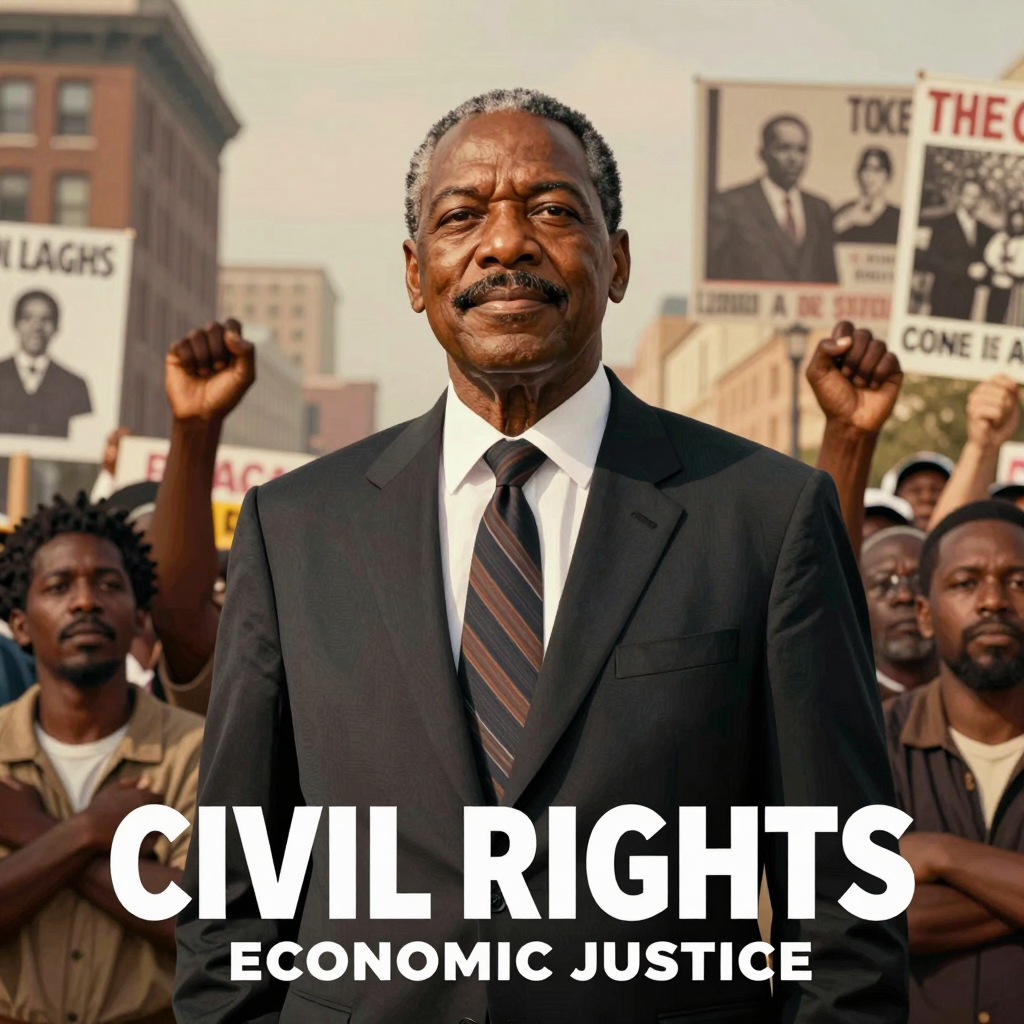
A desperate cry from a female worker on the streets of Chicago soon sparked a profound question: “Who gets the jobs, and who gets the opportunities?” This question reverberated throughout the city, shaking it to its core. At the heart of this wave that expanded into a nationwide economic justice movement stood Jesse Jackson.
In the 1960s, in Chicago, Jackson led the SCLC’s Operation Breadbasket, shifting the language of civil rights from “voting rights” to “dinner tables.” The core principle was straightforward: any business profiting from Black communities must hire Black workers from the area and invest back into the neighborhood. Jackson challenged corporate hiring practices and trade structures, while the community responded with consumer power and organized action. The anger on the streets quickly transformed into economic pressure and negotiation, producing concrete results.
During this time, Jackson was much more than a mere orator. He organized the ground, translating community demands into clear statements and bringing them to the negotiating table. Standing beside Martin Luther King Jr., Jackson’s words—“He was the pilot of the plane, but we were the ground crew.”—reveal the tireless work on the ground that fuels the lofty ideals soaring above.
Jackson’s Chicago experience became the foundation for establishing Operation PUSH and stepping onto a larger political stage. He proved that economic justice is not just a slogan but a structural issue, and that a single voice, when met with organized strength, can elevate a city’s struggle to a national agenda. This is the legacy Jesse Jackson demonstrated in Chicago.
Jesse Jackson's Challenge on the Political Stage: A Record of Presidential Campaigns
Jesse Jackson’s two presidential bids most vividly showcased his political ambition. At the same time, the institutional barriers and the era’s limitations he faced reveal how far—and where—the American political landscape had changed and where it remained stuck.
Building on Operation PUSH in 1971, Jackson sought to translate the demands of the streets into the language of elections. His first presidential run in 1984 was close to a “declaration of possibility.” Merely the fact that a symbolic leader of the civil rights movement stepped fully onto the national political stage shifted the Democratic Party’s agenda toward economic justice and racial equality.
His 1988 retry was a more pragmatic contest. Finishing second in the Democratic primary, he established himself beyond a symbol as a “candidate who builds coalitions.” His approach of uniting workers, minorities, and low-income groups into one political alliance influenced the framework for future Democratic primary strategies and policy debates.
Yet, the limitations that surfaced at decisive moments were clear. While expanding his support base successfully, the political environment of the time was not mature enough to clear the final hurdle to the White House. Nonetheless, Jackson’s challenge was far from just a failure. As symbolized by Obama’s victorious moment in 2008, his campaigns are remembered as events that broadened the standards of “who can run” and opened the next chapters of American politics.
Influence Across Borders: Jesse Jackson on the International Stage
What was it about his work reaching from Africa to Europe that went beyond being just a domestic activist? Following Jesse Jackson’s path on the global stage, it becomes clear that he sought to expand the language of the civil rights movement beyond “rights within America” into a universal project of justice and solidarity.
His global impact was revealed not through grand diplomatic rhetoric, but through his presence on the ground. Using the same approach he employed in advocating for economic justice within the United States, he focused abroad on understanding structures of oppression and discrimination, and connecting the voices of those affected. Particularly, his activities across Africa and Europe played a crucial role in elevating issues of race and class from internal national conflicts to urgent agendas for the international community to resolve together.
Moreover, he skillfully prevented international issues from being dismissed as “faraway problems,” adeptly linking realities often overlooked by American society directly to domestic discourse. In other words, his overseas solidarity was not about image management, but a process of expanding the question “Whose lives are worthy of dignity?” onto the entire world stage. As a result, Jesse Jackson emerged not only as an American civil rights leader, but also as a symbolic figure in the global civic movement, advancing social change across continents.
A Lifelong Struggle and the Legacy Left Behind: The Message of Jesse Jackson
On the night Barack Obama was elected president, Jesse Jackson wept in Chicago. That moment was not just simple joy; it encapsulated the price paid over decades to make what once seemed “impossible” possible. Some may see those tears simply as a victory moment, but within them lay years of accumulated frustration, compromise, and the resolute determination to rise again.
Jesse Jackson’s legacy cannot be summed up by a single achievement. Moving between streets, churches, polling stations, and negotiation tables, he sought to expand civil rights from a “language of rights” to a “condition of life.” His relentless push for economic justice in Chicago, the way he organized people through Operation PUSH, and the politics of solidarity displayed during his presidential campaigns all testify to this. For him, “representation” was not the goal but the starting point, inevitably leading to structural issues like jobs, education, and investment. This message underpinned his entire movement.
That is why his voice still poses the question: Do we rest and stop at symbolic moments of change, or do we connect those moments to institutions and cultures that rewrite the conditions for future generations? The meaning behind Obama’s tears ultimately lies here. It is not about the emergence of a single person, but about remembering the time and struggle of those who made that emergence possible—and translating that memory into action today.
Comments
Post a Comment