 \n
\n
The Birth of Kazakhstan’s New Hero: Mikhail Shaidorov’s Olympic Gold Medal Story
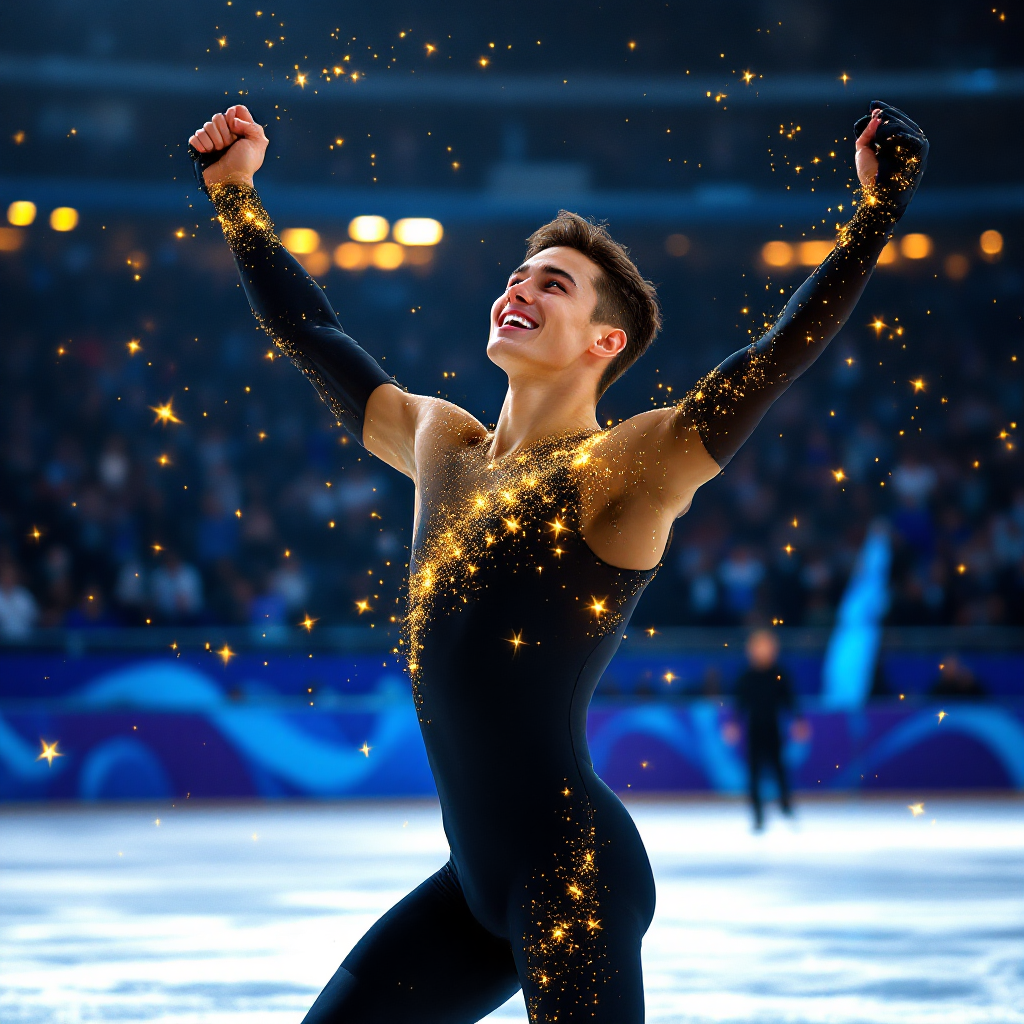
What if 22-year-old Mikhail Shaidorov clinched the gold medal in Olympic figure skating, becoming Kazakhstan’s very first Olympic champion? Wouldn’t you be curious about the story behind this remarkable feat?
This victory turned the word “possibility” into reality. The men’s singles event is usually dominated by established champions, but Shaidorov soared to the top with an astounding free skate score of 198.64 and a total score of 291.58. Even more incredible is that, as the 20th skater to take the ice, he remained unshaken despite witnessing the intense pressure and high scores set by those before him.
On a stage where most eyes were fixed on the frontrunners, Shaidorov chose mastery over risky moves. His technical score of 114.68 and program components score of 83.96 were far more than just numbers—they proved the maturity and focus essential for the biggest stages. While the favorites faltered under pressure, he pushed his program to the finish with his own unique rhythm, completing a stunning upset narrative.
Another key point not to miss is his origin. Born in Almaty and starting skating in 2010, Shaidorov continues to train and grow in his hometown. The countless hours he invested far from the world’s spotlight explosively paid off on the grandest Olympic stage. This victory is more than just a personal gold medal—it’s a declaration that Kazakhstani sports are stepping into an exciting new chapter.
The Secret Behind the Young Skater Shining Among the Elite: Why Mikhail Shaidorov Remained Unshaken
When the top skaters, boasting their finest skills, kept falling on the quad axel, how did Shaidorov maintain unwavering confidence to score the highest marks? The answer wasn’t “a harder jump,” but a faultless game plan that never wavered. Figure skating is a sport where a single mistake can quickly cascade into disaster, yet Mikhail Shaidorov successfully blocked that all-too-common domino effect of faltering until the very end.
There are two key factors. First, mental strength turning the pressure of the starting order into an advantage. Being the 20th skater on the ice means dealing with the noise of previous skaters’ scores, mistakes, and audience expectations. As this noise grows louder, many skaters rush their jump timing or exert unnecessary force, losing their rhythm. In contrast, Shaidorov didn’t hurry the flow; he pushed his program forward like a story, locking into his own pace without faltering.
Second, skating with a clear scoring strategy. In the Olympic free skate, Shaidorov pulled up his total score with a technical element score of 114.68 and a program component score of 83.96. These numbers reflect not only his successful jumps but also the seamless transitions, the quality of his skating, and the convincing composition all working in harmony. While his competitors lost balance on spectacular moves like the quad axel, he minimized errors and perfected his top score through a method of not losing points.
Ultimately, the true secret behind this upset wasn’t “boldness,” but calmness. On a grand stage, what determines the outcome isn’t just the technical ceiling, but the rhythm and confidence to recover even after stumbling—and the ability to hold onto that confidence until the very end.
mikhail shaidorov: A Growth Story That Began on a Small Rink in Almaty
What efforts lie behind the journey of a young skater who started on a small ice rink in Almaty and rose to the pinnacle of the world stage? The story of mikhail shaidorov cannot be explained by the word “talent” alone. In the relatively late year of 2010, he first laced up his skates, and his career began with countless hours circling the same rink, building fundamental skills.
The Altynalmas club he represents, along with the training environment in Almaty, may differ from the infrastructure enjoyed by the world’s top athletes. Yet, Shaidorov compensated for the limited environment with the ‘density of repetition.’ What’s required to increase jump success isn’t one perfect attempt but a routine of hundreds of precise approaches and failures recorded.
This growth process was clearly reflected on the Olympic stage. While competitors faltered under pressure, he maintained the flow with a confident performance, scoring 198.64 points in the free skate and a total of 291.58 points. It was proof of time accumulated not only in technique but in the breathing and focus needed to carry a program through to the end. Ultimately, Shaidorov’s victory may seem like a “sudden upset,” but in reality, it was an almost inevitable outcome crafted by steady training and mental management in Almaty.
Medal Rankings That Shine Amid Fierce Competition and Their Significance: How Mikhail Shaidorov Changed the Game
The moment an unexpected name topped the gold medal podium, the medal list ceased to be just a simple scoreboard—it became a signal forecasting the “next wave in figure skating.” So, amidst Mikhail Shaidorov’s stunning upset, how did Japanese and American skaters perform, and what might these results change going forward?
Japan: Stable Presence Built by a Deep Roster
At this competition, Japan claimed two spots on the podium with silver medalist Yuma Kagiyama (280.06 points) and bronze medalist Shun Sato (274.90 points), reaffirming their strength not in a single star but in collective competitiveness.
Especially in a scenario where the gold medal was overturned by an unpredictable variable, the fact that Japanese skaters held strong among the top ranks shows that their strategy focusing on reducing errors on the big stage through polished performance remains formidable. In other words, the brand image sharpened—not as “the team rising when the top contender falters,” but as “the team that seldom wavers at all.”
USA: The Challenge of ‘Risk Management’ Between Expectation and Reality
Ahead of the event, expectations for the USA were high, but the results were mixed. Andrew Torgashev finished relatively steadily in 12th place (259.06 points), while Maxim Naumov landed in 20th place (223.36 points).
Most notably, Ilia Malinin, who drew much attention, faltered on high-difficulty jumps (including the quad axel), slipping out of medal contention. This moment underscored a stark reality: technical upgrades don’t automatically translate into victory. Moving forward, the key for the US will likely be how well they balance audacious technical attempts with clean execution free of mistakes—a delicate equilibrium that may dictate their success.
The Message Behind the Medal Rankings: “A New Winning Formula for the Era of High Difficulty”
What makes this medal distribution special is that it signals not just a one-time upset, but a shift in the formula for victory. Mikhail Shaidorov built a high score in the free skate, proving that mental resilience and program stability can triumph over sheer technical difficulty.
This suggests that men’s singles figure skating is likely to move beyond simply “who conquers the hardest jumps first” to factors that could ultimately determine the finish line, such as:
- Risk design that minimizes the cost of failure (daring attempts balanced by program layouts that reduce the chance of collapse)
- The resurgence of program components (PCS) competitiveness (with greater emphasis on polish and artistic expression)
- Systematic mental training to withstand late-round pressure (lessons learned from top contenders’ “pressure breakdowns”)
In the end, the current medal tally shifts the spotlight in figure skating from “who holds the most massive technical arsenal” to “who remains most unshaken on the biggest stage.”
Unpredictable Yet More Moving Moments in the Olympics: The Lasting Impression Left by Mikhail Shaidorov
When the victory of a single athlete goes beyond mere records, prompting us to ponder the true emotions and lessons that sports offer, will you also immerse yourself in that lingering feeling?
The Olympics are special because the formula "the strongest always wins" is often broken. At the very moment when everyone’s expected scenario collapses, we encounter emotions that outlive records. Mikhail Shaidorov’s victory in the men’s figure skating event vividly proved this truth.
Throughout the competition, rankings were not fixed numbers but a ‘living flow,’ constantly shifting under pressure and focus. While a strong favorite faltered on a jump, Shaidorov maintained his routine to the end, demonstrating the powerful outcome created by the balance of technique, artistry, and mental strength. Especially noteworthy was his steadiness in a late performance slot, carrying greater pressure—highlighting that figure skating is far more than just the sum of jump success rates.
What makes this upset so moving isn’t that it’s a “miracle,” but that the preparation and maturity behind what seemed like a miracle became visible. The Olympics often ask us:
- Can you maintain your rhythm when everything’s shaking?
- Can you win by your own completeness, not by others’ failures?
- Can you execute the simplest fundamentals flawlessly on the biggest stage?
In the end, the real highlight of the Olympics isn’t the color of the medal but the single choice and single act of perseverance that created it. That’s why our hearts remain heavy long after the event. A moment so unpredictable makes it more touching—and so singular makes it clearer. The resonance left by Mikhail Shaidorov’s victory is found exactly at that point.
Comments
Post a Comment