 \n
\n
AI Agents Becoming the Protagonists of the Future: How Autonomous AI Will Transform 2026
Beyond AI that simply answers questions, AI agents that set and execute goals independently have emerged at the heart of innovation in 2026. The crucial shift is no longer about “what gets generated” but “who carries the work through to completion.” How exactly are these agents reshaping our lives and ways of working?
What Are AI Agents? The Shift from Reactive AI to Executive AI
Traditional generative AI excelled at responding to user prompts by creating text, images, or code. In contrast, AI agents receive a goal, then autonomously break down the necessary tasks (planning), choose tools to execute them, evaluate the outcomes, and decide on subsequent steps.
In other words, the paradigm is shifting from “AI that excels at answering” to “AI that performs work.”
The technical core enabling this is foundational models (LLMs) like GPT or Claude. LLMs handle natural language understanding and reasoning, while agents combine this with tool-use capabilities (e.g., search, database queries, calendars/email, internal system APIs) and state management (memory, history, current context) to act effectively in real-world environments.
Core Strengths of AI Agents: Autonomy, Rationality, and Proactivity Drive Execution Power
AI agents are hailed as “the stars of the future” because they combine these key qualities:
- Autonomy: They select their next actions independently, without continuous human intervention. For example, in accounting, they can automatically find missing invoices and carry through subsequent verification steps.
- Rationality: They integrate not only user inputs but also diverse data (sensors, logs, domain knowledge) to make decisions—much like how self-driving cars fuse sensor data to avoid hazards.
- Proactivity: Rather than merely reacting to issues, they anticipate future states and act beforehand. A typical case is detecting signs of customer dissatisfaction and proactively suggesting that agents reach out.
- Continuous Learning: Their performance cumulatively improves through past interactions and feedback, becoming ever more “field-ready” with repetitive tasks.
- Adaptability: They instantly adjust strategies when circumstances change. Just like trading bots modify tactics during market upheavals, responding flexibly to environmental shifts is vital.
These five elements boil down to one sentence: AI agents are systems designed not for ‘generation’ but for ‘completion.’
How AI Agents Are Already Transforming the Field: From Logistics to Accounting to Marketing
The impact of AI agents isn’t some distant future—it’s happening right now across industries in forms such as:
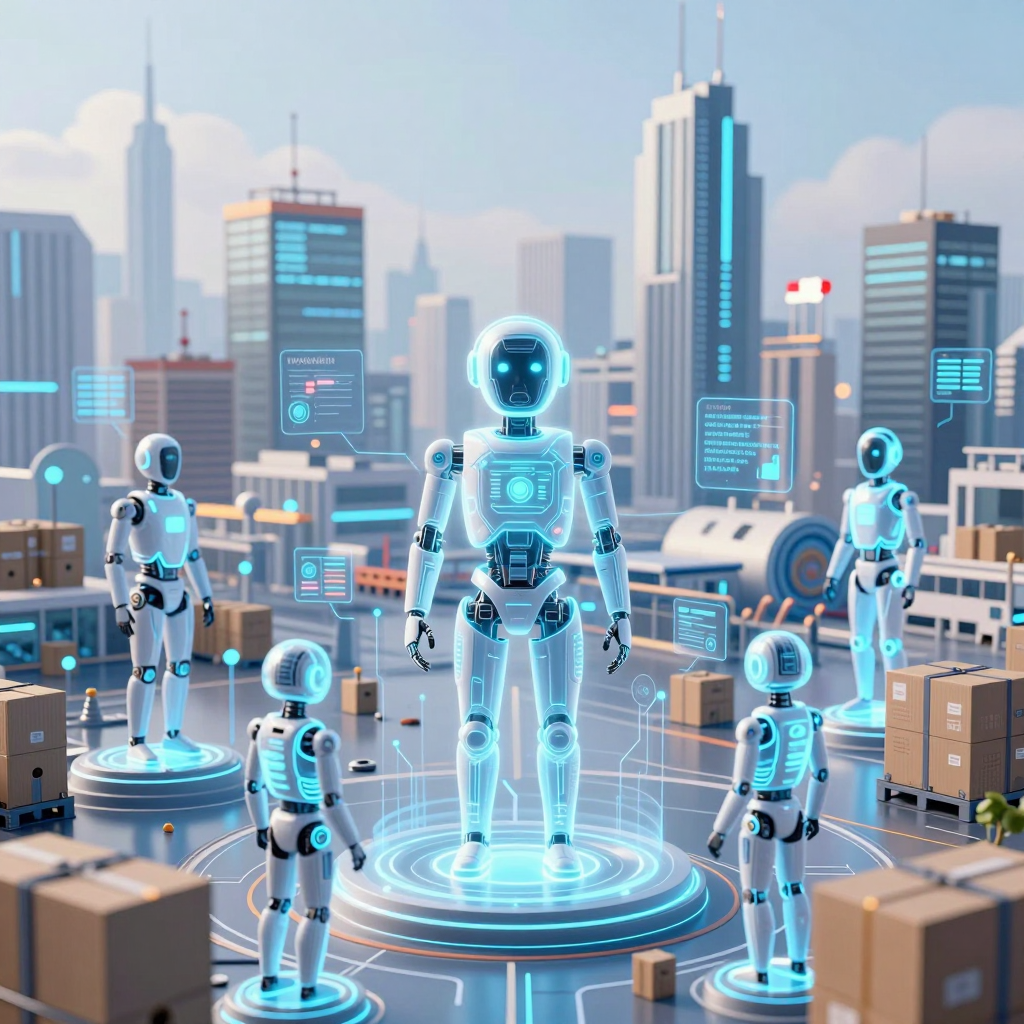
- Logistics: Autonomous warehouse robots predict traffic and congestion, proactively repositioning themselves to boost operational efficiency.
- Accounting: Missing invoice data is automatically identified during purchasing processes, cutting risks and shortening closing tasks.
- Marketing: Demand analysis by market segment guides adjustments of advertising goals and creatives, optimizing budget allocation based on performance.
- Predictive Maintenance: Learning from equipment failure histories, agents detect anomalies early and link up follow-up actions like inspection scheduling and parts ordering.
The heart of this transformation is that AI goes beyond “offering advice” to actually embedding itself into workflows—handling execution stages. Humans increasingly move from “doers” to “supervisors” who set goals, verify outcomes, and give approvals.
Why AI Agents Are Gaining Attention: What If They Think and Act Like Humans? (AI)
The era when AI merely "responded" to commands is over. Now, AI agents that independently perceive their environment, break down goals, and execute optimal actions are taking center stage. Although still called "AI," their roles have completely transformed. Moving beyond simple generation (text or images), they have become entities that redefine the entire workflow of tasks and decision-making, which is why they are attracting significant attention.
The Difference Between Reactive AI and Autonomous AI Agents (AI)
Reactive AI fundamentally operates on a prompt-response model. It only acts when a user asks a question, and the outcomes usually come in the form of “content.” In contrast, AI agents follow a cyclical structure:
- Understanding the Goal: Interpreting “What needs to be achieved?”
- Planning: Breaking down the goal into tasks and prioritizing them
- Utilizing Tools: Executing by connecting with search, databases, APIs, internal systems, and more
- Tracking Progress: Monitoring intermediate results and adjusting next steps
- Verifying Completion: Evaluating goal fulfillment and performing reporting or follow-up actions
In other words, AI agents focus not on “answering,” but on getting the job done.
The Technical Reasons Why AI Agents Appear ‘Human-like’ (AI)
The autonomy of AI agents isn’t magic—it’s the result of combining various technical components:
- Perception: They perceive not only user inputs but also signals from logs, sensors, business data, and more to understand the situation.
- Reasoning & Planning: Based on large language models (LLMs), they break down tasks and design executable pathways.
- Acting: Instead of merely generating responses, they take real-world actions in systems (e.g., issuing tickets, adjusting inventory, rescheduling).
- Feedback Loop: If outcomes differ from expectations, they adapt strategies and retry.
- Continuous Learning: They learn patterns from repetitive tasks to make progressively better decisions with less human intervention.
With this framework, AI evolves from being a “generator” into a task performer.
The Change AI Agents Will Bring: Not Just ‘Automation’ but ‘Redesigning Operations’ (AI)
The shock AI agents bring is not about simply reducing workforce through automation, but about transforming how organizations conduct their work.
- Proactive Handling of Tasks: Instead of reacting after problems arise, agents detect signs and act first (e.g., proactively caring for customers likely to complain).
- Real-time Decision Making: Rather than waiting for reports, agents read data and immediately suggest and execute actionable options.
- Blurring Department Boundaries: Agents seamlessly unify segmented flows like marketing-sales-customer support, handling goals end-to-end.
- Redefining Human Roles: Humans shift from repetitive task executors to higher-level roles such as goal setting, verification, and risk management.
Ultimately, AI agents aren’t “faster tools” but executional AI that mirrors human working styles, rewriting standards across industries.
The Five Core Characteristics of AI Agents – From Autonomy to Adaptability
Armed with ‘autonomy,’ ‘rationality,’ and ‘proactivity,’ AI agents aren’t just “AIs that answer questions.” When given a goal, they plan and execute on their own, and based on outcomes, they evolve more precisely over time and experience. Let’s highlight how these five key traits actually work in practice.
AI Autonomy: The Execution Engine Turning Goals into Actions
Autonomy is the ability to decide and carry out the next actions independently without constant human guidance. Technically, it typically unfolds as follows:
- Goal interpretation: Break down a natural language goal into smaller tasks (e.g., “finish month-end closing” → data collection → missing item verification → report generation).
- Planning: Determine the sequence of tasks and select necessary tools (APIs, databases, document systems, etc.).
- Execution and status update: Log results and re-calculate remaining tasks.
For example, in accounting, an AI agent can automatically flag invoice entries likely to be missing by comparing input data against purchase records, and even trigger requests for additional documents. The key here isn’t just “notifying,” but pushing the work forward proactively.
AI Rationality: Making Decisions by Weighing Information and Constraints
Rationality means combining diverse inputs (user demands, sensor data, regulations, cost/time limits) to choose the most reasonable option. Unlike rule-based automation, AI agents simultaneously consider:
- Handling uncertainty: Identifying points needing verification when data is incomplete or conflicting.
- Applying domain knowledge: Integrating real-world rules like policies, regulations, and business practices into decision-making.
- Evaluating trade-offs: Balancing competing factors such as cost vs speed or accuracy vs throughput.
Just as autonomous vehicles synthesize sensor info to avoid obstacles, AI agents in business integrate CRM logs, customer inquiries, and policy documents to calculate “which actions best reduce risk right now.”
AI Proactivity: Shifting from Reaction to Preemptive Action
Proactivity means not waiting for inputs but predicting future states and acting first. This is typically boosted by two elements:
- Predictive models and signal detection: Early spotting of patterns like likely complaints, glitches, or demand shifts.
- Executing preventive measures: Beyond warnings, actually performing next steps (priority changes, resource allocation, proactive outreach).
For instance, an AI-based customer service agent analyzes signals such as repeated clicks, cart abandonment, or complaint keywords to reach out before an issue escalates or automatically provide solutions.
AI Continuous Learning: Why Accuracy Improves with Experience
Continuous learning lets agents accumulate interaction results and feedback to refine future decision-making. Technically, this involves:
- Feedback loops: Using success/failure, user corrections, and performance metrics (processing time, error rate) as learning signals.
- Memory/log-based improvement: Reusing similar cases or adjusting rules, prompts, and tools for frequently failing steps.
- Policy updates: Gradually optimizing selection criteria on “what to prioritize and what to avoid.”
In other words, even performing the same goal over time means fewer mistakes and more efficient task sequences. At this stage, AI agents become not one-off automation but systems that enhance operational capability itself.
AI Adaptability: Instantly Shifting Strategies in New Situations
Adaptability is the ability to switch strategies immediately when environments change (data format shifts, market shocks, process reorganizations) without clinging to original plans. This hinges on:
- Situational awareness: Detecting changes like input format updates, tool failures, or policy conflicts.
- Exploring alternative paths: Using different data sources, detour processes, or escalating to humans.
- Re-planning: Maintaining goals but recalculating and executing new routes.
Just as a stock trading bot shifts strategy amid market crashes or a game AI discovers new tactics, AI agents in real work act not as “fixed scripts” but as robust operational logic that sustains performance amid change.
When these five features combine, AI agents evolve beyond simple responders into goal-oriented systems. Ultimately, the competitive edge lies not just in model performance but in how autonomously AI agents judge, execute, learn, and adapt.
Intelligence Built by AI Foundation Models: Beyond GPT and Claude
Large Language Models (LLMs) are the brains of AI agents. They go beyond simply stitching sentences together "plausibly"—they understand complex instructions, plan steps, and call upon necessary tools to achieve goals. So, how do foundation models like GPT or Claude become the basis for reasoning and execution? Let’s break down the core technologies structurally.
The Essence of AI Foundation Models: How “Next Token Prediction” Becomes Intelligence
The training objective of LLMs is fundamentally probability modeling of the next token (word piece). While it may appear simple on the surface, repeatedly tackling this task over internet-scale text (including code, tables, manuals, etc.) implicitly endows the model with the following capabilities:
- Statistical patterns of language: sentence structure, contextual coherence, expression habits
- Compressed representations of world knowledge: relationships between concepts (cause-effect, procedure-outcome, constraints)
- Problem-solving templates: code generation, step-by-step procedures, checklists, decision-making frameworks
In other words, “next token prediction” is not just sentence generation but a process of compressing traces of human reasoning (explanations, debates, proofs, debugging processes) embedded in massive data into the model’s internals. This foundation enables AI agents to infer “what to do first, what to check, and where failures might occur” when given a goal.
Key Technology Enabling AI Agent Reasoning: Transformer and Attention
The core architecture of foundation models is the Transformer, centered on the Attention mechanism.
- Attention dynamically selects “clues important for the current prediction” from the input text (or conversation history).
- Thanks to this, the model can pull requirements, constraints, and exceptions from long contexts and produce coherent answers.
- From an agent perspective, attention functions like working memory, constantly recombining “what is important at this step.”
However, LLMs alone are not complete logical engines. Therefore, real AI agent designs append external structures like Planning + Tool Use + Verification to “systematically stabilize reasoning.”
Why AI Understands “Complex Commands”: Instruction Tuning and RLHF/RLAIF
Early LLMs generated fluent text but struggled to follow the user’s intent as explicit instructions. This limitation was overcome by the following developments:
Instruction Tuning
Trained on diverse instruction-response data, it strengthens the ability to interpret questions, commands, and conditions as actionable tasks.RLHF (Reinforcement Learning with Human Feedback) / RLAIF (with AI Feedback)
Refines policies to prefer “helpful answers,” “safe answers,” and “consistent answers.”
As a result, the model more often chooses outputs aligned with user goals rather than merely plausible sentences.
This process is critical for AI agents. Because agents perform multi-step actions rather than single-shot replies, weak compliance, safety, or consistency leads to compounded errors.
Extending “Beyond” AI Foundation Models: Tools, Memory, and Retrieval (RAG)
Even though GPT and Claude are powerful, LLMs alone cannot solve everything. In practice, agents boost performance by combining foundation models with the following:
- Tool Use / Function Calling: Invoking calendars, ERPs, databases, crawlers, calculators, code runners to perform “actions” rather than just “words.”
- Retrieval-Augmented Generation (RAG): Searching internal documents, policies, and up-to-date information to reinforce evidence and reduce hallucinations.
- Memory: Storing user preferences, work contexts, and long-term goals to evolve from “conversational” to “relational” AI.
- Guardrails and Verification Loops: Proactively blocking constraint violations, data leaks, and abnormal behaviors.
In summary, the important question beyond “GPT vs Claude” is which foundation model is integrated into what kind of system to form a true agent. The model is the brain, but search, tools, memory, and verification form the nervous system and muscles.
The Takeaway for the AI Agent Era: Foundation Models as the ‘Core of Intelligence,’ Systems as ‘Complete Intelligence’
Foundation models serve as the core of language understanding and reasoning, the starting point where AI agents read goals and make plans. Yet, the real power driving autonomous revolutions lies in the combination of model capabilities + system design (tools/retrieval/memory/verification). Going forward, competition will shift from “bigger models” to who can standardize better-working AI agent architectures faster.
AI Agents Revolutionizing Industry: From Logistics to Marketing
AI agents, already embedded in many aspects of daily life, have evolved beyond “AI that answers questions” to become autonomous operators that plan and execute to achieve goals. Just as autonomous warehouse robots proactively rearrange logistics flow and predict equipment failures to schedule repairs before breakdowns occur, the future is no longer a preview—it’s a real-time evolving update.
AI-Driven Logistics: Autonomous Warehouse Robots Transform Operations through ‘Prediction’
Logistics is fraught with variables (surge in orders, traffic congestion, worker movements), and delayed decisions instantly increase costs. Here, AI agents do more than simple optimization—they interact with the environment to autonomously adjust operations.
- Pre-positioning inventory and robots based on demand and traffic forecasts: Learning from past shipping patterns and external signals (time of day, events, weather, etc.), AI moves robots and goods before bottlenecks arise.
- Automatically recalculating task priorities: Continuously updating “what to handle first” by simultaneously considering urgent orders, delivery SLAs, and picking congestion.
- On-site feedback loops: When delays or errors (like mispicks) occur, AI infers causes and improves performance by altering routes or revising inventory location strategies.
The crux is not “automation” but autonomous operations. Without operators having to redefine rules each time, AI agents choose next actions based on objectives such as lead time reduction or cost savings.
AI-Based Accounting and Back Office: Beyond ‘Finding’ Missing Invoices to ‘Preventing’ Them
Accounting and back-office tasks involve massive data and frequent exceptions, making human errors inevitable. AI agents understand transaction flows and navigate documents and systems to perform workflows that detect discrepancies and drive them to resolution.
- Automatically identifying and flagging missing invoices: By learning the linkage between ordering, receiving, and billing, AI detects signals indicating “a document that should exist is missing.”
- Automating evidence collection and verification requests: AI requests necessary information from staff or suppliers, then classifies and summarizes replies, passing them on for the next steps (approval, hold, re-request).
- Risk-based review recommendations: Combining context like amounts, client history, and payment terms to prioritize which cases need attention first.
Unlike rule-based RPA, AI agents reason over natural language documents and exception cases, significantly expanding their scope.
AI-Powered Marketing: From Segment Analysis to Campaign ‘Self-Optimization’
Marketing success hinges on rapid experimentation and instant adjustment. AI agents analyze market segment responses to operate the entire loop of campaign design, execution, measurement, and improvement.
- Demand analysis by segment → message/offer recommendation: Integrating customer behavior data and domain knowledge, AI infers which value propositions fit each customer group.
- Automatic budget and channel allocation: Reallocating budgets to high-performing channels while hypothesizing causes and suggesting tests when performance drops.
- Learning-based creative enhancement: Experimenting with copy and image variations, then learning from the results to refine creative assets for subsequent rounds.
AI thus becomes not just a “tool to prettify dashboards,” but an operator that autonomously drives toward performance goals.
AI-Enabled Predictive Maintenance: From Reactive to ‘Pre-Emptive’ Operations
Downtime in manufacturing and equipment means loss. In predictive maintenance, AI agents integrate signals from sensors, logs, and maintenance history to calculate failure probabilities ahead of time and connect them to execution plans.
- Early detection of anomalies: Capturing deviations from normal patterns based on continuous data such as vibration, temperature, and current.
- Root cause estimation and action recommendations: Offering more than alarms by suggesting which part is likely degrading and what inspection is effective.
- Automatic maintenance scheduling: Considering production plans, spare parts inventory, and technician availability to compute optimal maintenance timing, minimizing downtime.
Technically, combining foundation model (LLM) inference capabilities with time-series analysis and on-site system integration expands the scope from ‘detection’ to ‘decision-making + execution’.
Commonalities in Operational Changes Driven by AI Agents
Despite industry differences, the nature of change is similar.
- From reactive to proactive processes: Shifting from handling issues after they arise to preparing before they occur.
- From partial automation to end-to-end autonomy: Optimizing not just single tasks but the full cycle of goal-setting, planning, execution, and feedback.
- Reducing human decision time: Allowing practitioners to focus on high-value activities like exception handling, strategy, and quality verification instead of routine checks.
Ultimately, AI agents are not just tools for specific departments but catalysts redesigning operations across entire organizations. The transformations starting on the front lines today will soon become standard.
Comments
Post a Comment