 \n
\n
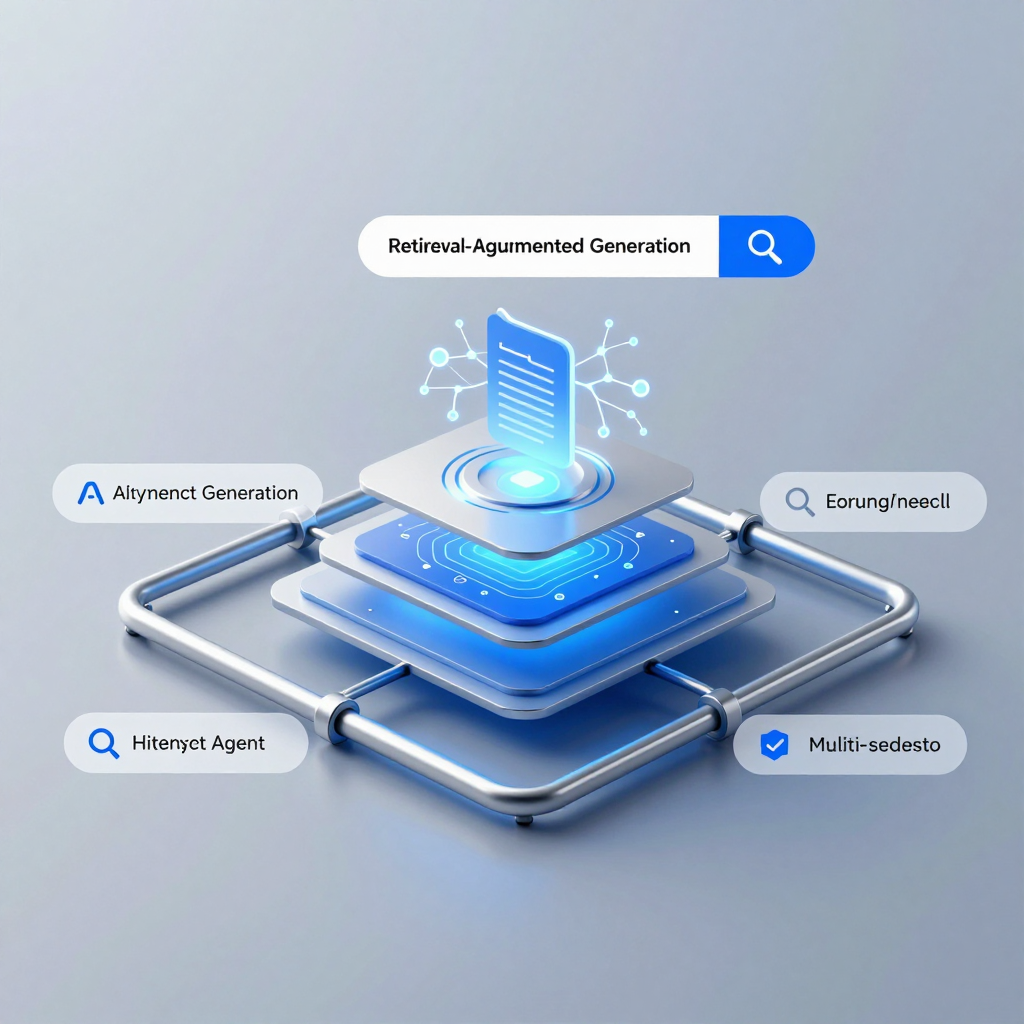
RAG: Opening New Eyes for AI – Redefining the Standard of Answers with RAG
What is the secret weapon that enables AI to answer not merely by generating text but by searching the latest information and expert knowledge in real time? The key lies in RAG, which refuses to let the model speak solely from its “memory (training data)” and instead makes it fetch and use necessary knowledge as evidence whenever needed.
Why RAG Is Essential: Overcoming LLM Limitations with Search
Large Language Models (LLMs) boast outstanding ability to generate sentences but suffer from inherent structural limitations:
- They don’t know the latest information beyond their training cutoff.
- They lack access to private or internal knowledge like company policies and project documents.
- They risk hallucination, confidently generating plausible but false statements.
RAG confronts these issues head-on. When a question arrives, it searches external documents (internal wikis, manuals, announcements, papers, etc.) to extract relevant evidence, feeding it alongside the query into the LLM, which then generates an informed answer grounded in this evidence. In other words, RAG gives AI a ‘new pair of eyes’ — the ability to look up knowledge in real time.
Core Structure of the RAG Pipeline: Multilayered Search → Refinement → Generation
Modern RAG goes beyond simply “gluing a few search results for the answer” and has evolved into a multi-stage pipeline designed to boost accuracy:
1) Hybrid Search (Vector + Keyword)
- Vector search excels at finding semantically similar documents (matching ‘intent’ even if phrasing differs).
- Keyword (BM25) search shines with information requiring exact matches like product names, regulation codes, and proper nouns.
- These two results are combined using methods like RRF (Reciprocal Rank Fusion) or weighted summation, reducing bias from either method and increasing recall.
2) Reranking
- A rerank model reevaluates the initially retrieved candidates (dozens of documents) to reorder them by their relevance to the question.
- This step reduces the problem of “documents found but missing the key points” surfacing on top, significantly contributing to hallucination reduction and improved reliability.
3) Evidence-based Generation (Answer with Evidence)
- The final top documents are provided as context so the LLM can generate answers firmly grounded in evidence.
- From an operational standpoint, this allows recording which documents were used as evidence for the answer, aiding verification and audits.
How RAG Transforms User Experience: From ‘Plausible Answers’ to ‘Verifiable Answers’
AI empowered by RAG exhibits a fundamentally different answering style:
- It increasingly delivers specific responses citing internal documents and the latest materials, rather than vague generalities,
- And it reveals when it lacks evidence, prompting further search or confirmation.
Ultimately, RAG is the pivotal technology that evolves generative AI from “a smooth talker” into “a practical system that finds and cites sources as the basis for its answers.”
From Basic Concepts to Evolution of RAG: The Birth and Development of RAG Technology
Large Language Models (LLMs) “seem smart” but inherently carry structural limitations that are hard to overcome. They cannot know information beyond their training cutoff, they lack access to private knowledge like internal company documents or policies, and without ways to verify sources, they sometimes generate plausible-sounding but incorrect answers (hallucinations). The solution that emerged is RAG. By preserving the language generation ability of LLMs and only injecting precise external knowledge when needed, RAG directly addresses these weaknesses.
Three Fundamental Limits of LLMs and How RAG Tackles Them
- Limitations of Currency: The model doesn’t know events after its training data cutoff.
→ RAG retrieves documents, news, or database info as of the query time to provide up-to-date context. - Disconnected Internal/Domain Knowledge: Internal rules, technical docs, customer data, etc., rarely make it into training.
→ RAG indexes internal documents to fetch “organization-specific knowledge” on demand. - Unverifiable Generation: The model “generates” answers but cannot guarantee factual accuracy by itself.
→ RAG supplies supporting source documents alongside answers and encourages generation centered on these evidences, boosting trustworthiness.
The Core Idea of RAG: “Fix Facts by Searching Before Generating”
RAG (Retrieval-Augmented Generation) simply follows this flow:
- Understanding the Question & Formulating Queries: Transforms user questions into search-friendly forms.
- Retrieving External Knowledge: Finds relevant documents via semantic vector search or keyword-based search (like BM25).
- Constructing Context: Summarizes, organizes, or extracts key parts of the documents to append to LLM input.
- Evidence-Based Generation: LLM generates the answer grounded on the attached documents.
The fundamental advantage here is that instead of LLM “guessing” from memory, it anchors answers on external knowledge brought in through retrieval. The model’s skill focuses on linguistic expression and reasoning, while facts and data come from search.
From Simple to Sophisticated RAG: Why the Pipeline Became ‘Multi-layered’
Early-stage RAG was roughly “search once → attach a few documents → generate answers.” But real-world applications involve many documents (introducing noise), complex questions (harder intent understanding), and even small errors can erode trust. Thus, RAG evolved into a refined multi-stage pipeline.
- Emergence of Hybrid Search:
Vector search excels in semantic similarity but may struggle with product codes, proper nouns, or exact phrase matches. Conversely, BM25 excels at precise matching. Modern RAG integrates both methods, blending semantic and exact-matching strengths. - Introduction of Reranking Stages:
More candidate documents from initial retrieval mean more noise. Reranking models reassess question-document relevance with precision, filtering top documents to enhance answer quality and evidence accuracy. - Design Focused on Reducing Hallucinations:
The better the search quality (what’s retrieved) and context quality (how it’s attached), the less room the model has to “guess,” structurally minimizing hallucinations.
The Shift RAG Brings: Competitive Edge Lies in “Knowledge Injection Quality,” Not Just “Model Performance”
RAG’s arrival reshaped the focus of generative AI. The game-changer is no longer just building bigger models but mastering engineering that accurately finds the right documents (retrieval) and correctly refines and integrates them (context construction). Because of this, RAG quickly became the standard architecture in precision-critical fields like internal document Q&A, tech support, policy/regulation consulting, and public administration innovation.
RAG Hybrid Search and Reranking: The Emergence of an Innovative Multi-Stage Pipeline
Vector search excels at finding “meaning,” while keyword search excels at finding “exact matching clues.” The problem begins the moment you rely on just one of these. Trusting only semantic similarity can lead to misses in queries requiring exact matches like product names, legal provisions, or error codes, whereas insisting solely on keywords can cause gaps where related documents are missed due to slight expression changes. The cutting-edge solution to fill this gap is precisely the multi-stage pipeline integrating RAG’s hybrid search + reranking. Let’s dissect why the intersection of vector and keyword search dramatically boosts AI answer reliability.
Hybrid Search: RAG’s Standard for Securing Both “Meaning” and “Accuracy”
Hybrid search typically combines two pillars:
- Vector-based Semantic Search (Dense Retrieval): Converts queries into embeddings and measures their distance to document embeddings.
- Strengths: Robust to synonyms, context, and expression changes
- Weaknesses: Can falter when “exact string matches” are critical, such as proper nouns, numbers, or versions
- Keyword-based Search (Sparse Retrieval like BM25): Locates documents through token matching and statistics-based scoring.
- Strengths: Strong in exact matches for regulation names, product codes, or person/organization names
- Weaknesses: Can miss relevant documents if expressions differ slightly
The practical challenge of RAG is that “good documents” rarely score high on both semantic closeness and exact keyword matches simultaneously. Hybrid search offsets each method’s weaknesses by expanding the candidate pool, laying the groundwork for the next step to enhance precision.
Result Merging (RRF/Weighted Summation): The Key to Reducing Bias and Boosting Recall
Hybrid search isn’t just “search twice and combine.” Because vector and BM25 score distributions differ, simple summation risks instability. Instead, safe ranking fusion usually involves:
- RRF (Reciprocal Rank Fusion): Combines based on rank positions from each search method, preventing domination by one score scale.
- Weighted Score Summation: Adjusts weighting according to domain needs—e.g., environments where keyword matching is paramount (regulations, law, parts) or where semantic search plays a bigger role (consultations, knowledge Q&A).
This merging step is not merely about increasing candidate numbers, but about designing the pipeline so that one search’s blind spots are complemented by the other, aligning toward “maximizing recall by finding as much as possible.”
Reranking: The Final Finely-Tuned Step That Transforms “Finding Many” into “Choosing Exactly”
Once hybrid search enlarges the candidate set, the next challenge is selecting the “documents truly needed for the answer.” This is where reranking models (Cross-Encoder types like Cohere Rerank, BGE-Reranker, etc.) enter.
Reranking typically works as follows:
- Collect the top N candidate documents from hybrid search (e.g., 20–100).
- The reranker directly reads question-document pairs together and scores their relevance.
- Candidates are reordered by relevance, and the top K are fed into the LLM context (e.g., 3–8).
While vector/BM25 excels at “finding,” they are ultimately approximations. Reranking more directly judges “does this document answer the question right now?” Adding this stage noticeably improves RAG outcomes by:
- Reducing hallucination triggers caused by irrelevant documents mixing into context
- Increasing verifiability as supporting evidence cited in answers is more accurate
- Ensuring consistent response quality by minimizing model confusion
Why Multi-Stage Pipelines Boost Reliability: Cutting LLM’s “Reasoning Cost” With Document Quality
In RAG, answer quality isn’t decided solely by “how smart the LLM is.” In reality, the quality and consistency of the supporting documents read by the LLM have a far greater impact.
- Hybrid search reduces misses by better “finding” necessary evidence
- Reranking cuts noise by more effectively “choosing” evidence
As a result, instead of filling gaps with uncertain reasoning, LLMs construct answers grounded in more accurate evidence. This is how the “magic of multi-layered architecture” works, and why the latest RAG evolves beyond simple search-and-generate into a multi-stage pipeline—the most practical advancement today.
RAG AutoRAG and Agent Systems: The Future of Automation and Self-Thinking AI
The saying “The RAG pipeline is ultimately experimental labor” reflects how performance fluctuates wildly depending on combinations of search methods (vector/keyword), document splitting strategies, the application of re-ranking, prompt templates, and more. Now, the game is changing with the emergence of AutoRAG, which automatically explores and evaluates over 960 combinations to find the optimal configuration, and an agent-based RAG that solves problems autonomously through a ‘think → act → observe’ loop. Let’s break down why this trend matters and what technical transformations are underway.
RAG AutoRAG: The Era Where Systems, Not Humans, Find the “Optimal Pipeline”
The core of AutoRAG lies not in crafting a single good RAG setup, but in automating the process of repeatedly experimenting to discover the best combinations tailored to specific data, domains, and goals.
- Handling combinatorial explosion: RAG is modular. Changing components like retrievers (vector, BM25, hybrid), re-rankers, context construction methods, generation prompts, and evaluation metrics causes the number of possible configurations to skyrocket. AutoRAG transforms these modules into a predefined experimental space and systematically compares hundreds to thousands of combinations.
- Reproducibility and operational readiness: Pipelines are defined via configuration files like YAML, preserving “who tuned what and how” in code and settings. Once the best setup is found, it can be immediately deployed as a FastAPI server, closing the gap between experimentation and production.
- Evaluation as a competitive edge: For automated optimization to be meaningful, evaluation must be precise. AutoRAG-style approaches consider not only ground-truth based QA or human assessments but also multi-purpose metrics including retrieval quality (coverage of answers), generation quality (faithfulness, exaggeration), and cost/latency. The evolution is toward finding a “RAG that is usable in real work” rather than a “precise but slow RAG.”
In essence, AutoRAG elevates RAG from an artisan’s tuning craft to a measurable engineering process.
RAG Agent Systems: Assembling Search and Generation Autonomously through ‘Think → Act → Observe’
Agent-based RAG is not just about “searching to answer.” Instead, it features a model that selects necessary actions (tool invocations), observes their outcomes, and decides the next move to achieve the goal. The prototypical framework is ReAct (Reasoning + Acting), and typically flows as:
- Think (Planning): Instead of answering immediately, the model assesses what is needed—definition checks, gathering supporting documents, calculation requirements.
- Act (Tool Execution): Executes tasks like searches (internal docs/DB), web lookups, Wikipedia queries, numerical calculations (WolframAlpha-style), image generation/analysis, or calls to custom APIs.
- Observe (Result Reflection): Uses tool outputs to verify the sufficiency or contradictions of information, adjusting by expanding search scope or rewriting queries if necessary.
What changes when this loop integrates with RAG?
- Dynamic query strategies: Rather than a single search round, the system can reassess and switch methods—for example, using keywords for product numbers, vectors for concept explanations—reshaping the search approach dynamically.
- Strengthened fact-based answers: If observation detects “insufficient or conflicting evidence,” additional searches are triggered, systematically guiding behavior toward hallucination reduction.
- Handling complex tasks: Beyond standalone QA, workflows like “find conditions in policy document A → query target customers in internal DB → generate a summary report per conditions” become feasible as entire business procedures are executed via RAG + tools.
The Next Phase of RAG: Growth Curve Created by Combining AutoRAG × Agents
An exciting point is how these two trajectories reinforce each other.
- AutoRAG automatically establishes “solid fundamentals.” Once the basic pipeline—hybrid search, re-ranking, document chunking, prompts—is optimized, agents can think based on higher-quality evidence.
- Agents perform “situational exception handling.” BM25 might be best for some questions, vectors for others, and some require extra tool calls. Agents dynamically decide at runtime, compensating for fixed pipeline limitations.
- From an operational perspective, a “continuous improvement loop” completes. As user query logs and failure cases accumulate, AutoRAG reruns experiments to update optimal settings while agents refine their action policies. Ultimately, RAG evolves from a one-off build to a self-improving product.
If AutoRAG is the “automatic tuner of RAG,” then agent-based RAG is the “problem solver that decides how to use RAG.” Their combination is poised to become the key path through which generative AI applications simultaneously elevate accuracy, reproducibility, and operational efficiency.
Innovation in Industrial Sites Driven by RAG and Its Future
As the adoption of generative AI accelerates across public sectors and enterprises alike, one question keeps arising on the ground: “Can we enhance accuracy while ensuring that sensitive data never leaks outside?” At this critical junction, RAG establishes itself not simply as a feature, but as an architecture that makes workplace innovation a reality. By securely connecting an organization’s unique knowledge—including internal documents, policies, guidelines, contracts, and historical data—RAG generates verifiable answers you can trust.
Why RAG-Based Innovation Is Strongest ‘On the Ground’ in Industrial Settings
The power of RAG in industrial environments is crystal clear. Using LLMs alone often misses the latest information, internal policies, and organization-specific terminology. RAG, however, searches for the necessary supporting documents and injects them into prompts, transforming responses into evidence-based answers. Recent advancements have significantly enhanced its suitability on site:
- Hybrid Search (Vector + BM25): Secures both semantic similarity and precise matches—like regulation numbers, product codes, or clause wording—in one go
- Reranking: Rearranges candidate documents to place the most relevant sources at the top, reducing hallucinations and boosting reliability
- Agent-Based RAG: Repeats the “think → act → observe” loop by searching, summarizing, and verifying, enabling stepwise handling of complex tasks
RAG in the Public Sector: Achieving Data Sovereignty and Work Standardization Simultaneously
Public organizations face intense pressure to manage data leak risks while satisfying demands for auditing and traceability. RAG excels here by generating answers grounded in internal document repositories—such as guidelines, legal interpretations, manuals, and case records—attaching source documents as evidence, which aligns perfectly with administrative workflows.
Technically, RAG runs document indexing and retrieval within closed networks or agency VPCs, carefully restricting the scope of referenced documents in answer generation. Combining hybrid search and reranking simultaneously ensures “accurate citation of clauses” and “discovery of analogous cases,” reliably raising the quality of repetitive tasks like inquiry responses, internal Q&A, and audit documentation.
RAG in the Corporate World: Beyond Cost Savings to ‘Actionable Knowledge’
In enterprises, the impact of RAG goes far beyond just “chatbots.” Its core lies in operationalizing knowledge. For example:
- Customer Support / Contact Centers: Searches product manuals, terms and conditions, outage notices, and past tickets to compose answers, prioritizing the latest, most accurate evidence through reranking
- Sales / Proposal Automation: Retrieves industry references, standard phrases, and pricing policies to draft proposals with references, drastically cutting review time
- R&D / Patent / Research Review: Uses semantic search to find related studies while supplementing with keyword searches to catch proper nouns and unique identifiers
- Security / Compliance: Connects internal policies and access permissions to deliver “answers only accompanied by evidence that can be shown,” controlling information exposure
A key design principle here is authorization-aware retrieval. By storing ACL metadata alongside indexed documents and filtering search results based on user permissions, it structurally blocks “knowledge the model may have but must not reveal.”
The Future of RAG: From ‘Accurate Search’ to ‘Self-Optimizing Work Systems’
Going forward, RAG will evolve beyond improving search quality to self-adjusting pipelines aligned with business goals.
- AutoRAG-Driven Optimization: Optimal configurations vary with data and objectives. Automated experimentation and evaluation of search methods, chunk strategies, rerankers, and prompt templates will become standard to maximize performance.
- Full Integration of Agents: Agents will move beyond one-off Q&A, calling tools (APIs, search, computation, document creation) to complete multi-step workflows. For instance, processes like “check regulations → find similar cases → draft answer → attach evidence links → apply final review checklist” will be fully automated.
- Standardized Evaluation and Observability: Measuring and improving which documents were selected, reranking scores, and failure patterns will offer a competitive edge.
Ultimately, the future unlocked by RAG is not about a “smarter model” but creating a system that safely connects organizational knowledge and supports execution grounded in evidence. Across both public and private sectors, RAG offers a practical solution that lowers data leak concerns while elevating work quality, with ever-broadening and deepening application potential.
Comments
Post a Comment