 \n
\n
A Historic Moment: The Opening of the 2026 Winter Paralympics
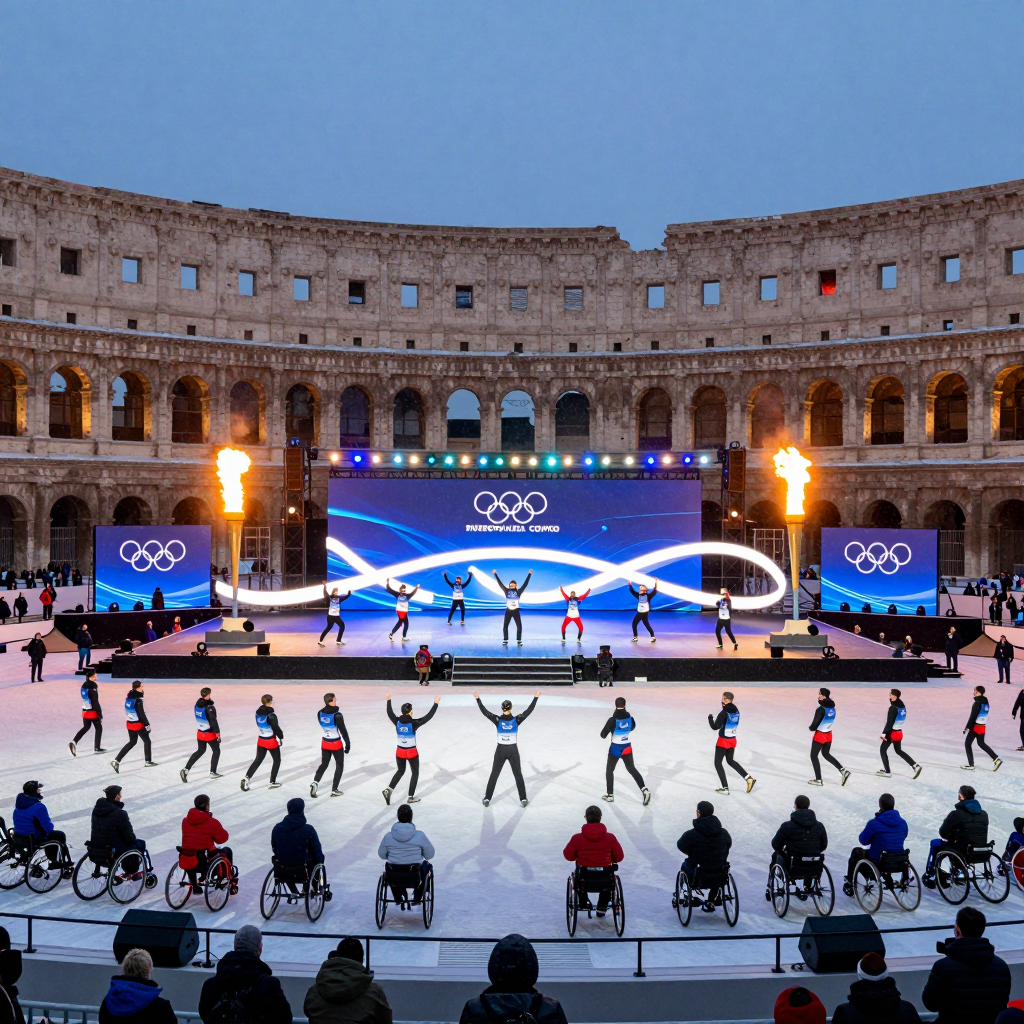
What makes this Winter Paralympics, held in Milan and Cortina, Italy, so historically significant? The answer lies in the convergence of the ‘stage,’ the ‘message,’ and the ‘symbol’ all in one scene. The 2026 Winter Paralympics Milano Cortina 2026 officially opened on March 6th at the historic Arena di Verona in Italy, with around 300 athletes kicking off the tournament’s grand beginning.
The opening ceremony went beyond a simple celebration, vividly expressing the identity of the Paralympics through culture and storytelling. A series of dance and music performances, along with a fresh reinterpretation of Romeo and Juliet, creatively expanded the themes of ‘challenge’ and ‘dignity.’ Highlights included a performance by the Italian music trio Meduza and an introduction to sports and venues by DJ Miky Bionic, known for raising disability awareness — these elements brought the festival to life as “a celebration for all.”
Most notably, the moments that will be etched into history were the speeches and the lighting of the flame. Organizing committee president Giovanni Malagò and IPC president Andrew Parsons emphasized the values of inclusion and opportunity. Parsons described Paralympians as those who redefine possibility and push the limits of human ability. The phrase “an opportunity to be respected and to succeed” demonstrated how sports transcend records to transform social standards.
Finally, the symbols were the most powerful. Inspired by Leonardo da Vinci, the dual cauldron was designed to be lit and extinguished simultaneously in both Milan and Cortina, visually embodying the meaning of co-hosting. This moment declared that the 10 days of competition across four venues are not merely a schedule of events but a shared narrative crafted by two cities and the entire world.
The Radiant Opening Ceremony of the 2026 Winter Paralympics: A Feast of Culture and Art
What kind of emotion did the stage, blending dance, music, and an interpretation of Romeo and Juliet, offer beyond a simple opening ceremony? The Arena di Verona, marking the start of the 2026 Winter Paralympics, seemed to answer this question by proclaiming, “Sports are not just about records, but stories.” Rather than heightening the tension of the competition in advance, the performances unfolding over this historic venue focused on connecting the journey of the athletes with the hearts of the audience.
Centered around dance and music performances, the opening ceremony created a depth beyond a mere ‘festival’ by incorporating a fresh reinterpretation of the familiar narrative, Romeo and Juliet. Notably, the Italian music trio Meduza captivated the venue instantly with the energy of their global collaborative tracks, while DJ Miky Bionic, known for raising disability awareness, smoothly guided the flow by introducing each sport and arena. Even the delivery of information became part of the performance, allowing the audience to receive not just an ‘explanation’ but an immersive ‘experience.’
The lingering impression left by the stage ultimately converges into one point. The message of inclusivity and respect was conveyed first through the language of performance, only then followed by the appearance of sports. Glamour was not the goal but a means, and art served not to merely adorn the athletes’ challenges but to shine a clearer light on their meaning. With an opening ceremony like this, the coming ten days naturally promise to be more than a medal contest—they will unfold as narratives expanding each individual’s potential.
A Message Embracing the Future of Disability Inclusion: The Hope and Challenges Unveiled by the 2026 Winter Paralympics
What did Giovanni Malago, the organizing committee chairman, and Andrew Parsons, IPC president, believe in that led them to shine the spotlight on “inclusion” rather than “records” during the opening ceremony? The message they delivered on the stage of the 2026 Winter Paralympics was more than a simple congratulatory speech; it clearly pointed to the next direction that disabled sports must take.
President Parsons introduced Paralympic athletes as “redefining possibilities,” emphasizing one key premise. The moment athletes prove their abilities is not merely the result of innate determination but becomes a reality only when respect and opportunities for success are provided. This implies a call not to settle for a narrative of “inspiration” alone, but for society to share the responsibility of changing the environment and standards that enable athletes to showcase their talent.
Chairman Malago’s message aligned with the same vision. The Paralympics should not be seen as a ‘special event’ but as a modern public asset that confirms everyone can grow through sports. In other words, inclusion must be more than a slogan—it should be a principle embedded in governance and culture.
Ultimately, the future outlined by these two leaders is clear. The Paralympics must transcend the limits of individual athletes and shatter the societal barriers imposed upon them. And the starting point of this change lies not in the crowd’s applause, but in making the ways athletes are respected—through opportunity, accessibility, and recognition—a part of everyday life.
The Enigmatic Dual Cauldrons That Ignite Inspiration: How the 2026 Winter Paralympics Connect Two Cities
How does the dual cauldron, inspired by Leonardo da Vinci, unite two cities and herald ten days of intense competition? More than just a symbol, this device announcing the opening of the 2026 Winter Paralympics vividly embodies Milan and Cortina “together” hosting the Games.
The most striking feature lies in the fact that the cauldrons installed in both host cities ignite and extinguish at exactly the same time. The flames in one city breathe in unison with those in the other, bridging the distance and varying terrains through perfect synchronization. As a result, spectators experience not a festival in one location, but a shared stage where two cities come alive together to open the curtain on this sporting spectacle.
The message conveyed by this dual cauldron is clear. At the moment when the same flame burns in different places, the Games transform geographic separation from a weakness into a strength. That flame then ignites the fierce competition across four venues over the next ten days, powerfully ushering in a new era of possibilities crafted by the athletes.
Beyond the Paralympics: The Beginning of Change We Share Together — What the 2026 Winter Paralympics Will Leave Behind
How will this Paralympics spark new shifts in perceptions of disability and inclusivity, and what impact will it have on our society moving forward? The opening ceremony of the 2026 Winter Paralympics offers a clear glimpse. The dance, music, and reinterpretation of Romeo and Juliet at the Arena di Verona conveyed the cultural message that “disability does not define a person.” This was a powerful moment where sport transcended the arena and challenged the audience’s perspectives and standards.
The most emblematic scene was the dual cauldron inspired by Leonardo da Vinci. Just as the flames lit and extinguished simultaneously in Milan and Cortina symbolized harmony between the two cities, inclusivity is not the result of goodwill from one place alone but a collective, simultaneous societal transformation. True change begins when accessibility in mobility, education, employment, and culture improves together—not just the efforts of a single city or institution.
IPC President Andrew Parsons’ call to “redefine possibility” ultimately poses a vital question for us all. Do we view disability as an individual limitation or as a challenge presented by the environment? The greatest power of the Paralympics is not just its emotional impact but its ability to update societal norms. Outside the stadium, what we need to do is simple:
- Reassess events and content through the lens of accessibility (captions, pathways, seating, signage)
- Embed respect as fellow citizens and athletes into our language habits—not treating disability as something ‘special’
- Move beyond one-time support toward sustained engagement through local sports, communities, and policy involvement
In the end, the 2026 Winter Paralympics is not a stage to showcase “who is more remarkable,” but a mirror asking, “What kind of society do we want to build?” Even after these ten days of competition conclude, the standards of inclusivity must continue to ignite our everyday lives.
Comments
Post a Comment