5 Key Innovations in Autonomous Driving Technology for 2026 and Analysis of the Global Competitive Landscape
 \n
\n
Autonomous Driving Tech: A New Turning Point in 2026
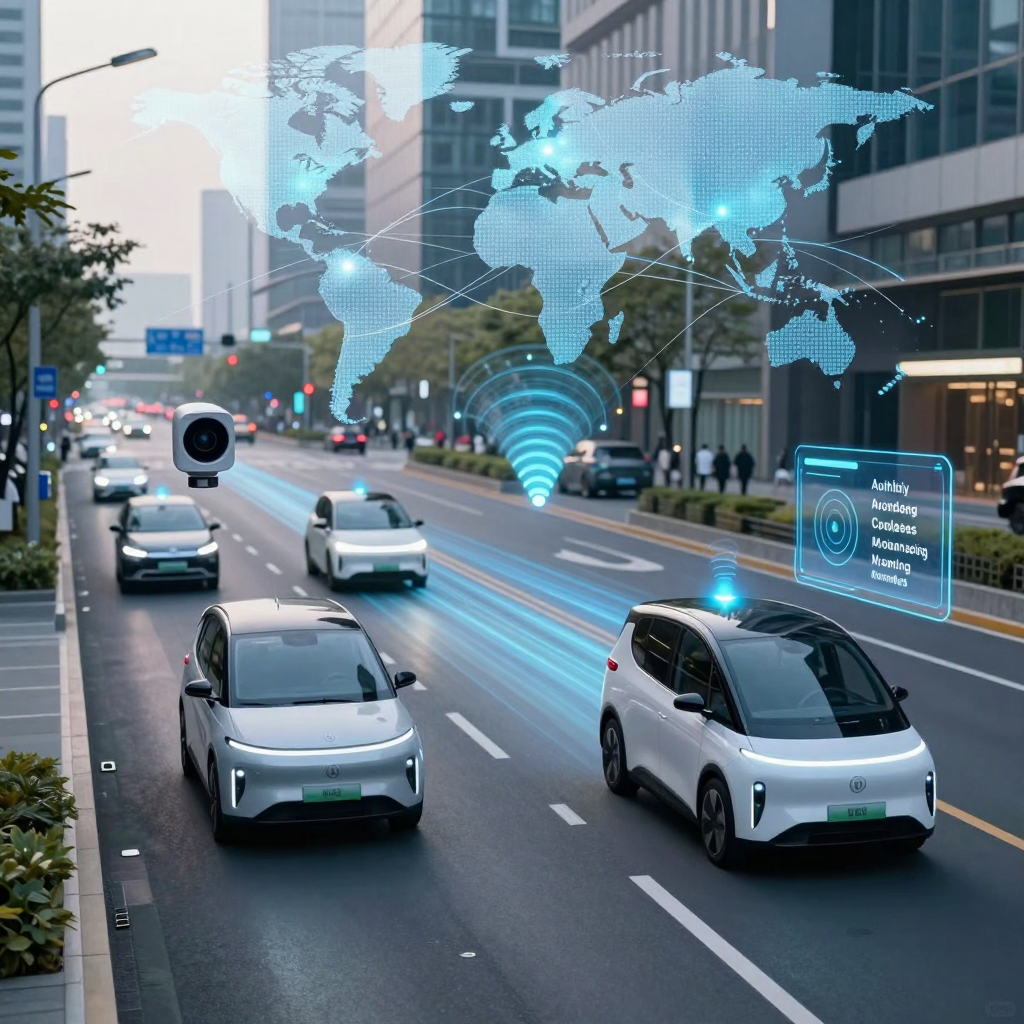
What kind of innovation will the autonomous driving industry witness in March 2026? The current changes go beyond just “a slightly smarter driver assistance” level—it’s a turning point moving from experiments to commercial services. Rapid advancements in neural networks and the map-less trend, combined with fierce competition among global companies, are jointly transforming the very nature of future transportation.
Leap in Neural Network-Based Autonomous Driving Tech: The ‘Economies of Scale’ Shown by Tesla’s FSD
The most symbolic recent example is Tesla FSD’s evolution. FSD V14 significantly expanded neural network parameters, boosting the ability to respond to “highly variable real-world situations” like emergency vehicle recognition and complex intersections. The difference is clear: the hands-off driving distance (where humans don’t intervene with steering or pedals) has improved 3–4 times, signaling that autonomous driving is moving beyond demos to real-world reliability.
Technically, the key approach started getting real with V12—namely, a single massive neural network (end-to-end) that takes camera video inputs and directly outputs steering and acceleration/braking. This method absorbs the traditional rule-based pipeline (perception → decision → control) into the neural network itself. Instead of piling up case-by-case rules, it leverages data and learning to enhance consistency in driving feel.
Map-less and Sensor Fusion Autonomous Tech: From “Reliance on Maps” to “On-the-Spot Creation”
For autonomous driving to reach commercial viability, it must go beyond just performing well in specific cities or roads. Rising to this challenge is map-less technology. While high-precision HD maps used to be a prerequisite, now vehicles use multi-sensor fusion—cameras, radar, lidar—to perceive surroundings in real time and generate local maps (lightweight maps) on the fly, establishing a new standard.
Why does this shift matter? Simply put:
- Driving becomes feasible even in areas without map data.
- Vehicles gain robustness against situations where map updates lag, like construction zones, lane changes, or temporary signs.
- Ultimately, the cost of expanding service areas (map creation and maintenance) drops, making scaling commercial deployment easier.
In short, map-less technology isn’t just a feature—it’s a pivotal tech shift that lowers the barrier to autonomous driving business viability.
Global Competition Driving Autonomous Tech Convergence: Nvidia’s Challenge and the Reality of Level 3
The competitive landscape is evolving rapidly. At CES 2026, Nvidia unveiled the autonomous-driving-dedicated AI “Alphamayo,” disrupting the previously dominant players. This means automakers, parts suppliers, and platform companies can now pursue strategies that combine proven AI stacks rapidly rather than waiting on a single tech supplier.
In South Korea, Hyundai Motor Group is pushing for Level 3 commercialization, but operational limits like a 60 km/h speed cap remain a practical barrier. These constraints relate less to technological absence and more to safety, regulations, and liability frameworks. They also reflect the industry’s movement from a “technology-only race” toward an “ecosystem race.” Indeed, the trend of considering Nvidia’s tech integration rather than insisting solely on proprietary AI exemplifies this global convergence of technologies.
Generative World Model-Based Autonomous Tech: Building ‘Virtual Experience’ Beyond Real Data
Finally, a defining feature in 2026 is the shift in learning methods. The adoption of generative world models is spreading, elevating capabilities beyond mere sensor data processing toward creating and validating countless scenarios in virtual environments. This allows for dense training on rare, hard-to-encounter situations in real life—unexpected cut-ins, unstructured obstacles, and complex intersection interactions—thus enhancing both safety and generalization performance.
In the end, autonomous driving in March 2026 is no longer a “technology of someday.” Thanks to the scaling of neural networks, map-less systems, sensor fusion, world models, and platform competition, it has reached a tech turning point advancing toward commercial service. The key question now is: how will this evolution reshape not only personal mobility but also logistics, urban infrastructure, insurance, and legislation?
Tesla FSD V14 from a Tech Perspective: Realizing Human-Like Driving
Saying the intervention-free driving distance has increased by 3 to 4 times is not just about simple performance improvement. It means the shift from “occasionally working autonomous driving” to “mostly self-reliant autonomous driving.” Moreover, the natural driving feel created by a single large neural network brings the autonomous driving we imagined closer to reality. So, what’s the secret behind FSD V14?
How the Single Large Neural Network Changed the ‘Form of Driving’
Starting with FSD V12, Tesla has fully adopted an end-to-end single large neural network structure that directly converts camera video input into steering and acceleration/braking output. Traditional autonomous driving typically separates modules as follows:
- Perception (detecting lanes, vehicles, pedestrians)
- Reasoning (situation assessment, priority determination)
- Planning (route generation)
- Control (steering, acceleration, braking)
This modular approach often leads to information loss at module boundaries or small errors being amplified in later stages. In contrast, a single large neural network integrates the continuous context from the video (speed changes, subtle movements of other vehicles, traffic flow at intersections) into one internal model representation, making it easier to realize driving that “reads the flow” more like a human.
As a result, driving evolves to be less rigid, reducing robotic jerks like sudden acceleration and braking.
What 3 to 4 Times the Intervention-Free Driving Distance Means: Reducing the ‘Long Tail’ Problem
The real challenge in autonomous driving isn’t ordinary straight driving, but the rare long-tail (exceptional) situations that can lead to accidents. Examples include:
- Approaching emergency vehicles (sirens/flashing lights) and yielding lanes
- Negotiating right-of-way at complex intersections
- Temporary lanes and ambiguous lane boundaries in construction zones
- Subtle speed adjustments when merging or cutting in
FSD V14’s maximized ability to recognize emergency vehicles and complicated intersection scenarios implies that coverage for these “troublemaker” situations—where interventions were frequent—has increased. The 3 to 4 times longer intervention-free driving distance suggests that, in exceptional situations, the frequency with which drivers must intervene is likely to feel substantially reduced.
The Learning Flywheel Created by Real-World Service Scale
One reason FSD V14’s evolution attracts attention is that the technology isn’t confined to the lab. Tesla provides over 400,000 paid services weekly across 10 U.S. cities, accumulating real-world driving data at scale. This scale is critical in autonomous driving tech.
- Diverse city structures, weather, and road cultures flow into the data
- Failure cases (interventions, sudden decelerations, uncertain maneuvers) are quickly collected
- Model updates are rapidly deployed back to the field
Ultimately, this creates a flywheel of “more real driving → better models → more use,” which becomes the core factor widening the gap with competitors.
Summary: V14 Is Not Just an ‘Addition of Features’ but a ‘Shift in Driving Method’
FSD V14 is not merely a version with more options—it represents a stage where the very way driving decisions are made is reorganized around neural networks, boosting performance. The dramatic improvement in intervention-free driving distance and human-like naturalness signals a change in the question from “Is autonomous driving possible?” to “Can it be trusted and used daily?” The next key observation will be how consistently this evolution can be replicated across broader environments beyond specific cities and conditions.
Tech Map-less Technology and Sensor Fusion: A New Standard for Autonomous Driving
What if you could navigate complex roads without map data? Autonomous driving is no longer just a battle over how densely precise HD maps are deployed. As of March 2026, the core trend is shifting toward map-less (Map-less) technology and multi-sensor fusion, transforming autonomous driving from a “well-prepared urban route” to a technology that works anywhere.
Tech Map-less: From HD Map Dependency to ‘Real-time Local Mapping’
Traditional autonomous driving relies on high-precision HD maps to determine “where the car is on the map,” overlaying sensor-detected obstacles and lane information on top. The problems are clear:
- Delayed map updates leave vehicles vulnerable to construction zones, lane changes, and temporary traffic signs.
- High costs and slow coverage expansion for map construction.
- Limited service in areas with poor map quality.
The map-less approach flips this perspective. Vehicles perceive their surroundings through cameras, radar, lidar, and other sensors to create a local map (low-form map) on the fly, using it as the basis for driving strategy. This means the car is less a “vehicle driving according to a map” and more a “vehicle seeing the road and creating its own map as it goes.”
Technically, map-less systems generally encompass:
- Localization: Not just GPS but also visual-inertial odometry (VIO), feature matching, and other methods to reliably estimate the vehicle’s position.
- Scene Understanding: Interpreting lanes, curbs, safety zones, signals/signs, and pedestrian paths at object and structural levels.
- Online Mapping: Constructing the immediate environment as occupancy grids or 3D representations.
- Planning & Control: Determining route, speed, and evasive maneuvers based on the generated local map and predictions.
This structure shines because it enables autonomous driving to function even in map-sparse areas and rapidly changing road conditions. Ultimately, map-less is becoming a core competitive advantage for both “scalability” and “real-world adaptability.”
Tech Sensor Fusion: Cameras, Radar, and Lidar Fill in Each Other’s Blind Spots
For map-less driving to succeed, the vehicle must perceive its surroundings with high confidence. This is where multi-sensor fusion has become standard. Each sensor excels in certain areas but has limitations that can cause instability if used alone.
- Camera: Excellent at detecting lanes, signs, and signals but vulnerable to night, backlight, rain, snow, and contamination.
- Radar: Strong at measuring distance and velocity (especially relative speed), resilient in adverse weather, but shape information can be coarse.
- Lidar: Offers precise 3D geometric data but comes with cost, packaging, and some environmental quality challenges.
Sensor fusion is more than simply “combining data”—it involves time synchronization, coordinate calibration, and uncertainty modeling as a complex system. Implementation methods include:
- Early Fusion: Combining raw data at the sensor level (high precision but computationally intense and synchronization-challenging).
- Late Fusion: Fusing detected objects and lane results from each sensor (easier to implement but with some information loss).
- Hybrid Fusion: A compromise using early fusion in critical areas and late fusion elsewhere.
In map-less driving, what’s crucial is reconstructing an accurate, reliable model of the current road structure. For instance, in construction zones where lane markings are erased, fusing radar/lidar-based boundary estimation with camera-based signage and cone detection allows the vehicle to form a plausible temporary lane layout.
A Tech Paradigm Shift: From ‘Map Quality’ to ‘Real-time World Model’
When map-less and sensor fusion combine, autonomous driving’s core shifts from HD maps to a continuously updated World Model inside the vehicle. This world model captures “where things are, how they move, and what’s likely to happen next.” Recently, generative world model approaches have enhanced the ability to cope with rare scenarios—like unpredictable lane cuts, irregular intersections, and emergency vehicle responses.
In summary, the 2026 autonomous driving tech standard can be encapsulated as:
“From cars driving by relying on maps to cars driving by reconstructing the world through sensor fusion.”
This shift is not merely a technology trend but a turning point that redefines the speed of autonomous service expansion and the very standards of safety.
Global Tech Race and NVIDIA’s Challenge: How AlphaMylo Shakes Up the Game
NVIDIA’s AlphaMylo AI reveal, poised to disrupt Tesla’s dominance, stands as the biggest game-changer in the autonomous driving landscape come March 2026. As the role shifts from being a “car manufacturer” to an “AI computing supplier,” the battleground pivots from who sells more cars to who can train and deploy autonomous driving AI faster and more safely.
AlphaMylo’s Significance Through a Tech Lens: The Battle for the ‘Vehicle AI Operating System’
NVIDIA’s ambition with AlphaMylo goes beyond merely adding autonomous driving capabilities—it aims to platformize the entire development process of self-driving technology. Technically, this means enhancing three key aspects:
- Acceleration of Large-Scale Neural Network Training: In a world where multi-sensor fusion of cameras, radar, and lidar is standard, models are growing bigger and training data is exploding. NVIDIA’s powerful training and inference stacks tackle compute, power, and latency bottlenecks to speed up the “time to market.”
- Integration with World Model-Based Simulation: Leveraging generative world models to recreate countless edge cases in virtual environments has become essential. By tightly linking the simulation-learning-deployment loop, AlphaMylo enables developers to quickly fill dangerous scenarios that real road data alone can’t cover.
- ‘Perception-Centric’ Architecture to Enable Mapless Transition: With the rise of mapless technology that generates local maps in real-time—breaking free from HD map reliance—vehicles increasingly depend on “perception, prediction, and planning” over static maps. This battle centers on how sensor inputs are reliably fused, uncertainties managed, and safety constraints systematically guaranteed—NVIDIA’s vision is to provide this as a standardized stack.
Industry Tension: Tesla’s Vertical Integration vs. NVIDIA’s Horizontal Expansion
Tesla’s FSD evolves into a single massive neural network (end-to-end) approach, boasting results like extended intervention-free driving distance, proving the “strength of its own ecosystem.” Meanwhile, NVIDIA grows the field by linking diverse automakers, parts suppliers, and mobility companies—not just confining to one manufacturer.
- Tesla’s Strategy: Vertically control the entire chain from data collection (vehicles) → training (in-house infrastructure) → deployment (FSD) for optimization
- NVIDIA’s Strategy: Provide a shared platform that absorbs and accelerates the development needs of multiple players across the ecosystem
This dynamic poses a crucial industry question:
“Will autonomous driving be built as a product, or assembled on top of a platform?”
Hyundai’s Tech Dilemma: Expanding Beyond ‘Level 3 Commercialization’
Domestically, Hyundai Motor Group is pushing Level 3 commercialization, but real-world constraints like speed limits remain. In this context, considering AlphaMylo adoption isn’t merely outsourcing—it’s a strategic choice to reduce development risk and time costs.
The technical challenges facing Hyundai and global automakers are clear:
- Skyrocketing Validation Costs: As levels rise, “proving safety” overwhelmingly complicates development. Strong simulation, reproduction, and testing pipelines embedded in a platform can significantly shorten commercialization timelines.
- Simultaneous Optimization of Sensor Configurations and Software: With multi-sensor fusion standard now, hardware choices (camera, radar, lidar combos) and software architectures (perception-prediction-planning) influence each other, increasing platform dependency.
- Field Adaptability in Mapless Transition: Generating local maps and making real-time decisions in construction zones, map gaps, and unpredictable traffic flow are critical; expanding training data and improving model generalization become the battleground.
The Tech Race Conclusion: “Who Seizes the Standard First?”
The autonomous driving race in March 2026 is no longer a solo sprint but a multilateral battle over standards. Tesla leads with real-world service expansion and end-to-end model refinement, while NVIDIA opens a “chaseable path” by uniting the ecosystem with AlphaMylo.
The spotlight now shines on one key question: beyond a mere announcement, how deeply AlphaMylo integrates into automakers’ commercial roadmaps to boost development speed, safety validation, and mapless adaptability—that will turn cracks in Tesla’s dominance from mere rumors into hard numbers.
Generative World Models and the Future of Autonomous Driving Technology
What scientific principles underpin the technological sophistication that allows AI to learn in virtual environments, surpassing real-world limitations? By March 2026, autonomous driving can no longer rely solely on “testing experiments on the road” to improve performance. In a reality filled with unpredictable variables—construction zones, irregular intersections, sudden emergency vehicle entries—the key solution enabling commercial-grade safety and scalability is none other than the Generative World Model.
How World Models Transform Learning: From “Memory” to “Prediction”
Traditional autonomous driving AI mostly gathered actual driving data (camera, radar, lidar) to classify patterns and select corresponding actions (steering, acceleration, deceleration). However, this approach has clear limitations.
- Rare events (such as just-before-collision scenarios or aggressive lane cutting) lack sufficient data,
- Different regions, weather, and cultures cause a rapid increase in “similar but distinct” situations, and
- Heavy dependency on HD maps results in unstable performance outside those mapped areas.
World models take a different approach. Instead of merely “storing” the scenes seen through sensors, they simulate and ‘predict’ how the world will change in the very next moment. In other words, a miniature virtual world is created inside the autonomous driving system, allowing rapid mental simulations of “What if that car crosses lanes now?” or “What if that pedestrian suddenly darts out?”—quickly running reflexive assumptions.
The Science Behind Generative World Models: Probabilistic Simulation Meets Reflexive Intelligence
Generative world models don't produce a single correct answer; they probabilistically generate multiple possible futures. Technically, this combines the following elements:
- Representation Learning: Compressing multi-sensor data—cameras, radar, lidar—into meaningful states.
- Dynamics Model: Learning how these states evolve over time to predict the next-frame scenes and object movements.
- Policy & Planning: Selecting the safest and most efficient path from the predicted possible futures and translating that into steering and speed control.
This method is powerful for a simple reason: you can identify and remedy vulnerable situations through millions of “what-if experiments” in the virtual world without taking dangerous risks in real life. This is the very foundation enabling autonomous driving technology to cross the commercialization threshold in 2026.
Why World Models Matter in the Mapless, Multi-Sensor Fusion Era
By 2026, the norm shifts to mapless combined with multi-sensor fusion, as vehicles generate local maps in real-time while driving. But “mapless” doesn’t mean “without a map”—it means continuously reconstructing the world based on the current view.
World models become the essential mechanism that compensates for mapless limitations. Even if the local map is incomplete or occluded, the world model probabilistically estimates blind spots and manages risks conservatively. Moreover, for anomalies like emergency vehicles that break rules, the response is not “rule-based” but based on situational prediction.
The Significance of 2026 as a Commercialization Turning Point: Not an End but a ‘Starting Point’
Even if trends like Tesla’s single massive neural network directly linking input (video) to output (steering, throttle) spread, what truly matters in commercial service goes beyond “smooth driving” to safe convergence in exceptional scenarios. World models tackle this head-on by:
- Filling real-world data gaps through simulation,
- Creating vast quantities of rare risk scenarios for training, and
- Helping the model understand the “physics of the world” despite changing regions.
In essence, autonomous driving in 2026 is not about the “end” of experiments and the start of commercial use, but rather the beginning of a new development cycle infinitely refined within virtual worlds. The future competition will not just be about sensors or maps—it will revolve around who can generate worlds closest to reality (and harsher conditions) and cultivate safer driving intelligence within them. This pivotal trend stitches together the final chapter of one era and the opening of another in autonomous driving technology.
Comments
Post a Comment