Blood Moon on March 3, 2026: The Last Total Lunar Eclipse in the U.S. Will Paint the Sky Red for Three Years
 \n
\n
The Night the Red Moon Glows: The Mystique of the Blood Moon March 3
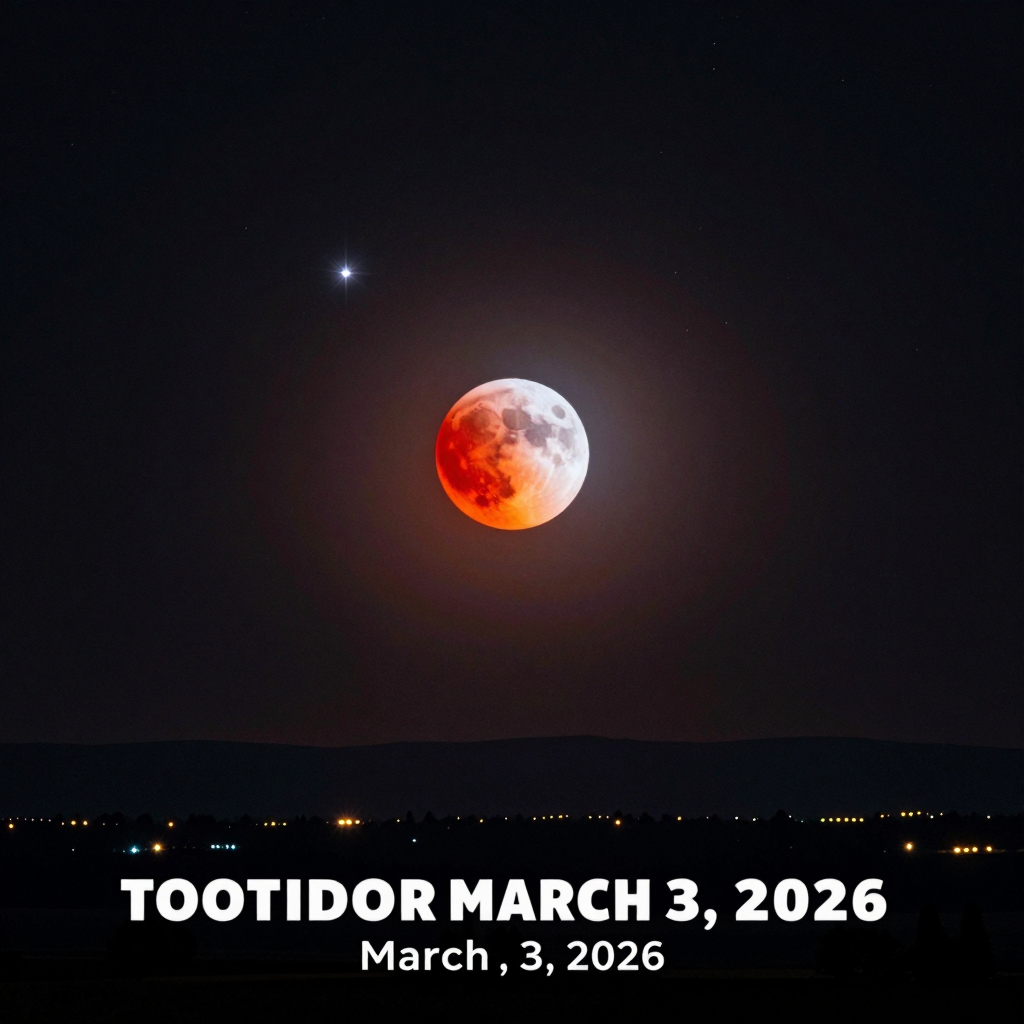
On March 3, 2026, a cosmic drama will unfold in the skies over the United States. Why does the glowing red moon captivate us so deeply? The Blood Moon is not simply a “night when the moon becomes beautiful,” but a grand shadow play created by the precise alignment of the Earth, Sun, and Moon in a straight line. During the total lunar eclipse, the moon slips into Earth’s shadow, but rather than vanishing completely, it rises bathed in a striking red glow.
Surprisingly, the secret lies with the Earth. When sunlight passes through Earth’s atmosphere, blue light scatters, allowing red and orange wavelengths to refract farther and gently illuminate the moon. Thus, the Blood Moon is both a transformation of the moon and a signature of Earth’s atmospheric light. It’s as if, on a vast stage watched by the world, Earth itself takes on the role of lighting director.
What makes this upcoming Blood Moon on March 3 even more special is its rarity. In the coming years, opportunities to witness a total lunar eclipse visible over wide areas of the globe will be limited, making this a night worth remembering—weather permitting. Moreover, no special equipment is needed; the Blood Moon can be fully enjoyed with the naked eye, making it one of the most accessible “space experiences” available.
The Science of Total Lunar Eclipses: The Secret of the Blood Moon (Blood Moon March 3)
The reason the moon turns red instead of “disappearing” during a total lunar eclipse is that even when the moon is engulfed in darkness, Earth doesn’t act as a perfect blackout screen but functions like a ‘lens that refracts light.’ This very principle creates the highlight of Blood Moon March 3—the captivating blood moon.
Why the Moon is Still Visible Inside Earth’s Shadow (Umbra)
A total lunar eclipse occurs when the moon completely enters Earth’s main shadow (umbra). Normally, the sunlight should be completely blocked from reaching the moon, but the moon doesn’t turn into a pitch-dark disc. That’s because some sunlight grazes Earth’s edge, passes through the atmosphere, and is refracted back into the umbra, faintly illuminating the moon’s surface.
Why Does Only the Red Light Remain on the Moon? (The Law of Scattering)
Earth’s atmosphere doesn’t allow incoming light to pass through unaltered. The key phenomenon here is Rayleigh scattering.
- Short wavelengths (blue light) scatter more easily upon hitting atmospheric molecules and spread out in all directions.
- Long wavelengths (red and orange light) scatter less and travel straighter and farther.
As a result, the light surviving this long journey through Earth’s atmosphere leans toward the red and orange spectrum. This refracted light touches the moon’s surface, making it appear bronze to deep crimson. Simply put, a blood moon is like Earth’s sunrise and sunset colors projected onto the moon.
Why Does the “Shade of Red” Change Every Time? The Scientific Reasons
A total lunar eclipse doesn’t always produce exactly the same shade of red. Even during Blood Moon March 3, the moon’s color can vary depending on the observation location and atmospheric conditions. Key factors include:
- Atmospheric clarity (dust, haze, pollution): More fine dust or aerosols weaken the light, causing the moon to appear darker and duller red.
- Cloud cover and humidity: A reduction in the amount of light passing through can make the color paler or lower in contrast.
- Moon’s path through the umbra: The deeper the moon travels through the shadow’s center, the darker and richer the color tends to be.
Understanding this process reveals that a total lunar eclipse isn’t merely a “red moon,” but feels like a colorful record of Earth’s atmospheric conditions left in space.
Blood Moon on March 3: A Midnight Cosmic Show – Where Will It Be Best Visible?
In California, the eclipse begins while the moon is relatively high in the sky, making it highly likely that observers can follow the sequence of penumbra → maximum eclipse → end of eclipse for an extended period before the moon sets. On the other hand, in the Eastern Time Zone, just when you’re thinking, “This is the real highlight!” the moon often dips below the horizon during the total eclipse phase (the blood moon segment), making the experience quite different even though it’s the same celestial event. Let’s focus on whether you can have a perfect viewing of the blood moon on March 3 in your area.
Why the West Coast (Especially California) Has the Advantage
- More viewing time: The eclipse starts around midnight, offering a good chance to watch the main phases unfold well before the moon sets.
- Higher moon altitude: The moon remains comfortably high in the sky early on, reducing the chances that buildings, mountains, or trees will block your view.
- Less weather-related risk: Forecasts suggest the Midwest and East Coast may face cloudier conditions, giving the West Coast a slight edge.
The Eastern Time Zone—A “Short and Low” Viewing Experience
- Total eclipse time window: Roughly 6:04 AM to 7:02 AM (EST)
- Key challenge: During this time, the moon gradually descends and may set below the horizon while still fully eclipsed.
- Viewing tip: Choose a spot with a wide open eastern horizon (toward moonset). Beaches, riverbanks, and large open fields beat city centers cluttered with tall buildings.
Quick Local Check: Which Side Are You On?
- West is better: Longer visibility and a steadier moon altitude.
- East depends on location: Securing an unobstructed horizon greatly boosts your chances.
- Aiming for the peak (deepest red moon)? Keep 11:33 UTC (6:33 AM EST) in mind, though for the East, this coincides with the moon’s low position—adding some unpredictability.
In conclusion, if your goal is to watch the entire event unfold, the West Coast clearly has the upper hand. If you’re in the East, your success largely hinges on finding a spot with an open horizon. This will make or break your chance to witness the phenomenal blood moon on March 3.
Blood Moon Observation Guide: Enjoy the Cosmic Show Without Equipment (Blood Moon March 3)
Don’t miss the magical moment when the red moon changes before your eyes with the naked eye, accompanied by the shining stars of Leo! The Blood Moon on March 3 is a spectacular celestial event where you can watch in “real-time” as the moon gradually darkens and then glows with a reddish hue — an experience far more thrilling than any photo.
Naked Eye Observation Tips: Follow the “Color Transformation” Until the End
- No equipment is needed. Your naked eyes are more than enough to notice how the moon’s brightness and color shift throughout the event.
- The key to observation is not just spotting the red moon for a moment, but witnessing the full flow of change: from bright moon → shaded moon → crimson moon. Try to watch continuously from start to finish.
- Since the moon may dip below the horizon during the eclipse in eastern areas, the further west you are, the better your viewing conditions will be. If you can travel, prioritize locations with a clear western sky.
Timing Check: The Easiest Way Not to Miss the “Peak”
- The peak, when the moon’s red glow is deepest, is at 11:33 UTC (6:33 AM Eastern Time).
- Since this happens early in the morning, set an alarm and go outside 10–15 minutes before the peak to let your eyes adjust to the darkness, making the colors appear even more vivid.
Leo and Regulus: The Starry Backdrop That Makes the Blood Moon Cinematic
As the moon darkens, the surrounding sky grows darker too, unveiling stars usually hidden from view. This time, the bright star “Regulus (the heart of Leo),” the brightest star in the constellation Leo where the moon is located, adds a special thrill.
- Spotting the star shining clearly next to the moon expands the experience beyond just watching the moon alone — it connects you to an entire cosmic landscape.
Viewing Location and Weather Strategy: Simple But Highly Effective
- Pick a spot with a wide-open view like a park, riverside, hill, or spacious parking lot.
- If local forecasts show uncertain clouds, it’s more realistic to aim for breaks in the clouds rather than waiting for perfectly clear skies.
- Since central and eastern regions have a higher chance of clouds, and the west tends to be clearer, planning your observation westward when possible is the safest bet.
Another Miracle in the Sky: The Dawn Stage of Venus and Saturn (blood moon march 3)
Right after the blood moon, another cosmic show unfolds in the early dawn of March 8. Before the excitement of blood moon march 3 fades, Venus and Saturn draw close together, creating a breathtaking scene where “two planets take the stage as one,” visible even to the naked eye. For astronomy enthusiasts, this is an unmissable second highlight.
What makes this planetary conjunction special?
- Venus shines like a brilliant ‘lighthouse’ in the dawn sky, making it easy to spot.
- Saturn is much dimmer than Venus, but their close proximity simplifies locating it, significantly lowering the difficulty of observation.
- While there’s no dramatic color change like during a lunar eclipse, the very moment these planets appear side by side is a rare event, highly valuable for photography and record-keeping.
Observation tips to increase your chances of success
- Timing: Since it’s a ‘dawn sky’ event, check the sky early before sunrise.
- Direction: Open eastern skies are ideal—places like parks, riversides, or hills offer better visibility than surrounded apartment complexes.
- Equipment: Naked eyes suffice, but binoculars help you spot Saturn more steadily.
- Tip: As the sky brightens, Saturn may fade before Venus, so try to observe while it’s still darker.
How to enjoy consecutive viewing after the blood moon
If the March 3 lunar eclipse was “the drama of the moon,” March 8 presents an intricate ‘dawn stage’ crafted by the planets. Watching both events back-to-back turns the early March sky into a flowing story, making your astronomical experience richer and far more memorable.
Comments
Post a Comment