International Women's Day, March 8: 117 Years of Struggle and Solidarity for Gender Equality and Democracy
 \n
\n
International Women’s Day: The Hidden Story Behind Its Origin
Why did March 8th become the globally recognized day for women’s rights and gender equality? The International Women’s Day we know today is not merely a day of “celebration” but a day that originated from the desperate voices of women workers demanding their rights to exist and vote. Tracing its beginnings reveals that this date is not just marked on the calendar; it is a powerful symbol condensed from a history of struggle.
The Origin of International Women’s Day: Women’s Demands on the Streets in 1909
International Women’s Day started in 1909 as a global observance, when women courageously stood up against discrimination and inequality in workplaces, demanding the right to work, the right to live with dignity, and political rights including suffrage. Crucially, this was not about “favoring women” but about collective action to change a reality where rights were stripped away.
The early significance of this day was crystal clear:
- Resistance against the reality where women’s labor was treated as ‘secondary’
- Challenging wage gaps and discriminatory working conditions
- Declaring a refusal to be excluded from social and political decision-making
In other words, from its inception, International Women’s Day has spoken the language of labor and democracy.
The Enduring Message of International Women’s Day: Past Struggles Become Today’s Standards
As time passed, International Women’s Day grew into a platform for global solidarity, but at its core remains the same question:
“Whose rights are taken for granted, and whose must still be fought for?”
Commemorating this day is not about romanticizing the past but about confronting current inequalities head-on and committing to change the lives of future generations. Memory becomes a standard, not mere sentiment; commemoration becomes the starting point for action rather than just an event.
Why International Women’s Day Remains a “Work in Progress” Today
The reason International Women’s Day continues to hold power today is undeniable: gender equality is not a goal already achieved but a challenge ever proven by the ongoing gaps and discrimination found throughout society.
March 8th is not just a “day in history” but a living question about the kind of society we choose to build. As long as this question persists, International Women’s Day returns every year with sharper meaning right before us.
International Women’s Day: The Courage of Women Workers and the Roots of Its Birth
The beginning that changed the world was not a grand slogan, but a desperate cry uttered “to survive today.” The voices of women workers demanding the right to live and the right to vote went beyond their individual hardships, eventually planting the seeds that shifted the direction of the global women’s rights movement.
The reality women faced in the workplace was not just “hard labor.” Despite doing the same work, they received lower wages, were easily excluded from promotions and decision-making, and endured unsafe working conditions as a daily norm. Naturally, their demands converged on two pillars: the right to livelihood (survival rights) and the right to vote to secure those rights through institutions and politics. To change discrimination at work, laws and policies had to change—and to do that, voting rights and representation were essential.
What began as a struggle in the workplace did not remain “an issue for a specific group.” The questions women workers raised in the streets—who works, who decides, and who gets protection—exposed the inequality embedded in society at large. Amid this movement, International Women’s Day became more than just a day of remembrance; it grew into a symbol of the movement, honoring historical discrimination women have endured and demanding equality today.
When we face March 8th, it does not simply mean ‘celebration.’ It reminds us of the courage of women workers who cried out to protect their lives, and the timeless truth that “rights expand only when demanded.” Ultimately, the roots of International Women’s Day lie in the most realistic arena—the workplace and daily life—where the fiercest voices first rose.
International Women’s Day: A New Revolution Unfolding in South Korea in 2026
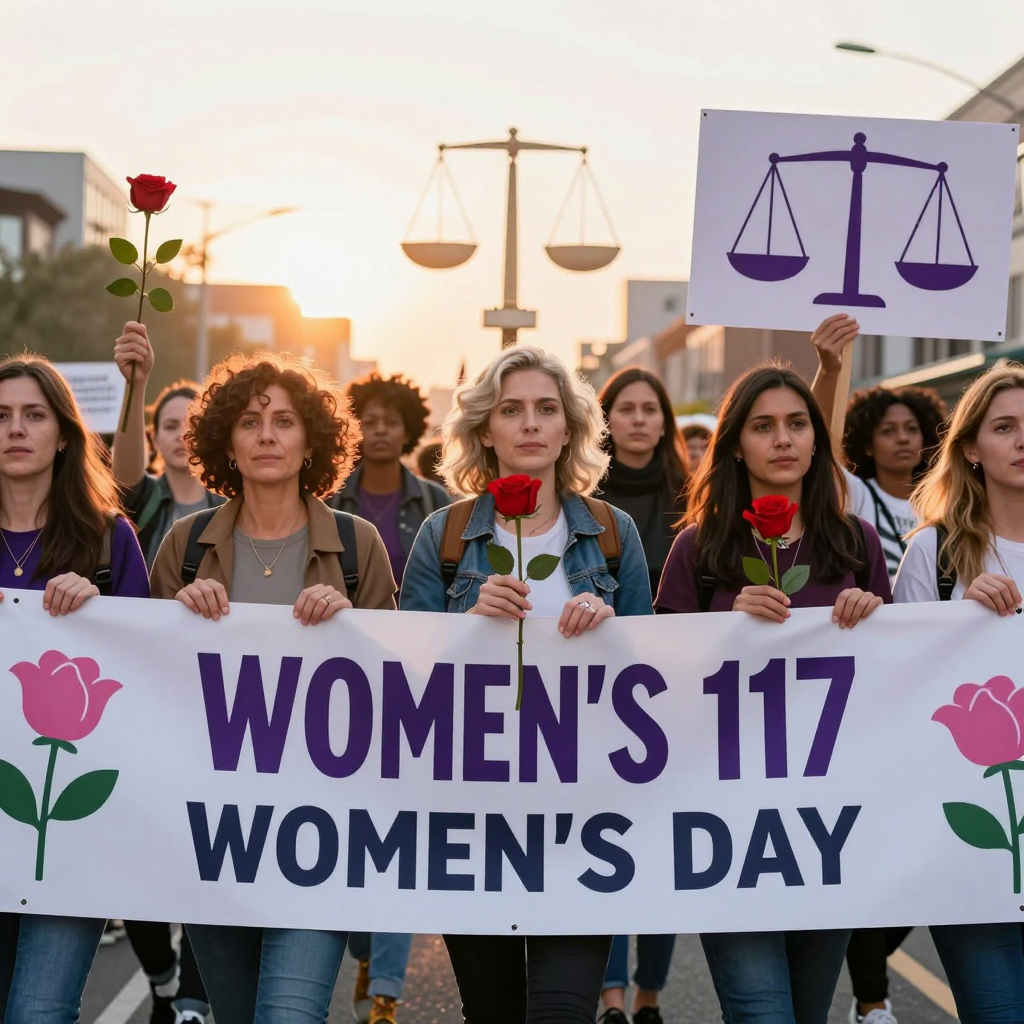
Over 400 citizens marched through the streets of Daegu, chanting “Gender Equality is Democracy” while holding rice cakes and roses. Though it appeared to be a gesture of celebration, the scene was closer to a public declaration demanding a transformation of the “here and now.” This is precisely why International Women’s Day refuses to remain just an annual commemoration. The act of walking together in the streets delivers the most direct message: gender equality is not a demand of a specific group but a fundamental societal baseline.
So, what voices echoed through Seoul’s Gwanghwamun Square? At the 41st Korean Women’s Conference, participants boldly proclaimed the message “Complete the Revolution of Light.” This slogan was not merely a tribute to past progress but a pledge to relentlessly pursue unfinished tasks. The moment gender equality is declared not a “subsidiary goal” of democracy but a core condition for its completion, International Women’s Day evolves from a symbol into a language of action.
International Women’s Day 2026 in South Korea cannot be encapsulated by a single scene. The agenda has expanded to include gender wage gaps in the workplace, discrimination at work, imbalances in safety and care, and even international solidarity, transforming issues once dismissed as “personal discomfort” into “structural problems society must address.” The march in Daegu and the voices from Gwanghwamun are not disparate events in different cities; they are signals pointing in the same direction. This year, right in the heart of the streets, we are witnessing more clearly than ever the truth that when gender equality wavers, democracy shakes alongside it.
International Women’s Day: The Power of Gender Equality, Labor Rights, and Global Solidarity
What do the voices of women fighting against persistent gender wage gaps and the rallies showing solidarity with Palestinian women truly signify? The message of International Women’s Day is crystal clear. Gender equality is not achieved through declarations alone; it must be tangibly proven in everyday life—especially in the realms of labor, safety, and international solidarity.
First, the issue of labor rights remains an ongoing struggle. The reality that “equal work does not mean equal pay” is not just a statistic—it is a structural inequality that affects individual livelihoods, careers, and retirement security. This is why women workers across South Korea strongly spoke out against wage gaps and workplace discrimination during this year’s events. To speak of gender equality while ignoring inequalities in the workplace is to reduce equality to mere rhetoric.
Another vital trend is global solidarity. As solidarity rallies with Palestinian women demonstrate, women’s rights are not confined to a single nation’s “internal agenda.” The harsh realities women face—amid war, violence, and survival crises—transcend borders, and so must solidarity extend beyond them. This underscores that International Women’s Day is not simply “one day,” but a platform for movement—where each other’s pain and demands are translated into collective action.
Ultimately, the gender equality championed on this day is a value inseparably linked to democracy. When wages, safety, dignity, and solidarity function effectively in real life, gender equality finally becomes both a system and a culture. International Women’s Day repeats every year not just to commemorate, but to urge society to reaffirm the unfinished tasks—and push forward, broadly and deeply—together.
International Women's Day: From Past Struggles to Future Hope
International Women's Day is not just a day of commemoration. It is a day to remember past battles, confront present inequalities, and pass on hope to future generations. Let us once again reflect on its true meaning.
Looking back, the origins of this day lie in the demands of women workers for survival rights and suffrage. Before there was "celebration," there was "struggle," and that struggle was made possible not by individual courage alone but by collective solidarity. Therefore, International Women's Day is not merely a day to offer congratulations to someone, but a historical mechanism that reminds us how rights have been built over time.
Today, International Women's Day embraces a broader agenda. Issues that change the conditions of life—such as gender wage gaps, workplace discrimination, safety, and caregiving—are still ongoing challenges, deeply connected to the completeness of democracy itself. This is why the message “gender equality is democracy” echoes throughout South Korea today, accompanied by voices of solidarity in various arenas. Gender equality is not just a demand of some; it is the baseline for a fair-functioning society.
Looking toward the future, the most important promise International Women's Day offers is the confidence that "the next generation can be a little better off." This confidence does not come automatically. When we choose to question and change discrimination in our workplaces, schools, homes, and communities today, past struggles become present change, and present change turns into hope for the future. Remembering International Women's Day is ultimately the most practical starting point for creating a better tomorrow.
Comments
Post a Comment