 \n
\n
The Dawn of Edge AI Innovation: The Arrival of AMD Ryzen AI Embedded Processors
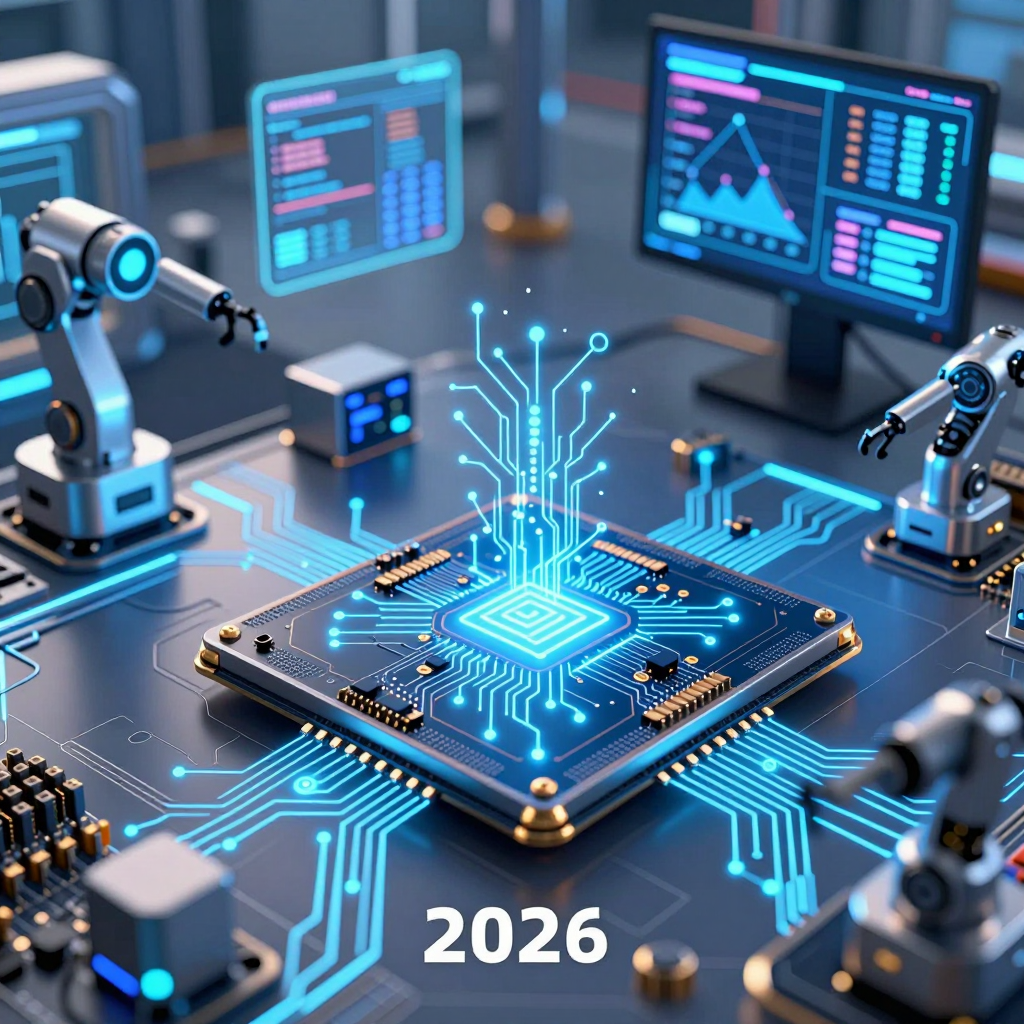
Can you believe that in 2026, a revolution in Edge AI technology is set to transform industrial sites? At the heart of this change is AMD’s expanded Ryzen AI Embedded Processor portfolio. AI is shifting from the cloud-centric model of “waiting for analysis results” to a new paradigm where on-site devices like factories, robots, and kiosks instantly make decisions and take action.
Why Edge AI Has Become an ‘Essential Requirement’ in Industry
In industrial AI, time and reliability trump flashy demos. Especially in Physical AI—where systems directly interact with the physical world, such as factory automation, mobile robotics, and intelligent robots—several critical demands must be met simultaneously:
- Real-time AI processing: Data from cameras, LiDAR, torque sensors, and more must be interpreted immediately. Any delay can jeopardize key functions like collision avoidance, defect detection, and safety control.
- Deterministic performance: It’s not enough to be “mostly fast”; results must be delivered within consistent, guaranteed timeframes every single time, a vital standard in robotic control and industrial safety.
- Long-term reliability: Industrial equipment runs for years. Embedded processors must offer stable supply, dependable operation, long-term support, and predictable performance.
While cloud-based AI excels at model updates and scalability, it suffers from variable latency and potential connection outages. In contrast, Edge AI processes data locally to reduce delays, enhance privacy and availability, and strengthen consistent on-site decision-making.
What AMD’s Expanded Ryzen AI Embedded Portfolio Means from an Edge AI Perspective
AMD’s expansion is drawing attention because it directly targets the three core Edge AI demands (real-time, deterministic, long-term stability) at the processor level. In embedded systems, having just a powerful CPU isn’t enough. To reliably handle video analytics, sensor fusion, and inference pipelines, these must be designed together:
- Enhanced compute resources for local inference: Running models on the edge reduces data transfer costs and latency. This evolution directly benefits workloads like robotic vision, quality inspection, and safety monitoring.
- Architecture optimized for on-site AI pipelines: Seamless flow from camera input → preprocessing → inference → post-processing → control signal output is essential. Embedded processors must maintain this pipeline with predictable performance.
- Operational stability optimized for edge deployment: In environments like factory lines or unmanned stores where “downtime means loss,” continuous operation and fault handling are more critical than frequent updates.
The Vision Comes Alive in Real-World Applications
Consider vision-based functions like facial recognition, behavior detection, and anomaly spotting—their effectiveness skyrockets when processed on the edge. With neural network acceleration, single workstations now handle multiple video channels simultaneously, accelerating rapid expansion of products needing “instant decisions” such as smart locks, kiosks, digital signage, and access control systems.
Taking it further, intelligent robots must respond instantly to sensor data changes. Edge AI’s local decision-to-action architecture is structurally superior to round-trip network models. Combined with on-sensor AI workflows that automate data preprocessing and parameter updates, industrial sites evolve swiftly into adaptive, context-aware environments.
What’s Next: The Era of Running Larger Models on the Edge
As memory and computing technologies advance, edge devices in 2026 are poised to run more complex models locally than ever before. AMD’s expansion of the Ryzen AI Embedded portfolio strengthens the hardware foundation supporting this shift. Ultimately, industry will transition faster from cloud-centric AI to on-site, Edge AI-first solutions.
The Secret of Edge AI Real-time Processing: The Triple Imperative of Deterministic Performance and Stability
How is it possible to achieve instant decision-making with zero network delay, while securing long-term reliability? The answer lies in a design philosophy that simultaneously fulfills three conditions: Real-time AI processing, Deterministic performance, and Long-term stability. Especially in fields like factory automation and mobile robotics—where “stopping means loss”—these three must operate as one cohesive unit for Edge AI to truly be deployed in the field.
The Structure Enabling ‘Real-time AI Processing’ in Edge AI
Cloud AI, no matter how accurate the model, suffers from round trip time delay. In contrast, Edge AI completes computations within the device, allowing for a short control loop (sensor input → inference → control output). The key to real-time operation lies in optimizing these three steps:
- Minimizing data movement: The longer sensor data travels through memory/bus, the greater the delay and variability. At the edge, preprocessing and inference occur nearby to reduce latency.
- Accelerator (NPU/GPU)-based inference: Even with the same model, dedicated engines like NPUs deliver lower latency and higher throughput compared to CPU alone.
- Pipeline parallelization: Capturing, preprocessing, inferring, and postprocessing are overlapped per frame, managing not only average latency but also maximum latency.
For example, tasks handling continuous video streams like face recognition must maintain a consistent speed with no frame drops to be valuable. The combination of edge inference acceleration and optimized runtimes (such as OpenVINO) explains why multi-channel real-time processing is possible even on constrained devices.
Why ‘Deterministic Performance’ Matters in Edge AI and How It’s Achieved
What truly threatens industrial sites isn’t “slowness,” but jitter—unpredictable timing variation. If inference time fluctuates even when a robot receives the same input, control command timing breaks down, raising safety concerns. Deterministic performance is the condition that prevents this, implemented through:
- Scheduling and fixed priority: Assigning real-time priorities so inference tasks aren’t preempted by others, reducing unnecessary background fluctuations.
- Predictability in memory/cache: Irregular data access causes latency spikes. Simplifying model execution paths, fixed-size buffers, and minimizing memory allocation/deallocation stabilize delays.
- Suppressing clock variation from power/thermal effects: Edge devices can temporarily degrade performance due to heat throttling. Industrial designs incorporate cooling and power policies aiming for “consistent performance at all times.”
In essence, deterministic performance is not about just a “fast processor” but about system design that bounds latency ceilings.
Edge AI Stability: Not Just ‘Long Usage’ but ‘Long-Term Trust’
Long-term stability goes beyond low failure rates to mean reliability encompassing field operation, updates, and security. Once installed, edge devices must function at consistent quality for years, especially in production lines and robotic systems where downtime costs are enormous. The pillars of stability are:
- Long-term supply and maintenance of drivers/software: In embedded environments, continuous part availability and software compatibility directly impact operational risk.
- Controlled model update procedures: Even if models improve from field data, enhancements causing increased latency jitter or errors are futile. Verified version management and rollback systems are essential.
- Consistency of on-sensor/edge preprocessing: The more preprocessing and adaptive learning done at the sensor level, the more stable the data quality and the less network reliance, boosting overall system stability.
Ultimately, stability in Edge AI means “performance and timing do not degrade over time,” enabling safe scaling of physical AI like factory automation and intelligent robots.
The Completion of ‘Field-Ready AI’ Enabled by Edge AI’s Triple Imperative
To summarize, Real-time AI reduces latency through local inference, Deterministic performance locks down latency variation, and Stability guarantees long-term consistent quality and operability. When these three conditions interlock, the edge device becomes not just a simple inference terminal, but an execution engine that instantly judges and triggers actions on site.
Beyond Edge AI Facial Recognition: Smart Applications Unlocked by Edge AI
Did you know facial recognition technology can process nearly 40 video channels at 10 frames per second? The secret lies not in sending data to the cloud for analysis but in on-site real-time inference through an Edge AI architecture. For instance, leveraging Intel OpenVINO’s neural network acceleration enables workstation-grade edge systems to handle 25 to 41 concurrent video streams (at 10 FPS), allowing real-time analysis of multiple camera feeds without delay. This performance means far more than just “faster facial recognition”—it lays the foundation for understanding and reacting to an entire smart environment in real time.
The Technical Principles Behind Edge AI’s Real-Time Multi-Channel Processing
To process multiple video channels in real time, it’s crucial to structurally reduce bottlenecks.
- Eliminating Transmission Delays: Cloud inference inevitably involves network round-trip delays and bandwidth fluctuations. Edge AI performs inference right where the video is generated (camera, gateway, industrial PC), enabling immediate decision-making.
- Hardware Acceleration and Pipeline Optimization: Neural network operations (convolutions, matrix calculations, etc.) are handled via dedicated acceleration paths. The workflow—from frame decoding to preprocessing, inference, and post-processing (NMS, tracking)—is fully pipelined to prevent latency buildup.
- Deterministic Performance: In industrial and security settings, consistent response times—even in worst-case scenarios—are more critical than average speed. Running inference on edge devices with fixed resources ensures predictable, stable responses regardless of network or cloud load.
Built on this foundation, facial recognition moves beyond simple “entry authentication” towards a broad range of smart applications.
Smart Locks, Kiosks, and Digital Signage Evolving with Edge AI
When facial recognition operates with high performance and low latency, user experiences go beyond mere “recognition success or failure” to embrace contextual understanding and interaction.
- Smart Locks: Beyond simple face matching, alarms and notifications can trigger based on door-dwelling time and approach patterns. Edge inference also facilitates designs that keep personal data on-site, perfectly balancing privacy and responsiveness.
- Unmanned Kiosks: Immediate responsiveness is vital during busy periods. Edge AI detects user states (waiting, leaving, needing assistance) locally to dynamically adapt UI flows and enable swift issue handling.
- Digital Signage: Managing multiple screens and cameras means simultaneous multi-channel processing directly translates to operational efficiency. To adjust content based on real-time viewer reactions, analyses must be timely and never lag behind.
Advanced Facial Landmarks and Expression Recognition with Edge AI: From “Seeing” to “Understanding”
Recently, sophisticated signals like 2D/3D facial landmarks, expressions, gaze, and attention levels have gained more value than basic facial recognition alone. For example, frameworks like MediaPipe Face Landmarker estimate facial feature points in real time, making possible interactions beyond simple authentication:
- Gaze-driven UI focus (touchless interfaces)
- Fatigue and attention drop detection (safety and operational monitoring)
- Expression-responsive content (education and interactive displays)
Here too, Edge AI is key. Landmark estimation can be computationally heavy, but optimized edge pipelines and acceleration keep latency virtually imperceptible while delivering these advanced capabilities.
The Real Impact of Edge AI on “Physical AI” in the Field
In physical AI—such as factory automation, mobile robotics, and intelligent robots—any break in the cycle of “recognition → decision → action” risks safety and quality. Edge AI processes sensor data on-site, enabling instant reactions to environmental changes and ensuring operational stability even amid network disruptions.
Ultimately, the ability to handle dozens of channels at 10 FPS is not a goal in itself but a catalyst expanding the scope of smart applications—from smart locks and digital signage to industrial robots—meeting the field’s demands for real-time responsiveness, determinism, and long-term stability at a whole new level.
Edge AI Intelligent Robots and On-Sensor AI: A Wave of Intelligence Sweeping Through Industrial Sites
Imagine intelligent robots that instantly perceive environmental changes and learn on the spot, combined with on-sensor AI technology that evolves independently through sensor data. This fusion is set to revolutionize the industrial landscape. Robots are no longer mere “machines repeating fixed actions” but are evolving into key players of Physical AI—robots that see, hear, judge, and move immediately right at the site.
The Conditions for ‘Instant Decision-Making’ Robots Enabled by Edge AI
As industrial robots become smarter, any delay in decision-making directly leads to accidents, stoppages, and defects. Therefore, three criteria must be simultaneously met on-site:
- Real-time AI processing: Seamlessly handling multi-sensor inputs such as cameras, LiDAR, and force-torque sensors without delay
- Deterministic performance: Responding at the same level within the same timeframe to identical inputs (ensuring predictability in production lines)
- Long-term stability: Maintaining performance and compatibility throughout the equipment’s lifecycle (crucial in industrial environments)
The design fulfilling these demands is precisely Edge AI. Instead of sending data to the cloud and waiting, inference is completed on embedded processors within the robot or local gateways, enabling “instant” actions regardless of network conditions.
On-Sensor AI: Becoming Smarter ‘Before the Data Moves’
On-sensor AI literally means performing preprocessing and partial inference near or inside the sensor itself. The key isn’t just speeding up processes, but altering how variability at industrial sites is absorbed.
- Automatic preprocessing: Noise removal, region-of-interest (ROI) extraction, event-driven frame selection, etc.
- Bandwidth and power reduction: Transmitting only “meaningful features” instead of all raw data
- Adaptive updates: Gradually refining model parameters using sensor pattern accumulation on-site (enhancing robustness against changing operational conditions)
For example, lighting changes on a conveyor belt or surface reflectivity shifts cause false detections in vision models. On-sensor AI detects such changes, adjusts preprocessing parameters, or runs quick correction loops at the edge—stabilizing the line before it stops.
How Edge AI Robots Are Transforming Industrial Operations
When intelligent robots and on-sensor AI unite, the operational mindset shifts from “reactive after-the-fact” to “real-time proactive prevention.”
Elevated safety and collaboration
Robots instantly sense distance, speed, and posture variations within human-robot collaborative zones, deciding to slow down, evade, or stop. Reduced latency increases safety margins and work density.Real-time quality control
Detecting defects mid-process rather than at the line’s end allows immediate process adjustments before defects accumulate. This goes beyond mere detection to root cause estimation (e.g., vibration increase, tool wear), naturally extending to predictive maintenance.Enhanced on-site robustness
Industrial environments differ from controlled laboratories—dust, vibration, lighting, and temperature fluctuate constantly. Edge AI and on-sensor AI absorb these variations locally, minimizing cloud dependence yet maintaining performance.
The Significance of Embedded Processor Innovation
At the core of this trend lies hardware. As factory automation, mobile robotics, and intelligent robots grow, so do the computational demands at the edge—balanced by strict constraints on power, heat, and reliability. Thus, expanding AI processing capabilities of embedded processors isn’t just a race for specs; it’s the foundational prerequisite for intelligent robots to become “practically usable technologies” on-site.
Ultimately, the decisive question for industrial sites converges to this: Can robots still see, judge, and act autonomously even when networks are unstable and conditions change? Edge AI-based intelligent robots and on-sensor AI provide the most realistic answer to that challenge.
Drawing the Future: The Endless Journey of Expanding AI Computing Power — The Next Ultimate Form of the Edge AI Hardware Ecosystem
The evolution of memory semiconductors goes far beyond merely “increasing capacity”; it acts as a catalyst that exponentially boosts AI computing power. In an era where data movement costs (bandwidth, latency, power) define performance, faster and more efficient memory hierarchies mean running larger models closer to the source, in real time. And the area benefiting most directly from this transformation is none other than Edge AI.
Why the Evolution of Memory Technology Is Bringing Edge AI Back to the “Field-Centric” Core
In AI inference, bottlenecks often arise not in the computing units but in memory access and data movement. Unlike the cloud, edge environments cannot assume unlimited power, cooling, or network resources, so performance hinges on:
- Increased Bandwidth: Field data such as high-resolution vision inputs (multiple cameras) and high-frequency sensor data (LiDAR, IMU) are large and fast. More memory bandwidth means a greater number of frames or streams can be processed within the same time.
- Minimized Latency: For robotics and automation control, timing is often more critical than correctness. Reducing memory latency decreases jitter throughout the inference pipeline, leading to deterministic responses.
- Power Efficiency: Edge environments have strict thermal and power budgets. Improving memory and interconnect efficiency enables achieving the same performance at lower power, allowing fanless designs and compact form factors to run reliably.
Ultimately, memory semiconductor evolution transforms what was “possible” at the edge into what is “deployable on-site.” Larger models, more sensors, and tighter control loops begin to function locally without network latency.
AMD’s Strategic Expansion: When the Edge AI Portfolio Becomes a ‘Platform,’ Not Just ‘Products’
By 2026, AMD’s expansion of Ryzen AI embedded processors signals a move beyond competing on single-chip performance to cultivating the edge hardware ecosystem from a platform perspective. The core demands on the field are these three:
- Real-Time AI Processing: Immediate local inference that leads directly to action
- Deterministic Performance: Consistent response times and predictable throughput
- Long-Term Stability: Ease of long-term supply, validation, and operation in industrial settings
For AMD, “expanding” their portfolio means enabling developers to choose the optimal point across performance, power, price, and durability tailored to diverse edge scenarios—factory automation, mobile robotics, intelligent robots, kiosks/signage. This also simplifies the scaling of software, models, and deployment pipelines initially built once across the entire product lineup.
Edge AI After 2026: From ‘Inference’ to ‘Adaptation,’ Hardware Ecosystem Lays the Foundation
The next phase of Edge AI transcends simple inference to embrace adaptation to environmental changes. On-site data distributions constantly fluctuate (lighting, dust, human/object movement, equipment aging), while robots and automation gear must decide amid ever-changing conditions. This demands:
- Combining On-Sensor/Local Preprocessing with Ultra-Low Latency Inference: Immediately refining sensor input and directly linking inference to control
- Realistic Model Updates and Operations: Deployment systems supporting manageable scaling of devices (version control, rollback, safe updates)
- Handling Complex Workloads: Multimodal pipelines running vision, speech, state estimation, and path planning simultaneously
The joint evolution of memory and compute, alongside AMD’s embedded portfolio expansion, converges on packaging these needs into a field-friendly form. Simply put, the competitive edge after 2026 will not be “the fastest chip,” but who best delivers “AI that runs stably, reliably, and predictably in the field for the long haul.”
The exponential surge in AI computing power is already underway, and AMD’s strategy lies in meticulously weaving a hardware ecosystem that naturally channels this power all the way to the edge. As a result, Edge AI will cease to be just a lab demo and instead become the standard operating mode across industries.
Comments
Post a Comment