LaGuardia Airport's Worst Disaster in 30 Years: What Happened Between the Air Canada Plane and the Fire Truck?
 \n
\n
A Shocking Night at LaGuardia Airport: The LaGuardia Plane Crash Collision Between Plane and Fire Truck
A deadly runway collision occurred for the first time in 30 years. When an Air Canada flight collided with an airport fire truck, what went wrong in that brief, fateful moment?
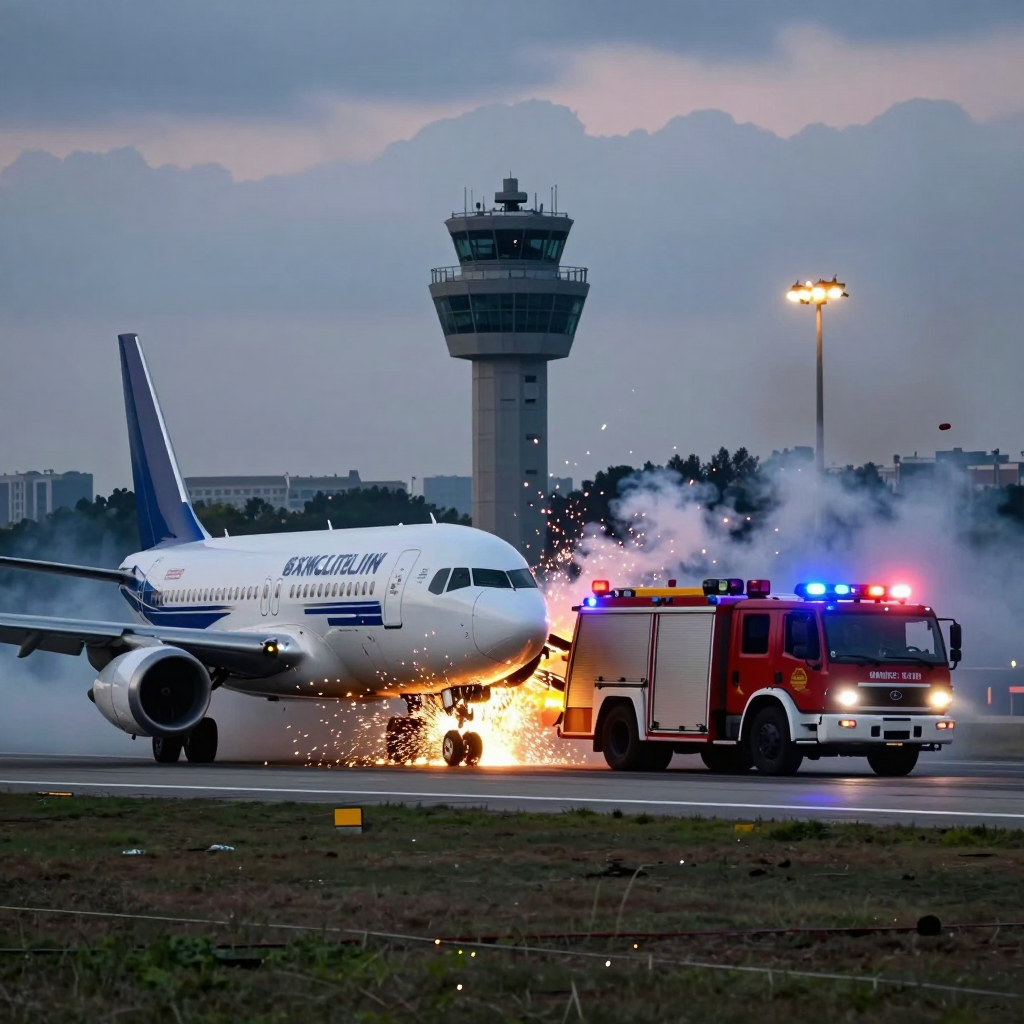
The incident happened around 11:45 PM local time on March 22nd on Runway 4 at LaGuardia Airport. Air Canada regional flight AC8646, arriving from Montreal, collided with a Port Authority rescue and fire vehicle while taxiing on the runway just after landing. The aircraft was moving at a speed of 93 to 105 mph (approximately 150 to 169 km/h), intensifying the devastating impact.
The damage was immense. Both the pilot and co-pilot lost their lives, and at least 43 passengers and personnel—including two Port Authority police officers—were rushed to hospitals. The front of the aircraft was severely damaged, with the cockpit completely destroyed by the force of the collision. This tragic LaGuardia plane crash quickly became more than a simple "accident," raising profound questions about the entire airport operation system.
What makes the initial circumstances even more shocking is that the fire truck did not just ‘recklessly’ enter the runway. The vehicle was responding to an emergency involving an odor problem inside a United Airlines aircraft and was reportedly attempting to cross Runway 4. According to air traffic control records, permission to cross the runway had been granted, but just before the collision, the controller repeatedly issued stop commands: “Stop, Truck 1. Stop.” The critical issue centers on how the clearance and stop commands became conflicting orders moments before impact, revealing possible communication and situational awareness failures.
The airport was temporarily closed immediately after the accident and reopened at 2 PM on Monday, but Runway 4 remained closed until Friday morning, causing unavoidable operational disruptions. Operating with a single runway inevitably led to increased delays and cancellations, starkly illustrating how difficult it is for a major airport to recover after such a catastrophe.
Now, all questions converge on one: On that tragic night at LaGuardia’s runway, who saw what, whose judgment was delayed, and why was that one crossing not prevented? In the following section, we will examine air traffic control staffing and communication records to closely analyze potential causes of the accident.
The Hidden Truth at the Crash Scene: Traffic Control Issues at the Moment of Collision (LaGuardia Plane Crash)
Why did the air traffic controller repeatedly order the fire truck to stop as it crossed the runway? Delving into the urgency of the situation reveals that the core of this LaGuardia plane crash may not be a “simple accident,” but rather a moment exposing a fracture in the traffic control system.
What the Repeated “Stop” Commands Signify
According to accident records, the fire truck was crossing Runway 4 from Taxiway Delta with permission granted. Yet just before the collision, the controller issued multiple stop commands like, “Stop, Truck 1. Stop.” This suggests the controller either recognized the danger at the very last moment or that the situation changed so abruptly that the previously given clearance was no longer valid.
In other words, the very fact that “stop” was repeated reflects that the runway had already slipped beyond “manageable control,” entering a critical phase where the possibility of collision was increasing by the second.
Why Did the Collision Happen Despite the Clearance?
The hardest question in this case remains: If clearance was granted and stop orders were given, why did the collision still occur? Possible explanations narrow down to a few key points:
- Visual illusions in runway entry timing: At night, judging distance and speed is difficult, leading to misperception that the aircraft was “still far away.”
- Delay between command and execution: There is always a reaction gap between when instructions are given and when the vehicle actually stops—this delay is especially lethal during emergency responses.
- Conflicting priorities: The fire truck was responding to an urgent call from another aircraft. The pressure to “move quickly” may have conflicted with the controller’s orders to “stop right now.”
Ultimately, once the runway is compromised, both vehicles and aircraft carry irreversible physical momentum. In fact, the aircraft was moving at approximately 93 to 105 mph (150 to 169 km/h) just after landing, leaving very limited room to maneuver and avoid collision.
A More Fundamental Question: Was Controller Work Overlapping?
The controversy around this LaGuardia plane crash intensifies given observations that landing clearances and vehicle crossing commands might have been issued via the same radio channel. Normally, ground and tower control duties are separated to allow for cross-verification (double checks).
If a single controller handled both roles simultaneously, the control tower may have become unstable in this way:
- Losing track of vehicle movement while focusing on aircraft landing sequences
- Granting crossing clearance without having the chance to reassess the aircraft’s approach speed
- Shouting “stop” when the problem was already beyond recovery
Though this remains unconfirmed pending investigation, this hypothesis offers the most realistic explanation for why repeated “stop” commands were issued: clearance had been granted, the danger detected, and stop orders shouted—but the window to act was simply too narrow.
Summary: The “Last Call” Reveals the System’s Vulnerability
The controller’s repetitive stop commands are less evidence of error and more a record that the last line of defense against collision was activated. The problem was that by the time this defense kicked in, the runway already hosted factors that couldn’t be undone.
Now, the NTSB must use CVR, FDR, and controller staffing analyses to uncover a critical truth:
Why did risk awareness only manifest as frantic “stop” calls, and what gaps made those calls ineffective?
Behind the Laguardia Plane Crash: Could One Controller Have Played Two Roles?
Landing clearance and vehicle control at the same time? The staffing arrangements in the air traffic control tower may hold the key clue to this accident. What draws particular attention in the Laguardia plane crash isn’t just “why was a fire truck on the runway,” but rather, who was controlling the situation and through what system?
The ‘Role Overlap’ Suspicion Revealed in a Single Voice
The question raised in the incident records is fairly straightforward. In normal airport operations, roles tend to be divided:
- Ground Control: Manages the movement of vehicles and aircraft on runways and taxiways
- Tower Control: Handles aircraft landing and takeoff clearance and manages final approach phases
However, audio recordings from the control tower suggest that the same voice appeared to be issuing both the landing clearance and managing the fire truck’s runway crossing. A former FAA official proposed the possibility that one controller was performing both roles simultaneously. This leads to a deeper question beyond mere staffing issues: was the ‘segregation of duties’ safety net actually maintained in real-time operations?
Why Could ‘One Person Doing Both Jobs’ Become Dangerous?
It’s undeniable that during night shifts or low traffic periods, combining duties occasionally happens. The core problem isn’t the combination itself, but the cognitive overload during complex, simultaneous situations. In this case, multiple critical factors coincided:
- The aircraft was moving at high speed (approximately 150–169 km/h) immediately after landing on the runway
- Emergency response vehicles, including rescue and fire trucks, were attempting to cross the runway
- The controller repeatedly issued stop commands moments before the collision (“Stop, Truck 1. Stop”)
If one person was managing both the landing flow and ground vehicle movements concurrently, there is a high risk of conflicting priority decisions, timing of radio calls, and situational updates. Rather than simply concluding a control error occurred, the key question becomes whether the operating conditions made such errors likely or unavoidable.
Key Points to be Clarified in the Investigation
The NTSB is currently reviewing the number of controllers on duty and their role assignments at the time of the collision. Of greater importance than the headcount are questions such as:
- Were ground control and tower control actually separated in practice at that moment?
- If separated, was the handoff and communication system between them functioning properly?
- Were there additional verification procedures (e.g., re-confirmation calls, runway access blockers) activated for the emergency vehicle’s runway entry?
- Despite repeated stop commands, if the vehicle did not stop, where did the failure occur—in communication reception, understanding, or procedural compliance?
The Laguardia plane crash cannot be explained solely by the fact of ‘runway incursion.’ Once it is revealed how the staffing and role design within the control tower were applied in actual operations, the true contours of the accident’s cause will come sharply into focus.
Warnings from the Past, Lessons for Today: The Repeated Near-Miss Incidents at LaGuardia Airport (laguardia plane crash)
Three decades of runway close calls. Was the recent laguardia plane crash merely an unlucky coincidence, or was it a repeated failure of a system that had been accumulating warnings? LaGuardia Airport’s history suggests a “structural risk waiting to explode someday” has consistently existed.
Signals Left by Repeated ‘Heart-Stopping Moments’ (laguardia plane crash)
For decades, LaGuardia has experienced numerous near-miss incidents as aircraft and ground vehicles shared the same space. The following cases clearly demonstrate that “the danger did not end after just one incident.”
- 1996: A landing aircraft spotted an airport vehicle on the runway and performed an emergency stop, narrowly avoiding a major accident.
- 1997: A Gulfstream 2 collided with a maintenance vehicle, but no fatalities occurred. Ironically, the absence of deadly consequences may have reduced overall vigilance.
- December 2000: An A320 passed perilously close—approximately 50 feet above—a snowplow vehicle.
The common theme among these incidents is the paradox that “it was more dangerous precisely because there was no accident.” Repeated near-misses cause the environment to become desensitized to risk (normalization of deviance), making small procedural lapses or communication errors more likely to accumulate.
Why Are ‘Near-Miss Incidents’ Repeated? Structural Vulnerabilities (laguardia plane crash)
The circumstances of the latest crash—runway crossing clearance, repeated stop commands, questionable night staffing—raise the same questions as past near misses. The core issue is not a single individual’s mistake, but an environment where an error quickly escalates into a catastrophic accident.
- Runways are the most dangerous intersections. Aircraft move at high speed just after landing, and ground vehicles must often enter urgently due to their mission.
- As radio communications and control complexity increase, moments arise when “clearance granted” conflicts with urgent “stop” orders.
- When operational conditions tighten, such as with controversial night shifts, role separations loosen and verification procedures risk being shortened.
Past near collisions were “failures saved by luck,” and the recent laguardia plane crash shows that luck has run out.
Lessons Needed Now: Look Beyond ‘Incidents’ to See the ‘Pattern’ (laguardia plane crash)
If this accident is viewed only as a one-off tragedy, solutions may focus solely on individual responsibility or temporary checks. However, LaGuardia’s history reveals a buildup of repeated near-misses. The key lesson is simple yet vital: Do not reduce the cause of accidents to a single mistake; trace them as recurring patterns.
Only then can future warnings be prevented from turning into yet another disaster.
Future Challenges and Solutions: Airport Safety Inspections and Investigation Status Following the LaGuardia Plane Crash
With the NTSB’s thorough investigation and a comprehensive review of airport safety protocols now underway, the recent LaGuardia plane crash is poised to become more than just a tragic incident—it could mark a turning point in transforming aviation traffic safety systems. The critical issue is not merely determining who was at fault, but closing the operational gaps to ensure that under the same conditions, nothing like this ever happens again.
Key Points in the Investigation of the LaGuardia Plane Crash
The NTSB has secured and begun analyzing the cockpit voice recorder (CVR) and flight data recorder (FDR). Especially because this incident involved a “runway collision between an aircraft and a ground vehicle,” the following questions will heavily influence the investigation’s conclusions:
- Continuity of control instructions: Was the fire truck granted permission to cross the runway, and why were the repeated “stop” commands just before the collision ignored?
- Adequacy of air traffic controller staffing: Was a single controller managing both ground and tower control simultaneously, potentially revealing structural issues in nighttime staffing?
- Effectiveness of runway entry and crossing procedures: How was vehicle access to the runway controlled during an emergency response, and at what points did these procedures exist but fail to operate effectively?
- Cross-risk in现场 operations: Did the overlap of managing an abnormal condition on another aircraft (takeoff halted due to a cabin odor) and the flow of arriving planes simultaneously intensify the danger?
Expected Changes in Airport Safety Protocols Following the LaGuardia Plane Crash
This accident cannot be resolved simply by “tightening regulations.” Changes that frontline personnel will immediately feel typically come as a combination of standardizing operations + introducing technological safety measures + restructuring staff deployment.
- Strengthening ‘double confirmation’ for runway crossing: In addition to controller approval, institutes more stringent vehicle call-back verifications and location confirmation procedures
- Redesigning nighttime air traffic controller staffing: If the current model demands a single controller to cover multiple roles, minimum staffing levels and shift operations may undergo critical reassessment
- Expanding runway incursion prevention technology: Widen the application of monitoring and alert systems that intuitively warn of ground vehicle and aircraft locations
- Realigning emergency dispatch protocols: Even when emergency response is urgent, runway access must be controlled in separate stages, clearly adjusting priority rules within the airport
The Challenge Left Behind by the LaGuardia Plane Crash: “Ensure Investigation Results Translate to the Field”
While the NTSB investigation will take time, the key moment is not the publication of conclusions but when those findings transform into onsite checklists, work schedules, and training scenarios. Airports like LaGuardia, which must operate a single runway during peak hours amidst heavy traffic and many variables, require rules redesigned to be easily followed in the field to truly prevent recurrence.
Ultimately, whether aviation traffic safety changes after this accident boils down to one essential question: it’s not whether procedures existed, but whether those procedures will be modified to function effectively amid congestion, nighttime, and emergency situations. That very challenge becomes both the greatest hurdle and the ultimate solution moving forward.
Comments
Post a Comment