 \n
\n
Physical AI: Touching the Future—The Moment AI Acts in the Real World
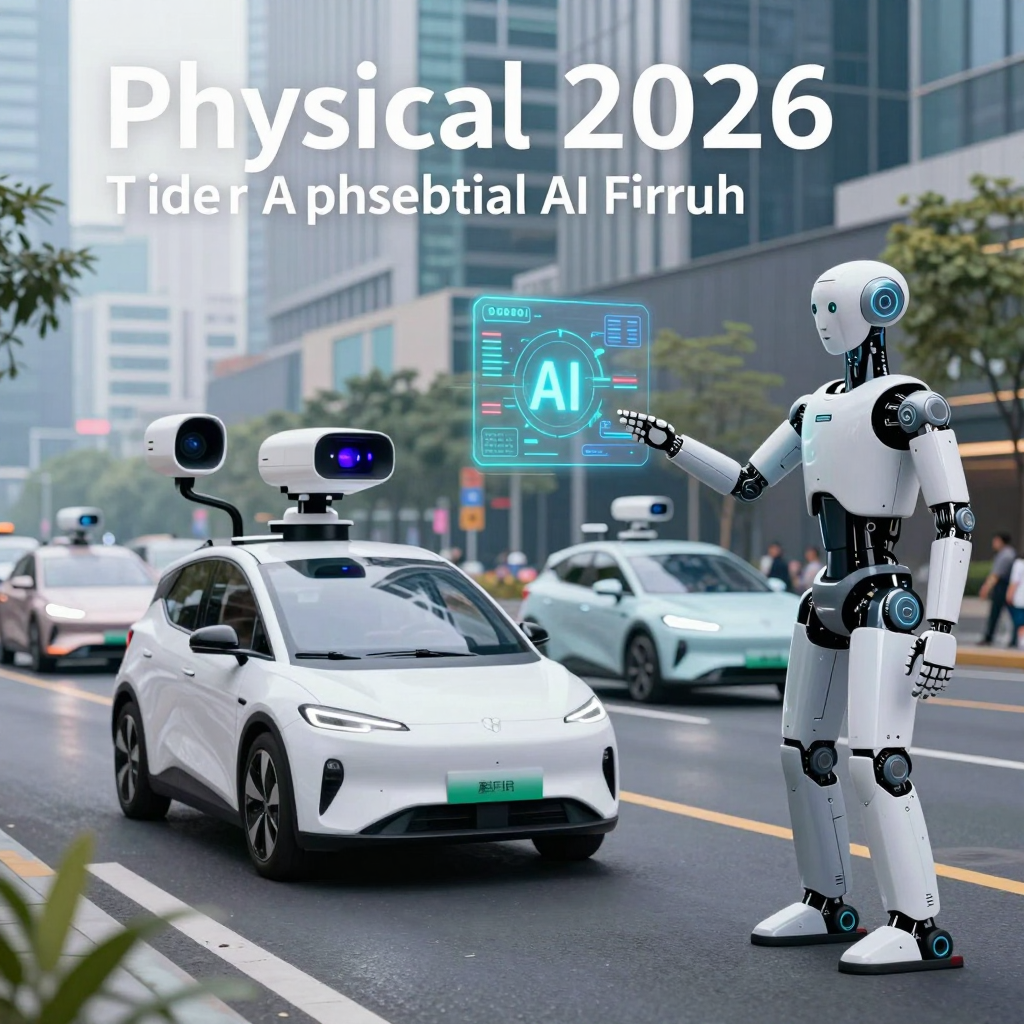
What happens when AI no longer exists just as information on a screen but makes autonomous decisions and takes action in the real environment? In 2026, Physical AI is breaking down that barrier.
Physical AI goes beyond summarizing text or classifying images; it is AI that integrates with physical systems like sensors, robots, and machines to perceive the real world, make decisions, and act in reality. In other words, AI has evolved from merely “thinking” to taking full responsibility for “acting.”
The Core Structure of Physical AI from an AI Perspective
To grasp Physical AI, remember the three essential stages it must pass through—unlike digital AI:
- Perception: Cameras, LiDAR, radar, microphones, and tactile sensors gather real-world data. The challenge is that real-world data is often incomplete and noisy. Physical AI fuses diverse sensor information to estimate “what is happening now” as accurately as possible.
- Decision / Planning: Based on perception, it sets goals and formulates action plans. This involves not just simple rules but complex variables such as human movement, friction, obstacles, time delays, and safety constraints, requiring sophisticated decision making.
- Action / Control: It executes the plan through motors and actuators. Since any error here can lead to accidents, Physical AI must simultaneously ensure control stability and real-time responsiveness.
Because of this structure, Physical AI is not just an AI that “answers correctly,” but one that safely achieves results amid an uncertain reality.
Representative Frontlines Transformed by AI: Autonomous Driving and Humanoids
Physical AI proves its value fastest in fields requiring movement and manipulation.
- Autonomous Vehicles: Surrounding vehicles and pedestrians are always in motion, and road conditions are full of exceptions. Physical AI reads the situation via sensors, makes real-time decisions like stopping, avoiding, or rerouting, and instantly links those decisions to driving controls. The crux is not just “driving well” but maintaining safety even in unpredictable scenarios.
- Humanoid Robots: To work in human-centered spaces—door handles, stairs, narrow passages, and diverse objects—they must do more than repetitive tasks; they must simultaneously maintain balance, manipulate objects, and collaborate with humans. Physical AI integrates visual, auditory, and tactile data to continuously calculate “what to grasp, how much force to apply, and in which direction to move.”
The Technical Significance of Physical AI: AI’s Stage Expands into Reality
The emergence of Physical AI marks a turning point where AI’s stage expands from digital space into the physical world. Reality suffers from data scarcity, constantly changing environments, and tiny errors that can cause great risks. Yet Physical AI harnesses machine learning–based training and inference to process complex variables and evolve in ways that work in real environments.
Ultimately, in 2026, Physical AI is no passing trend—it clearly shows AI’s trajectory from being a “tool” toward becoming an agent that moves and shapes the real world.
AI and Physical AI: Machines Reading, Feeling, and Moving Through the World
Beyond simple text generation or image analysis, Physical AI directly perceives the physical world through sensors and robots, responding in real time. This marks a shift from AI being "a tool that gives answers" to becoming "an agent that acts in reality." The core lies in its ability to make decisions and move while enduring the complexities of the real world (uncertainty, noise, unexpected situations).
How AI ‘Reads the World’: Sensor Fusion and Environmental Perception
The first step for Physical AI is observation. But real-world data is far from clean. Factors like lighting changes, reflections, rain, dust, and unpredictable human movements constantly occur. Therefore, Physical AI typically combines multiple sensors to increase reliability.
- Cameras (Vision): Provide rich information about object shapes, lanes, facial expressions, etc., but are heavily affected by light and weather conditions.
- Radar/LiDAR: Excellent at measuring distance and speed but involve trade-offs in data interpretation and cost.
- IMU/Encoders/Touch Sensors: Provide precise data on a robot’s posture, joint angles, and contact forces—the “state of the body.”
These sensor data go through sensor fusion and state estimation to probabilistically infer “where I am (self-localization), what surrounds me (object recognition), and how I’m moving (dynamics).” In other words, Physical AI’s perception goes beyond interpreting a single scene to continuously updating a world that changes over time.
How AI ‘Feels’: Touch, Force, and Stability Challenges
Unlike digital environments, ‘feeling’ in the physical world directly relates to safety. When a humanoid robot picks up a cup, “seeing the cup” alone isn’t enough. It must judge whether it will slip, break, or how much force to apply.
- Tactile/Force-Torque Sensors detect texture, slippage, and pressure distribution to adjust grip.
- Balance Control calculates physical quantities like center of mass shifts, joint torque, and ground friction in real time.
- Safety Constraints are essential when collaborating in human spaces, integrating force limits, speed restrictions, and emergency stop logic.
At this point, AI does not just “generate correct answers” but must choose actions that satisfy physical constraints. Hence, Physical AI evolves as a fusion of machine learning, control engineering, robotics, and safety engineering.
How AI ‘Moves’: Combining Planning and Control
Physical AI’s behavior generally follows this hierarchical structure:
- Goal Setting: Where to go, what to pick up
- Action Planning: Generating paths, avoiding collisions, deciding task sequences
- Low-Level Control: Motor torque/speed control, maintaining balance, fine manipulation
For example, autonomous vehicles predict pedestrian and vehicle movements to replan routes and immediately translate those decisions into steering, acceleration, and braking controls. Humanoid robots, when facing unexpected contact during object manipulation, adjust plans or re-calibrate force to prevent falls or damage. What matters most here is “real-time responsiveness.” The physical world doesn’t wait—AI must constantly observe, decide, and adjust its actions.
Why ‘Physical AI’ Is a Turning Point Now
Physical AI expands AI’s stage from digital into the physical realm. In other words, models are evolving from simply “speaking well” to technologies that grapple with real-world variables and risks to produce results. This transformation goes beyond flagship examples like autonomous driving and humanoid robots, marking the starting point for dramatically broadening AI’s impact in solving on-the-ground problems—logistics automation, manufacturing robotics, medical aids, disaster response, and more.
Stages of AI Innovation Unveiled by Physical AI
Autonomous vehicles and humanoid robots are no longer just “futuristic imaginations.” Physical AI is already reading reality through sensors, making judgments, executing physical actions, and transforming the very way we live. This shift is profound—not mere automation, but the emergence of AI that understands on-site variables and responds instantly.
AI Shining in Autonomous Driving: The Fusion of Real-Time Road Decisions
Autonomous driving is the flagship stage for Physical AI. The essence lies not just in “driving,” but in the entire process of interpreting reality every fraction of a second to make decisions.
- Perception: Cameras, radar, and LiDAR detect lanes, signals, pedestrians, and unexpected obstacles. Each sensor has different strengths and weaknesses (e.g., cameras excel at visual info, radar is more robust in bad weather), so sensor data is fused to enhance reliability.
- Prediction: AI probabilistically forecasts the next moves of surrounding vehicles and pedestrians. For example, if a pedestrian hesitates near a crosswalk, the AI calculates the likelihood of crossing and decides whether to slow down accordingly.
- Planning & Control: Choosing actions like lane changes, slowing, stopping, or evasive maneuvers, the vehicle is then controlled accordingly. Crucially, this is not just about maps or rules but the capability to handle the complexity and uncertainty of road conditions.
The implication is clear: while generative AI handled documents and digital worlds, Physical AI performs decision-making that concurrently satisfies safety and efficiency in shared human spaces. As a result, mobility is shifting from being “driving skill”-centered to “AI-driven mobility services.”
AI in Humanoid Robots: Versatile Workers Who Understand Human Spaces
Unlike factory-specific robots, humanoid robots are designed to work in spaces built around humans. They endure the “unfriendly standards” of reality—door handle heights, stairs, narrow hallways, and varied objects—demanding especially strong Physical AI.
- Multisensory Perception: Vision (cameras), touch (grippers/hand sensors), and balance (inertial sensors) operate simultaneously. When grasping objects, AI detects not only a visible position but also “slippage and pressure changes” to adjust grip strength.
- Balance & Walking Control: Walking like a human is easily disrupted by small disturbances. Physical AI quickly tracks changes in posture and fine-tunes foot placement and weight distribution to prevent falls.
- Manipulation and Collaboration: In variable tasks such as opening doors, moving boxes, or using tools, AI estimates object shape, friction, and weight to refine movements. When working with humans, it also considers collaboration rules like safe distance, movement prediction, and speed limits.
The real-life transformation driven by these robots goes beyond “robots doing work.” It heralds a shift toward returning time to humans in environments full of exceptions, such as logistics, facility management, and hazardous work support.
The Technical Message from Physical AI Applications: AI of “Adaptation” Not “Right Answers”
The power of Physical AI applications stems from reality always being loaded with incomplete information and exceptions. Sensors include noise, environments constantly change, and humans move unpredictably. Therefore, Physical AI’s strength lies not only in data-processing speed but in learning-based rule induction (machine learning) and adapting effectively to real-world conditions.
Ultimately, autonomous driving and humanoid robots surpass “automation of specific functions” to become the most realistic stages showcasing how far AI can extend in managing the complexity of the physical world.
A New Horizon Beyond Digital AI: Physical AI Unlocking Reality-Adaptive Intelligence
Physical AI changes the game by going beyond mere algorithmic performance—it is AI that actively understands and instantly responds to the complex real world. If digital-centric AI was the “brain handling information,” summarizing text and classifying images, Physical AI is intelligence expanded into the form of seeing (perceiving), thinking (judging), and moving (acting) in reality through sensors and machines. This shift places greater value not on delivering the “correct answer” but on the ability to generate safe, consistent behavior amid uncertain environments.
Why AI Struggles in the Real World: Uncertainty and Physical Laws
The real world isn’t a neatly organized dataset. Lighting changes, sensor noise, unpredictable human behavior, and physical variables like friction, inertia, and collisions all operate simultaneously. Physical AI must solve these challenges at once:
- Partial Observability: “Hidden information” always exists, such as camera blind spots and LiDAR reflection errors.
- Real-time Responsiveness: Delayed judgment can cause accidents; even millisecond delays can be fatal.
- Safety Constraints: High performance is meaningless if the AI behaves dangerously.
- Distribution Shift: Unforeseen scenarios—rain, snow, construction zones, new objects—constantly arise, differing from the training environment.
Thus, Physical AI’s performance is evaluated not by raw accuracy but by its ability to reliably generate behavior amid real-world variability.
Transformations from Applying Machine Learning and Inductive Reasoning to Reality
In Physical AI, machine learning moves away from “people manually coding rules” to inductively learning general rules from experience (data) to build behavioral strategies. Key technical trends include:
Multi-Sensor Fusion
Combining the strengths and weaknesses of diverse sensors like cameras, radar, LiDAR, and IMUs creates a more reliable model of the environment. For example, when cameras weaken in rain or darkness, radar data compensates.Situation Estimation and World Models
The AI doesn’t just gather observed information but also estimates “the likely state of the world right now.” This combines inference-based state estimation (e.g., filtering) with learning-based representation, which governs the stability of subsequent actions.Decision Making and Control
Based on perception results, the AI generates behaviors like path planning, obstacle avoidance, and speed control. Since physical constraints must be met, this stage often blends learned policies (reinforcement learning, etc.) with classical control methods.Simulation-to-Reality Transfer (Sim2Real)
Learning in simulators helps avoid costly or risky real-world data collection, but minimizing the gap when deploying in reality is crucial. Techniques like domain randomization, online adaptation, and calibration help bridge this divide.
The implication is clear: Physical AI’s breakthrough lies not in “smarter answers” but in a structural evolution where inductive learning about reality connects directly to action.
The Definitive Factor Distinguishing ‘Digital AI’ and ‘Physical AI’: Accountability in Action
While generative AI focuses mainly on the quality of outputs, Physical AI carries responsibility for the consequences of its actions. Autonomous vehicles’ stopping, avoidance, and lane changes are directly tied to safety, and humanoid robots’ small mistakes in balance or object manipulation can cause accidents. Therefore, Physical AI requires these capabilities:
- Quantifying uncertainty and acting conservatively (e.g., slowing or stopping when risks rise)
- Fault tolerance assuming failure (maintaining minimal function even if some sensors fail)
- Verifiable safety (including testing, validation, and monitoring systems)
In the end, this new horizon beyond digital means the moment AI expands from “technology that generates information” to technology that safely handles reality. Physical AI stands at the forefront of this transition, driving the most direct changes in our everyday lives and industries.
Physical AI Writes the Next Chapter of Our Lives: The Era When AI “Sees, Touches, and Acts”
AI no longer works confined to screens. Now, it touches with hands, sees with eyes, and acts directly. Physical AI combines sensors (vision, hearing, touch) with physical systems like robots and machines to perceive reality, make judgments, and generate physical outcomes. In other words, it has evolved beyond being an “answer-generating AI” to becoming an “on-site task-performing AI.”
The Technical Framework of Physical AI: How AI Moves in the Real World
For Physical AI to operate seamlessly in real environments, the following pipeline must connect flawlessly:
- Perception: Cameras, LiDAR, radar, microphones, force/torque sensors measure the surroundings to estimate objects, distances, speeds, and contact states.
- State Estimation: Since sensor data includes noise and gaps, filtering and fusion processes reliably compute “where I am now and how things are moving.”
- Planning & Decision: The next action is selected by simultaneously considering goals (e.g., reaching a destination, grasping an object) and constraints (safe distances, joint limits, traffic rules).
- Control: The selected action is transformed into commands for actuators such as motors, steering, brakes, and grippers. Here, millisecond-level responsiveness and safe failure handling are crucial.
- Learning: Machine learning inductively acquires rules to adapt to complex variables like unpredictable human movements, friction changes, and lighting variations.
This flow makes one thing clear: Physical AI is not just a technology that “gives answers,” but an AI that handles real-world uncertainties and takes responsibility for actions.
How Physical AI Transforms Daily Life: Beyond Autonomous Driving and Humanoids
While autonomous vehicles and humanoid robots are flagship examples of Physical AI, its impact reaches far wider.
- Automation of Mobility: Autonomous driving continuously perceives road environments to make decisions like stopping, avoiding obstacles, and changing lanes. The core is not only maps or rules but the ability to recognize exceptions on the spot and handle them safely.
- Roboticization of Homes and Offices: Humanoids are designed to operate in human-centered spaces (door handles, stairs, narrow paths). When combined with vision- and touch-based object manipulation, balance control, and human-robot collaboration, they extend beyond simple repetitive tasks to unstructured and flexible work.
- Real-Time Optimization in Manufacturing and Logistics: Sensors monitor production lines, and robots adjust tasks so that manufacturing becomes not a “fixed recipe” but a process that dynamically adapts to the situation.
Ultimately, Physical AI transfers digital productivity into the physical world, proving results not by “clicking” but by “completing tasks.”
Changes We Must Prepare for in the Physical AI Era: Safety, Responsibility, and Capability
Physical AI brings clear challenges alongside convenience.
- Safety and Validation: Unlike text errors that can just be corrected, errors in physical actions can lead to accidents. Therefore, a multi-layered safety system—including simulations, field tests, formal verifications, and safety constraint controls—is essential.
- Responsibility and Governance: Trackable logs, audits, and operational policies become critical to answer who made the decision (model), who configured it (operator), and who approved it (organization).
- Reconfiguration of Job Skills: More people will “use” robots. On-site roles will expand to robot operation, sensor calibration, data labeling/management, and safety protocol design, while existing jobs may shift toward supervision, exception handling, and quality control.
Physical AI is not just a technology trend—it is a turning point that fundamentally transforms how we work in reality. The key question going forward won’t be “What can AI say?” but rather “What can AI safely accomplish?”
Comments
Post a Comment