 \n
\n
Pi Day: Where Math Meets Mystery — día del número pi
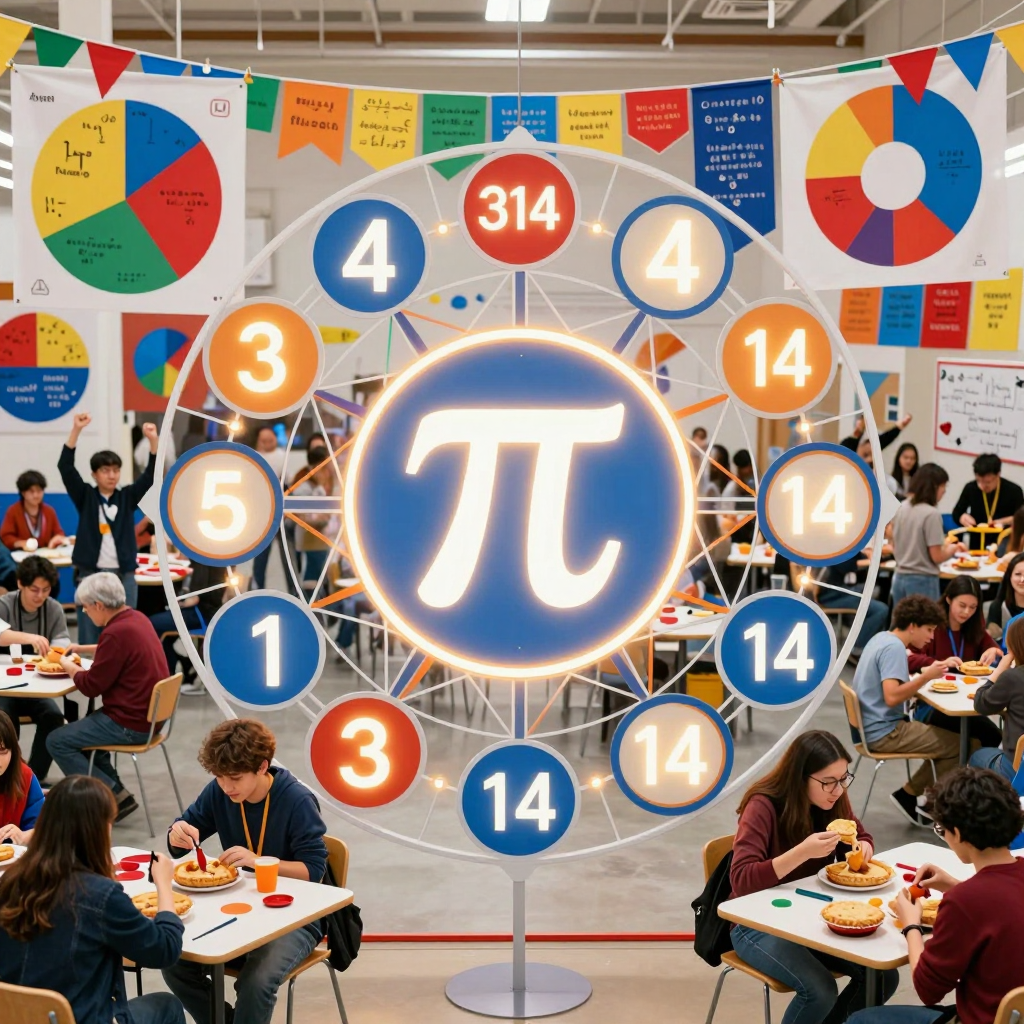
Do you know that March 14th is more than just a date? It’s a special day celebrated worldwide to honor the most enigmatic constant in mathematics — Pi (π). Because the American date format 3/14 perfectly matches Pi’s famous approximation 3.14, this day naturally earned the name Pi Day.
But Pi Day is more than just a commemorative date; it’s a festive celebration of “how math explains reality.” Pi (π) begins simply as the ratio of a circle’s circumference to its diameter, yet its value unfolds into an infinite, non-repeating decimal that sparks endless mathematical curiosity. That’s why in some countries it’s called día del número pi in Spanish — different languages, same sense of wonder.
This tradition truly took off in 1988 at San Francisco’s Exploratorium, when physicist Larry Shaw launched the first official event. Since then, the celebration has spread through schools, science museums, and universities, becoming a cultural phenomenon. With the U.S. Congress officially recognizing Pi Day in 2009 and UNESCO declaring March 14 International Day of Mathematics in 2019, the significance of this day has only deepened. March 14 is no longer just a “nice number to commemorate” — it’s a symbol that transforms math into a daily festival of knowledge.
Today, the question that makes this day extraordinary is simple: Why do we get so passionate about a single number that never ends? The answer lies in the fact that Pi is not just a number — it’s where circles and curves, measurement and precision, and human curiosity all converge.
The Origin and Global Spread of Pi Day Alongside día del número pi
How did a small festival that began in San Francisco in 1988 transform into a worldwide international mathematics day? The starting point was the moment when physicist Larry Shaw at the San Francisco Exploratorium discovered the symbolism of the date “3/14” (3.14) and turned the idea of joyfully celebrating it into reality. The biggest turning point of Pi Day was transforming mathematics—which can feel rigid and dull—into the language of play and celebration.
This event didn’t stop as a simple gathering; it quickly spread to schools, universities, and science museums, becoming a “culture celebrating mathematics.” Participatory traditions like pi digit memorization challenges, hands-on workshops, and pie-eating contests that connect the pronunciation of ‘pi’ with ‘pie’ made it easy for anyone to join in. Thanks to this friendly format, the celebration naturally spread within Spanish-speaking communities as día del número pi, laying the foundation for it to transcend language and culture.
The decisive leap came with ‘official recognition.’ When the U.S. Congress officially recognized Pi Day in 2009, the festival, once a local event, expanded into a credible educational and cultural occasion. Then, with UNESCO’s declaration of March 14 as the International Day of Mathematics in 2019, Pi Day finally gained its identity as a global commemorative day. An idea born in a city’s science museum grew, fueled by education and culture, into an international language—this journey itself is the most symbolic story that Pi Day conveys.
Exploring Pi (π) with día del número pi: More Than Just the Circle Constant
Pi is more than just a number. It’s a bridge connecting circles and mathematics, and reaching into computer science—deeply woven into our daily lives. What is the true role of pi? The reason we celebrate día del número pi is not just because of the iconic “3.14,” but because π astonishingly broadens and deepens the way we explain the world.
π’s Core Role Beyond Circles
At its core, π starts as the simple ratio of a circle’s circumference to its diameter. Yet this ratio extends far beyond circles—wherever there are “rotations” and “curves,” π appears.
- The Language of Geometry: Calculating the surface area and volume of circles, cylinders, and spheres always involves π. The moment designers, manufacturers, and architects handle curved surfaces and circular components, π becomes a practical tool.
- The Measure of Precision: The commonly used 3.14 is just an approximation, but fields demanding high precision require far more digits. How accurately you need to deal with circles directly translates to how many digits of π you need.
π in Computer Science: Calculation, Verification, and Culture
Pi is not just a constant locked in math textbooks; it is a prime example of how computers handle ‘precision’.
- A High-Performance Testing Ground: Calculating digits of π serves as a classic task to test the performance of CPUs, GPUs, and distributed computing systems. The goal isn’t just the calculation itself but confirming how reliably a system performs massive computations—a “proving ground.”
- At the Intersection of Algorithms and Numerical Analysis: Diverse methods to compute π efficiently—from geometric approximations to modern rapid-converging algorithms—nurture essential computer science skills in accuracy, speed, and error management.
- Symbolizing Knowledge Sharing: Challenges to memorize π’s decimals or educational workshops on Pi Day exist for this reason. π stands as an icon of “knowledge that is challenging yet fun to approach,” connecting general audiences with academia.
Why Archimedes’ Approximation Still Matters Today
The ancient Greek Archimedes inscribed and circumscribed polygons within and around a circle, increasing the number of sides to narrow down π’s bounds. This is not merely an old method—it carries an important message that resonates today.
If a complex target is hard to tackle directly, create boundaries (upper and lower limits) and gradually improve accuracy. This approach mirrors modern mathematical thinking and problem-solving in engineering and computer science.
That’s what makes π even more fascinating. A constant starting with circles, becoming a tool to explain the world, testing technology through computation, and expanding into playful culture. día del número pi is the most intuitive stage showcasing that remarkable expansiveness.
The Festival Where Fun Meets Learning: día del número pi
Pi Day is the day that instantly shatters the stereotype that “math is hard.” From memorizing the digits of pi to pie-eating contests, classrooms, science centers, and public squares around the world burst with laughter and curiosity alike. More than just a simple celebration, día del número pi is a festival that naturally invites everyone—from children to adults—into the world of mathematics.
- Decimal Memory Challenge: Participants compete to see how far they can recite 3.141592…, experiencing both intense focus and the joy of achievement. It’s not just rote memorization; by discovering number patterns and sharing memory techniques (rhythms, phrases, storytelling), math transforms into a playful game.
- Interactive Workshops and Mini Lectures: Attendees can measure the ratio of a circle’s circumference to its diameter firsthand or engage in geometry puzzles and coding activities that inspire the question, “Why does π show up here too?”
- Pie-Eating Tradition: The pun between “pi” and “pie” completes the festive mood. A sweet slice of pie acts as the friendliest invitation to break down psychological barriers toward math.
When fun (games and treats) and learning (concepts and exploration) come together, pi stops being just a constant in textbooks and becomes a “culture to share and celebrate.” That’s why día del número pi, repeated every year, always feels fresh—drawing more and more people into the fascinating realm of mathematics.
From Archimedes to Google: The History and Future of Pi through día del número pi
From the innovative methods of ancient Greek mathematician Archimedes to Google’s latest interactive doodles, humanity’s quest to understand pi continues. Let’s look forward to the next generation of mathematical stories.
Instead of measuring the circle directly, Archimedes chose a geometric approach by overlapping polygons inside and outside the circle. As the number of polygon sides increased, the polygon’s perimeter approached the circle’s circumference, capturing π not as a single value but as a narrowing range. Notably, his technique of extending inscribed and circumscribed polygons up to 96 sides elevated the accuracy of approximation, marking a moment that went beyond simple calculation—a true “breakthrough through mathematical thinking.”
Today, día del número pi gains attention again because π is not just a legacy of the past but an ongoing story. Google’s interactive doodles vividly revive these historical computation methods, turning complex math into an “experience you can touch with your hands.” Though brief, these interactions embody a flow connecting classical geometry ideas with modern visualization technology.
The future of π is more than just competing to push its decimal points farther with faster computing. As educational content, simulations, and visualization tools evolve, π transforms from a “number to memorize” into a concept to understand and explore for many more people. The door Archimedes opened with polygons now extends to wider generations through digital experiences.
Comments
Post a Comment