 \n
\n
At the Heart of Tech Trends: Physical AI—The Innovative Technology Turning the Future into Reality
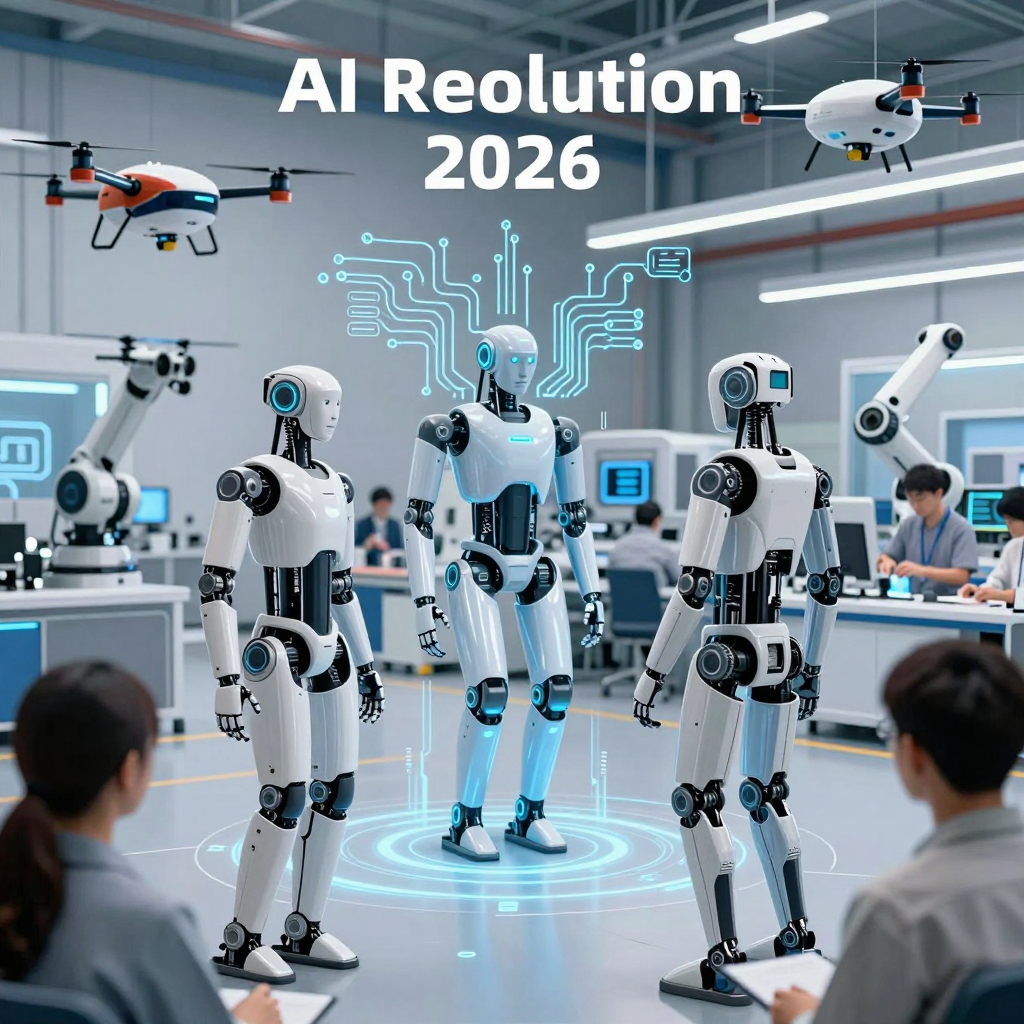
Physical AI, which combines the brainpower of AI with the body of robots, has taken center stage in technology trends for 2026. This is no longer “AI on screen,” but an AI that sees, decides, moves, and produces outcomes in the real world. So, how will this groundbreaking innovation transform our daily lives?
What Is Physical AI from a Tech Perspective?
In essence, Physical AI is a system that unites cognition (brain) + actuation (body) + environmental understanding (sensors) into one. While traditional AI excelled at analyzing text, images, and data to provide “answers,” Physical AI takes those answers and executes them through physical actions.
- Brain (AI Model): Understands situations, sets goals, and plans actions.
- Senses (Sensors): Uses cameras, LiDAR, force/torque sensors, etc., to perceive the surroundings.
- Body (Robotic Mechanisms): Performs actual tasks using wheels, joints, grippers, and more.
- Control (Real-time Control Systems): Executes planned motions stably and corrects errors instantly.
With this powerful combination, AI evolves beyond a mere “advisor” into a true on-site worker.
Signals of Realization Revealed at Tech Exhibitions
By March 2026, leading tech events showcased Physical AI not as a concept but as fully functioning products and services. Examples like a ‘camera robot phone’—a smartphone with an extending robotic arm tracking subjects—and ‘robot restaurants’ providing cooking, serving, and payment highlight a clear message: “AI is actively working in real spaces.”
The momentum is quickening domestically, too. Hyundai Motor Group Robotics Lab’s unveiling of the all-terrain mobile robot platform ‘MobED’, capable of reliable movement across diverse landscapes and environments, makes expansion into logistics, safety, and service sectors a tangible reality.
The Speed of Spread Driven by Tech Infrastructure: The Role of Semiconductors and Memory
One key reason Physical AI is rapidly advancing is that computational infrastructure has hit a critical threshold. Robots must not only be “smart” but simultaneously meet these demands:
- Real-time processing: Instantly analyzing sensor input to avoid collisions and complete tasks
- Power efficiency: Operating long hours on battery power
- On-device/edge computing: Minimizing latency and withstanding communication faults
Here, next-generation memory and semiconductors play a pivotal role. High-bandwidth, low-power memory technologies like HBM4 and LPDDR6 serve as foundational enablers to boost both AI computational speed and power efficiency—not just in data centers but also in autonomous driving and robotic control. Ultimately, this sets the stage for robots that “see faster, decide more accurately, and move more smoothly.”
Daily Life and Industry Transformed by Tech: Where Will Changes Be Felt First?
The impact of Physical AI won’t stay confined to select industries. Capital and innovation are increasingly flowing into mobility, drones, and robotics, while smart logistics sites see rapid adoption of automated new products and applications. The sectors where profound change will soon be palpable include:
- Logistics Automation: Enhanced sorting, transportation, and picking increase delivery speed and accuracy
- Smart Factories: Automation expands beyond repetitive tasks to processes requiring dynamic “situational responses”
- Service Robots: Evolving into integrated workflows for guidance, transport, and payment in stores, restaurants, and hospitals
- Autonomous and Mobile Robots: Mobility bridging indoor and outdoor environments becomes a key competitive advantage
In the end, Physical AI is not just “new hardware”—it heralds an operational transformation that reshapes how technology redefines real-world labor and services.
Physical AI Realized: Exploring the Evolution of Technology Through Real-World Examples
At MWC 2026, a smartphone equipped with a robotic arm and an autonomous cooking robot restaurant were unveiled. Physical AI has now moved beyond mere "possibility"—it has entered a phase where it is demonstrated through products and services operating right before our eyes. Here, focusing on showcased examples, we examine how Physical AI is becoming reality through technological evolution.
Smartphone with a Robotic Arm: The Fusion of ‘Sensing–Inference–Actuation’
The so-called camera robot phone unveiled at MWC 2026 features a robotic arm extending from the back of the smartphone that rotates 360 degrees to track subjects. Whereas traditional smartphone cameras function as “eyes that only capture images,” devices integrated with Physical AI transform into an architecture that sees (sensor), decides (AI), and moves (actuator) as one body.
Technically, this combines the following elements:
- Perception: Using camera input, it detects and tracks people, faces, and motions in real time. It goes beyond merely recognizing “where a person is” by estimating the subject’s speed and direction to predict their position in the next frame.
- Planning & Control: It calculates the robotic arm’s rotation angles, speed, and acceleration to create natural movements. The key here is a low-latency control loop—any delay in perception, inference, or control causes jittery images or lagging response, damaging user experience.
- Actuation Hardware: Miniature motors, gear/ring mechanisms, and durable design are all required. Fitting the actuator system within a smartphone’s form factor entails engineering that also addresses battery usage, heat dissipation, durability, and dust resistance.
This example sends a clear signal: Physical AI is no longer confined to robotics industries but is redefining consumer devices as ‘moving products’.
Cooking and Payment Automated: The Robotic Restaurant Demonstrates ‘End-to-End Automation’ Technology
The robotic restaurant demo illustrates Physical AI’s expansion beyond simple repetitive tasks to cover the entire service process (end-to-end). Cooking → serving → payment involve different environmental variables, and the key is tying these elements into one operating system.
For a robotic restaurant to function, the following technological stack must operate simultaneously:
- Environment Awareness and Safety: Kitchens are hot, slippery, and busy spaces with human movement. Robots must use cameras, LiDAR, depth sensors, and more to separate workers’ paths, predict collision risks, and have safety logic to slow down or stop accordingly.
- Manipulation: Grasping ingredients, handling tools, adjusting heat, and moving dishes all require contact-based control. Because each object varies in weight, friction, and shape, force control and grip strategies are essential.
- Workflow Orchestration: Order data, cooking sequences, inventory, and robot operation queues must connect not just to run “fast” but to run “stably.” In other words, one smart robotic arm isn’t enough; on-site operational software becomes a part of Physical AI.
- Standardizing Quality: Taste, movements, and speed—which previously depended on human skill—must be standardized through data. This involves repetitive learning, logging processes, and managing measurable performance.
Ultimately, the robotic restaurant shows not merely “robots cooking,” but the moment when on-site service is reconstructed based on data. Here, Physical AI moves beyond tech demos into business domains tied to actual sales and operational efficiency.
What These Cases Reveal in Common: Real-Time Performance and Reliability Are the Competitive Edge
The shared message from both cases is straightforward: Physical AI must not only be smart but also have reliable, repeatable operation in the field. Three major factors determine this:
- Low Latency (Real-time): Any delay in perception or control instantly leads to failure.
- Robustness: It must withstand real-world variables like lighting changes, noise, human interference, and unexpected objects without faltering.
- Safety and Compliance: The moment robots share space with humans, safety design becomes as critical as functionality.
Scenes from MWC 2026 demonstrate that Physical AI is no longer a laboratory experiment but evolving into product technology that withstands real-world constraints. The critical viewing point has shifted from “Can it be done?” to “How reliably, affordably, and broadly can it operate?”
The Spread of Physical AI Tech into Industrial Sites and Capital Markets
Curious about how Physical AI is revolutionizing industries, from the startup investment frenzy to new automation products in smart logistics? Physical AI has moved beyond the “cool demo” phase to become a technology that transforms cost structures on the ground. The core lies not just in introducing robots, but in uniting an AI brain (perception and reasoning) + robot body (mobility and manipulation) + data (on-site feedback) into a single operating system that redefines industrial productivity.
Physical AI Automation Realized in Smart Logistics Tech
Smart logistics is the frontline where Physical AI commercialization is happening fastest. The reason is clear: logistics operations involve repetitive tasks, with intense concerns over worker safety, labor shortages, and lead-time pressures, making the ROI (return on investment) immediately measurable. Recent exhibitions and market trends highlight the following directions:
- Advanced automation of picking and sorting: Automation is evolving from simple conveyor-based systems to robots that actually “grip, move, and stack” items. AI vision systems recognize product shapes, materials, and locations, while robot arms plan collision-free motion paths—these structures are becoming standard.
- Field-friendly AMRs/mobile robots: Instead of devices fixed to preset routes, mobile platforms that independently adjust their paths in spaces crowded with people, carts, and boxes are proliferating. This is a hallmark achievement of Physical AI technology combining sensor fusion (cameras, lidar, etc.) and real-time control.
- Integration with operational software: Logistics automation isn’t complete by placing robots alone. Connecting with WMS (warehouse management systems) and OMS (order management systems) to allocate tasks, avoid congestion, and handle exceptions (inventory mismatches, damages) requires an “operational brain.” Physical AI expands to this layer, shifting ‘automation units’ from mere equipment to entire ‘processes.’
The Mechanism Behind Physical AI Tech Spreading Across Industries
Physical AI is expanding beyond logistics into manufacturing, mobility, and services because the shared technological foundation is reusable. For instance, robot abilities in perception, decision-making policy, and precise control apply uniformly across sectors. Added to this, recent tech trends accelerate the pace of diffusion:
- Accumulation of field data and learning loops: Video, motion, and error data gathered on-site during operations feed back to improve models continuously. Once this “field-learning-redistribution” loop is established, performance improvements accelerate exponentially.
- Advancements in AI semiconductor and memory infrastructure: Progress in high-performance memory (HBM4, LPDDR6, etc.) and accelerators enables robots to perceive faster and control more delicately. AI computation is becoming feasible not just in data centers but also on edge devices (on-site equipment), reducing latency and enhancing safety, thereby lowering commercialization barriers.
Why Capital Markets Are Moving: The ‘Measurable Value’ Created by Physical AI Tech
From an investor’s perspective, Physical AI is attractive because it impacts quantifiable metrics like labor cost, error rates, uptime, safety incidents, and lead times. Thus, the growing influx of funding into mobility, drones, and robotics signals more than a fad—it reflects the arrival of “business models verifiable on the ground.”
- From CAPEX to OPEX shift: The model is moving away from buying robots once toward subscription/service models that cover operation, maintenance, and software updates. This lowers adoption barriers for companies while creating recurring revenue for suppliers—a structure favored by capital markets.
- From pilots to rollouts: Whereas proof-of-concept (PoC) stages once often stalled, now industries with standardizable processes—like logistics and manufacturing—can scale solutions from one site to many. Scalability becomes the core foundation of enterprise value.
Physical AI is no longer just futuristic robot showcases. On industrial floors, new automation products are transforming operational units, and in capital markets, Physical AI is valued as a scalable tech business. The moment has come when the question isn’t “Should we adopt robots?” but rather “Which processes should we redesign first with Physical AI?”
Core Tech Infrastructure: Next-Generation Semiconductors Power Physical AI
High-performance memory semiconductors like SK Hynix’s HBM4 (6th-generation High Bandwidth Memory) and LPDDR6 go beyond merely making AI “smarter”—they come remarkably close to actually ‘driving’ Physical AI in the real world. For robots to see (vision), hear (audio), make judgments (reasoning), and instantly control arms and wheels (control loops) like humans, computing speed and power efficiency must be maximized simultaneously. Without this foundation, Physical AI struggles to move beyond demos into real-world deployment.
Tech Insight 1: For Physical AI, ‘Latency’ Equals Safety and Performance
The essence of Physical AI is the continuous, real-time closed-loop flow of sensor input → AI inference → motor control without interruptions. The critical issue here is not just accuracy but latency.
- If the camera frames lag the moment a robotic arm grasps an object, the grip point shifts, causing collisions or damage.
- In autonomous driving or mobile robots, delayed decisions directly result in increased braking distances.
In other words, Physical AI demands not just fast computation but a memory and bandwidth architecture capable of ‘fast, continuous processing.’ Here, high-bandwidth HBM memory plays a decisive role.
Tech Insight 2: Why HBM4 Matters—‘Data Movement,’ Not Computation, Is the Bottleneck
AI workloads today are often constrained more by memory bandwidth and data transfer than sheer computational power. Large-scale model inference repeatedly cycles through:
- Fetching weights and activations from memory
- Performing computations
- Writing results back to memory
A lack of bandwidth idles GPUs/accelerators and lowers throughput. High-bandwidth memories like HBM4 supply more data within the same timeframe, directly boosting inference throughput while reducing latency. In highly real-time domains like Physical AI, this difference defines tangible performance.
Tech Insight 3: Without Power Efficiency, ‘Field Robots’ Collapse Under Operating Costs and Heat
Physical AI’s challenges extend beyond data centers; in on-site scenarios like robotic restaurants, logistics robots, and factory automation, constraints on power, heat, and space become immediate realities.
- Low power efficiency shortens battery life in robots, complicating charging and replacement logistics.
- Excessive heat raises the size of fans and cooling systems, triggering a vicious cycle of increased weight → higher motor load → greater battery consumption.
For these reasons, SK Hynix’s focus on power efficiency improvements (e.g., next-gen low-power memories like LPDDR6) is crucial—it’s not just about “performance enhancements” but directly linked to feasibility of real-world deployment. As Physical AI scales industrially, performance per watt becomes as important as raw performance.
Tech Insight 4: From Data Centers to Robots—Memory Innovation Connects the Ecosystem
Physical AI broadly spans two computational arenas:
- Data centers (training and large-scale inference): training massive models, simulations, refining robotic behavior policies
- Edge/on-device (real-time control): immediate robot reactions, sensor fusion, safety controls on-site
High-bandwidth memories like HBM4 accelerate training and inference speeds at data centers, fueling the evolution of the robot’s “brain,” while low-power memories in the LPDDR family support continuous operation and heat suppression at the edge. Ultimately, next-generation memory semiconductors serve as the critical tech infrastructure link that enables Physical AI’s “brain” and “body” to evolve together.
Tech Conclusion: The Real Battleground of Physical AI Is Not Just ‘Models’ But ‘Memory’
Physical AI cannot be realized by sleek robot designs or high-performance models alone. It requires a semiconductor foundation that meets real-world demands of real-time responsiveness (latency), throughput (bandwidth), and operational viability (power and heat).
Thus, SK Hynix’s roadmap for next-gen memories like HBM4 and LPDDR6 stands as the crucial engine enabling Physical AI to shift from “feasible technology” to “operational business.”
Physical AI from a Tech Perspective: Beyond Innovation to a Business Revolution
Physical AI is rapidly entering domains where the “field” itself becomes the stage, such as autonomous driving and remote surgery. The key question now goes beyond what robots can do to how they reshape industrial structures and reorganize existing markets. By combining AI’s decision-making prowess with robots’ physical execution capabilities, Physical AI is directly transforming the offline economy—territory where digital innovation hadn’t reached before.
Shifting the ‘Center of Value’ Across Industries
As Physical AI spreads, industry KPIs shift from “automation rates” to “on-site performance.” In other words, the real competitive edge lies in how much productivity, safety, quality, and lead times improve after deploying robots.
- Autonomous Driving & Mobility: Moving beyond simple driving automation, operations like delivery, shuttles, and logistics become service offerings. Vehicles transform from mere transport tools into 24/7 robot platforms, with insurance, maintenance, monitoring, and data businesses growing alongside.
- Remote Surgery & Medical Robotics: Digital assistance and standardization of physician expertise broaden surgical access. The core lies not just in the robotic arms, but in medical operating systems integrating ultra-low latency communication, sensor feedback, fail-safe control, regulatory approvals, and liability models.
- Smart Factories & Logistics: Workers step away from repetitive tasks as sites get redesigned for “human+robot” hybrid operations. When robots handle picking, transport, and inspection in warehouses, companies compete not just on labor cost savings but through inventory turnover and delivery schedule accuracy.
- Service Industries (Retail & Food): As seen at MWC 2026, automation spanning ordering, cooking, serving, and payment transforms store formats. These become spaces operated by robots and designed by humans to craft experiences rather than just places run by people.
The Technological Battleground Lies More in ‘Body and Infrastructure’ Than ‘Brain’
For Physical AI to spark a business revolution, superior model performance alone won’t suffice. The technical demands on real-world deployment are stringent.
- Real-time Control and Safety: Robots operate in unpredictable environments. Safety functions like collision avoidance, force control, and emergency stop depend not on “just smart AI” but on verifiable control logic fused with sensor data.
- Edge Computing and Low Power: Factories, hospitals, and road sites lack flawless network coverage. Some decisions must be processed immediately within the robot, requiring semiconductor technologies like high-bandwidth memory (HBM4) and next-gen LPDDR (e.g., LPDDR6). Computational efficiency translates directly into uptime, maintenance cost, and scalability.
- Data Flywheel: As robot numbers grow, vast field data (video, tactile, force, location) accumulates, fueling further performance gains. The critical factor isn’t just data collection but the operational capabilities around labeling, validation, simulation (digital twin), and update deployment (MLOps/RobotOps).
Economy and Daily Life Transformed by ‘Servitization’ and ‘Redesign’
With Physical AI’s diffusion, companies are likely to buy robots more for the “outcomes” than just as “equipment.” Monthly subscriptions and performance-based billing like RaaS (Robot as a Service) will rise, creating ecosystems where manufacturers, software firms, and operators specialize and collaborate.
From a lifestyle perspective, logistics, caregiving, medical services, and mobility become more finely interconnected, enabling individuals to receive more services without waiting. Simultaneously, jobs won’t vanish but transform. Repetitive tasks decrease, while new frontline tech roles in operations, monitoring, maintenance, safety, and data quality expand.
Final Outlook: Physical AI Becomes the OS of the ‘Field Economy’
Physical AI is evolving not as a mere new product from a handful of companies but toward an operating system (OS) that runs industrial sites. Rapid standard setting will happen first in high-stakes fields like autonomous driving, remote surgery, and logistics automation, spawning myriad services atop those standards. Ultimately, the winners won’t be those who build the most robots, but those who deploy them reliably on-site, deliver continuous updates, and simultaneously prove safety and profitability.
Comments
Post a Comment