 \n
\n
The Gamechanger of the IoT Industrial Revolution: The IoT-Based Metaverse Is Coming
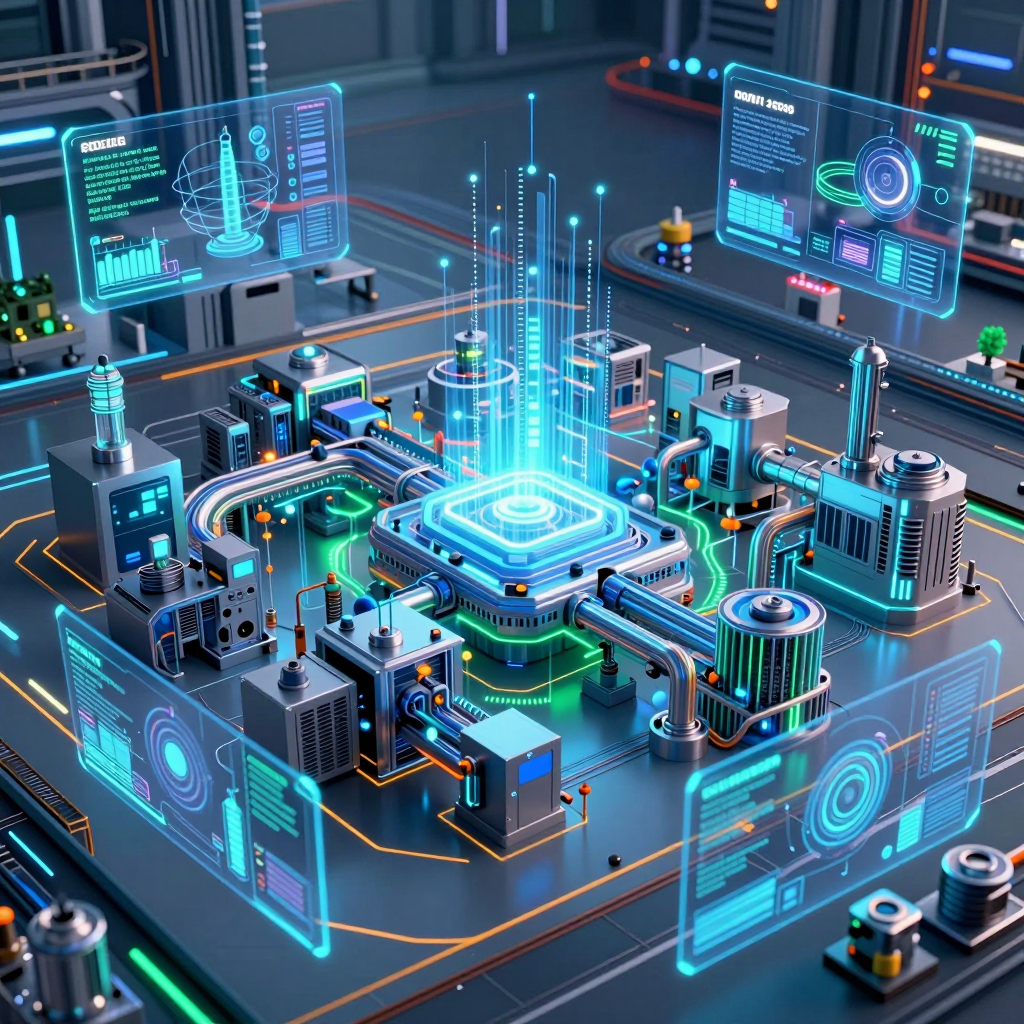
What if, by 2026, real factories and urban infrastructures were perfectly replicated in a virtual world? It would no longer be just about “monitoring data.” Based on information collected by IoT sensors, real machines, production lines, power facilities, and transportation infrastructures would be mirrored and simulated in real-time within virtual spaces, transforming onsite operations into predictable and controllable systems. This is the core transformation behind the IoT-based industrial metaverse that will shake up the industrial landscape.
What Is the IoT Industrial Metaverse? From ‘Observing IoT’ to ‘Reproducing and Controlling IoT’
In short, the industrial metaverse is an environment that replicates the physical world in real time within a virtual world, performs physics-based simulations, and connects these simulations to decision-making and control. While traditional IoT focused on “collecting states from sensors and viewing them on dashboards,” the industrial metaverse takes it to the next level.
- Creating virtual replicas of real-world assets (equipment, lines, buildings, urban infrastructure)
- Keeping these replicas continuously synchronized and up-to-date with IoT data
- Testing failure, delay, and risk scenarios first in the virtual environment
- Then safely applying verified actions to the real systems
A crucial premise here is that the virtual world is not just a “plausible imitation” of reality but a model that behaves like the real thing by reflecting physical laws and operational conditions. Only then does the simulation outcome directly translate to onsite performance.
Advancing IoT Digital Twins: From Real-Time Insights to Automated Operations
At the heart of the industrial metaverse lies the digital twin. A digital twin is a virtual model tracking the lifecycle and state of physical entities such as machines, equipment, processes, or buildings. When combined with IoT sensors, it offers near real-time insights. But “insights” here go beyond simple alerts—they extend to operational-level decision-making like:
- Predictive Maintenance: Early detection of anomalies using sensor data such as vibration, current, temperature, and pressure; calculating failure probabilities
- Process Optimization: Reproducing line bottlenecks, energy waste, and quality variance in the digital twin to explore optimal conditions
- Safety Enhancement: Verifying and refining prevention rules for accident scenarios like hazardous area entry, equipment collisions, and overloads within the virtual environment
- Remote Operations: Understanding conditions and simulating the effects of changes without physically visiting the site
Especially as demonstrated in various industries, the fusion of AI and IoT analyzes power parameters, equipment-level data, and energy consumption in real time to dramatically accelerate onsite operational decision speed. In effect, digital twins evolve from “models for reports” into an operational engine driving the field.
IoT Edge-Cloud Integrated Infrastructure: The Tech Stack Powering Real-Time Metaverses
For the industrial metaverse to be truly “real-time,” robust infrastructure is essential. Factories and urban infrastructures generate massive data volumes, demand ultra-low latency, and require strict privacy and security. The key to solving these challenges is the combination of edge computing and cloud.
Edge Computing (processing near the field)
- Performs initial sensor data refinement, event detection, and emergency control locally
- Reduces network latency for immediate response
- Cuts bandwidth load, improving cost efficiency and reliability
Cloud (large-scale analytics and learning)
- Aggregates long-term data, trains large-scale models, and optimizes across multiple factories and cities
- Manages policies and standards centrally, distributing updates
The importance of this architecture is simple: industrial sites demand both “fast outcomes” and “precise analysis.” Edge-cloud architecture strikes a realistic balance among response speed, cost, and privacy, enabling immersive simulations and controls in IoT-based metaverses.
IoT Standardization and Interoperability: The Final Puzzle Linking Diverse Equipment into One World
The reality of industrial environments is that manufacturers, equipment, and protocols are all different. For the industrial metaverse to become a true “single world,” standardization of data formats and semantic connectivity (understanding the same data with the same meaning) are indispensable. Advances in industrial communication protocols like Modbus, OPC-UA, and MQTT lay the groundwork for such interoperability.
In summary, the success of the IoT-based metaverse is not about flashy technology, but because connections and interpretations are consistent. When different equipment reads data with the same meaning, simulates with the same rules, and makes decisions by the same standards, the virtual world becomes not a mere “demo” but the standard platform for operations.
IoT Digital Twin: The Bridge Connecting Reality and Virtuality
A digital twin that reflects every movement and change of physical equipment in real-time transforms the “invisible field” into a visible data-driven space, accelerating industrial innovation at a rapid pace. So, how does an IoT-based digital twin revolutionize the operation of actual factories and facilities?
The Core of IoT Digital Twins: ‘Real-time Mirroring’ and ‘Physics-based Simulation’
A digital twin is not just a simple 3D model or dashboard. Based on data collected from IoT sensors (vibration, current, temperature, pressure, location, energy consumption, etc.), it synchronizes the status of physical equipment in the virtual space almost in real-time and performs simulations that reflect physical laws on top of that.
- Real-time Mirroring: Instantly reflects the current state, enabling precise insight into “what is happening right now”
- State Estimation and Prediction: Estimates internal conditions that are difficult to measure directly with sensors (wear, degradation, lubrication status, etc.) through modeling
- What-if Simulation: Pre-validates how changes in production conditions, speed, or load will affect quality, energy use, and failure risks
In other words, a digital twin acts as a laboratory that both replicates reality and tests the future.
Three Ways IoT Digital Twins Transform the Field
1) Improved Accuracy in Predictive Maintenance
As IoT data accumulates, the digital twin distinguishes normal patterns from anomalies and estimates failure probabilities. This shifts the approach from “repair after failure” to “replacement before failure,” reducing downtime and enabling part replacements only when necessary, avoiding excessive maintenance.
2) Operational Optimization (Simultaneous Improvement of Quality, Energy, and Productivity)
By analyzing energy consumption, process conditions, and production volume collectively on the twin, bottlenecks and waste factors are quickly identified. For example, correlating motor load, power consumption, and production speed to find optimal operating points can target both energy cost reduction and quality stabilization.
3) Enhanced Remote Collaboration and Safety
Sharing the digital twin within an industrial metaverse environment allows understanding of equipment status on a common “single screen” without being physically onsite. Replacing hazardous tasks with simulations or detecting anomalies early and issuing alerts establishes a structure that lowers the risk of safety accidents.
The Technological Infrastructure Enabling IoT Digital Twins
To approach ‘real-time’ digital twins, data processing delays must be minimized. This is where edge computing becomes crucial in the field. Edge processes and analyzes data near the sensors, enabling immediate control and alerts, while the cloud handles long-term data storage and large-scale model training. This combination satisfies a practical architecture that simultaneously achieves minimal latency, bandwidth reduction, and a balance between privacy and efficiency.
Moreover, to integrate equipment from various manufacturers into a single twin, data format standardization and semantic linkage must follow alongside industrial protocols like Modbus, OPC-UA, and MQTT. Only then can data between facilities be integrated beyond mere “connection” into a state of being meaningfully understandable.
Ultimately, the digital twin is a bridge built on IoT-generated data flows that elevates decision-making speed and accuracy on the ground. By making the unseen interiors of facilities transparent and allowing testing before changes, it brings industrial innovation down to an ‘actionable’ level.
From IoT Edge to Cloud: The Secret to Perfect Data Processing
What happens if there’s no technology to process the massive big data generated by countless IoT sensors in real time? Data piles up endlessly, on-site decision-making is delayed, and digital twins and industrial metaverses degrade from “real-time” marvels into mere “after-the-fact” reports. The solution isn’t simply bigger servers—it lies in optimal infrastructure design where edge computing and cloud share their roles perfectly.
Three Bottlenecks Created by Exploding IoT Data
- Latency: Even if equipment anomalies are detected, lengthy network round trips miss critical control timing.
- Bandwidth: High-frequency vibration, video, and power quality data generate massive transmission loads, inflating network costs and causing congestion.
- Reliability: On-site connections aren’t always stable. Disconnections halt observation and control simultaneously.
Edge computing solves these bottlenecks by handling data “first at the source,” while the cloud extends value by “aggregating massively and analyzing deeply.”
What IoT Edge Computing Must Do: Fast, Proximate Real-Time Processing
Edge computing performs calculations close to the data source (sensors, PLCs, gateways) to reduce response times and save bandwidth. From an industrial metaverse or digital twin perspective, the edge is ideal for:
- Real-time filtering and summarization (Pre-processing): Noise removal, outlier filtering, event-driven sampling (“send only on change”)
- On-site inference: Running lightweight AI models like anomaly detection or quality classification on edge devices for instant alerts and control
- Local closed-loop control: Completing time-critical control tasks at the edge with minimal cloud dependence
- Buffering and store-and-forward: Storing locally during communication failures and sending after recovery
The key is not to push all data raw to the cloud, but to refine and send only meaningful data from the field.
Where IoT Cloud Shines: Scalability and Integrated Analytics
The cloud tackles “long-term, large-scale, multi-department” demands that are tough for the edge.
- Long-term data lakes/warehouses: Equipment lifecycle analysis, seasonal and long-term trend detection
- Model training and deployment management: Heavy computation training in the cloud, deploying inference models back to the edge
- Digital twin/simulation sophistication: Integrating multiple lines, factories, and urban infrastructure for scenario-based optimization
- Enterprise system integration: Linking with MES, ERP, PLM to connect operations, finance, and supply chains
In essence, the cloud handles integration and expansion, while the edge delivers immediacy and continuity.
Quick Checklist to Decide “Edge vs. Cloud” for IoT
Use these questions to swiftly determine processing location:
1) Do you need a response within 1 second? → Prioritize edge
2) Is data too large, causing costly transmission? → Summarize/compress at edge before sending
3) Are regulations/security limiting external data transfer? → Favor edge (or private cloud)
4) Does combining data from multiple factories unlock meaningful insights? → Favor cloud
5) Do AI models require frequent updates/deployment? → Combine cloud (MLOps) + edge (inference)
IoT Tech Stack at a Glance: “Sensor → Edge → Cloud → Digital Twin”
A common practical workflow looks like this:
- Field Layer: Collect signals from IoT sensors/PLCs
- Edge Layer: Protocol conversion (Modbus, OPC-UA, etc.), streaming processing, local analytics at gateways
- Transmission Layer: Lightweight messaging (e.g., MQTT) delivers events/summary data
- Cloud Layer: Data storage, analysis, model training, and API/service provisioning
- Application Layer: Real-time state mirroring in digital twins and industrial metaverses, predictive maintenance, and optimization simulation
With this structure, IoT data transforms from mere “flowing logs” into signals driving immediate actions on-site and becomes an asset reinvested through precise predictions and optimal strategies in the cloud.
IoT Metaverse Innovation Spreading Across Diverse Industries
From construction to agriculture, how far will the IoT metaverse reshape operations across various sectors? The industry is moving beyond merely “collecting data” to a stage where it mirrors reality in virtual space in real time (digital twin) and simulates scenarios for instant decision-making. The key lies in processing sensor-collected data at the edge and cloud to reduce latency, while simultaneously enhancing prediction and safety within virtual environments.
IoT-Based Construction Site Metaverse: Reducing Latency and Boosting Safety
Construction sites are classic examples of “complex systems” where equipment, workers, materials, and environmental variables interact simultaneously. By densely deploying IoT sensors (tracking location, vibration, load, temperature, humidity, gas, etc.), the state of the site is synchronized in real-time through a digital twin.
The transformation enabled by the IoT metaverse is crystal clear:
- Predictive Process Management: Real-time tracking of equipment utilization, inbound materials locations, and work zone congestion identifies bottlenecks early. Delays against schedule are swiftly spotted, allowing workflows to be reorganized virtually to mitigate risks.
- Safety Simulation and Automated Alerts: Incursions into hazardous zones, collision risks between heavy equipment, and spikes in toxic gas levels are instantly visualized within the digital twin; edge computing then rapidly triggers alerts on-site—even if the network is unstable.
- Enhanced Operational Transparency: Accumulating work logs and status data shifts decision-making from retrospective reporting to real-time, evidence-based actions.
IoT Manufacturing Metaverse: Redefining Quality and Maintenance with Factory Digital Twins
In manufacturing, the IoT metaverse goes beyond “virtually duplicating the factory.” Continuously reading signals such as current, voltage, temperature, vibration, and noise from equipment enables physics-based simulation and anomaly detection simultaneously within the digital twin.
- Predictive Maintenance (PdM): Early detection of signals like bearing wear, misalignment, and overload converts failures from problems to be “repaired” into issues to be “prevented.”
- Tracing Causes of Quality Variation: Replicating the effects of process conditions (temperature, pressure, speed) on product quality in the digital twin helps find optimal parameters that reduce defect rates.
- Distributed Edge+Cloud Processing: Ultra-low-latency control and alerts run on the edge, while long-term optimization and model training are handled in the cloud, balancing speed and cost efficiency.
IoT Agricultural Metaverse: From Intuition-Based Farming to Data-Driven Growth Management
The IoT metaverse is rapidly expanding in agriculture as well. When soil moisture, sunlight, temperature, humidity, pest detection, and irrigation/fertilizer equipment status data converge in a digital twin, farms can no longer rely solely on intuition.
- Precision Irrigation and Fertilization Optimization: Applying water and fertilizer only as needed according to growth stages and soil conditions reduces costs and stabilizes quality.
- Climate Risk Response: Scenarios of volatile weather such as heatwaves, cold snaps, and excessive moisture are tested in the digital twin to swiftly adjust shading, ventilation, heating, and irrigation strategies.
- Remote Operation and Scalability: Sensor and equipment conditions across vast cultivation areas are integrated onto a single screen, boosting operational efficiency even with minimal personnel.
The Key to IoT Metaverse Expansion: Standardization and Interoperability
As industrial adoption grows, standardizing data formats and ensuring semantic connectivity become ever more critical. Digital twins operate accurately only when data from different manufacturers and equipment speak the same “language.” With industrial protocols like Modbus, OPC-UA, and MQTT advancing, unifying data models and simplifying system interconnections determine the pace of IoT metaverse expansion.
The field is already providing answers. The IoT metaverse is swiftly evolving from a “pilot” to a “standard operational approach” in environments where real-time data enables early detection (prediction) and preemptive intervention (safety).
The Future Shaped by IoT Standardization: An Industrial Metaverse Where Everything Connects
How can perfect compatibility between different devices and systems be achieved? For the industrial metaverse to evolve from a “convincing demo” into an “operating system running on site,” the answer ultimately lies in standardization. In particular, standardizing data formats and semantic connectivity are decisive moves that tie factories, equipment, and urban infrastructure into a single digital twin world.
Why Does IoT Standardization Determine the Success of the Industrial Metaverse?
Industrial sites house equipment that varies by manufacturer, age, and protocol. No matter how much data IoT sensors pour out, if the data is stored in different formats and interpreted with different meanings, the digital twin can’t advance to the next stage.
- Connected but not interpretable problem: Values are exchanged, but differences in units (°C/°F), scaling, measurement locations, and equipment status definitions distort analysis.
- Skyrocketing integration costs: The more devices added, the more adapters and conversion logics multiply exponentially, creating the paradox of “the more you connect, the more complex it becomes.”
- Impossible real-time control: The industrial metaverse must go beyond mirroring to simulation-based decision-making and control, but without standards, meeting verification and safety requirements is challenging.
In the end, standardization is the foundation that turns “connection” into “operation.”
IoT Data Format Standardization: The First Step Toward Speaking the Same Language
Data format standardization simply means expressing the data generated by devices in a consistent structure and rules. This includes key industrial communication protocols and messaging standards.
- Protocols and messaging formats like Modbus, OPC-UA, and MQTT open the way for data exchange between different devices.
- But more importantly, “how the data is structured” must be defined. For example, a temperature sensor’s data isn’t just
25.4; it must at least specify these elements:- Measured value, unit, timestamp
- Sensor location or asset identifier
- Quality information (e.g., calibration status, confidence level, missing data)
Once this stage is in place, the industrial metaverse can read the entire factory’s data at once, store it under uniform rules, and reuse analysis pipelines efficiently.
IoT Semantic Connectivity: The Second Step Agreeing on “What the Data Means”
Even if the format matches, differences in meaning still cause problems. For instance, one machine might use status=1 to mean “operating,” while another calls it “stopped.” Semantic connectivity eliminates this confusion by assigning a shared meaning (context) to data.
With semantic connectivity implemented, the following become possible:
- Comparability across equipment: Vibration values from Line A and Line B are interpreted on the same basis, enabling rapid expansion of anomaly detection models.
- Automatic digital twin configuration: When relationships between assets (motors, pumps, conveyors) are defined, the virtual environment can automatically recreate “which equipment connects to what and which processes it affects.”
- Faster root cause analysis: Instead of simple alerts, cause-effect reasoning like “temperature rise → bearing wear risk → increased power consumption” becomes straightforward.
In other words, data format standardization is like having the same sentence structure, while semantics unify the meaning of words. For immersive simulations in the industrial metaverse to be accurate, this agreement on meaning is essential.
Operational Innovation Delivered by IoT Standardization: From Interoperability to Prediction and Control
When standardization and semantic connectivity combine, companies gain more than mere connections—they unlock:
- Interoperability: Equipment from different manufacturers and generations integrate under unified rules
- Scalability: Integration costs and time plummet when adding new lines or plants
- Advanced predictive maintenance: Standardized data accelerates model training and validation
- Remote operation and enhanced safety: Safe control strategies based on scenarios verified with digital twins
- Optimal edge-cloud distribution: Preprocessing in standard formats at the edge and comprehensive analysis and simulation in the cloud reduce latency and cost simultaneously
In conclusion, the industrial metaverse is not about flashy 3D visuals—it is an operational platform with real-time capabilities and reliability built on IoT data standardization and semantic connectivity. A future where everything is connected begins not merely by linking things but by connecting them according to the same rules and shared meanings.
Comments
Post a Comment