What Are 3 Breakthrough Technologies in Distributed MLOps and Their Applications in Finance and Healthcare?
 \n
\n
The New Wave of Distributed Machine Learning Operations in MLOps: The Evolution of MLOps
In an era where privacy and data ownership are becoming increasingly important, why has traditional centralized MLOps hit its limits? The answer is simple: the very method of gathering data in one place has become a bottleneck due to regulations, risks, and costs. With regulations like GDPR and HIPAA, as well as stronger demands for data sovereignty by institutions, the conventional MLOps model of “gathering, training, and operating” centrally is structurally shaken.
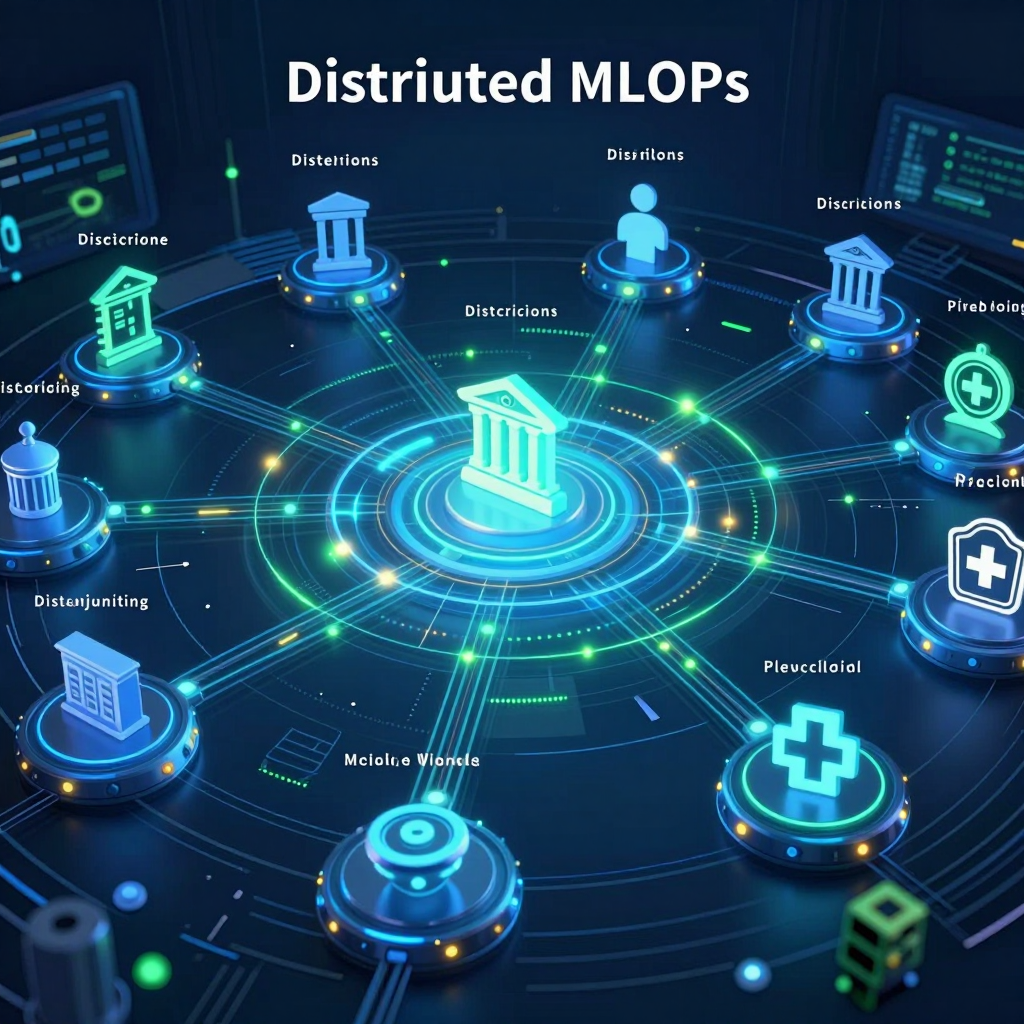
The emerging solution in this trend is standardizing distributed machine learning operations, particularly Federated MLOps with Decentralized Governance. The core principle is to extend the rule of “collaborate without sharing data beyond own boundaries” up to the operational level (MLOps).
Practical Limitations of Centralized MLOps
Exploding Complexity in Regulatory Compliance
When data is consolidated into a central lake or warehouse, compliance chains become dramatically more complex—covering anonymization, pseudonymization, access controls, audit logs, and more. Especially in industries with a high proportion of sensitive information like healthcare and finance, “safe audits” outweigh mere “technical feasibility,” making centralized strategies readily blocked.
Data Transfer Costs and Security Risks
Large-scale data transmission not only increases network costs but also expands the attack surface. Each time data moves, encryption, key management, delegation of access rights, and secure transfer path controls are necessary, significantly increasing operational overhead.
Inefficiency in Collaborative Structures
Creating a central repository for joint research and development among institutions delays contract negotiations, policy setting, and responsibility clarifications, slowing down projects. Ultimately, although models are needed, the lack of agreement on data sharing causes MLOps pipelines to stall before they even start.
The New Operational Paradigm Offered by Distributed MLOps
Multi-Tenant Based Operations: “Data Stays Local, Only Performance Metrics Shared”
Distributed MLOps enables multiple institutions (or business units) to train and validate models within their own environments, yet function as a unified collaboration system from an operational standpoint. For example:
- Data stays within each institution’s local infrastructure
- Only “minimum necessary information” such as model parameters/gradients or performance metrics is exchanged
- The central system integrates and monitors model drift, performance trends, and deployment status without accessing raw data
Critically, this goes beyond simple federated learning by standardizing the entire distributed operation system including deployment, monitoring, and retraining.
AI-Native Observability: Turning Anomalies into ‘Explainable Operations’
When models lag or degrade, traditional operations only recognize “poor metrics” but take a long time to identify causes. Cutting-edge distributed MLOps:
- Summarizes anomalies in natural language via LLM-driven analysis
- Uses causal inference (not mere correlations) to pinpoint fundamental causes
- Automatically triggers retraining workflows once conditions are met
In distributed environments with varying node data, observability isn’t optional—it’s a condition for survival.
Edge-Cloud Hybrid: Low Latency at the Edge, Updates in the Cloud
Services requiring real-time inference must respond at the edge, while model updates and governance should be managed in the cloud. Distributed MLOps unifies these two worlds into one pipeline:
- Execute low-latency inference on the edge
- Manage model versions, deployment policies, and approval workflows in the cloud
- Run RAG pipelines with distributed vector databases and optimize synchronization across edge nodes
This approach provides a practical operational balance superior to “centralize everything” models.
Why Standardization Is Critical Now
While distributed operations are powerful, as the number of institutions, nodes, and environments grows, issues like version control, network latency, and policy consistency escalate rapidly. The current focus is not just adoption but standardization of distributed machine learning operations. Major players like Databricks and Weights & Biases are investing heavily, and discussions at CNCF reflect this urgency.
In summary, MLOps is no longer merely a technology to deploy models effectively. It is evolving into a distributed operational system that enables collaboration and management without moving data—and this is exactly why distributed machine learning operations are gaining unstoppable momentum today.
The Secret of MLOps Multi-Tenant Architecture and AI-Native Observability
What if multiple organizations could improve a single model together while keeping their data safely local? The key lies in a multi-tenant structure where “data doesn’t move, only operational signals and model updates flow,” combined with AI-Native Observability that monitors and explains in real time. This combination is how next-generation distributed MLOps becomes a reality.
MLOps Multi-Tenant Architecture: “Data Stays Local, Collaboration Goes Global”
Multi-tenant MLOps is an operational pattern that connects multiple organizations (tenants) while maintaining their own isolated environments and permissions, collaborating toward a common goal: improving model performance. Unlike traditional centralized approaches that gather “data into one place,” the distributed approach follows these principles:
- Original data never crosses tenant boundaries: Raw training data and logs are never centralized.
- Minimal shared assets: Only the “signals needed for collaboration”—such as model weight updates, aggregated metrics, and anonymized drift indicators—are exchanged.
- Environment isolation + policy-based access control: Tenant namespaces, resource quotas, and network policies block intrusion at the root.
Kubernetes, in particular, provides a powerful foundation for implementing this structure.
Core Components of Tenant Isolation with Kubernetes
- Namespace-level Multi-Tenancy: Separate
namespacesper organization, finely controlling “who can see what” via RBAC. - NetworkPolicy / Service Mesh: Restrict communication between tenants only to approved endpoints, minimizing data leak surfaces.
- Distributed Observability Agents: Agents on each node/organization send only metrics and events to a central aggregation server—never raw data.
With this setup, “Organization A’s data stays with Organization A,” while the central node monitors overall operations and manages model quality without sensitive information.
MLOps AI-Native Observability: How LLMs Explain ‘Anomalies’
In distributed operations, the toughest challenge is “finding the cause when issues arise.” Performance degradation caused by environment differences, network delays, or data distribution shifts per organization is hard to analyze with dashboards alone. This is where AI-Native Observability steps in.
1) LLM-Based Automated Anomaly Detection & Root Cause Summarization
Traditional monitoring could “raise alerts,” but humans had to investigate why. With LLMs analyzing observability data (metrics, log summaries, traces), the following can be automated:
- Anomaly detection: Capture patterns like performance drops, latency spikes, or error rate increases exclusive to specific tenants.
- Natural language root cause analysis: Generate actionable explanations, e.g., “The recently deployed model version became vulnerable to data distribution shifts in a certain region, and missing rate of input feature X increased.”
- Prioritization: Recommend response order by considering impact scope (number of tenants affected, traffic share, regulatory risk).
2) Causal-Inference-Based Monitoring: Finding the ‘Real Cause,’ Not Just Correlations
Distributed MLOps often falls into correlation traps—for example, “latency increased, so the model slowed down,” when the true cause might be increased network hops or resource contention on a specific node. Causal inference enables:
- Separation of intervention variables: Observe deployment version changes, feature pipeline adjustments, or infrastructure scaling independently.
- Ranking candidate causes: Quantify which is more likely responsible—drift, degraded data quality, infrastructure bottlenecks, or version mismatches.
- Tenant-specific impact analysis: Explain why identical models show different problem patterns across tenants due to varied input distributions.
3) Automated Retraining Triggering: Operational Signals Drive the Pipeline
Observability shouldn’t stop at monitoring but must enable a “detect → decide → act” cycle. A typical automation flow looks like this:
- Detect drift/performance degradation
- Policy-based gating (e.g., human approval required for tenants under regulatory constraints)
- Trigger retrain or rollback
- Post-deployment validation (tenant-specific A/B testing or safe canary rollouts)
Combined with multi-tenancy, this allows each organization to perform retraining locally without sharing raw data, while the central system enforces consistent quality control.
Key Takeaway from MLOps Operations: “Minimal Sharing, Maximum Observability”
The essence of multi-tenant distributed MLOps is straightforward:
- Keep data local
- Centralize only models and operational signals
- Standardize isolation and deployment with Kubernetes
- Explain “why issues occur” using LLM and causal inference–based observability
- Automatically trigger retraining and rollback when needed
With this structure, collaborative MLOps becomes practical even in privacy- and data-sovereignty-sensitive environments like finance and healthcare.
MLOps Edge-Cloud Hybrid Deployment: The Technical Challenges of Real-Time Responsiveness
Low-latency inference handled at the edge, with model updates and governance managed in the cloud, sounds “ideal.” Yet in real-world operations, striking the right balance is far more challenging. How much to push to the edge, what to leave in the cloud, and how to design synchronization for distributed vector DBs all simultaneously impact performance, cost, and reliability. This section delves deeply into the technical hurdles of edge-cloud hybrid deployment from an MLOps perspective.
Clear Role Separation: Low-Latency Inference (Edge) vs. Model Updates (Cloud)
The fundamental principle of hybrid deployment is straightforward:
- Edge: Perform latency-sensitive inference locally (e.g., manufacturing defect detection, medical device alerts, in-store personalized recommendations)
- Cloud: Handle large-scale training, policy-driven deployment approvals, model/feature versioning, and long-term monitoring aggregation
The problem is that this “role separation” does not directly translate to simplified operations. The edge environment often suffers from unstable networks and limited resources, and as the number of devices grows, the update pipeline transforms into a distributed system synchronization challenge. Ultimately, MLOps boils down to these core questions:
- How to optimize update frequency while maintaining inference quality?
- How to guarantee prediction consistency even when offline due to network outages?
- When pushing vector search (RAG) to the edge, how should index synchronization be handled?
Distributed Vector DB-Based RAG Pipelines: When “Search” Becomes the Bottleneck
Introducing LLM/RAG into an edge-cloud architecture is not just about deploying model files—it also means managing the search infrastructure (vector DB/index) itself.
Three typical patterns emerge:
Cloud-Only Retrieval (Cloud Search + Edge Inference)
- Edge runs lightweight inference models; search happens entirely in the cloud
- Pros: Simple index operations, easy freshness maintenance
- Cons: High network round-trip latency; severe quality drops if connectivity falters
Edge Cache Retrieval (Partial Index/Cache at the Edge)
- Edge caches “frequently used” documents/embeddings locally
- Pros: Minimizes latency for core queries
- Cons: Difficult cache invalidation and consistency management (deciding replacement criteria, sync timing)
Fully Distributed Vector DB (Sharded/Replicated Distributed Indexes)
- Indexes are sharded or partially replicated per site/device
- Pros: Meets regional data sovereignty and latency requirements simultaneously
- Cons: Synchronization, conflict resolution, and reindexing costs skyrocket
The key point: a vector index functions both as a “database” and, simultaneously, as part of the “model”. Even with the same underlying model, varying index snapshots can yield different responses, so from an MLOps standpoint, indexes demand versioning, validation, and rollback controls similar to model artifacts.
Edge Device Synchronization: Delta Propagation, Conflicts, and Consistency Models
Edge-cloud synchronization is far more complex than “file distribution” alone. Multiple layers require syncing:
- Model weights/runtime (ONNX, TensorRT, TFLite, etc.)
- Feature processing logic (preprocessing, tokenizers, rule-based filters)
- Vector index/embedding data
- Policies and configurations (thresholds, safety filters, routing rules)
The latest trend is moving away from full syncs toward delta (change-based) propagation:
- Delta updates: Transmit only changed embeddings/documents to save bandwidth
- Content addressing (hash-based): Prevent redundant transfers, simplify integrity checks
- Snapshots + logs (like checkpoint + WAL): Reduce resync and recovery times
However, applying delta propagation introduces the inevitable challenge of conflicts. For example, branch-specific document edits or locally created data merging with central repositories can clash. Usual consistency models to tackle this include:
- Strong Consistency: Accurate but costly in latency and availability
- Eventual Consistency: Practical but requires careful design of “when convergence happens”
- Session/Regional Consistency: Strikes compromise focused on user experience
Given edge environments assume frequent network breaks, the pragmatic approach often converges on eventual consistency with explicit conflict resolution policies (priority rules, timestamps, merge strategies).
Operational MLOps Checklist: Observability, Rollback, and Safe Deployment
One of the most common causes of MLOps failure in edge-cloud hybrids is not “model performance” but lack of operational visibility. Tracking what was deployed when, which index was referenced, or under what input distributions performance degraded becomes increasingly difficult as devices multiply.
The following features become nearly mandatory:
- Version Binding Management (Model–Index–Config Binding):
Track not just model versions but index snapshots and settings grouped per release for traceability - Progressive Delivery:
Deploy canary/blue-green releases selectively across edge device groups (regions, device types, network qualities) - Remote Rollback and Failsafe Mechanisms:
Instantly revert to the last stable version upon failure, maintaining a “last known good state” that operates safely even offline - Standardized Observability:
Collect integrated metrics such as latency (p95/p99), search hit rates, embedding quality drift, index sync latency, and device resource usage
(Designed around metadata/statistics rather than raw data to minimize privacy risks)
The Balance Is Not “What Goes Where” but “How They Converge”
Balancing low-latency inference and model updates is far from a simple placement decision. The crux lies in how the system is architected to ‘converge’ despite unstable edge connectivity and distributed vector DB sync costs.
Ultimately, MLOps maturity in edge-cloud hybrid deployments is measured by answers to:
- Is user experience stable even if updates are slow?
- Does prediction and search quality remain within a manageable range despite network outages?
- Are model and index versioning managed together with instant rollback in case of issues?
When explicit operational principles and automation handle these questions clearly, hybrid deployment shifts from “compromise” to a strategy that achieves real-time responsiveness alongside compliance and cost-efficiency.
Winds of Change in Industry: MLOps Innovations Seen Through Finance and Healthcare Success Stories
What is the secret behind two highly regulated industries achieving cost-cutting breakthroughs without compromising compliance? The answer lies in “not moving data” but “standardizing operations.” Finance and healthcare, burdened by stringent regulations like GDPR and HIPAA along with data sovereignty mandates, find centralized pipelines quickly hitting their limits. That’s why the approach of Federated MLOps with Decentralized Governance—keeping data within each institution while standardizing distributed model operations—is rapidly gaining ground.
MLOps Transformation in Finance: Achieving Compliance and Collaboration Hand-in-Hand
Finance faces critical challenges in sensitive and time-sensitive areas such as fraud detection, credit scoring, and anti-money laundering (AML). The real impact of distributed MLOps is seen in:
- Collaborative learning/improvement without moving data
Subsidiaries and overseas branches collaborate while customer source data stays local. Only performance metrics or gradient/weight-level information needed for model updates flow centrally, drastically reducing regulatory risk. - Multi-tenant MLOps architecture for standardized operations
Each institution maintains its own compliance policies, yet deployment, monitoring, and retraining triggers are unified under a common operational framework. Leveraging Kubernetes-based observability and deployment ensures operational stability even as branches multiply. - A shift in cost structure (TCO reduction)
Collaboration is enabled without aggressively scaling costly central infrastructure like massive data lakes, ETL, or access controls. Ultimately, this reduces reliance on centralized infrastructure and makes 30–40% TCO savings realistic.
Technically, distributed monitoring is the linchpin. Model drift and performance decline are detected locally on each node using local data, while only alerts and metadata ascend centrally—minimizing privacy exposure.
MLOps Transformation in Healthcare: Boosting Patient Data Security and Clinical Readiness
Healthcare faces even higher data sensitivity (medical records, imaging, genomics) and struggles with slow model development due to difficult cross-institutional data sharing. Distributed MLOps drives change centered on clinical applicability:
- Inter-institutional learning allowed, patient data inviolate
Hospitals and research centers collaborate without external data transfer, easing IRB and legal burdens while enhancing model performance possibilities. - AI-native observability reduces operational risks
LLM-powered automatic anomaly detection summarizes, in natural language, “which hospital, equipment, or patient group shows performance drops,” enabling rapid operator insight. Coupling this with causality-based monitoring reveals true causes (equipment changes, protocol differences, data shifts) rather than simple correlations. - Edge-cloud hybrid enables low-latency care delivery
Critical inferences—like emergency room diagnostics or image reading—occur on edge devices for minimal delay; model updates, validation, and release management are standardized in the cloud. Especially for retrieval-augmented generation (RAG) tasks such as searching medical documents and guidelines, a distributed vector database ensures compliance with local and institutional policies and data access controls while preserving search quality.
Consequently, the focus shifts from “Can we build the model?” to “Can we safely operate it clinically?” From an MLOps perspective, a consistent closed loop of observability → automated retraining triggers → validated rollout must function seamlessly in distributed environments—the pace of innovation hinges on this standardization.
Common Success Factors in Finance and Healthcare: Conditions Where Distributed MLOps Delivers Results
The commonalities behind successes in both sectors are clear:
- Centralizing the “operations” standard, not the data
Designing a system first that improves quality without sharing source data. - Prioritizing observability
Detecting drift, bias, and performance degradation locally and interpreting it consistently at the center. - Splitting deployment hybrid-style
Separating low-latency edge operations from cloud-based controls to absorb real-world constraints.
Challenges remain: network latency, complex version control, and operational variance stemming from institutional policy differences top the list. Yet distributed MLOps shatters the myth that compliance slows innovation—making regulatory adherence, cost reduction, and scalable collaboration achievable simultaneously.
The Future of Distributed MLOps and the Challenges to Overcome
How are efforts progressing to overcome network latency and version management complexity? MLOps in distributed environments is rapidly moving toward a paradigm where "data is held locally, but operations are standardized collectively." However, as this transition accelerates, real-world issues like latency, synchronization, and governance become increasingly apparent. Recent investments by companies like Databricks, Weights & Biases (W&B), and standardization efforts centered around the CNCF can be seen as industrial signals aimed at solving these challenges.
MLOps Challenge 1: Network Latency and the ‘Operational Cost’ of Asynchronous Learning
In distributed (federated) learning and multi-tenant operations, network latency transcends mere performance concerns to directly impact operational stability.
- Aggregation Bottleneck: The process of collecting and merging model parameters/gradients updated at each node depends heavily on network quality, determining the entire round’s duration. Especially in edge-cloud hybrid setups, round-based synchronous learning easily becomes a bottleneck.
- Straggler Problem: Delays in some nodes hold back the entire training/deployment process. From an operations standpoint, this unpredictability in “model update cycles” complicates SLA design.
- Explosion of Telemetry Data: Even without sharing raw data, performance metrics, drift indicators, and logs accumulate in a distributed manner, increasing transmission and storage costs.
To address these, distributed MLOps is evolving along these lines:
- Asynchronous/Partial Participation Learning: Designing the system so learning continues even if not all nodes participate every round, thereby mitigating latency effects.
- Hierarchical Aggregation: Performing primary aggregation at regional (local) hubs before forwarding upstream to reduce WAN traffic and latency.
- Compression, Quantization, and Delta Transmission: Efficiently sending only the “difference” in updates instead of the entire model to lower communication costs.
- Separating Edge Inference from Cloud Updates: Running real-time inference reliably at the edge while managing updates centrally in the cloud to separate operational risks.
The key shift lies not in “eliminating latency” but in designing MLOps systems that remain operationally robust despite inherent latency.
MLOps Challenge 2: Version Management Complexity — When Models Become a ‘Cluster’ Instead of One
In centralized MLOps, a “model version” typically equates to a single artifact. But in distributed settings, models evolve differently at each node, and these variations must be managed.
- Differences in node-specific data distributions cause performance variance despite uniform training strategies.
- Local regulations and policies lead to variations in allowed features, logging levels, and explainability requirements even for the same model.
- Consequently, “global models” coexist with “local models (or adapters),” creating complexity in release units.
Emerging operational patterns that tackle this include:
- Metadata-Centric Lineage Enhancement: Tracking not only model artifacts but also data schemas, feature definitions, training parameters, aggregation rounds, and participating node sets to ensure reproducibility and auditability.
- Policy-Based Promotion Pipelines: Automating rules that define conditions for “promotion to global models” (e.g., bias metrics passing, node coverage, compliance checklists).
- Composition-Oriented Model Configuration for Federated Environments: Increasing use of composite version management such as global base models plus local adapters (e.g., domain-specific tuning).
- Signed Artifacts and Trust Chains: Distributed governance requires clear approval records of models, making signature and verification-based deployment crucial.
In essence, future MLOps version management is not about “adding a few tags” but about redesigning release and audit frameworks suited to distributed governance.
MLOps Challenge 3: Standardization and Ecosystem — What Investments and CNCF Discussions Signal
The rationale behind investments from companies like Databricks and W&B in observability, experiment management, and deployment automation is clear. As distributed MLOps expands, operational tools must cover multi-organization, multi-cluster, and multi-regulation scopes rather than optimize for a single organization.
- Changing Enterprise Requirements: The purchasing criteria shift from “pipelines that work well in one place” to “operational systems that operate consistently across multiple boundaries (organizations, clusters, regions).”
- Commercialization of AI-Native Observability: With LLM-based anomaly detection, root cause analysis, and retraining triggers driving operational efficiency, observability emerges as a competitive epicenter in MLOps.
- Core Value of CNCF Standardization Discussions: Just as the Kubernetes ecosystem demonstrated, distributed operations demand interoperability free from vendor lock-in as a fundamental risk management strategy. Standards become infrastructure enabling “procurement, auditing, and scaling,” not merely technical trends.
Looking ahead, the decisive battleground for distributed MLOps lies less in novel algorithms and more in who provides robust operational standards (metadata, policies, observability, trusted deployment chains). Network latency and version management complexities are inherent to distributed environments, but methods to address them are rapidly converging into industry standards—with corporate investments and CNCF-centered dialogues playing catalytic roles.
Comments
Post a Comment